Support Vector Machine (SVM)
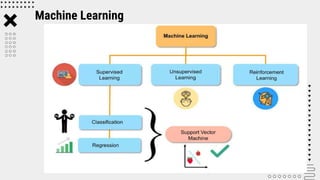
Machine Learning
Introduction:
● Support Vector Machine is a supervised machine learning problem where to try to
find a hyperplane that best separates two classes.
● It is considered as one of the best algorithm as it can handle high-dimensional data,
is effective in cases with limited training samples, and can handle nonlinear
classification using kernel functions.
● SVM can be used for both regression and classification tasks, but generally work best
in classification problem.
What is SVM ?
Types of SVM Algorithm:
1. Simple or Linear SVM: When the data is perfectly linearly separable only then we
can use Linear SVM. Perfectly linearly separable means that the data points can be
classified into 2 classes by using a single straight line(if 2D).
1. Kernel or Non-Linear SVM: When the data is not linearly separable then we can
use Non-Linear SVM, which means when the data points cannot be separated into
2 classes by using a straight line (if 2D) then we use some advanced techniques
like kernel tricks to classify them. In most real-world applications we do not find
linearly separable data points hence we use kernel trick to solve them.
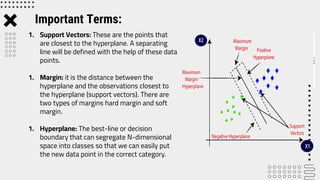
Important Terms:
1. Support Vectors: These are the points that
are closest to the hyperplane. A separating
line will be defined with the help of these data
points.
1. Margin: it is the distance between the
hyperplane and the observations closest to
the hyperplane (support vectors). There are
two types of margins hard margin and soft
margin.
1. Hyperplane: The best-line or decision
boundary that can segregate N-dimensional
space into classes so that we can easily put
the new data point in the correct category.
Hyper Plane:
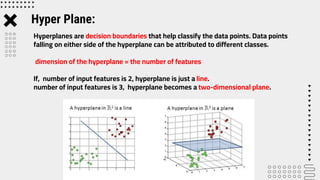
Hyperplanes are decision boundaries that help classify the data points. Data points
falling on either side of the hyperplane can be attributed to different classes.
dimension of the hyperplane = the number of features
If, number of input features is 2, hyperplane is just a line.
number of input features is 3, hyperplane becomes a two-dimensional plane.
Objective:
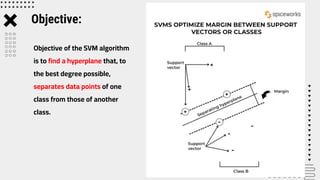
Objective of the SVM algorithm
is to find a hyperplane that, to
the best degree possible,
separates data points of one
class from those of another
class.
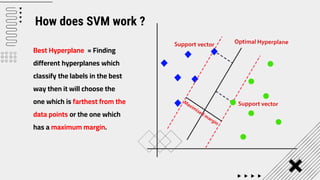
How does SVM work ?
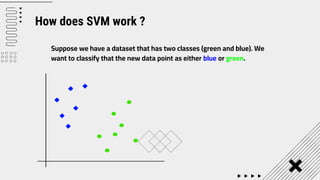
Suppose we have a dataset that has two classes (green and blue). We
want to classify that the new data point as either blue or green.
How does SVM work ?
Best Hyperplane = Finding
different hyperplanes which
classify the labels in the best
way then it will choose the
one which is farthest from the
data points or the one which
has a maximum margin.
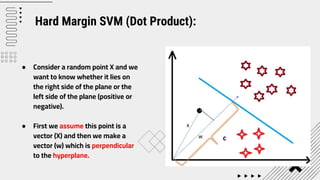
Hard Margin SVM (Dot Product):
● Consider a random point X and we
want to know whether it lies on
the right side of the plane or the
left side of the plane (positive or
negative).
● First we assume this point is a
vector (X) and then we make a
vector (w) which is perpendicular
to the hyperplane.
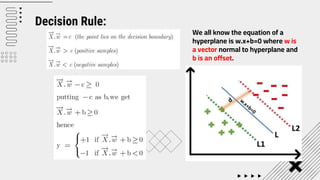
Decision Rule:
We all know the equation of a
hyperplane is w.x+b=0 where w is
a vector normal to hyperplane and
b is an offset.
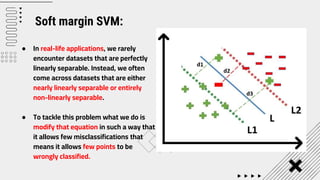
Soft margin SVM:
● In real-life applications, we rarely
encounter datasets that are perfectly
linearly separable. Instead, we often
come across datasets that are either
nearly linearly separable or entirely
non-linearly separable.
● To tackle this problem what we do is
modify that equation in such a way that
it allows few misclassifications that
means it allows few points to be
wrongly classified.
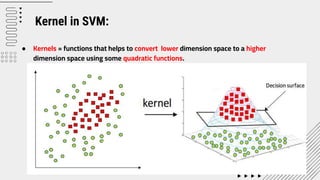
Kernel in SVM:
● Kernels = functions that helps to convert lower dimension space to a higher
dimension space using some quadratic functions.
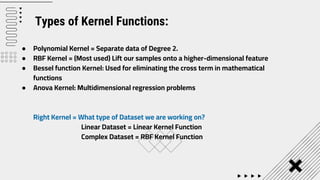
Types of Kernel Functions:
● Polynomial Kernel = Separate data of Degree 2.
● RBF Kernel = (Most used) Lift our samples onto a higher-dimensional feature
● Bessel function Kernel: Used for eliminating the cross term in mathematical
functions
● Anova Kernel: Multidimensional regression problems
Right Kernel = What type of Dataset we are working on?
Linear Dataset = Linear Kernel Function
Complex Dataset = RBF Kernel Function
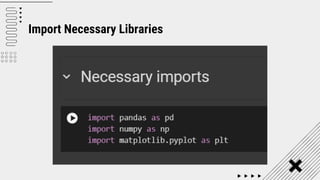
Import Necessary Libraries
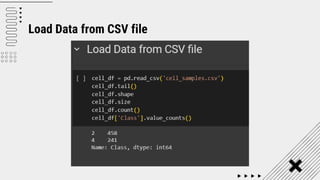
Load Data from CSV file
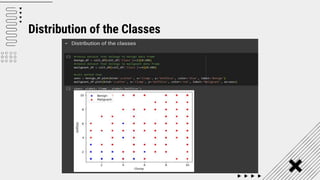
Distribution of the Classes
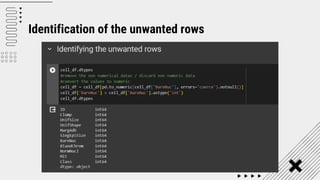
Identification of the unwanted rows
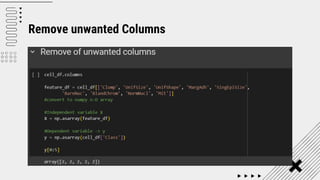
Remove unwanted Columns
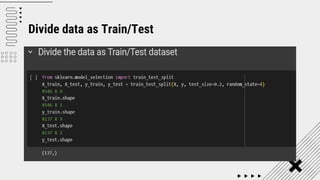
Divide data as Train/Test
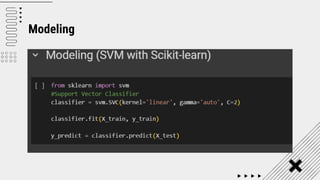
Modeling
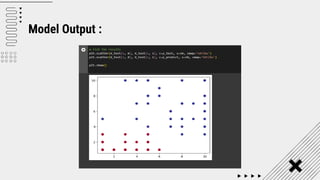
Model Output :
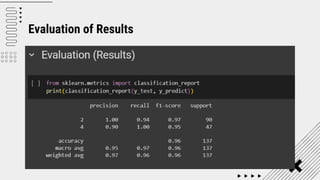
Evaluation of Results
● Accuracy: The portion of correctly classified instances among the
total instances.
● Precision and recall: Precision measures the portion of true
positive predictions among all positive predictions while recall
measures the portion of true positive predictions among all
actual positives.
● F1 Score: The harmonic mean of precision and recall, which
provides a balance between the two metrics.
● Support: Support refers to the number of occurrences of each
class in the actual data. It represents the number of samples
belonging to each class.
Metrics:
● SVM works better when the data is linear
● It is more effective in high dimensions
● With the help of the kernel trick, we can solve any complex problem
● SVM is not sensitive to outliers
● Can help us with Image Classification
Advantages of SVM
● Choosing a good kernel is not easy
● It does not show good result on a big dataset
● The SVM hyperparameters are Cost -C and gamma.
● It is not easy to fine-tune these hyper-parameters.
● It is hard to visualize their impact
Disadvantage of SVM
● We have demonstrated SVM by segregation two different classes.
● We discussed its concept of working, math intuition behind SVM,
implementation in python, the tricks to classify non-linear datasets, Pros and
cons, and finally, we solved a problem with the help of SVM.
Support vector machine is an elegant and powerful algorithm.
Conclusion:
THANK YOU!
Any Questions?

Classification-Support Vector Machines.pptx

  • 1.
  • 2.
  • 3.
    Introduction: ● Support VectorMachine is a supervised machine learning problem where to try to find a hyperplane that best separates two classes. ● It is considered as one of the best algorithm as it can handle high-dimensional data, is effective in cases with limited training samples, and can handle nonlinear classification using kernel functions. ● SVM can be used for both regression and classification tasks, but generally work best in classification problem. What is SVM ?
  • 4.
    Types of SVMAlgorithm: 1. Simple or Linear SVM: When the data is perfectly linearly separable only then we can use Linear SVM. Perfectly linearly separable means that the data points can be classified into 2 classes by using a single straight line(if 2D). 1. Kernel or Non-Linear SVM: When the data is not linearly separable then we can use Non-Linear SVM, which means when the data points cannot be separated into 2 classes by using a straight line (if 2D) then we use some advanced techniques like kernel tricks to classify them. In most real-world applications we do not find linearly separable data points hence we use kernel trick to solve them.
  • 5.
    Important Terms: 1. SupportVectors: These are the points that are closest to the hyperplane. A separating line will be defined with the help of these data points. 1. Margin: it is the distance between the hyperplane and the observations closest to the hyperplane (support vectors). There are two types of margins hard margin and soft margin. 1. Hyperplane: The best-line or decision boundary that can segregate N-dimensional space into classes so that we can easily put the new data point in the correct category.
  • 6.
    Hyper Plane: Hyperplanes aredecision boundaries that help classify the data points. Data points falling on either side of the hyperplane can be attributed to different classes. dimension of the hyperplane = the number of features If, number of input features is 2, hyperplane is just a line. number of input features is 3, hyperplane becomes a two-dimensional plane.
  • 7.
    Objective: Objective of theSVM algorithm is to find a hyperplane that, to the best degree possible, separates data points of one class from those of another class.
  • 8.
    How does SVMwork ? Suppose we have a dataset that has two classes (green and blue). We want to classify that the new data point as either blue or green.
  • 9.
    How does SVMwork ? Best Hyperplane = Finding different hyperplanes which classify the labels in the best way then it will choose the one which is farthest from the data points or the one which has a maximum margin.
  • 10.
    Hard Margin SVM(Dot Product): ● Consider a random point X and we want to know whether it lies on the right side of the plane or the left side of the plane (positive or negative). ● First we assume this point is a vector (X) and then we make a vector (w) which is perpendicular to the hyperplane.
  • 11.
    Decision Rule: We allknow the equation of a hyperplane is w.x+b=0 where w is a vector normal to hyperplane and b is an offset.
  • 12.
    Soft margin SVM: ●In real-life applications, we rarely encounter datasets that are perfectly linearly separable. Instead, we often come across datasets that are either nearly linearly separable or entirely non-linearly separable. ● To tackle this problem what we do is modify that equation in such a way that it allows few misclassifications that means it allows few points to be wrongly classified.
  • 13.
    Kernel in SVM: ●Kernels = functions that helps to convert lower dimension space to a higher dimension space using some quadratic functions.
  • 14.
    Types of KernelFunctions: ● Polynomial Kernel = Separate data of Degree 2. ● RBF Kernel = (Most used) Lift our samples onto a higher-dimensional feature ● Bessel function Kernel: Used for eliminating the cross term in mathematical functions ● Anova Kernel: Multidimensional regression problems Right Kernel = What type of Dataset we are working on? Linear Dataset = Linear Kernel Function Complex Dataset = RBF Kernel Function
  • 15.
  • 16.
  • 17.
  • 18.
    Identification of theunwanted rows
  • 19.
  • 20.
    Divide data asTrain/Test
  • 21.
  • 22.
  • 23.
  • 24.
    ● Accuracy: Theportion of correctly classified instances among the total instances. ● Precision and recall: Precision measures the portion of true positive predictions among all positive predictions while recall measures the portion of true positive predictions among all actual positives. ● F1 Score: The harmonic mean of precision and recall, which provides a balance between the two metrics. ● Support: Support refers to the number of occurrences of each class in the actual data. It represents the number of samples belonging to each class. Metrics:
  • 25.
    ● SVM worksbetter when the data is linear ● It is more effective in high dimensions ● With the help of the kernel trick, we can solve any complex problem ● SVM is not sensitive to outliers ● Can help us with Image Classification Advantages of SVM
  • 26.
    ● Choosing agood kernel is not easy ● It does not show good result on a big dataset ● The SVM hyperparameters are Cost -C and gamma. ● It is not easy to fine-tune these hyper-parameters. ● It is hard to visualize their impact Disadvantage of SVM
  • 27.
    ● We havedemonstrated SVM by segregation two different classes. ● We discussed its concept of working, math intuition behind SVM, implementation in python, the tricks to classify non-linear datasets, Pros and cons, and finally, we solved a problem with the help of SVM. Support vector machine is an elegant and powerful algorithm. Conclusion:
  • 28.