Unsupervised
Machine Learning
Presented By
Rateesh Babu Livares Technologies Pvt Ltd
Tech & Socio-Cultural Group
1
What is Machine Learning?
➔ Subfield of AI.
➔ Involves the creation of Algorithms and Models.
➔ Enables computer to perform specific tasks/predictions
ML is a subfield of AI that involves the creation of Algorithms and statistical models, which enables
computers to perform a specific task or to make a prediction by learning from data.
Key feature of ML is it’s ability to automatically learn and improve from the
experience.
2
Why we need ML?
❖ Predictive Analytics: Forecasting future based on historical data.
❖ Natural Language Processing: Understand human languages
❖ Computer vision: Recognize objects in Images or Videos
❖ Recommender Systems: Build personalized recommendations
❖ Fraud detection: Detect fraudulent activities or anomalies
3
Types of ML
1. Supervised learning: Model is trained on a labeled dataset.
2. Unsupervised learning: Model is trained on a unlabeled dataset.
3. Reinforcement learning: Learns to make decisions based on feedbacks
4
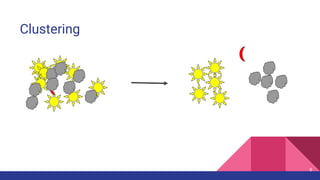
Unsupervised ML- What?
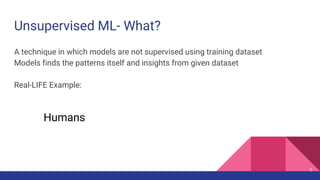
A technique in which models are not supervised using training dataset
Models finds the patterns itself and insights from given dataset
Real-LIFE Example:
Humans
5
Unsupervised ML - Why?
❏ When 0 manual labour is desired in training.
❏ When it is difficult to find patterns.
❏ When there is a need to find the hidden pattern
6
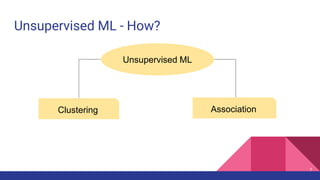
Unsupervised ML - How?
7
Unsupervised ML
Clustering Association
8
Clustering
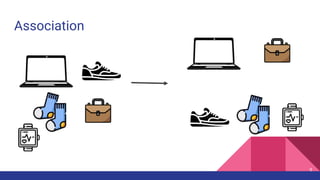
Association
9
Popular Algorithms
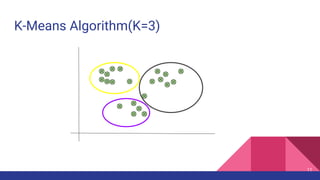
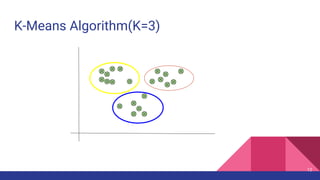
★ K-means Clustering: K clusters and centroids
★ Hierarchical Clustering: Dendrogram shaped
★ Apriori Association Algorithm
★ Eclat Algorithm
★ F-P Growth Algorithm
★ Anomaly Detection Algorithm
10
K-Means Algorithm(K=3)
11
K-Means Algorithm(K=3)
12
Pros and cons of K-mean
13
Pros Cons
Various Applications like Customer
segmentation, image segmentation, etc.
Sensitive to initial choice of centroids
Scalable (Suitable for large datasets) Prior knowledge of number of clusters
Fast Limited to linearly separable data
Simple and easy to understand Prone to converge into local optima
Hierarchical Clustering
❖ Hierarchy of clusters in Dendrogram
shaped
❖ Agglomerative Approach: Bottom-up
i.e. each data set is a cluster
❖ Divisive Approach: Top-down approach
i.e. whole data set is a single cluster.
14
Hierarchical Clustering - Linkage methods
❖ Single(Shortest)
❖ Complete
❖ Average
❖ Centroid
15
Single Linkage
16
N Clusters
N-1
N-2
N-3
N-4
N-5
Pros and cons of Hierarchical Clustering
17
Pros Cons
Easy to understand Computationally expensive(time complexity
is O(n^3))
Suitable for small datasets Different methods gives different results
Detection of overlapping clusters Greedy Algorithm
Handles different types of distance
measure and linkage
Not suitable for large dataset and when
clusters are not well separated
Apriori Association Algorithm
❖ Uses Frequent item sets to generate association rules.
❖ Designed to work on Databases containing transactions.
❖ Determines the strength(Strong or weak) connection between two objects.
❖ Iterative in nature.
❖ Mainly used for market-basket analysis and drug-reaction analysis on
patients.
18
Apriori Association Algorithm
19
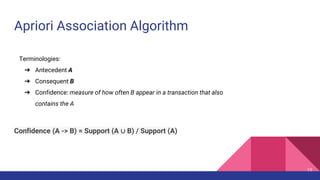
Terminologies:
➔ Antecedent A
➔ Consequent B
➔ Confidence: measure of how often B appear in a transaction that also
contains the A
Confidence (A -> B) = Support (A ∪ B) / Support (A)
Apriori Association Algorithm
20
Confidence (A -> B) = Support (A ∪ B) / Support (A)
Support(X) = number of times X appeared in any transaction / total number of
transactions.
∪ = Union i.e., Transactions that have A and B together
Apriori Association Algorithm
21
Sales data of a shop
1. 1000 overall Transactions.
2. 200 transactions included the purchase of milk
3. 150 transactions included the purchase of bread along with milk
Confidence(Milk->Bread) = Support (Milk ∪ Bread) / Support (Milk)
Confidence = (150/1000) / (200/1000)
Confidence = 0.15 / 0.2
Confidence = 0.75
Frequent Itemset
22
Frequent Itemset- Candidate 1 and Itemset 1
23
Frequent Itemset- Candidate 2 and Itemset 2
24
Frequent Itemset- Candidate 3 and Itemset 3
25
Itemset Support count
{A, B, C} 2
Confidence
26
Confidence((A∪B)->C) = Support ((A∪B)∪C)/Support (A∪B)
Pros and cons of Apriori Algorithm
27
Pros Cons
Scalable Computationally expensive for large
dataset.
Simple Only suitable for binary data
Widely used Need high memory to store all the itemsets
generated in between
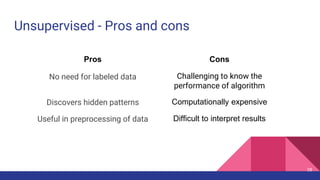
Unsupervised - Pros and cons
28
Pros Cons
No need for labeled data Challenging to know the
performance of algorithm
Discovers hidden patterns Computationally expensive
Useful in preprocessing of data Difficult to interpret results
What’s next?
KNN Algorithm
29
OUR
CONTACT DETAILS
Livares Technologies Pvt Ltd
5th Floor, Yamuna Building
Technopark Phase III Campus
Trivandrum, Kerala, India-695581
Livares Technologies Pvt Ltd
Tech&Socio-Cultural Group
Our helpline is always open to receive any inquiry
or feedback.Please feel free to contact us
www.livares.com
contact@livares.com
@livaresofficial
www.facebook.com/livaresofficial
+91-471-2710003 | +91-471-
2710004
THANK YOU
30

Unsupervised Machine Learning

  • 1.
    Unsupervised Machine Learning Presented By RateeshBabu Livares Technologies Pvt Ltd Tech & Socio-Cultural Group 1
  • 2.
    What is MachineLearning? ➔ Subfield of AI. ➔ Involves the creation of Algorithms and Models. ➔ Enables computer to perform specific tasks/predictions ML is a subfield of AI that involves the creation of Algorithms and statistical models, which enables computers to perform a specific task or to make a prediction by learning from data. Key feature of ML is it’s ability to automatically learn and improve from the experience. 2
  • 3.
    Why we needML? ❖ Predictive Analytics: Forecasting future based on historical data. ❖ Natural Language Processing: Understand human languages ❖ Computer vision: Recognize objects in Images or Videos ❖ Recommender Systems: Build personalized recommendations ❖ Fraud detection: Detect fraudulent activities or anomalies 3
  • 4.
    Types of ML 1.Supervised learning: Model is trained on a labeled dataset. 2. Unsupervised learning: Model is trained on a unlabeled dataset. 3. Reinforcement learning: Learns to make decisions based on feedbacks 4
  • 5.
    Unsupervised ML- What? Atechnique in which models are not supervised using training dataset Models finds the patterns itself and insights from given dataset Real-LIFE Example: Humans 5
  • 6.
    Unsupervised ML -Why? ❏ When 0 manual labour is desired in training. ❏ When it is difficult to find patterns. ❏ When there is a need to find the hidden pattern 6
  • 7.
    Unsupervised ML -How? 7 Unsupervised ML Clustering Association
  • 8.
  • 9.
  • 10.
    Popular Algorithms ★ K-meansClustering: K clusters and centroids ★ Hierarchical Clustering: Dendrogram shaped ★ Apriori Association Algorithm ★ Eclat Algorithm ★ F-P Growth Algorithm ★ Anomaly Detection Algorithm 10
  • 11.
  • 12.
  • 13.
    Pros and consof K-mean 13 Pros Cons Various Applications like Customer segmentation, image segmentation, etc. Sensitive to initial choice of centroids Scalable (Suitable for large datasets) Prior knowledge of number of clusters Fast Limited to linearly separable data Simple and easy to understand Prone to converge into local optima
  • 14.
    Hierarchical Clustering ❖ Hierarchyof clusters in Dendrogram shaped ❖ Agglomerative Approach: Bottom-up i.e. each data set is a cluster ❖ Divisive Approach: Top-down approach i.e. whole data set is a single cluster. 14
  • 15.
    Hierarchical Clustering -Linkage methods ❖ Single(Shortest) ❖ Complete ❖ Average ❖ Centroid 15 Single Linkage
  • 16.
  • 17.
    Pros and consof Hierarchical Clustering 17 Pros Cons Easy to understand Computationally expensive(time complexity is O(n^3)) Suitable for small datasets Different methods gives different results Detection of overlapping clusters Greedy Algorithm Handles different types of distance measure and linkage Not suitable for large dataset and when clusters are not well separated
  • 18.
    Apriori Association Algorithm ❖Uses Frequent item sets to generate association rules. ❖ Designed to work on Databases containing transactions. ❖ Determines the strength(Strong or weak) connection between two objects. ❖ Iterative in nature. ❖ Mainly used for market-basket analysis and drug-reaction analysis on patients. 18
  • 19.
    Apriori Association Algorithm 19 Terminologies: ➔Antecedent A ➔ Consequent B ➔ Confidence: measure of how often B appear in a transaction that also contains the A Confidence (A -> B) = Support (A ∪ B) / Support (A)
  • 20.
    Apriori Association Algorithm 20 Confidence(A -> B) = Support (A ∪ B) / Support (A) Support(X) = number of times X appeared in any transaction / total number of transactions. ∪ = Union i.e., Transactions that have A and B together
  • 21.
    Apriori Association Algorithm 21 Salesdata of a shop 1. 1000 overall Transactions. 2. 200 transactions included the purchase of milk 3. 150 transactions included the purchase of bread along with milk Confidence(Milk->Bread) = Support (Milk ∪ Bread) / Support (Milk) Confidence = (150/1000) / (200/1000) Confidence = 0.15 / 0.2 Confidence = 0.75
  • 22.
  • 23.
    Frequent Itemset- Candidate1 and Itemset 1 23
  • 24.
    Frequent Itemset- Candidate2 and Itemset 2 24
  • 25.
    Frequent Itemset- Candidate3 and Itemset 3 25 Itemset Support count {A, B, C} 2
  • 26.
  • 27.
    Pros and consof Apriori Algorithm 27 Pros Cons Scalable Computationally expensive for large dataset. Simple Only suitable for binary data Widely used Need high memory to store all the itemsets generated in between
  • 28.
    Unsupervised - Prosand cons 28 Pros Cons No need for labeled data Challenging to know the performance of algorithm Discovers hidden patterns Computationally expensive Useful in preprocessing of data Difficult to interpret results
  • 29.
  • 30.
    OUR CONTACT DETAILS Livares TechnologiesPvt Ltd 5th Floor, Yamuna Building Technopark Phase III Campus Trivandrum, Kerala, India-695581 Livares Technologies Pvt Ltd Tech&Socio-Cultural Group Our helpline is always open to receive any inquiry or feedback.Please feel free to contact us www.livares.com contact@livares.com @livaresofficial www.facebook.com/livaresofficial +91-471-2710003 | +91-471- 2710004 THANK YOU 30