Supply Chain Management

Introduction to
SUPPLY CHAIN MANAGEMENT

13.12.2013

EUROMPM- Information Supply Chain

1
Supply Chain Management

Agenda
Introduction to Supply Chain Management
Planning- Supply Chain Management
Production- Supply Chain Management

13.12.2013

EUROMPM- Information Supply Chain

2
Supply Chain Management : General Introduction to Supply Chain Management

Introduction
Supply Chain Management is the integration of key business processes from
end users through original suppliers that provides products, services and
information that add value to customers and other stakeholders.
- Global Supply Chain Forum (GSCF)

Two forces can be drawn out that leads in a Supply chain process of goods:
1. Product Supply
2. Customer Demand
Supply Chain Management flows can be divided into three main flows:
1. The Product Flow
2. The Information Flow
3. The Finances Flow
13.12.2013

EUROMPM- Information Supply Chain

3
Supply Chain Management : General Introduction to Supply Chain Management

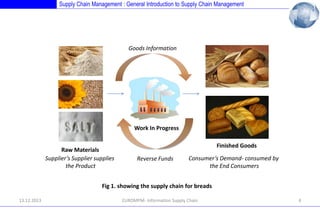
Goods Information

Work In Progress
Raw Materials
Supplier’s Supplier supplies
the Product

Finished Goods

Reverse Funds

Consumer’s Demand- consumed by
the End Consumers

Fig 1. showing the supply chain for breads
13.12.2013

EUROMPM- Information Supply Chain

4
Supply Chain Management : General Introduction to Supply Chain Management

History
 1750 - 1800

 Industrial Revolution
 Era of Mechanical Inventions
 Product and process complexity increase


1800’s

Increased factory complexity
 Birth of Industrial Engineering movement


 1900’s

Assembly line, Mass production
 Henry Gantt: Gantt charts, Scheduling
 Human factors
 Statistical Quality Control




1989 - 1993

 Business Process Reengineering

13.12.2013

EUROMPM- Information Supply Chain

5
Supply Chain Management : General Introduction to Supply Chain Management

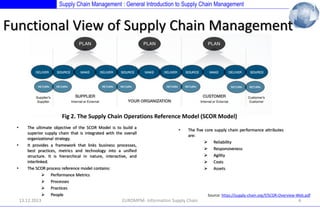
Functional View of Supply Chain Management

Fig 2. The Supply Chain Operations Reference Model (SCOR Model)
•

•

•

The ultimate objective of the SCOR Model is to build a
superior supply chain that is integrated with the overall
organizational strategy.
It provides a framework that links business processes,
best practices, metrics and technology into a unified
structure. It is hierarchical in nature, interactive, and
interlinked.
The SCOR process reference model contains:
 Performance Metrics
 Processes
 Practices
 People

13.12.2013

•

The five core supply chain performance attributes
are:
 Reliability
 Responsiveness
 Agility
 Costs
 Assets

EUROMPM- Information Supply Chain

Source: https://supply-chain.org/f/SCOR-Overview-Web.pdf

6
Supply Chain Management : General Introduction to Supply Chain Management

Supply Chain Players
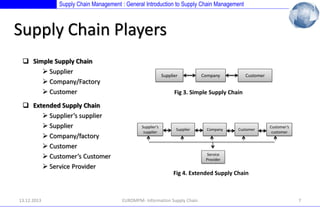
 Simple Supply Chain
 Supplier
 Company/Factory
 Customer
 Extended Supply Chain
 Supplier’s supplier
 Supplier
 Company/factory
 Customer
 Customer’s Customer
 Service Provider

13.12.2013

Supplier

Company

Customer

Fig 3. Simple Supply Chain

Supplier’s
supplier

Supplier

Company

Customer

Customer’s
customer

Service
Provider

Fig 4. Extended Supply Chain

EUROMPM- Information Supply Chain

7
Supply Chain Management : General Introduction to Supply Chain Management

Supply Chain Dynamics
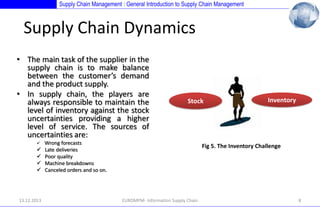
• The main task of the supplier in the
supply chain is to make balance
between the customer’s demand
and the product supply.
• In supply chain, the players are
always responsible to maintain the
level of inventory against the stock
uncertainties providing a higher
level of service. The sources of
uncertainties are:







13.12.2013

Stock

Wrong forecasts
Late deliveries
Poor quality
Machine breakdowns
Canceled orders and so on.

Inventory

Fig 5. The Inventory Challenge

EUROMPM- Information Supply Chain

8
Supply Chain Management : General Introduction to Supply Chain Management

Logistics
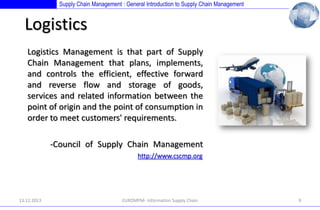
Logistics Management is that part of Supply
Chain Management that plans, implements,
and controls the efficient, effective forward
and reverse flow and storage of goods,
services and related information between the
point of origin and the point of consumption in
order to meet customers' requirements.
-Council of Supply Chain Management
http://www.cscmp.org

13.12.2013

EUROMPM- Information Supply Chain

9
Supply Chain Management : Planning- Supply Chain Management

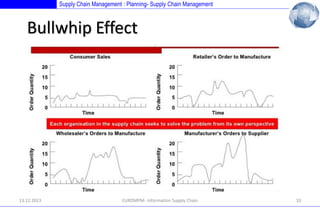
Bullwhip Effect

13.12.2013

EUROMPM- Information Supply Chain

10
Supply Chain Management : Planning- Supply Chain Management

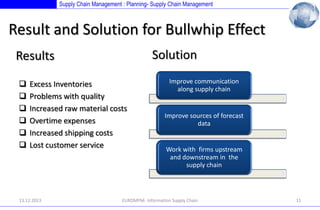
Result and Solution for Bullwhip Effect
Solution

Results







Excess Inventories
Problems with quality
Increased raw material costs
Overtime expenses
Increased shipping costs
Lost customer service

13.12.2013

Improve communication
along supply chain

Improve sources of forecast
data

Work with firms upstream
and downstream in the
supply chain

EUROMPM- Information Supply Chain

11
Supply Chain Management : Planning- Supply Chain Management

Inventory
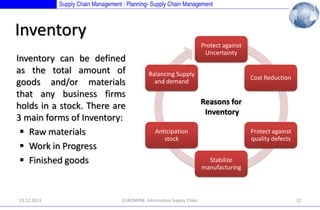
Inventory can be defined
as the total amount of
goods and/or materials
that any business firms
holds in a stock. There are
3 main forms of Inventory:
 Raw materials
 Work in Progress
 Finished goods

13.12.2013

Protect against
Uncertainty

Balancing Supply
and demand

Cost Reduction

Reasons for
Inventory
Anticipation
stock

EUROMPM- Information Supply Chain

Protect against
quality defects
Stabilize
manufacturing

12
Supply Chain Management : Planning- Supply Chain Management

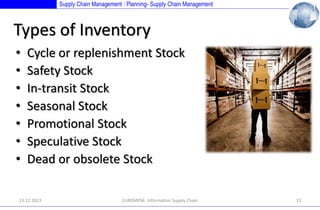
Types of Inventory
•
•
•
•
•
•
•

Cycle or replenishment Stock
Safety Stock
In-transit Stock
Seasonal Stock
Promotional Stock
Speculative Stock
Dead or obsolete Stock

13.12.2013

EUROMPM- Information Supply Chain

13
Supply Chain Management : Planning- Supply Chain Management

Cycle Stock & Safety Stock
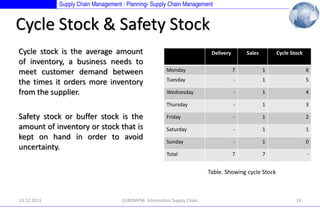
Cycle stock is the average amount
of inventory, a business needs to
meet customer demand between
the times it orders more inventory
from the supplier.

Delivery

Sales

Cycle Stock

7

1

6

Tuesday

-

1

5

Wednesday

-

1

4

Thursday

-

1

3

Friday

-

1

2

Saturday

-

1

1

Sunday

-

1

0

Total

Safety stock or buffer stock is the
amount of inventory or stock that is
kept on hand in order to avoid
uncertainty.

Monday

7

7

-

Table. Showing cycle Stock

13.12.2013

EUROMPM- Information Supply Chain

14
Supply Chain Management : Planning- Supply Chain Management

Reducing Inventory
The cycle stock can be reduce by ordering more
often.
In safety stock case,





Reduce lead-time
Reduce supplier uncertainty
Reduce forecast error
Reduce service level

13.12.2013

EUROMPM- Information Supply Chain

15
Supply Chain Management : Planning- Supply Chain Management

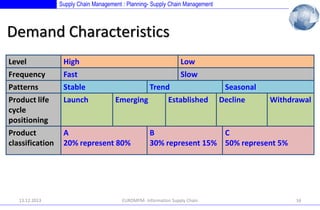
Demand Characteristics
Level

High

Low

Frequency
Patterns
Product life
cycle
positioning
Product
classification

Fast
Stable
Launch

Slow

13.12.2013

Trend
Emerging

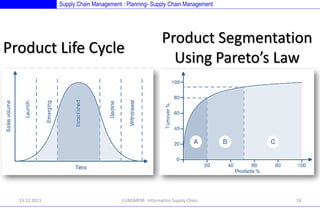
A
20% represent 80%

Established

Seasonal
Decline

Withdrawal

B
C
30% represent 15% 50% represent 5%

EUROMPM- Information Supply Chain

16
Supply Chain Management : Planning- Supply Chain Management

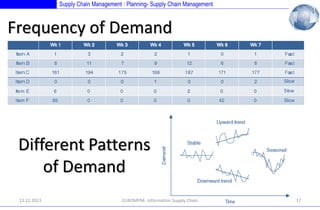
Frequency of Demand

Different Patterns
of Demand
13.12.2013

EUROMPM- Information Supply Chain

17
Supply Chain Management : Planning- Supply Chain Management

Product Life Cycle

13.12.2013

Product Segmentation
Using Pareto’s Law

EUROMPM- Information Supply Chain

18
Supply Chain Management : Planning- Supply Chain Management

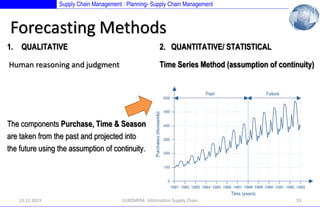
Forecasting Methods
1.

QUALITATIVE

2. QUANTITATIVE/ STATISTICAL
Time Series Method (assumption of continuity)

Human reasoning and judgment

The components Purchase, Time & Season
are taken from the past and projected into
the future using the assumption of continuity.

13.12.2013

EUROMPM- Information Supply Chain

19
Supply Chain Management : Planning- Supply Chain Management

Models of Order Cycle Management
1. Continuous review (fixed order quantity)
Inventory is reviewed daily and a fixed quantity is ordered whenever the
stock drops below a certain point

2. Periodic review (fixed order cycle)
Inventory is reviewed at regular intervals and every time a sufficient
quantity is ordered to raise the inventory level up to a certain level.

13.12.2013

EUROMPM- Information Supply Chain

20
Supply Chain Management : Planning- Supply Chain Management

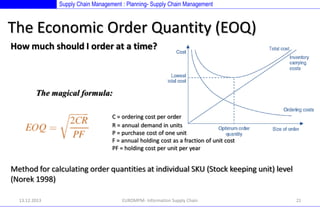
The Economic Order Quantity (EOQ)
How much should I order at a time?

The magical formula:
C = ordering cost per order
R = annual demand in units
P = purchase cost of one unit
F = annual holding cost as a fraction of unit cost
PF = holding cost per unit per year

Method for calculating order quantities at individual SKU (Stock keeping unit) level
(Norek 1998)
13.12.2013

EUROMPM- Information Supply Chain

21
Supply Chain Management : Planning- Supply Chain Management

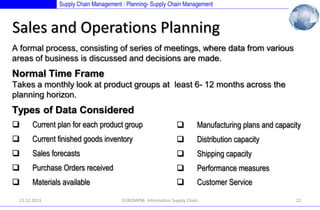
Sales and Operations Planning
A formal process, consisting of series of meetings, where data from various
areas of business is discussed and decisions are made.

Normal Time Frame
Takes a monthly look at product groups at least 6- 12 months across the
planning horizon.

Types of Data Considered


Current plan for each product group



Manufacturing plans and capacity



Current finished goods inventory



Distribution capacity



Sales forecasts



Shipping capacity



Purchase Orders received



Performance measures



Materials available



Customer Service

13.12.2013

EUROMPM- Information Supply Chain

22
Supply Chain Management : Planning- Supply Chain Management

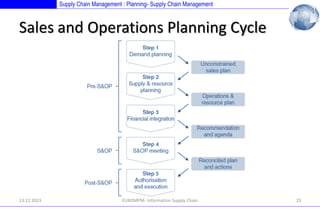
Sales and Operations Planning Cycle

13.12.2013

EUROMPM- Information Supply Chain

23
Supply Chain Management : Planning- Supply Chain Management

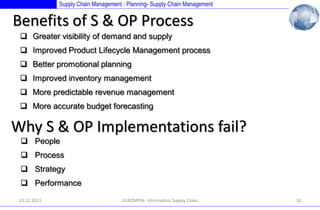
Benefits of S & OP Process
 Greater visibility of demand and supply
 Improved Product Lifecycle Management process
 Better promotional planning

 Improved inventory management
 More predictable revenue management
 More accurate budget forecasting

Why S & OP Implementations fail?
 People

 Process
 Strategy
 Performance
13.12.2013

EUROMPM- Information Supply Chain

24
Supply Chain Management : Planning- Supply Chain Management

Tips for a Successful Implementation
 Develop a formal structure to support S&OP.
 Identify KPIs prior to beginning & monitor them monthly to identify areas for
improvement.
 Attitude of continuous improvement.

 Stabilize the Demand Planning process
 Hold regular meetings
The S&OP process is a decision making tool – don’t confuse having
meetings with making progress.

13.12.2013

EUROMPM- Information Supply Chain

25
Supply Chain Management : Production- Supply Chain Management

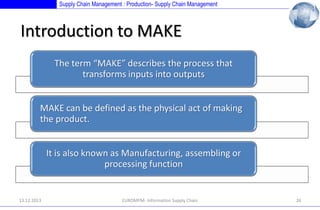
Introduction to MAKE
The term “MAKE” describes the process that
transforms inputs into outputs
MAKE can be defined as the physical act of making
the product.
It is also known as Manufacturing, assembling or
processing function

13.12.2013

EUROMPM- Information Supply Chain

26
Supply Chain Management : Production- Supply Chain Management

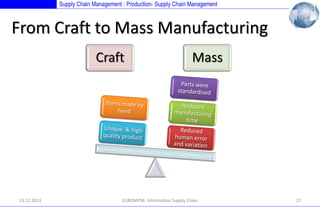
From Craft to Mass Manufacturing
Craft

13.12.2013

Mass

EUROMPM- Information Supply Chain

27
Supply Chain Management : Production- Supply Chain Management

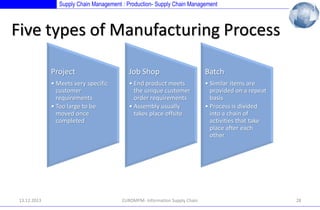
Five types of Manufacturing Process
Project

Batch

• Meets very specific
customer
requirements
• Too large to be
moved once
completed

13.12.2013

Job Shop
• End product meets
the unique customer
order requirements
• Assembly usually
takes place offsite

• Similar items are
provided on a repeat
basis
• Process is divided
into a chain of
activities that take
place after each
other

EUROMPM- Information Supply Chain

28
Supply Chain Management : Production- Supply Chain Management

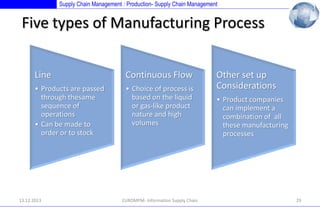
Five types of Manufacturing Process
Line

Continuous Flow

• Products are passed
through thesame
sequence of
operations
• Can be made to
order or to stock

• Choice of process is
based on the liquid
or gas-like product
nature and high
volumes

13.12.2013

EUROMPM- Information Supply Chain

Other set up
Considerations
• Product companies
can implement a
combination of all
these manufacturing
processes

29
Supply Chain Management : Production- Supply Chain Management

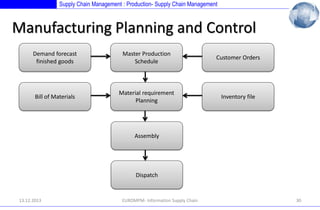
Manufacturing Planning and Control
Demand forecast
finished goods

Master Production
Schedule

Customer Orders

Bill of Materials

Material requirement
Planning

Inventory file

Assembly

Dispatch

13.12.2013

EUROMPM- Information Supply Chain

30
Supply Chain Management : Production- Supply Chain Management

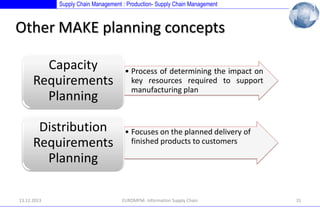
Other MAKE planning concepts
Capacity
Requirements
Planning
Distribution
Requirements
Planning
13.12.2013

• Process of determining the impact on
key resources required to support
manufacturing plan

• Focuses on the planned delivery of
finished products to customers

EUROMPM- Information Supply Chain

31
Supply Chain Management : Production- Supply Chain Management

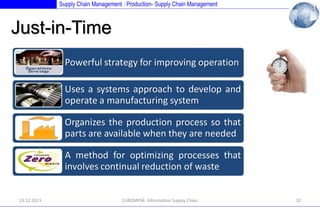
Just-in-Time
Powerful strategy for improving operation

Uses a systems approach to develop and
operate a manufacturing system
Organizes the production process so that
parts are available when they are needed

A method for optimizing processes that
involves continual reduction of waste

13.12.2013

EUROMPM- Information Supply Chain

32
Supply Chain Management : Production- Supply Chain Management

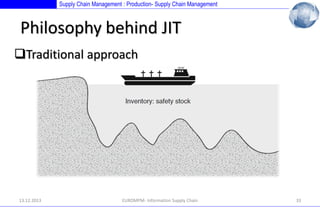
Philosophy behind JIT
Traditional approach

13.12.2013

EUROMPM- Information Supply Chain

33
Supply Chain Management : Production- Supply Chain Management

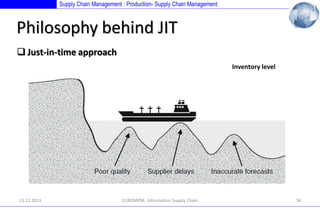
Philosophy behind JIT
 Just-in-time approach
Inventory level

13.12.2013

EUROMPM- Information Supply Chain

34
Supply Chain Management : Production- Supply Chain Management

Overview
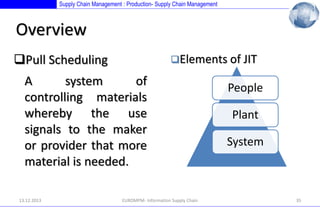
Pull Scheduling

Elements of JIT

A
system
of
controlling materials
whereby the use
signals to the maker
or provider that more
material is needed.
13.12.2013

EUROMPM- Information Supply Chain

People
Plant
System

35
Supply Chain Management : Production- Supply Chain Management

Limitations of JIT





Cultural difference
Loss of safety stock
Decreased individual autonomy
Industry-specific success

13.12.2013

EUROMPM- Information Supply Chain

36
Supply Chain Management : Production- Supply Chain Management

Lean Manufacturing
 Lean focuses on flow, the value stream and eliminating “Muda”, the
Japanese word for waste.
 A way to eliminate waste and improve efficiency in a manufacturing
environment.
 Lean manufacturing is the production of goods using less of
everything compared to traditional mass production: less waste,
human effort, manufacturing space, investment in tools, inventory,
and engineering time to develop a new product.

13.12.2013

EUROMPM- Information Supply Chain

37
Supply Chain Management : Production- Supply Chain Management

Improving Performance through waste
reduction
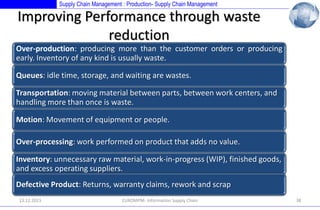
Over-production: producing more than the customer orders or producing
early. Inventory of any kind is usually waste.
Queues: idle time, storage, and waiting are wastes.
Transportation: moving material between parts, between work centers, and
handling more than once is waste.
Motion: Movement of equipment or people.
Over-processing: work performed on product that adds no value.
Inventory: unnecessary raw material, work-in-progress (WIP), finished goods,
and excess operating suppliers.

Defective Product: Returns, warranty claims, rework and scrap
13.12.2013

EUROMPM- Information Supply Chain

38
Supply Chain Management : Production- Supply Chain Management

Tools to Improve “Make” Performance
Bottle Leakage
391 (100%)

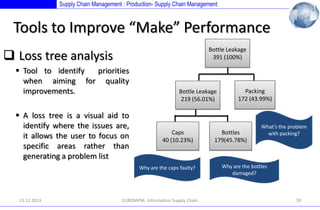
 Loss tree analysis
 Tool to identify
priorities
when aiming for quality
improvements.

 A loss tree is a visual aid to
identify where the issues are,
it allows the user to focus on
specific areas rather than
generating a problem list

Bottle Leakage
219 (56.01%)

Caps
40 (10.23%)

Why are the caps faulty?

13.12.2013

EUROMPM- Information Supply Chain

Packing
172 (43.99%)

Bottles
179(45.78%)

What’s the problem
with packing?

Why are the bottles
damaged?

39
Supply Chain Management : Production- Supply Chain Management

Tools to Improve “Make” Performance
5- Why Analysis
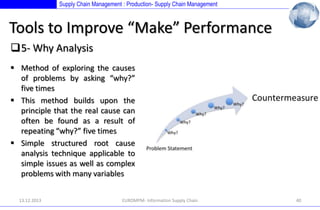
 Method of exploring the causes
of problems by asking “why?”
five times
 This method builds upon the
principle that the real cause can
often be found as a result of
repeating “why?” five times
 Simple structured root cause
analysis technique applicable to
simple issues as well as complex
problems with many variables
13.12.2013

EUROMPM- Information Supply Chain

40
Supply Chain Management : Production- Supply Chain Management

Tools to Improve “Make” Performance
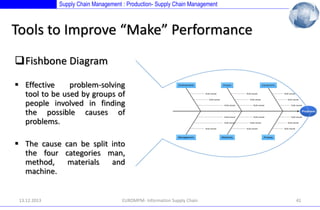
Fishbone Diagram
 Effective
problem-solving
tool to be used by groups of
people involved in finding
the possible causes of
problems.
 The cause can be split into
the four categories man,
method,
materials
and
machine.

13.12.2013

EUROMPM- Information Supply Chain

41
Supply Chain Management

References
•
•
•
•
•

https://supply-chain.org/f/SCOR-Overview-Web.pdf
https://searchmanufacturingerp.techtarget.com
http://www.cscmp.org
http://www.slideshare.net/anandsubramaniam/the-bullwhip-effect
http://smallbusiness.chron.com/justintime-method-31185.html

13.12.2013

EUROMPM- Information Supply Chain

42
Supply Chain Management

Contact
ujjwaljoshi1990@gmail.com

13.12.2013

EUROMPM- Information Supply Chain

43

Supply chain

  • 1.
    Supply Chain Management Introductionto SUPPLY CHAIN MANAGEMENT 13.12.2013 EUROMPM- Information Supply Chain 1
  • 2.
    Supply Chain Management Agenda Introductionto Supply Chain Management Planning- Supply Chain Management Production- Supply Chain Management 13.12.2013 EUROMPM- Information Supply Chain 2
  • 3.
    Supply Chain Management: General Introduction to Supply Chain Management Introduction Supply Chain Management is the integration of key business processes from end users through original suppliers that provides products, services and information that add value to customers and other stakeholders. - Global Supply Chain Forum (GSCF) Two forces can be drawn out that leads in a Supply chain process of goods: 1. Product Supply 2. Customer Demand Supply Chain Management flows can be divided into three main flows: 1. The Product Flow 2. The Information Flow 3. The Finances Flow 13.12.2013 EUROMPM- Information Supply Chain 3
  • 4.
    Supply Chain Management: General Introduction to Supply Chain Management Goods Information Work In Progress Raw Materials Supplier’s Supplier supplies the Product Finished Goods Reverse Funds Consumer’s Demand- consumed by the End Consumers Fig 1. showing the supply chain for breads 13.12.2013 EUROMPM- Information Supply Chain 4
  • 5.
    Supply Chain Management: General Introduction to Supply Chain Management History  1750 - 1800  Industrial Revolution  Era of Mechanical Inventions  Product and process complexity increase  1800’s Increased factory complexity  Birth of Industrial Engineering movement   1900’s Assembly line, Mass production  Henry Gantt: Gantt charts, Scheduling  Human factors  Statistical Quality Control   1989 - 1993  Business Process Reengineering 13.12.2013 EUROMPM- Information Supply Chain 5
  • 6.
    Supply Chain Management: General Introduction to Supply Chain Management Functional View of Supply Chain Management Fig 2. The Supply Chain Operations Reference Model (SCOR Model) • • • The ultimate objective of the SCOR Model is to build a superior supply chain that is integrated with the overall organizational strategy. It provides a framework that links business processes, best practices, metrics and technology into a unified structure. It is hierarchical in nature, interactive, and interlinked. The SCOR process reference model contains:  Performance Metrics  Processes  Practices  People 13.12.2013 • The five core supply chain performance attributes are:  Reliability  Responsiveness  Agility  Costs  Assets EUROMPM- Information Supply Chain Source: https://supply-chain.org/f/SCOR-Overview-Web.pdf 6
  • 7.
    Supply Chain Management: General Introduction to Supply Chain Management Supply Chain Players  Simple Supply Chain  Supplier  Company/Factory  Customer  Extended Supply Chain  Supplier’s supplier  Supplier  Company/factory  Customer  Customer’s Customer  Service Provider 13.12.2013 Supplier Company Customer Fig 3. Simple Supply Chain Supplier’s supplier Supplier Company Customer Customer’s customer Service Provider Fig 4. Extended Supply Chain EUROMPM- Information Supply Chain 7
  • 8.
    Supply Chain Management: General Introduction to Supply Chain Management Supply Chain Dynamics • The main task of the supplier in the supply chain is to make balance between the customer’s demand and the product supply. • In supply chain, the players are always responsible to maintain the level of inventory against the stock uncertainties providing a higher level of service. The sources of uncertainties are:      13.12.2013 Stock Wrong forecasts Late deliveries Poor quality Machine breakdowns Canceled orders and so on. Inventory Fig 5. The Inventory Challenge EUROMPM- Information Supply Chain 8
  • 9.
    Supply Chain Management: General Introduction to Supply Chain Management Logistics Logistics Management is that part of Supply Chain Management that plans, implements, and controls the efficient, effective forward and reverse flow and storage of goods, services and related information between the point of origin and the point of consumption in order to meet customers' requirements. -Council of Supply Chain Management http://www.cscmp.org 13.12.2013 EUROMPM- Information Supply Chain 9
  • 10.
    Supply Chain Management: Planning- Supply Chain Management Bullwhip Effect 13.12.2013 EUROMPM- Information Supply Chain 10
  • 11.
    Supply Chain Management: Planning- Supply Chain Management Result and Solution for Bullwhip Effect Solution Results       Excess Inventories Problems with quality Increased raw material costs Overtime expenses Increased shipping costs Lost customer service 13.12.2013 Improve communication along supply chain Improve sources of forecast data Work with firms upstream and downstream in the supply chain EUROMPM- Information Supply Chain 11
  • 12.
    Supply Chain Management: Planning- Supply Chain Management Inventory Inventory can be defined as the total amount of goods and/or materials that any business firms holds in a stock. There are 3 main forms of Inventory:  Raw materials  Work in Progress  Finished goods 13.12.2013 Protect against Uncertainty Balancing Supply and demand Cost Reduction Reasons for Inventory Anticipation stock EUROMPM- Information Supply Chain Protect against quality defects Stabilize manufacturing 12
  • 13.
    Supply Chain Management: Planning- Supply Chain Management Types of Inventory • • • • • • • Cycle or replenishment Stock Safety Stock In-transit Stock Seasonal Stock Promotional Stock Speculative Stock Dead or obsolete Stock 13.12.2013 EUROMPM- Information Supply Chain 13
  • 14.
    Supply Chain Management: Planning- Supply Chain Management Cycle Stock & Safety Stock Cycle stock is the average amount of inventory, a business needs to meet customer demand between the times it orders more inventory from the supplier. Delivery Sales Cycle Stock 7 1 6 Tuesday - 1 5 Wednesday - 1 4 Thursday - 1 3 Friday - 1 2 Saturday - 1 1 Sunday - 1 0 Total Safety stock or buffer stock is the amount of inventory or stock that is kept on hand in order to avoid uncertainty. Monday 7 7 - Table. Showing cycle Stock 13.12.2013 EUROMPM- Information Supply Chain 14
  • 15.
    Supply Chain Management: Planning- Supply Chain Management Reducing Inventory The cycle stock can be reduce by ordering more often. In safety stock case,     Reduce lead-time Reduce supplier uncertainty Reduce forecast error Reduce service level 13.12.2013 EUROMPM- Information Supply Chain 15
  • 16.
    Supply Chain Management: Planning- Supply Chain Management Demand Characteristics Level High Low Frequency Patterns Product life cycle positioning Product classification Fast Stable Launch Slow 13.12.2013 Trend Emerging A 20% represent 80% Established Seasonal Decline Withdrawal B C 30% represent 15% 50% represent 5% EUROMPM- Information Supply Chain 16
  • 17.
    Supply Chain Management: Planning- Supply Chain Management Frequency of Demand Different Patterns of Demand 13.12.2013 EUROMPM- Information Supply Chain 17
  • 18.
    Supply Chain Management: Planning- Supply Chain Management Product Life Cycle 13.12.2013 Product Segmentation Using Pareto’s Law EUROMPM- Information Supply Chain 18
  • 19.
    Supply Chain Management: Planning- Supply Chain Management Forecasting Methods 1. QUALITATIVE 2. QUANTITATIVE/ STATISTICAL Time Series Method (assumption of continuity) Human reasoning and judgment The components Purchase, Time & Season are taken from the past and projected into the future using the assumption of continuity. 13.12.2013 EUROMPM- Information Supply Chain 19
  • 20.
    Supply Chain Management: Planning- Supply Chain Management Models of Order Cycle Management 1. Continuous review (fixed order quantity) Inventory is reviewed daily and a fixed quantity is ordered whenever the stock drops below a certain point 2. Periodic review (fixed order cycle) Inventory is reviewed at regular intervals and every time a sufficient quantity is ordered to raise the inventory level up to a certain level. 13.12.2013 EUROMPM- Information Supply Chain 20
  • 21.
    Supply Chain Management: Planning- Supply Chain Management The Economic Order Quantity (EOQ) How much should I order at a time? The magical formula: C = ordering cost per order R = annual demand in units P = purchase cost of one unit F = annual holding cost as a fraction of unit cost PF = holding cost per unit per year Method for calculating order quantities at individual SKU (Stock keeping unit) level (Norek 1998) 13.12.2013 EUROMPM- Information Supply Chain 21
  • 22.
    Supply Chain Management: Planning- Supply Chain Management Sales and Operations Planning A formal process, consisting of series of meetings, where data from various areas of business is discussed and decisions are made. Normal Time Frame Takes a monthly look at product groups at least 6- 12 months across the planning horizon. Types of Data Considered  Current plan for each product group  Manufacturing plans and capacity  Current finished goods inventory  Distribution capacity  Sales forecasts  Shipping capacity  Purchase Orders received  Performance measures  Materials available  Customer Service 13.12.2013 EUROMPM- Information Supply Chain 22
  • 23.
    Supply Chain Management: Planning- Supply Chain Management Sales and Operations Planning Cycle 13.12.2013 EUROMPM- Information Supply Chain 23
  • 24.
    Supply Chain Management: Planning- Supply Chain Management Benefits of S & OP Process  Greater visibility of demand and supply  Improved Product Lifecycle Management process  Better promotional planning  Improved inventory management  More predictable revenue management  More accurate budget forecasting Why S & OP Implementations fail?  People  Process  Strategy  Performance 13.12.2013 EUROMPM- Information Supply Chain 24
  • 25.
    Supply Chain Management: Planning- Supply Chain Management Tips for a Successful Implementation  Develop a formal structure to support S&OP.  Identify KPIs prior to beginning & monitor them monthly to identify areas for improvement.  Attitude of continuous improvement.  Stabilize the Demand Planning process  Hold regular meetings The S&OP process is a decision making tool – don’t confuse having meetings with making progress. 13.12.2013 EUROMPM- Information Supply Chain 25
  • 26.
    Supply Chain Management: Production- Supply Chain Management Introduction to MAKE The term “MAKE” describes the process that transforms inputs into outputs MAKE can be defined as the physical act of making the product. It is also known as Manufacturing, assembling or processing function 13.12.2013 EUROMPM- Information Supply Chain 26
  • 27.
    Supply Chain Management: Production- Supply Chain Management From Craft to Mass Manufacturing Craft 13.12.2013 Mass EUROMPM- Information Supply Chain 27
  • 28.
    Supply Chain Management: Production- Supply Chain Management Five types of Manufacturing Process Project Batch • Meets very specific customer requirements • Too large to be moved once completed 13.12.2013 Job Shop • End product meets the unique customer order requirements • Assembly usually takes place offsite • Similar items are provided on a repeat basis • Process is divided into a chain of activities that take place after each other EUROMPM- Information Supply Chain 28
  • 29.
    Supply Chain Management: Production- Supply Chain Management Five types of Manufacturing Process Line Continuous Flow • Products are passed through thesame sequence of operations • Can be made to order or to stock • Choice of process is based on the liquid or gas-like product nature and high volumes 13.12.2013 EUROMPM- Information Supply Chain Other set up Considerations • Product companies can implement a combination of all these manufacturing processes 29
  • 30.
    Supply Chain Management: Production- Supply Chain Management Manufacturing Planning and Control Demand forecast finished goods Master Production Schedule Customer Orders Bill of Materials Material requirement Planning Inventory file Assembly Dispatch 13.12.2013 EUROMPM- Information Supply Chain 30
  • 31.
    Supply Chain Management: Production- Supply Chain Management Other MAKE planning concepts Capacity Requirements Planning Distribution Requirements Planning 13.12.2013 • Process of determining the impact on key resources required to support manufacturing plan • Focuses on the planned delivery of finished products to customers EUROMPM- Information Supply Chain 31
  • 32.
    Supply Chain Management: Production- Supply Chain Management Just-in-Time Powerful strategy for improving operation Uses a systems approach to develop and operate a manufacturing system Organizes the production process so that parts are available when they are needed A method for optimizing processes that involves continual reduction of waste 13.12.2013 EUROMPM- Information Supply Chain 32
  • 33.
    Supply Chain Management: Production- Supply Chain Management Philosophy behind JIT Traditional approach 13.12.2013 EUROMPM- Information Supply Chain 33
  • 34.
    Supply Chain Management: Production- Supply Chain Management Philosophy behind JIT  Just-in-time approach Inventory level 13.12.2013 EUROMPM- Information Supply Chain 34
  • 35.
    Supply Chain Management: Production- Supply Chain Management Overview Pull Scheduling Elements of JIT A system of controlling materials whereby the use signals to the maker or provider that more material is needed. 13.12.2013 EUROMPM- Information Supply Chain People Plant System 35
  • 36.
    Supply Chain Management: Production- Supply Chain Management Limitations of JIT     Cultural difference Loss of safety stock Decreased individual autonomy Industry-specific success 13.12.2013 EUROMPM- Information Supply Chain 36
  • 37.
    Supply Chain Management: Production- Supply Chain Management Lean Manufacturing  Lean focuses on flow, the value stream and eliminating “Muda”, the Japanese word for waste.  A way to eliminate waste and improve efficiency in a manufacturing environment.  Lean manufacturing is the production of goods using less of everything compared to traditional mass production: less waste, human effort, manufacturing space, investment in tools, inventory, and engineering time to develop a new product. 13.12.2013 EUROMPM- Information Supply Chain 37
  • 38.
    Supply Chain Management: Production- Supply Chain Management Improving Performance through waste reduction Over-production: producing more than the customer orders or producing early. Inventory of any kind is usually waste. Queues: idle time, storage, and waiting are wastes. Transportation: moving material between parts, between work centers, and handling more than once is waste. Motion: Movement of equipment or people. Over-processing: work performed on product that adds no value. Inventory: unnecessary raw material, work-in-progress (WIP), finished goods, and excess operating suppliers. Defective Product: Returns, warranty claims, rework and scrap 13.12.2013 EUROMPM- Information Supply Chain 38
  • 39.
    Supply Chain Management: Production- Supply Chain Management Tools to Improve “Make” Performance Bottle Leakage 391 (100%)  Loss tree analysis  Tool to identify priorities when aiming for quality improvements.  A loss tree is a visual aid to identify where the issues are, it allows the user to focus on specific areas rather than generating a problem list Bottle Leakage 219 (56.01%) Caps 40 (10.23%) Why are the caps faulty? 13.12.2013 EUROMPM- Information Supply Chain Packing 172 (43.99%) Bottles 179(45.78%) What’s the problem with packing? Why are the bottles damaged? 39
  • 40.
    Supply Chain Management: Production- Supply Chain Management Tools to Improve “Make” Performance 5- Why Analysis  Method of exploring the causes of problems by asking “why?” five times  This method builds upon the principle that the real cause can often be found as a result of repeating “why?” five times  Simple structured root cause analysis technique applicable to simple issues as well as complex problems with many variables 13.12.2013 EUROMPM- Information Supply Chain 40
  • 41.
    Supply Chain Management: Production- Supply Chain Management Tools to Improve “Make” Performance Fishbone Diagram  Effective problem-solving tool to be used by groups of people involved in finding the possible causes of problems.  The cause can be split into the four categories man, method, materials and machine. 13.12.2013 EUROMPM- Information Supply Chain 41
  • 42.
  • 43.