ICB’s Main Technical Competence
Element
Prepared By:
Ujjwal Kumar Joshi
INTRODUCTION
Generally, the Technical
Competencies Elements deals
with the elements that are
required :
 To initiate and start,
 To manage the execution
 To close a project.
This order can differ
depending on the kind, size
and complexity of a project
and other influencing factors.
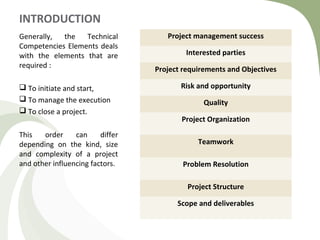
The Technical Competence
Project management success
Interested parties
Project requirements and Objectives
Risk and opportunity
Quality
Project Organization
Teamwork
Problem Resolution
Project Structure
Scope and deliverables
PROJECT MANAGEMENT SUCCESS
 Project management Success is the appreciation of the project management result by the
relevant interested parties.
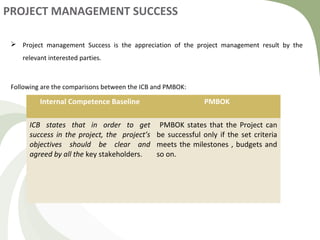
Following are the comparisons between the ICB and PMBOK:
Internal Competence Baseline PMBOK
ICB states that in order to get
success in the project, the project’s
objectives should be clear and
agreed by all the key stakeholders.
PMBOK states that the Project can
be successful only if the set criteria
meets the milestones , budgets and
so on.
INTERESTED PARTIES (STAKEHOLDERS)
 Interested Parties also refers to ‘Stakeholders’, ‘Clients’ or the ‘Customers’. They are people
or groups, who are interested in the project or in it’s success , who are generally affected by
the project.
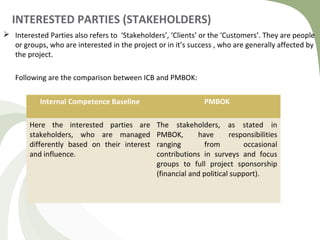
Following are the comparison between ICB and PMBOK:
Internal Competence Baseline PMBOK
Here the interested parties are
stakeholders, who are managed
differently based on their interest
and influence.
The stakeholders, as stated in
PMBOK, have responsibilities
ranging from occasional
contributions in surveys and focus
groups to full project sponsorship
(financial and political support).
PROJECT REQUIREMENTS & OBJECTIVES
 PROJECT REQUIREMENTS consists of the identification, definition and agreement of the project
to meet the needs and expectations of interested parties, especially those of the customers and
users. While the PROJECT OBJECTIVE is to produce the agreed end results, especially the
deliverables, in the time-frame required, within budget and within acceptable parameters of risk.
Its Process steps Includes;
 Gather, document, and get agreement on project requirements.
 Develop a business case and project strategies and place them under change management.
 Define project objectives, appraise the project, carry out a feasibility study, and establish a
project plan.
 Communicate progress and changes.
 Validate requirements at key points in the project life-cycle.
 Assess compliance with project objectives and requirements and seek authorization for the
project.
 Set up project review process.
RISK & OPPORTUNITY
o Risk and Opportunity management is an ongoing process taking place during all phases of
the project life cycle, from initial idea to project close-out. At project close-out the lessons
learnt in risk and opportunity management throughout the project are an important
contribution to the success of future projects. Its Process steps Includes;
 Identify and assess risks and opportunities.
 Develop a risk and opportunity response plan and have it approved and communicated.
 Update the different project plans affected by the approved risks and opportunities
response plan.
 Assess the probability of attaining time and cost objectives, and keep doing it during the
project.
 Continuously identify new risks, reassess risks, plan responses and modify the project plan.
 Control the risk and opportunity response plan.
 Document lessons learnt and apply to future projects; update risk identification tools.
QUALITY
 Quality of the project is the degree to which a set of inherent
characteristics fulfills the project.
 ensures long-term business success through customer
satisfaction.
 Customer/user will be involved to review to ensure
compliance with the product requirements.
 Validation of project quality is carried out via procedures such
as quality assurance,(QA), Quality Control (QC), and project
and product audits.
Project Organization
• Group of people and associated infrastructure with an
arrangement.
• Normally has a shorter life and changes more rapidly than the
permanent organization
• The performance of a project organization depends on the
personnel working in it.
Comparison with PMBOK
 The technical competences of ICB are adequately covered in
PMBOK.
 Quality, teamwork,procurement, monitor and control,
information distribution and closing are covered in both the
standards.
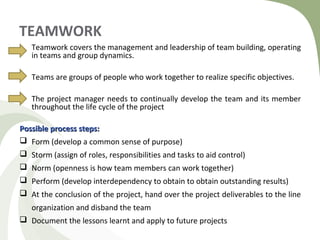
TEAMWORK
• Teamwork covers the management and leadership of team building, operating
in teams and group dynamics.
• Teams are groups of people who work together to realize specific objectives.
• The project manager needs to continually develop the team and its member
throughout the life cycle of the project
Possible process steps:Possible process steps:
 Form (develop a common sense of purpose)
 Storm (assign of roles, responsibilities and tasks to aid control)
 Norm (openness is how team members can work together)
 Perform (develop interdependency to obtain to obtain outstanding results)
 At the conclusion of the project, hand over the project deliverables to the line
organization and disband the team
 Document the lessons learnt and apply to future projects
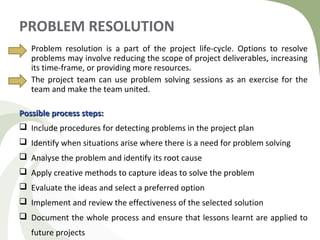
PROBLEM RESOLUTION
• Problem resolution is a part of the project life-cycle. Options to resolve
problems may involve reducing the scope of project deliverables, increasing
its time-frame, or providing more resources.
• The project team can use problem solving sessions as an exercise for the
team and make the team united.
Possible process steps:Possible process steps:
 Include procedures for detecting problems in the project plan
 Identify when situations arise where there is a need for problem solving
 Analyse the problem and identify its root cause
 Apply creative methods to capture ideas to solve the problem
 Evaluate the ideas and select a preferred option
 Implement and review the effectiveness of the selected solution
 Document the whole process and ensure that lessons learnt are applied to
future projects
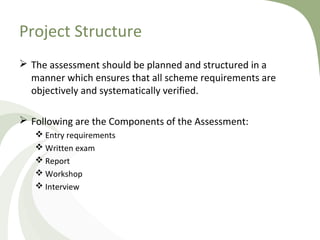
Project Structure
 The assessment should be planned and structured in a
manner which ensures that all scheme requirements are
objectively and systematically verified.
 Following are the Components of the Assessment:
 Entry requirements
 Written exam
 Report
 Workshop
 Interview
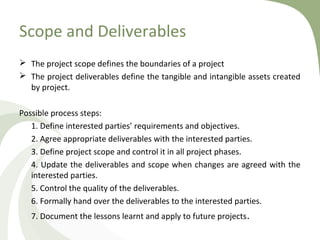
Scope and Deliverables
 The project scope defines the boundaries of a project
 The project deliverables define the tangible and intangible assets created
by project.
Possible process steps:
1. Define interested parties’ requirements and objectives.
2. Agree appropriate deliverables with the interested parties.
3. Define project scope and control it in all project phases.
4. Update the deliverables and scope when changes are agreed with the
interested parties.
5. Control the quality of the deliverables.
6. Formally hand over the deliverables to the interested parties.
7. Document the lessons learnt and apply to future projects.
Thank You For your
Attention!

ICB Competence, Project Standards

  • 1.
    ICB’s Main TechnicalCompetence Element Prepared By: Ujjwal Kumar Joshi
  • 2.
    INTRODUCTION Generally, the Technical CompetenciesElements deals with the elements that are required :  To initiate and start,  To manage the execution  To close a project. This order can differ depending on the kind, size and complexity of a project and other influencing factors. The Technical Competence Project management success Interested parties Project requirements and Objectives Risk and opportunity Quality Project Organization Teamwork Problem Resolution Project Structure Scope and deliverables
  • 3.
    PROJECT MANAGEMENT SUCCESS Project management Success is the appreciation of the project management result by the relevant interested parties. Following are the comparisons between the ICB and PMBOK: Internal Competence Baseline PMBOK ICB states that in order to get success in the project, the project’s objectives should be clear and agreed by all the key stakeholders. PMBOK states that the Project can be successful only if the set criteria meets the milestones , budgets and so on.
  • 4.
    INTERESTED PARTIES (STAKEHOLDERS) Interested Parties also refers to ‘Stakeholders’, ‘Clients’ or the ‘Customers’. They are people or groups, who are interested in the project or in it’s success , who are generally affected by the project. Following are the comparison between ICB and PMBOK: Internal Competence Baseline PMBOK Here the interested parties are stakeholders, who are managed differently based on their interest and influence. The stakeholders, as stated in PMBOK, have responsibilities ranging from occasional contributions in surveys and focus groups to full project sponsorship (financial and political support).
  • 5.
    PROJECT REQUIREMENTS &OBJECTIVES  PROJECT REQUIREMENTS consists of the identification, definition and agreement of the project to meet the needs and expectations of interested parties, especially those of the customers and users. While the PROJECT OBJECTIVE is to produce the agreed end results, especially the deliverables, in the time-frame required, within budget and within acceptable parameters of risk. Its Process steps Includes;  Gather, document, and get agreement on project requirements.  Develop a business case and project strategies and place them under change management.  Define project objectives, appraise the project, carry out a feasibility study, and establish a project plan.  Communicate progress and changes.  Validate requirements at key points in the project life-cycle.  Assess compliance with project objectives and requirements and seek authorization for the project.  Set up project review process.
  • 6.
    RISK & OPPORTUNITY oRisk and Opportunity management is an ongoing process taking place during all phases of the project life cycle, from initial idea to project close-out. At project close-out the lessons learnt in risk and opportunity management throughout the project are an important contribution to the success of future projects. Its Process steps Includes;  Identify and assess risks and opportunities.  Develop a risk and opportunity response plan and have it approved and communicated.  Update the different project plans affected by the approved risks and opportunities response plan.  Assess the probability of attaining time and cost objectives, and keep doing it during the project.  Continuously identify new risks, reassess risks, plan responses and modify the project plan.  Control the risk and opportunity response plan.  Document lessons learnt and apply to future projects; update risk identification tools.
  • 7.
    QUALITY  Quality ofthe project is the degree to which a set of inherent characteristics fulfills the project.  ensures long-term business success through customer satisfaction.  Customer/user will be involved to review to ensure compliance with the product requirements.  Validation of project quality is carried out via procedures such as quality assurance,(QA), Quality Control (QC), and project and product audits.
  • 8.
    Project Organization • Groupof people and associated infrastructure with an arrangement. • Normally has a shorter life and changes more rapidly than the permanent organization • The performance of a project organization depends on the personnel working in it.
  • 9.
    Comparison with PMBOK The technical competences of ICB are adequately covered in PMBOK.  Quality, teamwork,procurement, monitor and control, information distribution and closing are covered in both the standards.
  • 10.
    TEAMWORK • Teamwork coversthe management and leadership of team building, operating in teams and group dynamics. • Teams are groups of people who work together to realize specific objectives. • The project manager needs to continually develop the team and its member throughout the life cycle of the project Possible process steps:Possible process steps:  Form (develop a common sense of purpose)  Storm (assign of roles, responsibilities and tasks to aid control)  Norm (openness is how team members can work together)  Perform (develop interdependency to obtain to obtain outstanding results)  At the conclusion of the project, hand over the project deliverables to the line organization and disband the team  Document the lessons learnt and apply to future projects
  • 11.
    PROBLEM RESOLUTION • Problemresolution is a part of the project life-cycle. Options to resolve problems may involve reducing the scope of project deliverables, increasing its time-frame, or providing more resources. • The project team can use problem solving sessions as an exercise for the team and make the team united. Possible process steps:Possible process steps:  Include procedures for detecting problems in the project plan  Identify when situations arise where there is a need for problem solving  Analyse the problem and identify its root cause  Apply creative methods to capture ideas to solve the problem  Evaluate the ideas and select a preferred option  Implement and review the effectiveness of the selected solution  Document the whole process and ensure that lessons learnt are applied to future projects
  • 12.
    Project Structure  Theassessment should be planned and structured in a manner which ensures that all scheme requirements are objectively and systematically verified.  Following are the Components of the Assessment:  Entry requirements  Written exam  Report  Workshop  Interview
  • 13.
    Scope and Deliverables The project scope defines the boundaries of a project  The project deliverables define the tangible and intangible assets created by project. Possible process steps: 1. Define interested parties’ requirements and objectives. 2. Agree appropriate deliverables with the interested parties. 3. Define project scope and control it in all project phases. 4. Update the deliverables and scope when changes are agreed with the interested parties. 5. Control the quality of the deliverables. 6. Formally hand over the deliverables to the interested parties. 7. Document the lessons learnt and apply to future projects.
  • 14.
    Thank You Foryour Attention!