Business English
  Logistics & Transportation Engineering
Seminar : Basics of Supply Chain Management
             By Youssef Serroukh
           15/11/2011 ~ 22/11/2011


            Y.Serroukh – Anglais Commercial   1
Contents


 Part 1 What is SCM?
 Part 2 The Evolving Supply Chain


               Y.Serroukh – Anglais Commercial   2
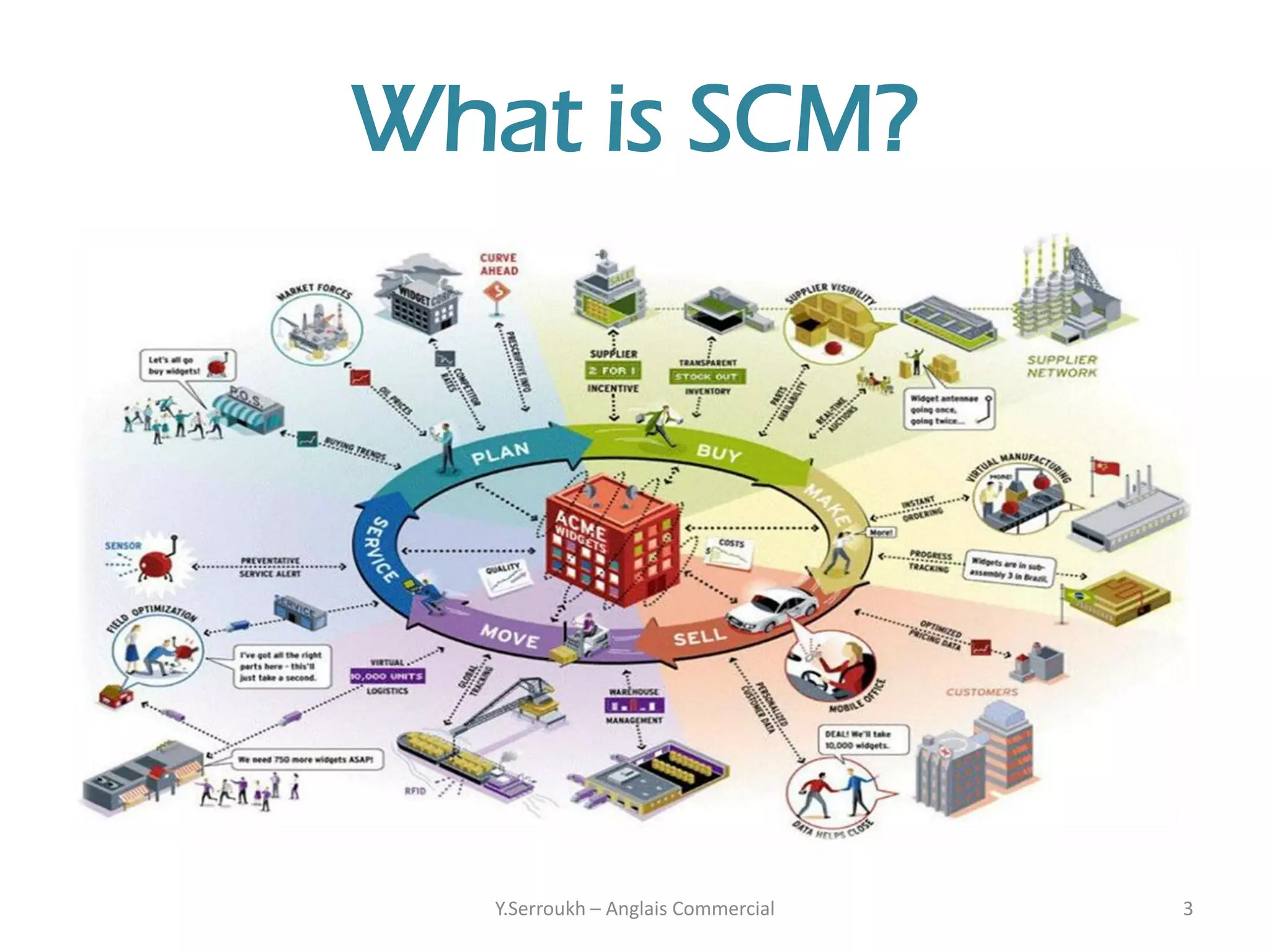
What is SCM?


   Y.Serroukh – Anglais Commercial   3
1.1 Overview of Supply Chain

Supply chain (also called value chain or demand chain), is
the network of the involved companies, through upstream
and downstream linkages, in the different processes and
activities that produce value in the form of products and
services in the hands of the ultimate consumer. For
example, a shirt manufacturer is a part of a supply chain
that goes upstream through the weavers of fabrics to the
manufacturers of fibers, and downstream through
distributors and retailers to the final consumer. Each of
these organizations in the chain is dependent upon each
other.


                    Y.Serroukh – Anglais Commercial          4
1.2 The Definition of SCM
There are various definitions of different edition. But in general, Supply
chain management means the management of upstream and
downstream relationships with suppliers and customers to deliver
superior customer value at less cost to the supply chain as a whole. The
supply chain arrangement links a firm and its distributive and supplier
network to end customers.

The integrated value-creation process must be managed from material
procurement to end-customer product delivery. The integrated supply
chain management shifts traditional channel arrangements from
loosely linked groups of independent businesses that buy and sell
inventory to each other toward a coordinated initiative to increase
market impact, overall efficiency, continuous improvement, and
competitiveness.


                          Y.Serroukh – Anglais Commercial                    5
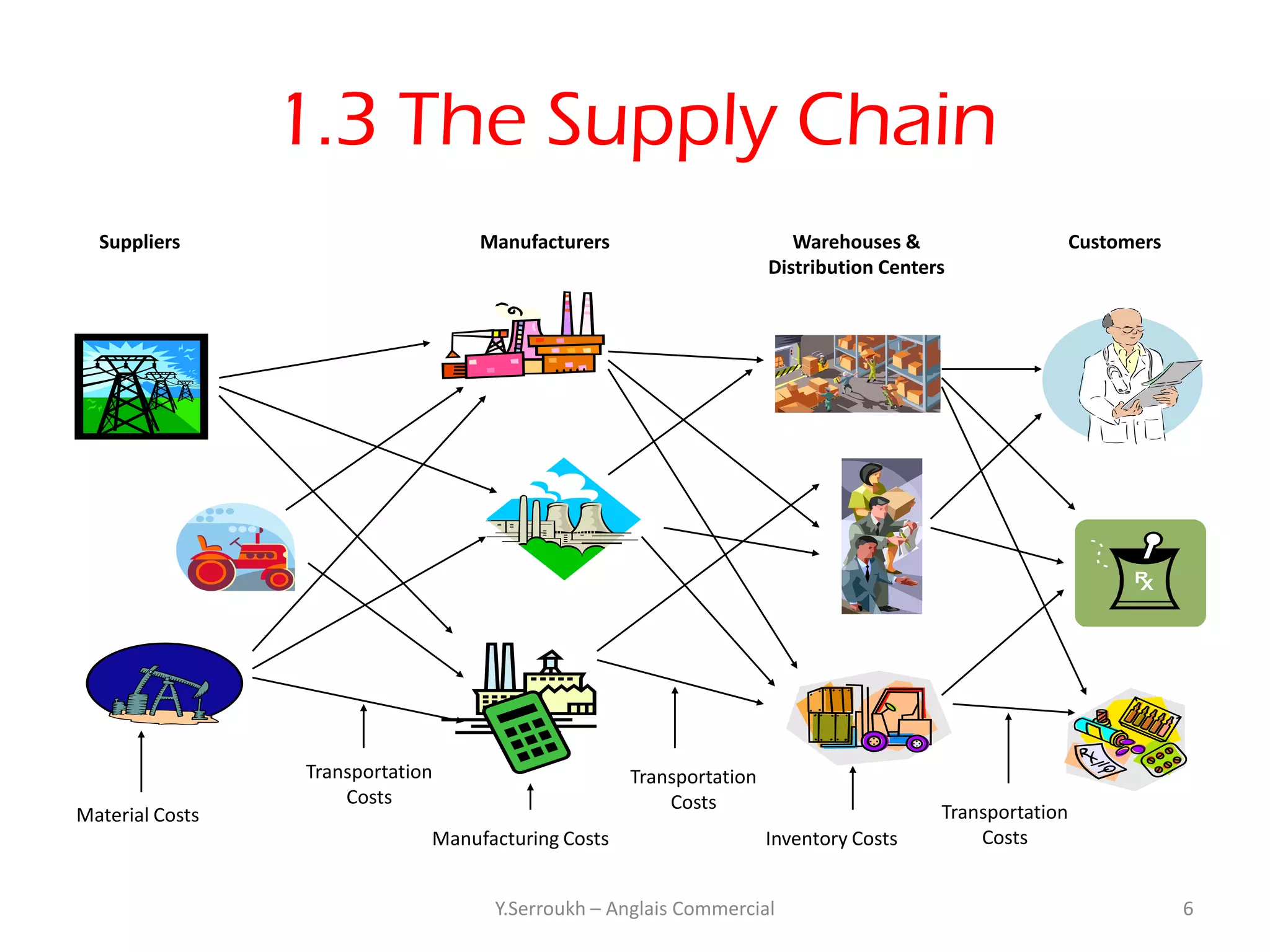
1.3 The Supply Chain
  Suppliers                        Manufacturers                        Warehouses &                     Customers
                                                                     Distribution Centers


                 Transportation                     Transportation
                     Costs                              Costs
Material Costs                                                                          Transportation
                              Manufacturing Costs                    Inventory Costs        Costs


                                    Y.Serroukh – Anglais Commercial                                                  6
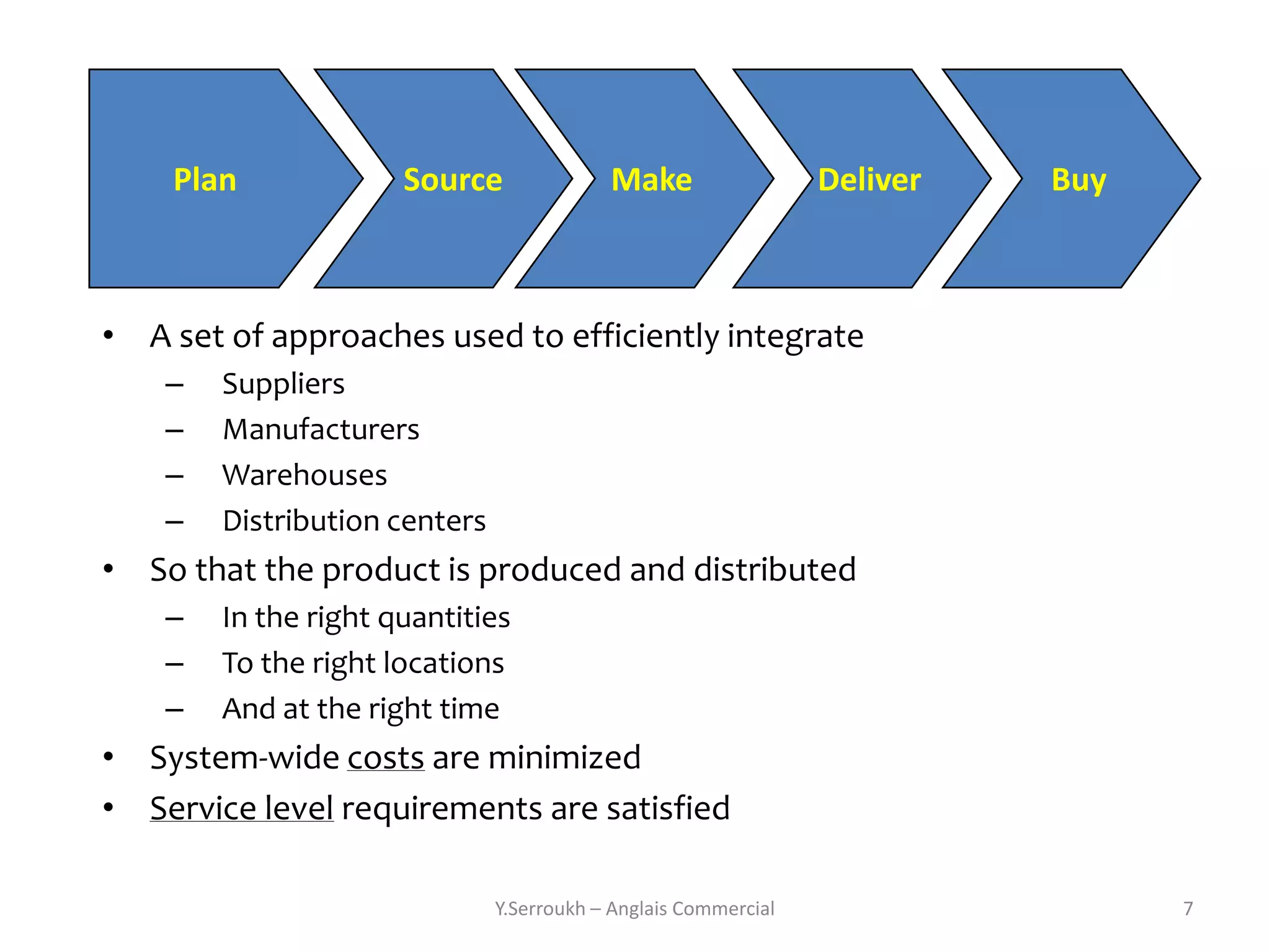
Plan              Source               Make                  Deliver   Buy


• A set of approaches used to efficiently integrate
    –   Suppliers
    –   Manufacturers
    –   Warehouses
    –   Distribution centers
• So that the product is produced and distributed
    –   In the right quantities
    –   To the right locations
    –   And at the right time
• System-wide costs are minimized
• Service level requirements are satisfied

                               Y.Serroukh – Anglais Commercial                   7
1.4 Difficulties
• Uncertainty is inherent to every supply chain
   – Travel times
   – Breakdowns of machines and vehicles
   – Weather, natural catastrophe, war
   – Local politics, labor conditions, border issues

• The complexity of the problem to globally optimize a
  supply chain is significant
   – Minimize internal costs
   – Minimize uncertainty
   – Deal with remaining uncertainty


                       Y.Serroukh – Anglais Commercial   8
1.5 History of SCM
• 1960’s - Inventory Management Focus, Cost Control
• 1970’s - MRP & BOM - Operations Planning
• 1980’s - MRPII, JIT - Materials Management, Logistics
• 1990’s - SCM - ERP - “Integrated” Purchasing,
  Financials, Manufacturing, Order Entry
• 2000’s - Optimized “Value Network” with Real-Time
  Decision Support; Synchronized & Collaborative
  Extended Network


                     Y.Serroukh – Anglais Commercial      9
1.6 Reasons for Developing Supply
               Chains
 Greater competitive advantage
 Greater value to consumers
 Reduces the lead time gap
 Faster and smaller deliveries to intermediate customers
 Introduces the concept of increased shareholder value

      These reasons give rise to the notion that in future,
    we will see supply chains competing with supply chains
    rather than competition between organizations.


                        Y.Serroukh – Anglais Commercial        10
1.7 The Goal of SCM
Since World War II, with the development of the operations
research and management science, there has been an increasing
interest in supply chain planning and management. Working
together, supply chain planners/managers and all members of
the front, middle and back end of the supply chain may enhance
revenue, cost control, and asset utilization as well as customer
satisfaction.
 Furthermore, software for optimization has been embraced by
all of these parties, as it offers mathematical modeling solutions
to supply chain problems. For example, a software package
might provide an optimum delivery route of the products, from
supplier to manufacture. In conclusion, the goal is to optimize
efficiency through supply chain management.


                       Y.Serroukh – Anglais Commercial           11
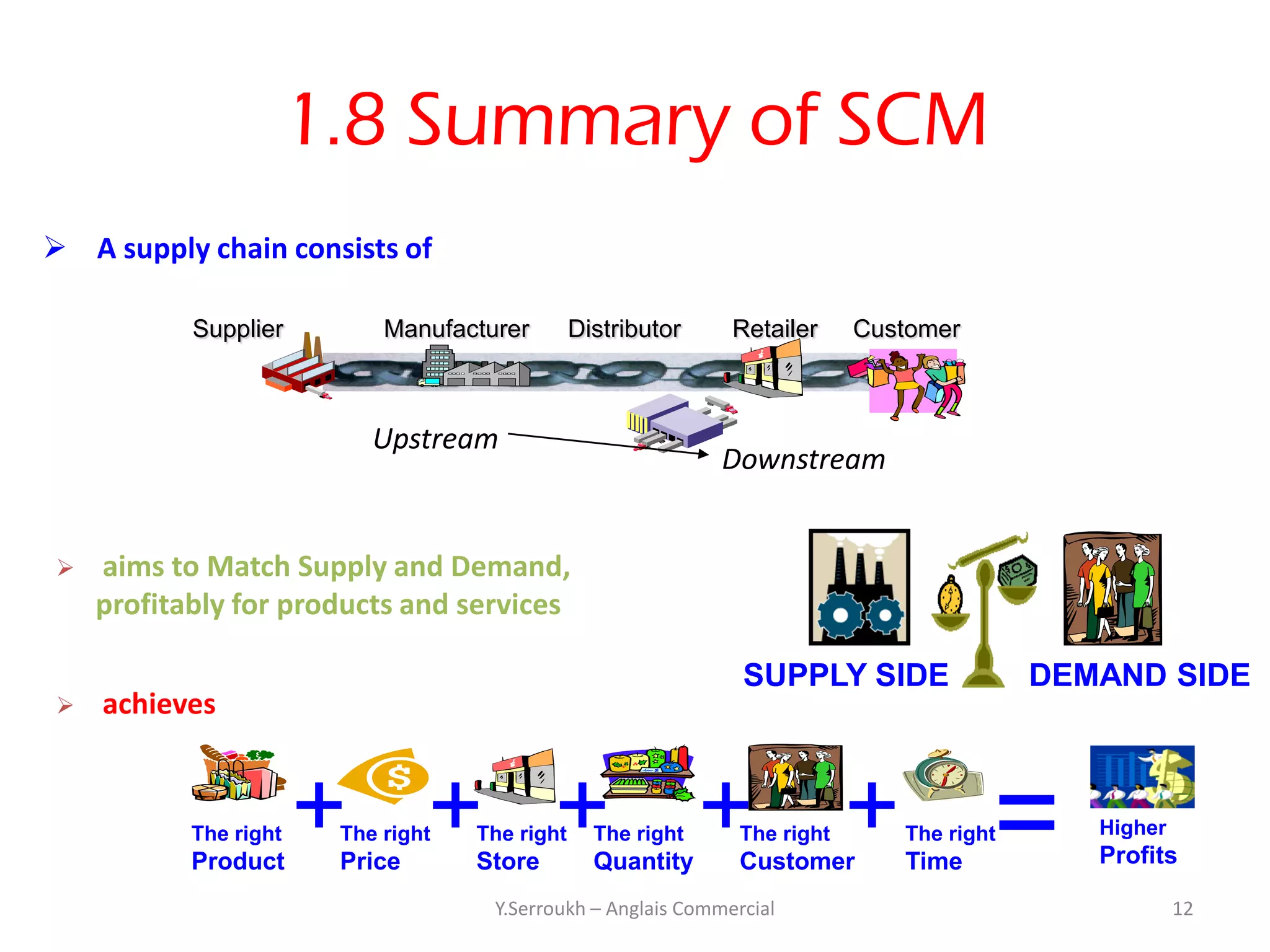
1.8 Summary of SCM
 A supply chain consists of

           Supplier        Manufacturer        Distributor    Retailer     Customer


                          Upstream
                                                             Downstream


   aims to Match Supply and Demand,
    profitably for products and services

                                                               SUPPLY SIDE                DEMAND SIDE
   achieves


           The right
           Product
                       + + + + +
                       The right
                       Price
                                   The right
                                   Store
                                                 The right
                                                 Quantity
                                                               The right
                                                               Customer
                                                                                      =
                                                                              The right
                                                                              Time
                                                                                             Higher
                                                                                             Profits

                                    Y.Serroukh – Anglais Commercial                                   12
The Evolving Supply Chain


        Y.Serroukh – Anglais Commercial   13
2.1 Supply Chain Integration :
           Push Strategies
•   Classical manufacturing supply chain strategy
•   Manufacturing forecasts are long-range
     – Orders from retailers’ warehouses
•   Longer response time to react to marketplace changes
     – Unable to meet changing demand patterns
     – Supply chain inventory becomes obsolete as demand for certain products
          disappears
•   Increased variability (Bullwhip effect) leading to:
     – Large inventory safety stocks
     – Larger and more variably sized production batches
     – Unacceptable service levels
     – Inventory obsolescence
•   Inefficient use of production facilities (factories)
     – How is demand determined? Peak? Average?
     – How is transportation capacity determined?
•   Examples: Auto industry, large appliances, others?


                             Y.Serroukh – Anglais Commercial                14
2.2 Supply Chain Integration :
             Pull Strategies
• Production and distribution are demand-driven
   – Coordinated with true customer demand
• None or little inventory held
   – Only in response to specific orders
• Fast information flow mechanisms
   – POS data
• Decreased lead times
• Decreased retailer inventory
• Decreased variability in the supply chain and especially at
  manufacturers
• Decreased manufacturer inventory
• More efficient use of resources
• More difficult to take advantage of scale opportunities
• Examples: Dell, Amazon
                            Y.Serroukh – Anglais Commercial     15
2.3 Supply Chain Integration :
                 Push/Pull Strategies
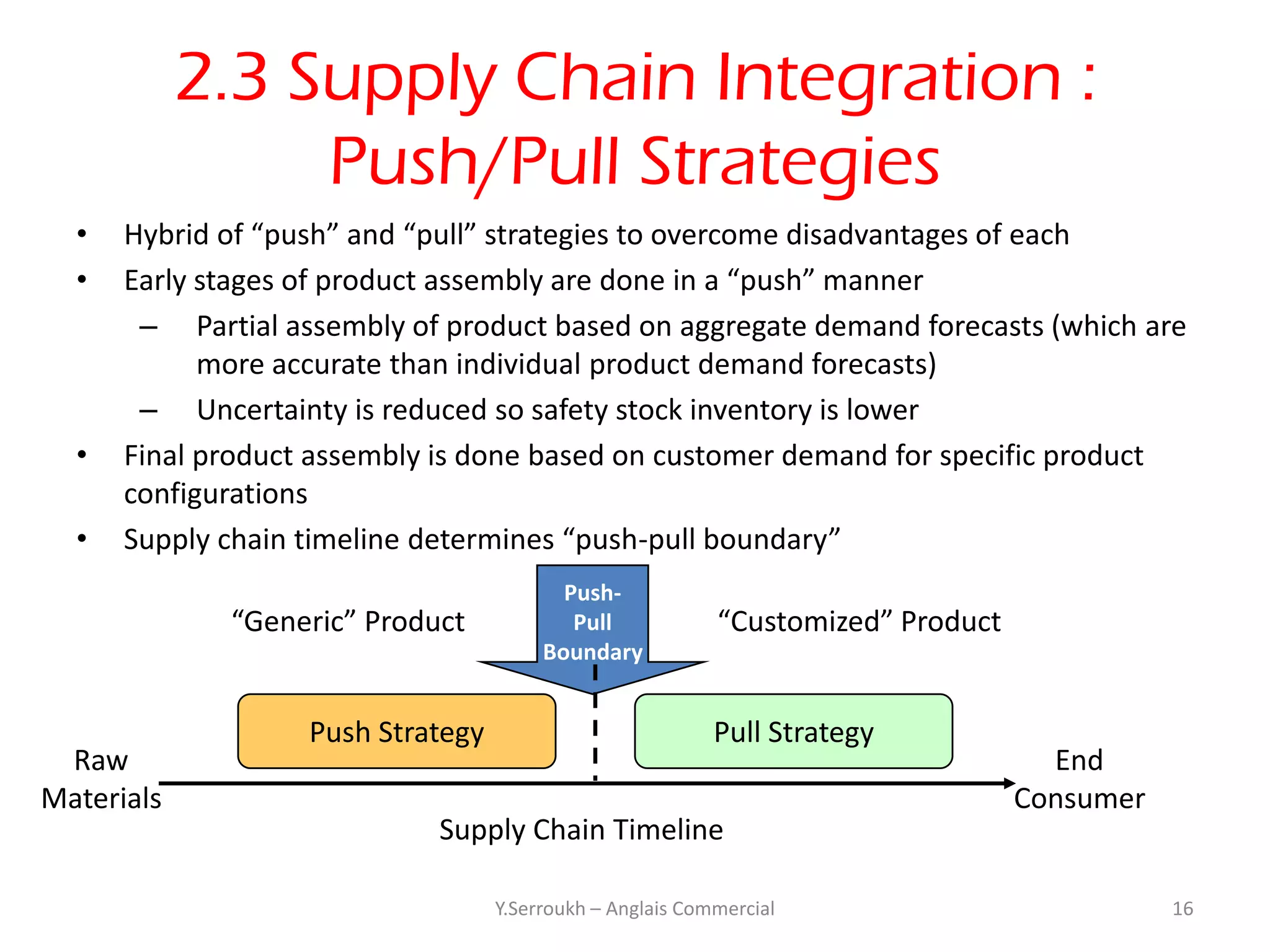
  •   Hybrid of “push” and “pull” strategies to overcome disadvantages of each
  •   Early stages of product assembly are done in a “push” manner
       – Partial assembly of product based on aggregate demand forecasts (which are
            more accurate than individual product demand forecasts)
       – Uncertainty is reduced so safety stock inventory is lower
  •   Final product assembly is done based on customer demand for specific product
      configurations
  •   Supply chain timeline determines “push-pull boundary”
                                          Push-
             “Generic” Product             Pull            “Customized” Product
                                        Boundary


                   Push Strategy                           Pull Strategy
 Raw                                                                                End
Materials                                                                         Consumer
                            Supply Chain Timeline

                                   Y.Serroukh – Anglais Commercial                           16
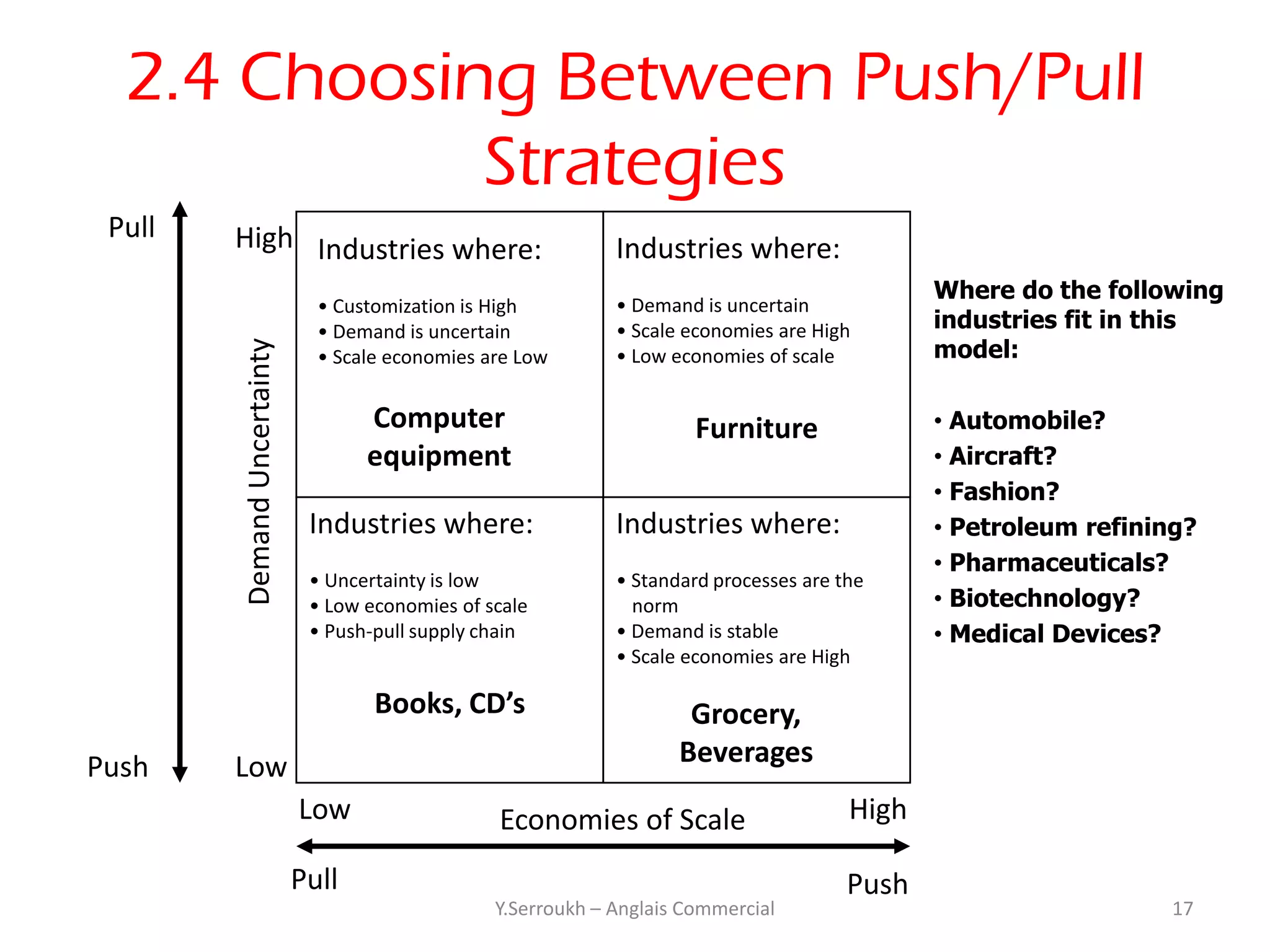
2.4 Choosing Between Push/Pull
             Strategies
 Pull   High Industries where:                                 Industries where:
                                                                                                Where do the following
                               • Customization is High         • Demand is uncertain
                               • Demand is uncertain           • Scale economies are High       industries fit in this
                                                                                                model:
        Demand Uncertainty

                               • Scale economies are Low       • Low economies of scale


                                    Computer                            Furniture               • Automobile?
                                    equipment                                                   • Aircraft?
                                                                                                • Fashion?
                              Industries where:                Industries where:                • Petroleum refining?
                                                                                                • Pharmaceuticals?
                              • Uncertainty is low             • Standard processes are the
                              • Low economies of scale           norm                           • Biotechnology?
                              • Push-pull supply chain         • Demand is stable               • Medical Devices?
                                                               • Scale economies are High

                                     Books, CD’s                       Grocery,
Push    Low                                                           Beverages
                             Low                  Economies of Scale                     High

                             Pull                                                        Push
                                                  Y.Serroukh – Anglais Commercial                                  17
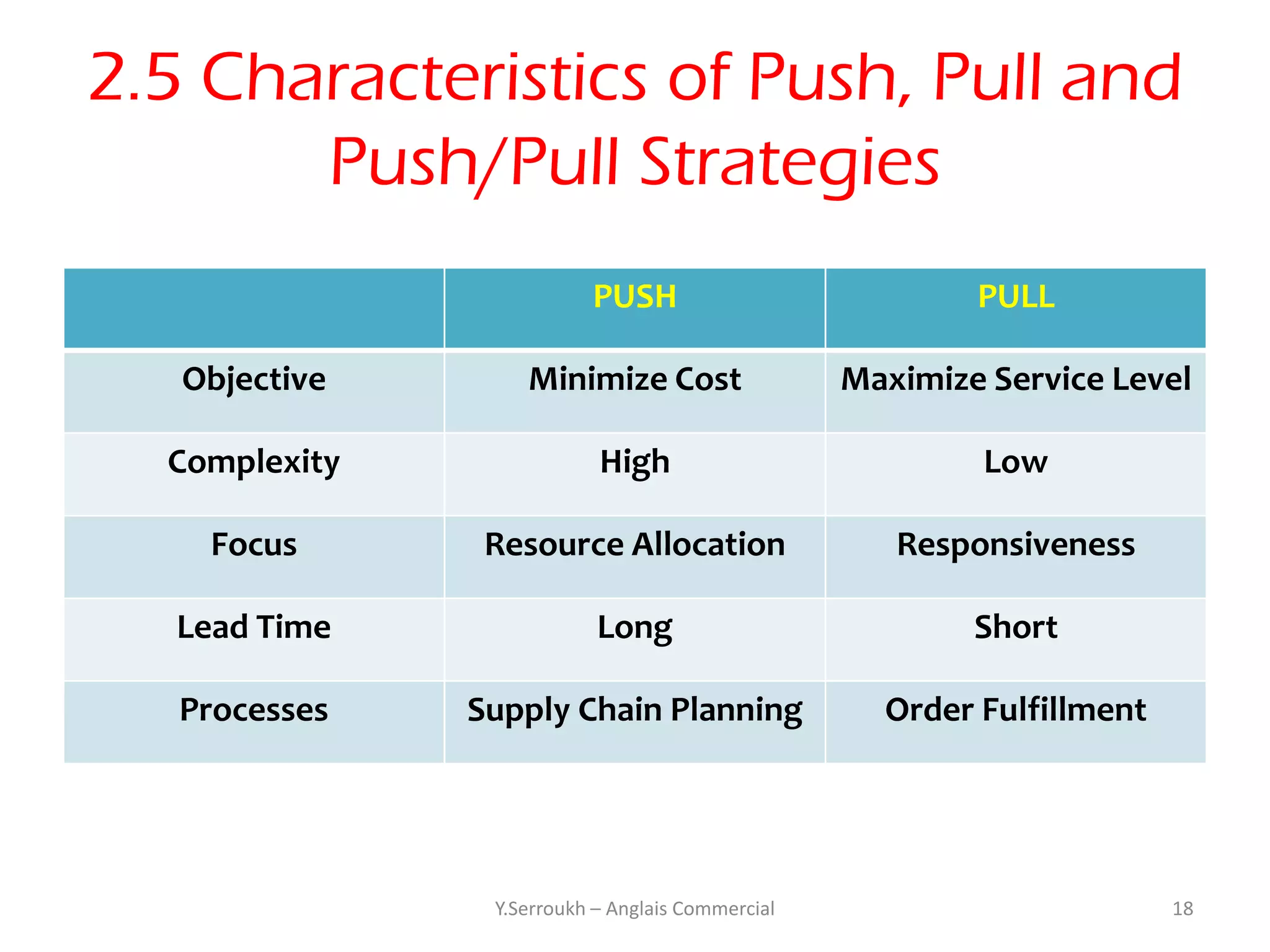
2.5 Characteristics of Push, Pull and
       Push/Pull Strategies
                          PUSH                            PULL

   Objective       Minimize Cost                  Maximize Service Level

  Complexity               High                           Low

    Focus       Resource Allocation                  Responsiveness

   Lead Time               Long                           Short

   Processes   Supply Chain Planning                Order Fulfillment


                Y.Serroukh – Anglais Commercial                         18
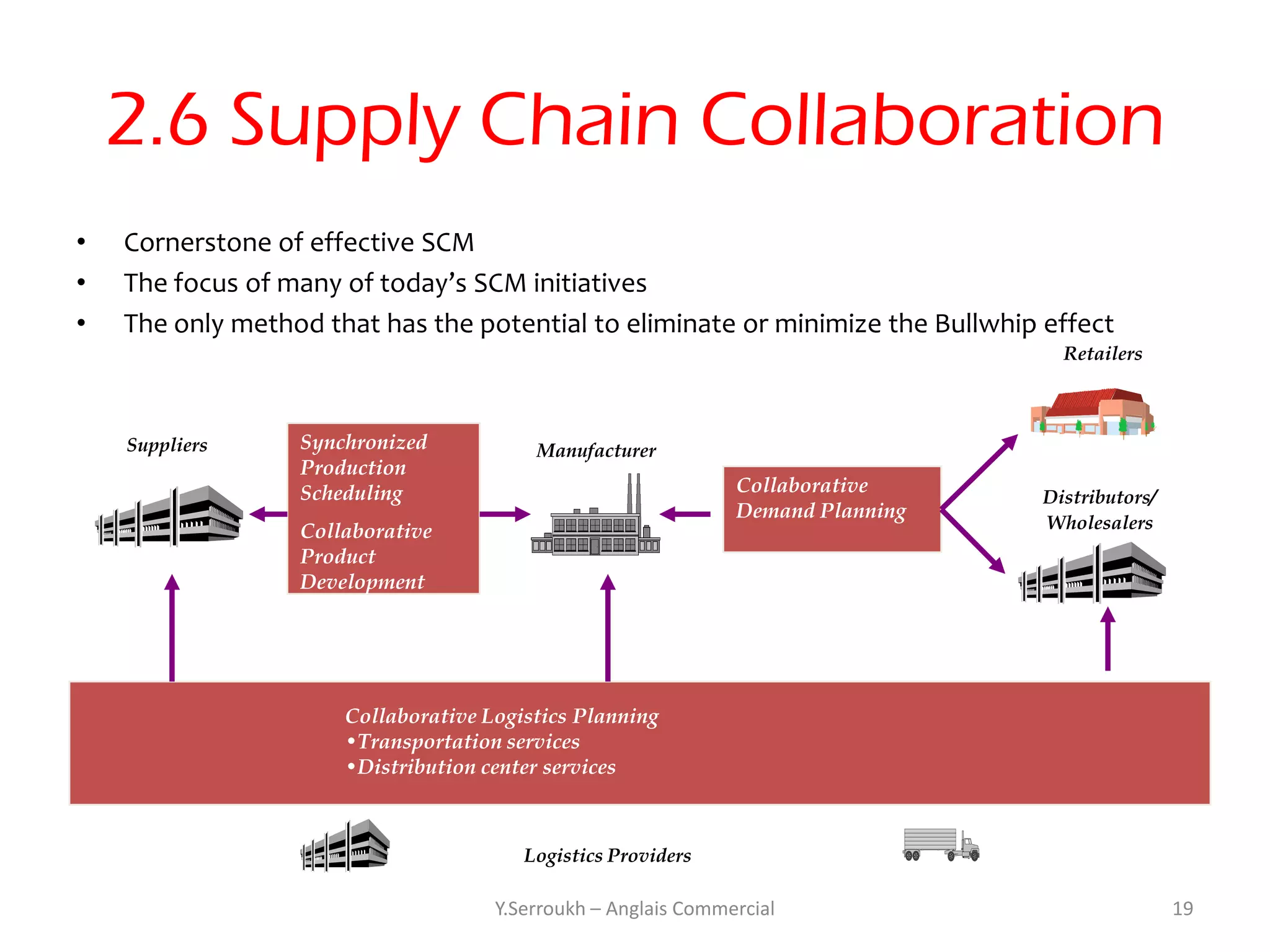
2.6 Supply Chain Collaboration
•   Cornerstone of effective SCM
•   The focus of many of today’s SCM initiatives
•   The only method that has the potential to eliminate or minimize the Bullwhip effect
                                                                                   Retailers


    Suppliers     Synchronized           Manufacturer
                  Production
                  Scheduling                                   Collaborative
                                                                                 Distributors/
                                                               Demand Planning
                  Collaborative                                                  Wholesalers
                  Product
                  Development


                      Collaborative Logistics Planning
                      •Transportation services
                      •Distribution center services


                                        Logistics Providers

                                     Y.Serroukh – Anglais Commercial                             19
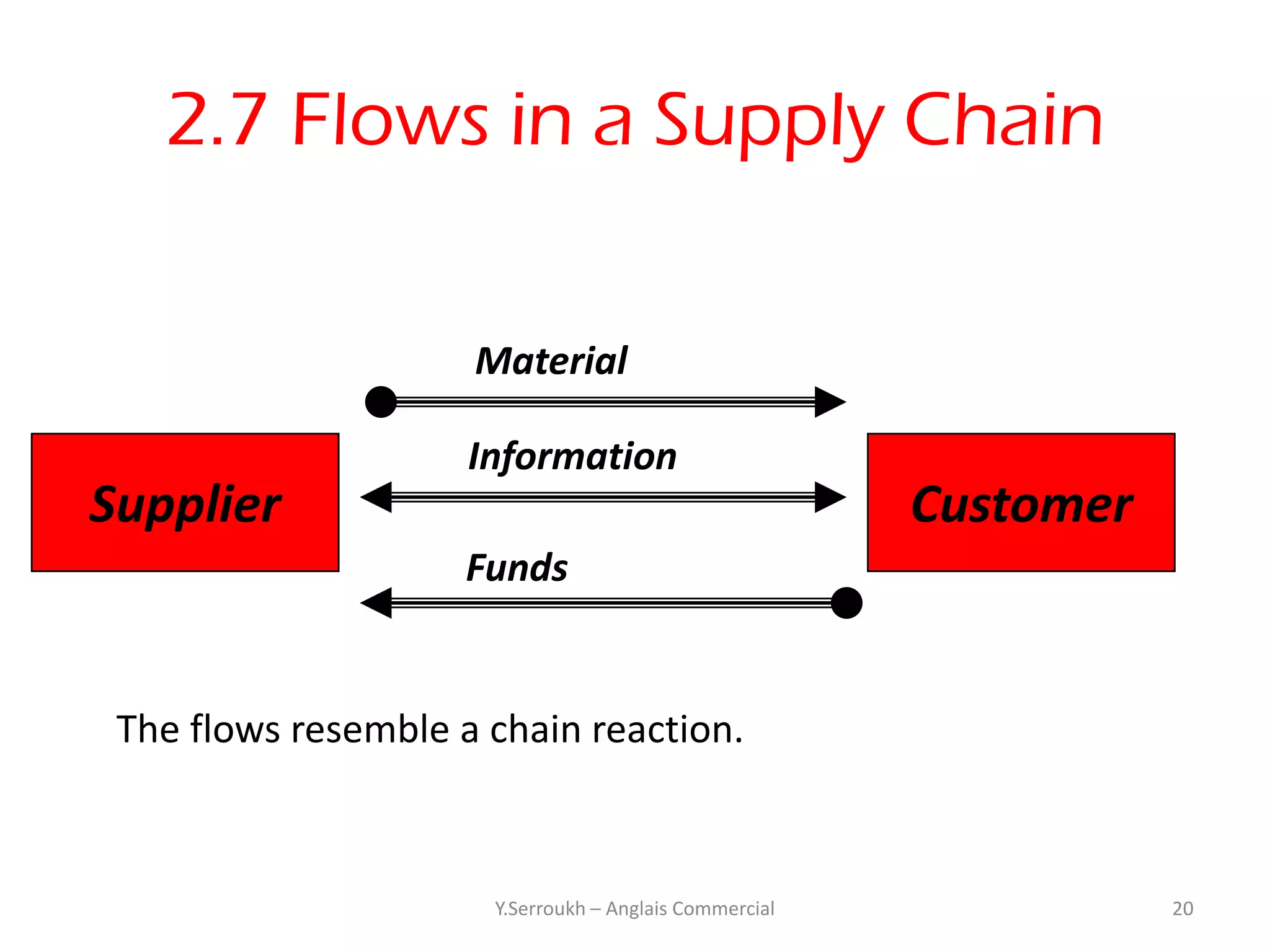
2.7 Flows in a Supply Chain

                     Material

                     Information
Supplier                                                Customer
                     Funds


 The flows resemble a chain reaction.


                      Y.Serroukh – Anglais Commercial              20
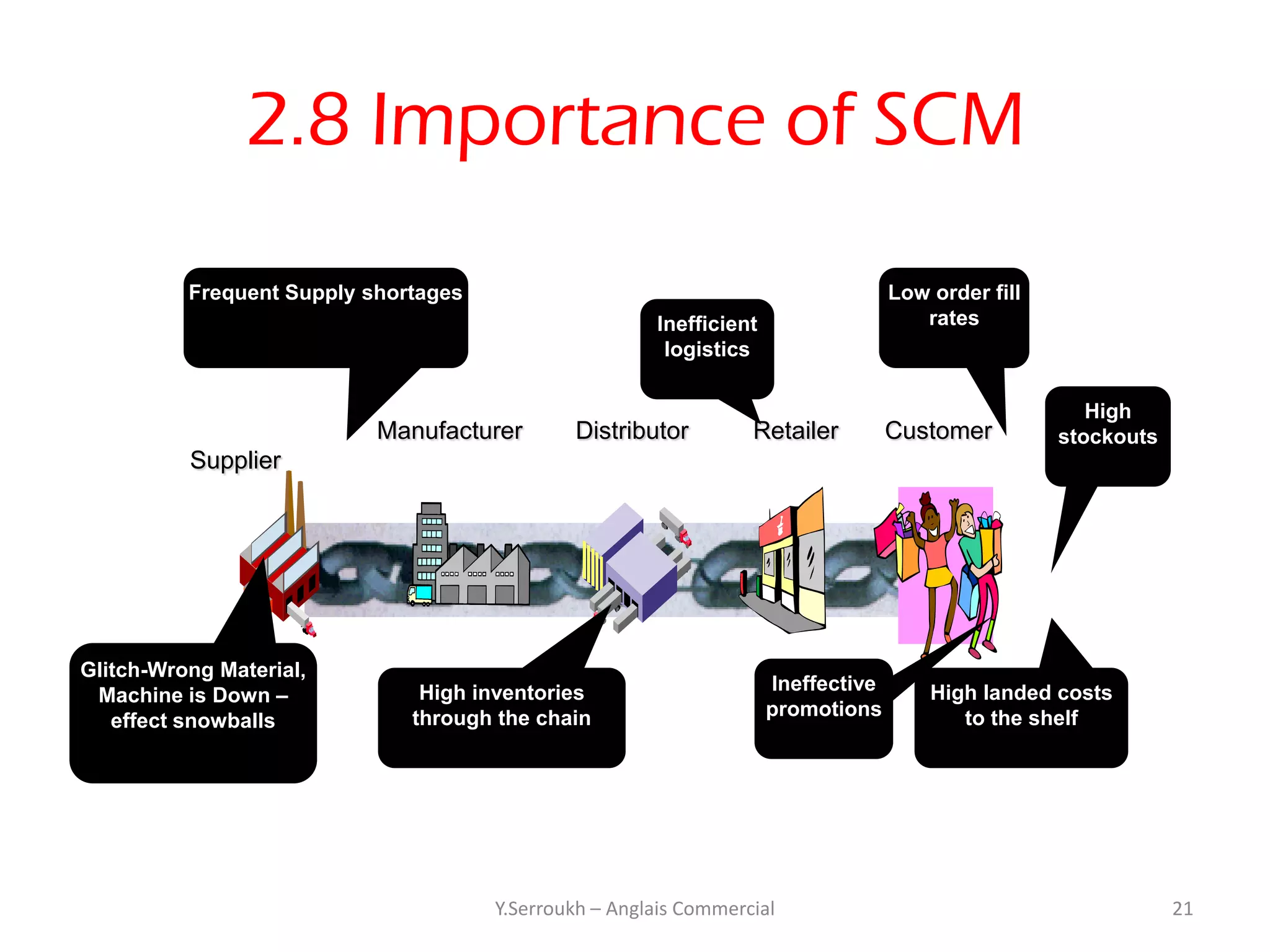
2.8 Importance of SCM
          Frequent Supply shortages                                                Low order fill
                                                       Inefficient                    rates
                                                        logistics

                                                                                                       High
                           Manufacturer       Distributor         Retailer         Customer         stockouts
          Supplier


Glitch-Wrong Material,
                                                                     Ineffective
 Machine is Down –             High inventories                                        High landed costs
                              through the chain                      promotions           to the shelf
   effect snowballs


                                      Y.Serroukh – Anglais Commercial                                           21
Exercise
 1. Match the words (1-6) with correct definition (a-f).

1.Outsourcing
2.comprehensive
3.consolidation
4.requirements
5.demand
6.Competition

a. including a wide range of services.
b. details of what is expected and needed
c. the need for particular goods or services
d. companies trying to sell the same or similar products to customers
e. the grouping of small shipments into one container.
f. contracting functions out to third-party providers

                            Y.Serroukh – Anglais Commercial             22
Thank you for your attention


         Y.Serroukh – Anglais Commercial   23

Basics of Supply Chain Managment

  • 1.
    Business English Logistics & Transportation Engineering Seminar : Basics of Supply Chain Management By Youssef Serroukh 15/11/2011 ~ 22/11/2011 Y.Serroukh – Anglais Commercial 1
  • 2.
    Contents  Part 1What is SCM?  Part 2 The Evolving Supply Chain Y.Serroukh – Anglais Commercial 2
  • 3.
    What is SCM? Y.Serroukh – Anglais Commercial 3
  • 4.
    1.1 Overview ofSupply Chain Supply chain (also called value chain or demand chain), is the network of the involved companies, through upstream and downstream linkages, in the different processes and activities that produce value in the form of products and services in the hands of the ultimate consumer. For example, a shirt manufacturer is a part of a supply chain that goes upstream through the weavers of fabrics to the manufacturers of fibers, and downstream through distributors and retailers to the final consumer. Each of these organizations in the chain is dependent upon each other. Y.Serroukh – Anglais Commercial 4
  • 5.
    1.2 The Definitionof SCM There are various definitions of different edition. But in general, Supply chain management means the management of upstream and downstream relationships with suppliers and customers to deliver superior customer value at less cost to the supply chain as a whole. The supply chain arrangement links a firm and its distributive and supplier network to end customers. The integrated value-creation process must be managed from material procurement to end-customer product delivery. The integrated supply chain management shifts traditional channel arrangements from loosely linked groups of independent businesses that buy and sell inventory to each other toward a coordinated initiative to increase market impact, overall efficiency, continuous improvement, and competitiveness. Y.Serroukh – Anglais Commercial 5
  • 6.
    1.3 The SupplyChain Suppliers Manufacturers Warehouses & Customers Distribution Centers Transportation Transportation Costs Costs Material Costs Transportation Manufacturing Costs Inventory Costs Costs Y.Serroukh – Anglais Commercial 6
  • 7.
    Plan Source Make Deliver Buy • A set of approaches used to efficiently integrate – Suppliers – Manufacturers – Warehouses – Distribution centers • So that the product is produced and distributed – In the right quantities – To the right locations – And at the right time • System-wide costs are minimized • Service level requirements are satisfied Y.Serroukh – Anglais Commercial 7
  • 8.
    1.4 Difficulties • Uncertaintyis inherent to every supply chain – Travel times – Breakdowns of machines and vehicles – Weather, natural catastrophe, war – Local politics, labor conditions, border issues • The complexity of the problem to globally optimize a supply chain is significant – Minimize internal costs – Minimize uncertainty – Deal with remaining uncertainty Y.Serroukh – Anglais Commercial 8
  • 9.
    1.5 History ofSCM • 1960’s - Inventory Management Focus, Cost Control • 1970’s - MRP & BOM - Operations Planning • 1980’s - MRPII, JIT - Materials Management, Logistics • 1990’s - SCM - ERP - “Integrated” Purchasing, Financials, Manufacturing, Order Entry • 2000’s - Optimized “Value Network” with Real-Time Decision Support; Synchronized & Collaborative Extended Network Y.Serroukh – Anglais Commercial 9
  • 10.
    1.6 Reasons forDeveloping Supply Chains  Greater competitive advantage  Greater value to consumers  Reduces the lead time gap  Faster and smaller deliveries to intermediate customers  Introduces the concept of increased shareholder value  These reasons give rise to the notion that in future, we will see supply chains competing with supply chains rather than competition between organizations. Y.Serroukh – Anglais Commercial 10
  • 11.
    1.7 The Goalof SCM Since World War II, with the development of the operations research and management science, there has been an increasing interest in supply chain planning and management. Working together, supply chain planners/managers and all members of the front, middle and back end of the supply chain may enhance revenue, cost control, and asset utilization as well as customer satisfaction. Furthermore, software for optimization has been embraced by all of these parties, as it offers mathematical modeling solutions to supply chain problems. For example, a software package might provide an optimum delivery route of the products, from supplier to manufacture. In conclusion, the goal is to optimize efficiency through supply chain management. Y.Serroukh – Anglais Commercial 11
  • 12.
    1.8 Summary ofSCM  A supply chain consists of Supplier Manufacturer Distributor Retailer Customer Upstream Downstream  aims to Match Supply and Demand, profitably for products and services SUPPLY SIDE DEMAND SIDE  achieves The right Product + + + + + The right Price The right Store The right Quantity The right Customer = The right Time Higher Profits Y.Serroukh – Anglais Commercial 12
  • 13.
    The Evolving SupplyChain Y.Serroukh – Anglais Commercial 13
  • 14.
    2.1 Supply ChainIntegration : Push Strategies • Classical manufacturing supply chain strategy • Manufacturing forecasts are long-range – Orders from retailers’ warehouses • Longer response time to react to marketplace changes – Unable to meet changing demand patterns – Supply chain inventory becomes obsolete as demand for certain products disappears • Increased variability (Bullwhip effect) leading to: – Large inventory safety stocks – Larger and more variably sized production batches – Unacceptable service levels – Inventory obsolescence • Inefficient use of production facilities (factories) – How is demand determined? Peak? Average? – How is transportation capacity determined? • Examples: Auto industry, large appliances, others? Y.Serroukh – Anglais Commercial 14
  • 15.
    2.2 Supply ChainIntegration : Pull Strategies • Production and distribution are demand-driven – Coordinated with true customer demand • None or little inventory held – Only in response to specific orders • Fast information flow mechanisms – POS data • Decreased lead times • Decreased retailer inventory • Decreased variability in the supply chain and especially at manufacturers • Decreased manufacturer inventory • More efficient use of resources • More difficult to take advantage of scale opportunities • Examples: Dell, Amazon Y.Serroukh – Anglais Commercial 15
  • 16.
    2.3 Supply ChainIntegration : Push/Pull Strategies • Hybrid of “push” and “pull” strategies to overcome disadvantages of each • Early stages of product assembly are done in a “push” manner – Partial assembly of product based on aggregate demand forecasts (which are more accurate than individual product demand forecasts) – Uncertainty is reduced so safety stock inventory is lower • Final product assembly is done based on customer demand for specific product configurations • Supply chain timeline determines “push-pull boundary” Push- “Generic” Product Pull “Customized” Product Boundary Push Strategy Pull Strategy Raw End Materials Consumer Supply Chain Timeline Y.Serroukh – Anglais Commercial 16
  • 17.
    2.4 Choosing BetweenPush/Pull Strategies Pull High Industries where: Industries where: Where do the following • Customization is High • Demand is uncertain • Demand is uncertain • Scale economies are High industries fit in this model: Demand Uncertainty • Scale economies are Low • Low economies of scale Computer Furniture • Automobile? equipment • Aircraft? • Fashion? Industries where: Industries where: • Petroleum refining? • Pharmaceuticals? • Uncertainty is low • Standard processes are the • Low economies of scale norm • Biotechnology? • Push-pull supply chain • Demand is stable • Medical Devices? • Scale economies are High Books, CD’s Grocery, Push Low Beverages Low Economies of Scale High Pull Push Y.Serroukh – Anglais Commercial 17
  • 18.
    2.5 Characteristics ofPush, Pull and Push/Pull Strategies PUSH PULL Objective Minimize Cost Maximize Service Level Complexity High Low Focus Resource Allocation Responsiveness Lead Time Long Short Processes Supply Chain Planning Order Fulfillment Y.Serroukh – Anglais Commercial 18
  • 19.
    2.6 Supply ChainCollaboration • Cornerstone of effective SCM • The focus of many of today’s SCM initiatives • The only method that has the potential to eliminate or minimize the Bullwhip effect Retailers Suppliers Synchronized Manufacturer Production Scheduling Collaborative Distributors/ Demand Planning Collaborative Wholesalers Product Development Collaborative Logistics Planning •Transportation services •Distribution center services Logistics Providers Y.Serroukh – Anglais Commercial 19
  • 20.
    2.7 Flows ina Supply Chain Material Information Supplier Customer Funds The flows resemble a chain reaction. Y.Serroukh – Anglais Commercial 20
  • 21.
    2.8 Importance ofSCM Frequent Supply shortages Low order fill Inefficient rates logistics High Manufacturer Distributor Retailer Customer stockouts Supplier Glitch-Wrong Material, Ineffective Machine is Down – High inventories High landed costs through the chain promotions to the shelf effect snowballs Y.Serroukh – Anglais Commercial 21
  • 22.
    Exercise 1. Matchthe words (1-6) with correct definition (a-f). 1.Outsourcing 2.comprehensive 3.consolidation 4.requirements 5.demand 6.Competition a. including a wide range of services. b. details of what is expected and needed c. the need for particular goods or services d. companies trying to sell the same or similar products to customers e. the grouping of small shipments into one container. f. contracting functions out to third-party providers Y.Serroukh – Anglais Commercial 22
  • 23.
    Thank you foryour attention Y.Serroukh – Anglais Commercial 23