1  1
Basics of Supply Chain Management
Introduction to
Supply Chain
Management
Aggregate
Inventory
Management
Demand
Management
Item Inventory
Management
Capacity
Management
and Production
Activity Control
Material
Requirements
Planning
Lean and
Quality
Systems
Master
Planning
Purchasing and
Physical
Distribution
1. 2. 3. 4. 5.
6. 7. 8. 9. 10.
Learning Objectives
• Introduction to Manufacturing
– Describe the components of the manufacturing business model.
– Describe the impact of four significant aspects of the business environment on
manufacturing.
• Manufacturing Planning and Control
– Identify five objectives of manufacturing.
– Describe the concepts of priority and capacity.
– Present an overview of the manufacturing planning and control (MPC)
hierarchy.
– Describe the four steps in the evolution of MRP to ERP.
• The Impact of New Systems and Philosophies
– Present a high-level description of lean, total quality management (TQM), six
sigma.
1  2
1  3
Introduction to Manufacturing
Introduction to Supply Chain Management
1  4
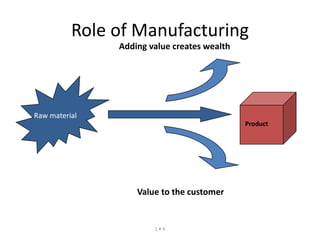
Role of Manufacturing
Product
Adding value creates wealth
Value to the customer
Raw material
1  5
Managing Material Flow
Material
acquisition
Manufacturing
Distribution
1  6
Manufacturing Business Model
• Defining products and customers
• Designing products and processes
• Managing material flow
• Providing customer service and support
1  7
Designing Products and Processes
Meet customer
needs
Cost
effectiveness
Quality
Efficiency
DESIGN
Accommodate
planning
parameters
1  8
Providing Customer Service and Support
• Understanding and meeting customer wants
and needs
• Two-way communication
• Working with customers to solve problems
1  9
Customer Expectations
Characteristics that provide value to the
customer:
• Cost (price)
• Quality
• Speed (order lead time)
• Dependability
• Flexibility (product and volume)
1  10
Manufacturing Environments and Process Choices
Introduction to Supply Chain Management
1  11
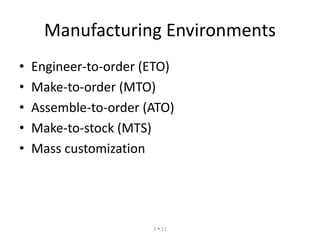
Manufacturing Environments
• Engineer-to-order (ETO)
• Make-to-order (MTO)
• Assemble-to-order (ATO)
• Make-to-stock (MTS)
• Mass customization
1  12
Determinants of Manufacturing
Environments
• Lead time expectations
• Product design input from customers
• Product volume and variety
• Product life cycle
1  13
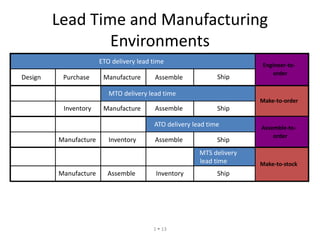
Lead Time and Manufacturing
Environments
Design Purchase Manufacture Ship
Inventory Manufacture Ship
Manufacture Inventory Ship
MTS delivery
lead time
Manufacture Assemble ShipInventory
ETO delivery lead time
MTO delivery lead time
ATO delivery lead time
Assemble
Assemble
Assemble
Engineer-to-
order
Make-to-order
Make-to-stock
Assemble-to-
order
1  14
Volume and Variety Relationships
Product volume
Productvariety
HighLow
High
Engineer-to-order
Make-to-order
Assemble-to-order
Make-to-stock
Mass
customization
1  15
Product Life Cycle
Introduction Growth Maturity Decline Phase-out
Units
sold Time
1  16
Product Life Cycle and Manufacturing
Environments
ETO
MTO
ATO
MTS
Mass customization
Introduction Growth Maturity Decline Phase-out
Units
sold Time
1  17
The Manufacturing Supply Chain
Introduction to Supply Chain Management
1  18
Basic Supply Chain: External
ManufacturerSuppliers Distributors Retailers Consumers
Dominant flow of goods and services
Dominant flow of demand and design information
Dominant flow of cash
Returns and reverse logistics
1  19
Traditional Internal Supply Chain View
Raw materials
Customers
Purchasing Production Distribution
Lowest purchase
price
Inventory buffers
High utilization percent
Long runs (minimal
changeovers)
Low unit costs
Safety stocks
Full truckload
quantities
Best shipping rate
Safety stocks
1  20
Conflicts in Traditional Supply Systems
FinanceMarketing Operations
Inventory investment
Traditional
objective
Customer service
Production efficiency
Increase profit and
cash flow, reduce
investment
Increase revenue and
satisfy customers
Reduce
manufacturing cost
82 5
93 6
71 4
1  21
Role of Materials Management
Demand Resources
1  22
Manufacturing Planning and Control
Introduction to Supply Chain Management
1  23
Why Plan?
• To satisfy customer demand and ensure the
availability of the following resources:
– material
– capacity
Demand Resources
1  24
These are questions of priority and capacity.
A Good Planning and Control System
What must
we get and
when?
1  25
Manufacturing Planning and Control
Order sequencing
Input/output
control
Master scheduling
Capacity
requirements
planning (CRP)
Sales and operations
planning
Strategic and business planning
Resource
planning (RP)
Rough-cut capacity
planning (RCCP)
PriorityplanningExecution
CapacityplanningExecution
Material
requirements
planning (MRP)
Production activity
control (PAC)
1  26
From MRP to ERP
Introduction to Supply Chain Management
Session 1
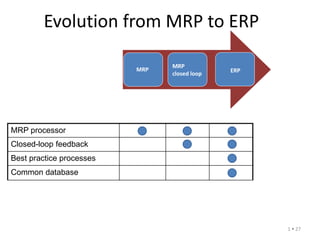
MRP processor
Closed-loop feedback
Best practice processes
Common database
1  27
Evolution from MRP to ERP
MRP
MRP
closed loop
ERP
1  28
The Impact of
New Systems and Philosophies
Introduction to Supply Chain Management
1  29
Impact of New Systems
• Reduced lead times
• Reduced inventory levels
• Improved worker productivity
• Improved product quality
• Cost reductions
• Increased profitability
TOCLean
TQM
Six sigma

Introduction to supply chain management

  • 1.
    1  1 Basicsof Supply Chain Management Introduction to Supply Chain Management Aggregate Inventory Management Demand Management Item Inventory Management Capacity Management and Production Activity Control Material Requirements Planning Lean and Quality Systems Master Planning Purchasing and Physical Distribution 1. 2. 3. 4. 5. 6. 7. 8. 9. 10.
  • 2.
    Learning Objectives • Introductionto Manufacturing – Describe the components of the manufacturing business model. – Describe the impact of four significant aspects of the business environment on manufacturing. • Manufacturing Planning and Control – Identify five objectives of manufacturing. – Describe the concepts of priority and capacity. – Present an overview of the manufacturing planning and control (MPC) hierarchy. – Describe the four steps in the evolution of MRP to ERP. • The Impact of New Systems and Philosophies – Present a high-level description of lean, total quality management (TQM), six sigma. 1  2
  • 3.
    1  3 Introductionto Manufacturing Introduction to Supply Chain Management
  • 4.
    1  4 Roleof Manufacturing Product Adding value creates wealth Value to the customer Raw material
  • 5.
    1  5 ManagingMaterial Flow Material acquisition Manufacturing Distribution
  • 6.
    1  6 ManufacturingBusiness Model • Defining products and customers • Designing products and processes • Managing material flow • Providing customer service and support
  • 7.
    1  7 DesigningProducts and Processes Meet customer needs Cost effectiveness Quality Efficiency DESIGN Accommodate planning parameters
  • 8.
    1  8 ProvidingCustomer Service and Support • Understanding and meeting customer wants and needs • Two-way communication • Working with customers to solve problems
  • 9.
    1  9 CustomerExpectations Characteristics that provide value to the customer: • Cost (price) • Quality • Speed (order lead time) • Dependability • Flexibility (product and volume)
  • 10.
    1  10 ManufacturingEnvironments and Process Choices Introduction to Supply Chain Management
  • 11.
    1  11 ManufacturingEnvironments • Engineer-to-order (ETO) • Make-to-order (MTO) • Assemble-to-order (ATO) • Make-to-stock (MTS) • Mass customization
  • 12.
    1  12 Determinantsof Manufacturing Environments • Lead time expectations • Product design input from customers • Product volume and variety • Product life cycle
  • 13.
    1  13 LeadTime and Manufacturing Environments Design Purchase Manufacture Ship Inventory Manufacture Ship Manufacture Inventory Ship MTS delivery lead time Manufacture Assemble ShipInventory ETO delivery lead time MTO delivery lead time ATO delivery lead time Assemble Assemble Assemble Engineer-to- order Make-to-order Make-to-stock Assemble-to- order
  • 14.
    1  14 Volumeand Variety Relationships Product volume Productvariety HighLow High Engineer-to-order Make-to-order Assemble-to-order Make-to-stock Mass customization
  • 15.
    1  15 ProductLife Cycle Introduction Growth Maturity Decline Phase-out Units sold Time
  • 16.
    1  16 ProductLife Cycle and Manufacturing Environments ETO MTO ATO MTS Mass customization Introduction Growth Maturity Decline Phase-out Units sold Time
  • 17.
    1  17 TheManufacturing Supply Chain Introduction to Supply Chain Management
  • 18.
    1  18 BasicSupply Chain: External ManufacturerSuppliers Distributors Retailers Consumers Dominant flow of goods and services Dominant flow of demand and design information Dominant flow of cash Returns and reverse logistics
  • 19.
    1  19 TraditionalInternal Supply Chain View Raw materials Customers Purchasing Production Distribution Lowest purchase price Inventory buffers High utilization percent Long runs (minimal changeovers) Low unit costs Safety stocks Full truckload quantities Best shipping rate Safety stocks
  • 20.
    1  20 Conflictsin Traditional Supply Systems FinanceMarketing Operations Inventory investment Traditional objective Customer service Production efficiency Increase profit and cash flow, reduce investment Increase revenue and satisfy customers Reduce manufacturing cost 82 5 93 6 71 4
  • 21.
    1  21 Roleof Materials Management Demand Resources
  • 22.
    1  22 ManufacturingPlanning and Control Introduction to Supply Chain Management
  • 23.
    1  23 WhyPlan? • To satisfy customer demand and ensure the availability of the following resources: – material – capacity Demand Resources
  • 24.
    1  24 Theseare questions of priority and capacity. A Good Planning and Control System What must we get and when?
  • 25.
    1  25 ManufacturingPlanning and Control Order sequencing Input/output control Master scheduling Capacity requirements planning (CRP) Sales and operations planning Strategic and business planning Resource planning (RP) Rough-cut capacity planning (RCCP) PriorityplanningExecution CapacityplanningExecution Material requirements planning (MRP) Production activity control (PAC)
  • 26.
    1  26 FromMRP to ERP Introduction to Supply Chain Management Session 1
  • 27.
    MRP processor Closed-loop feedback Bestpractice processes Common database 1  27 Evolution from MRP to ERP MRP MRP closed loop ERP
  • 28.
    1  28 TheImpact of New Systems and Philosophies Introduction to Supply Chain Management
  • 29.
    1  29 Impactof New Systems • Reduced lead times • Reduced inventory levels • Improved worker productivity • Improved product quality • Cost reductions • Increased profitability TOCLean TQM Six sigma