LOGO
Different project types and why is it
important to know
MP01: Projects - Concepts, Types,
Cases Context and Organization
LOGO
Contents
Click to add Title1 Short Term vs. Long Term Projects1
Click to add Title2 Large, Medium and Small Projects2
Click to add Title1 Classification of projects by type
and area3
Click to add Title2 Sequential vs. Parallel Projects4
Click to add Title1 External vs. Internal Projects
5
Click to add Title2
Why is it important to know
different project types?6
2
LOGO
Short Term vs. Long Term Projects
3
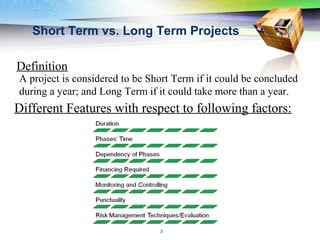
Definition
A project is considered to be Short Term if it could be concluded
during a year; and Long Term if it could take more than a year.
Different Features with respect to following factors:
LOGO
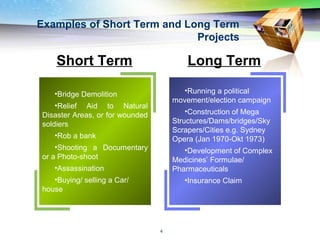
Examples of Short Term and Long Term
Projects
4
•Bridge Demolition
•Relief Aid to Natural
Disaster Areas, or for wounded
soldiers
•Rob a bank
•Shooting a Documentary
or a Photo-shoot
•Assassination
•Buying/ selling a Car/
house
•Running a political
movement/election campaign
•Construction of Mega
Structures/Dams/bridges/Sky
Scrapers/Cities e.g. Sydney
Opera (Jan 1970-Okt 1973)
•Development of Complex
Medicines’ Formulae/
Pharmaceuticals
•Insurance Claim
Short Term Long Term
LOGO
Large, Medium and Small Projects
5
The Projects are
categorized as
Large, Medium
and Small on the
basis of the
following:
1Total financial resources available
2 Number of team members involved
3Number and size of deliverables to be produced
4 Complexity of deliverables to be produced
5Timeframes involved in delivery
LOGO
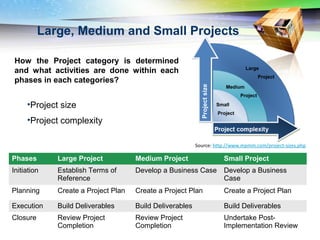
Large, Medium and Small Projects
Large
Project
Large
Project
Medium
Project
Medium
Project
Small
Project
Small
Project
ProjectsizeProjectsize
6
Phases Large Project Medium Project Small Project
Initiation Establish Terms of
Reference
Develop a Business Case Develop a Business
Case
Planning Create a Project Plan Create a Project Plan Create a Project Plan
Execution Build Deliverables Build Deliverables Build Deliverables
Closure Review Project
Completion
Review Project
Completion
Undertake Post-
Implementation Review
How the Project category is determined
and what activities are done within each
phases in each categories?
•Project size
•Project complexity
Source: http://www.mpmm.com/project-sizes.php
LOGO
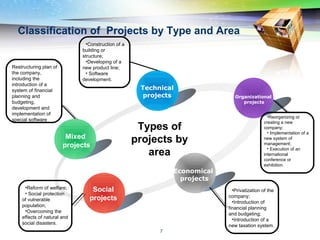
Classification of Projects by Type and Area
7
Mixed
projects
Technical
projects Organizational
projects
Economical
projects
Social
projects
Types of
projects by
area
•Privatization of the
company;
•Introduction of
financial planning
and budgeting;
•Introduction of a
new taxation system.
•Construction of a
building or
structure;
•Developing of a
new product line;
• Software
development.
•Reorganizing or
creating a new
company;
• Implementation of a
new system of
management;
• Execution of an
international
conference or
exhibition.
•Reform of welfare;
• Social protection
of vulnerable
population;
•Overcoming the
effects of natural and
social disasters.
Restructuring plan of
the company,
including the
introduction of a
system of financial
planning and
budgeting,
development and
implementation of
special software
LOGO
Sequential vs. Parallel Projects
8
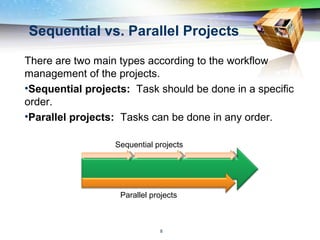
There are two main types according to the workflow
management of the projects.
•Sequential projects: Task should be done in a specific
order.
•Parallel projects: Tasks can be done in any order.
Sequential projects
Parallel projects
LOGO
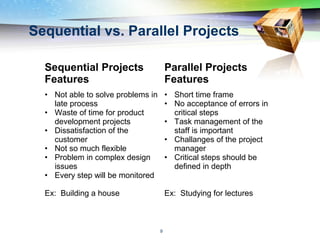
Sequential vs. Parallel Projects
9
Sequential Projects
Features
Parallel Projects
Features
• Not able to solve problems in
late process
• Waste of time for product
development projects
• Dissatisfaction of the
customer
• Not so much flexible
• Problem in complex design
issues
• Every step will be monitored
Ex: Building a house
• Short time frame
• No acceptance of errors in
critical steps
• Task management of the
staff is important
• Challanges of the project
manager
• Critical steps should be
defined in depth
Ex: Studying for lectures
LOGO
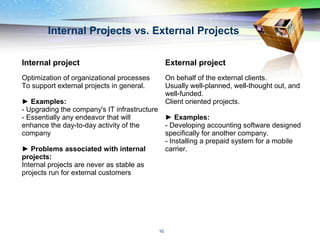
Internal Projects vs. External Projects
10
Internal project External project
Optimization of organizational processes
To support external projects in general.
► Examples:
- Upgrading the company's IT infrastructure
- Essentially any endeavor that will
enhance the day-to-day activity of the
company
► Problems associated with internal
projects:
Internal projects are never as stable as
projects run for external customers
On behalf of the external clients.
Usually well-planned, well-thought out, and
well-funded.
Client oriented projects.
► Examples:
- Developing accounting software designed
specifically for another company.
- Installing a prepaid system for a mobile
carrier.
LOGO
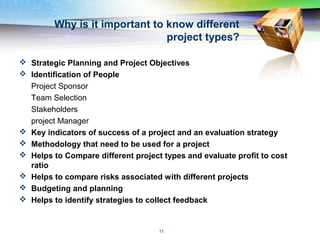
Why is it important to know different
project types?
11
 Strategic Planning and Project Objectives
 Identification of People
Project Sponsor
Team Selection
Stakeholders
project Manager
 Key indicators of success of a project and an evaluation strategy
 Methodology that need to be used for a project
 Helps to Compare different project types and evaluate profit to cost
ratio
 Helps to compare risks associated with different projects
 Budgeting and planning
 Helps to identify strategies to collect feedback
LOGO

Project Types and their importance

  • 1.
    LOGO Different project typesand why is it important to know MP01: Projects - Concepts, Types, Cases Context and Organization
  • 2.
    LOGO Contents Click to addTitle1 Short Term vs. Long Term Projects1 Click to add Title2 Large, Medium and Small Projects2 Click to add Title1 Classification of projects by type and area3 Click to add Title2 Sequential vs. Parallel Projects4 Click to add Title1 External vs. Internal Projects 5 Click to add Title2 Why is it important to know different project types?6 2
  • 3.
    LOGO Short Term vs.Long Term Projects 3 Definition A project is considered to be Short Term if it could be concluded during a year; and Long Term if it could take more than a year. Different Features with respect to following factors:
  • 4.
    LOGO Examples of ShortTerm and Long Term Projects 4 •Bridge Demolition •Relief Aid to Natural Disaster Areas, or for wounded soldiers •Rob a bank •Shooting a Documentary or a Photo-shoot •Assassination •Buying/ selling a Car/ house •Running a political movement/election campaign •Construction of Mega Structures/Dams/bridges/Sky Scrapers/Cities e.g. Sydney Opera (Jan 1970-Okt 1973) •Development of Complex Medicines’ Formulae/ Pharmaceuticals •Insurance Claim Short Term Long Term
  • 5.
    LOGO Large, Medium andSmall Projects 5 The Projects are categorized as Large, Medium and Small on the basis of the following: 1Total financial resources available 2 Number of team members involved 3Number and size of deliverables to be produced 4 Complexity of deliverables to be produced 5Timeframes involved in delivery
  • 6.
    LOGO Large, Medium andSmall Projects Large Project Large Project Medium Project Medium Project Small Project Small Project ProjectsizeProjectsize 6 Phases Large Project Medium Project Small Project Initiation Establish Terms of Reference Develop a Business Case Develop a Business Case Planning Create a Project Plan Create a Project Plan Create a Project Plan Execution Build Deliverables Build Deliverables Build Deliverables Closure Review Project Completion Review Project Completion Undertake Post- Implementation Review How the Project category is determined and what activities are done within each phases in each categories? •Project size •Project complexity Source: http://www.mpmm.com/project-sizes.php
  • 7.
    LOGO Classification of Projectsby Type and Area 7 Mixed projects Technical projects Organizational projects Economical projects Social projects Types of projects by area •Privatization of the company; •Introduction of financial planning and budgeting; •Introduction of a new taxation system. •Construction of a building or structure; •Developing of a new product line; • Software development. •Reorganizing or creating a new company; • Implementation of a new system of management; • Execution of an international conference or exhibition. •Reform of welfare; • Social protection of vulnerable population; •Overcoming the effects of natural and social disasters. Restructuring plan of the company, including the introduction of a system of financial planning and budgeting, development and implementation of special software
  • 8.
    LOGO Sequential vs. ParallelProjects 8 There are two main types according to the workflow management of the projects. •Sequential projects: Task should be done in a specific order. •Parallel projects: Tasks can be done in any order. Sequential projects Parallel projects
  • 9.
    LOGO Sequential vs. ParallelProjects 9 Sequential Projects Features Parallel Projects Features • Not able to solve problems in late process • Waste of time for product development projects • Dissatisfaction of the customer • Not so much flexible • Problem in complex design issues • Every step will be monitored Ex: Building a house • Short time frame • No acceptance of errors in critical steps • Task management of the staff is important • Challanges of the project manager • Critical steps should be defined in depth Ex: Studying for lectures
  • 10.
    LOGO Internal Projects vs.External Projects 10 Internal project External project Optimization of organizational processes To support external projects in general. ► Examples: - Upgrading the company's IT infrastructure - Essentially any endeavor that will enhance the day-to-day activity of the company ► Problems associated with internal projects: Internal projects are never as stable as projects run for external customers On behalf of the external clients. Usually well-planned, well-thought out, and well-funded. Client oriented projects. ► Examples: - Developing accounting software designed specifically for another company. - Installing a prepaid system for a mobile carrier.
  • 11.
    LOGO Why is itimportant to know different project types? 11  Strategic Planning and Project Objectives  Identification of People Project Sponsor Team Selection Stakeholders project Manager  Key indicators of success of a project and an evaluation strategy  Methodology that need to be used for a project  Helps to Compare different project types and evaluate profit to cost ratio  Helps to compare risks associated with different projects  Budgeting and planning  Helps to identify strategies to collect feedback
  • 12.