Just-In-Time (JIT) Manufacturing:
What? Where? When?
Rahul Iyer, ASQ CQE
October 2015
Mesa AZ USA
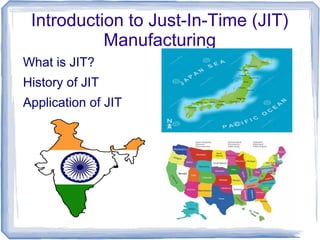
Introduction to Just-In-Time (JIT)
Manufacturing
What is JIT?
History of JIT
Application of JIT
What is JIT?

JIT-Just In Time Manufacturing-a methodology aimed
primarily at reducing flow times within production as well
as response times from suppliers and to customers

Can be attributed to Toyota Production Systems
(TPS), and Lean Manufacturing methodology

Can include the use of kanban:

a Japanese manufacturing system in which the
supply of components is regulated through the
use of a card displaying a sequence of
specifications and instructions, sent along the
production line.

Components and goods do not “sit around” too long in
holding area waiting for next step in process
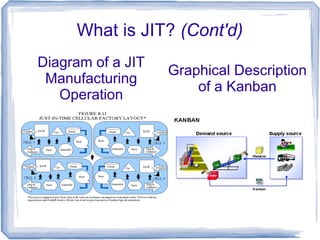
What is JIT? (Cont'd)
Graphical Description
of a Kanban
Diagram of a JIT
Manufacturing
Operation
History of JIT
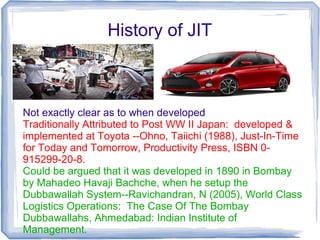
Not exactly clear as to when developed
Traditionally Attributed to Post WW II Japan: developed &
implemented at Toyota --Ohno, Taiichi (1988), Just-In-Time
for Today and Tomorrow, Productivity Press, ISBN 0-
915299-20-8.
Could be argued that it was developed in 1890 in Bombay
by Mahadeo Havaji Bachche, when he setup the
Dubbawallah System--Ravichandran, N (2005), World Class
Logistics Operations: The Case Of The Bombay
Dubbawallahs, Ahmedabad: Indian Institute of
Management.
History of JIT
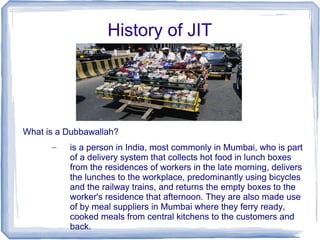
What is a Dubbawallah?
– is a person in India, most commonly in Mumbai, who is part
of a delivery system that collects hot food in lunch boxes
from the residences of workers in the late morning, delivers
the lunches to the workplace, predominantly using bicycles
and the railway trains, and returns the empty boxes to the
worker's residence that afternoon. They are also made use
of by meal suppliers in Mumbai where they ferry ready,
cooked meals from central kitchens to the customers and
back.
Application of JIT

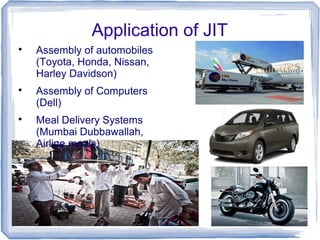
Assembly of automobiles
(Toyota, Honda, Nissan,
Harley Davidson)

Assembly of Computers
(Dell)

Meal Delivery Systems
(Mumbai Dubbawallah,
Airline meals)
Conclusion

JIT-Just In Time Manufacturing is a methodology that
has been adopted across many industries

It helps to reduce waste & many techniques have been
applied for it

It is not a new idea, dating back to the 1890s in India, or
Post WW II in Japan

It is increasingly becoming part of our lives each day.

What is Just In Time (JIT) Manufacturing?

  • 1.
    Just-In-Time (JIT) Manufacturing: What?Where? When? Rahul Iyer, ASQ CQE October 2015 Mesa AZ USA
  • 2.
    Introduction to Just-In-Time(JIT) Manufacturing What is JIT? History of JIT Application of JIT
  • 3.
    What is JIT?  JIT-JustIn Time Manufacturing-a methodology aimed primarily at reducing flow times within production as well as response times from suppliers and to customers  Can be attributed to Toyota Production Systems (TPS), and Lean Manufacturing methodology  Can include the use of kanban:  a Japanese manufacturing system in which the supply of components is regulated through the use of a card displaying a sequence of specifications and instructions, sent along the production line.  Components and goods do not “sit around” too long in holding area waiting for next step in process
  • 4.
    What is JIT?(Cont'd) Graphical Description of a Kanban Diagram of a JIT Manufacturing Operation
  • 5.
    History of JIT Notexactly clear as to when developed Traditionally Attributed to Post WW II Japan: developed & implemented at Toyota --Ohno, Taiichi (1988), Just-In-Time for Today and Tomorrow, Productivity Press, ISBN 0- 915299-20-8. Could be argued that it was developed in 1890 in Bombay by Mahadeo Havaji Bachche, when he setup the Dubbawallah System--Ravichandran, N (2005), World Class Logistics Operations: The Case Of The Bombay Dubbawallahs, Ahmedabad: Indian Institute of Management.
  • 6.
    History of JIT Whatis a Dubbawallah? – is a person in India, most commonly in Mumbai, who is part of a delivery system that collects hot food in lunch boxes from the residences of workers in the late morning, delivers the lunches to the workplace, predominantly using bicycles and the railway trains, and returns the empty boxes to the worker's residence that afternoon. They are also made use of by meal suppliers in Mumbai where they ferry ready, cooked meals from central kitchens to the customers and back.
  • 7.
    Application of JIT  Assemblyof automobiles (Toyota, Honda, Nissan, Harley Davidson)  Assembly of Computers (Dell)  Meal Delivery Systems (Mumbai Dubbawallah, Airline meals)
  • 8.
    Conclusion  JIT-Just In TimeManufacturing is a methodology that has been adopted across many industries  It helps to reduce waste & many techniques have been applied for it  It is not a new idea, dating back to the 1890s in India, or Post WW II in Japan  It is increasingly becoming part of our lives each day.