UNIT-1
SUPPLY CHAIN MANAGEMENT
Definition
Facilities, activities, associated with flow and transformation
of goods and services from raw material to customer as well
as information flows.
It is the management of the flow of goods
It includes the movement and storage of raw materials,
work-in-process inventory, and finished goods from point of
origin to consumption.
Process
Procurement
Production
Distribution
Drivers in SCM
Production
Inventory
Location
Transportation
Information
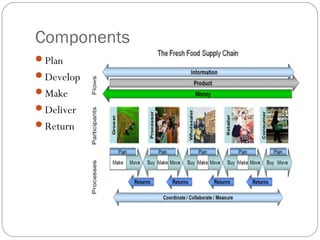
Components
Plan
Develop
Make
Deliver
Return
Flows in a supply chain
Customer
Information
Product
Funds
Key Observations
Integrated activity:
* Among functions such as logistics, manufacturing, distribution,
design/engineering, marketing, finance,etc.
* Multiple organizations,i.e., suppliers, customers& 3 PL providers
* Coordination of conflicting goals, metrics, etc.
Responsible for multiple flows:
* Information (orders, status, contracts)
* Physical (finished goods, raw material, w.i.p.)
* Financial (payment, credits, etc.)
Key Observations (continued)
Most analysis involves trade-offs
* Across different entities
* Across metrics: Cost, Service, Time, Risk, etc.
Each interface in the supply chain represents
* Movement of goods
* Information flows
* Transfer of title
* Purchase and sale
Features
Inventory Management
Technology
End to End operations
Maximize cost productivity
Increase productivity
Order management
Logistics
Forecasting and planning
Strategic Issues
Effects of Globalization
Issues of Infrastructure
Mergers, Acquisition and Alliances
Safety and Security
Leveraging Human Capital
Responding to customers
Exploiting technology.
SCM Current Scenario
Pre and Post modelling
Pre and Post practising
Outline
Supply-Chain Management of “Yesterday”
How Modeled
How Practiced
Supply-Chain Management of “Today”
How Practiced
How Modeled
SCM Practice of “Yesterday”
Single-Owner Chains Took a Centralized Perspective
Single Objective Function: F(x1, x2, x3, ...)
De-Centralized Decision-Making
Information: Not Available or, at best, “Asymmetric”
Implementation: De-Centralized; NOT Contractible
Examples
USAF Logistics Command Consumable Inventory System
IBM Service-Parts Inventory System
“Yesterday’s” Relationship:
“Mismatched”
Models
Too Specialized
Required More Information than Practice Had
Practice
Inexperienced with Models & Computers
Confused by Models
SCM Practice “Today”
The Beginnings of “Real” SCM for Single-Owner Chains
Ex: Wal-Mart’s, Tesco and ASDA Retail Link
Target’s Partners OnLine
Capabilities
Broadcast SKU-level Data Across the Chain
Observe Status ==> Implemetation “Contractible”
Results
Huge Reductions in Buffers ==> Lower Operating Costs
Improved Competitiveness
 Lower Prices
 More Customization
 Higher Availability
Development of Technologies to Support Multiple-Owner SCM
 Internet is Providing Experience
 E-Markets
 Providing Buyer-Supplier Linkages
 Data Standardization.
Using simple models based on “pull down” menus in ERP systems
Value Chain Management
VCM is also concerned the flow of goods to consumers but
takes a different approach
Consumer to source
Value chain managers are typically responsible to analysing
issues and providing in order to maximize value created for a
business.
Activities in VCM
Primary
-Logistics
-Production
Secondary
-HR
-Marketing
-IT
CRM-Definition
“The approach of identifying, Establishing, Maintaining and
enhancing lasting relationships with customers”
“Formation of bonds between a company and its customers”
“An Integrated approach to identifying, acquiring and
maintaining customers”
History
1980’s-Database Marketing Emerges
1980’s-Database helped larger organization rather than small
who only go survey type info
1990’s-CRM appears as a two way communication device
1990’s-CRM leads to programs such frequent flyer miles and
bonus points on credit cards
2000’s to till now-Internet has helped expand from stagnant
and database and allows offsite information storage
CRM what it does?
Builds a Database that describes the customer and the
relationship they hold with the company.
Benefits of CRM
Decrease cost of customer
Increase sales
Increase efficiencies
Better and more accurate data
Data security
TOP CRM Manufactures and its Products
1.Microst-Microsoft Dynamics CRM 3.0
2.SAP America-SAP Business One.
3.Sage Software-Saleslogix CRM
4.Parature Inc-Parature
5.Entellium CRM-Entellium

Unit 1 Supply Chain management

  • 1.
  • 2.
    Definition Facilities, activities, associatedwith flow and transformation of goods and services from raw material to customer as well as information flows. It is the management of the flow of goods It includes the movement and storage of raw materials, work-in-process inventory, and finished goods from point of origin to consumption.
  • 3.
  • 4.
  • 5.
  • 6.
    Flows in asupply chain Customer Information Product Funds
  • 7.
    Key Observations Integrated activity: *Among functions such as logistics, manufacturing, distribution, design/engineering, marketing, finance,etc. * Multiple organizations,i.e., suppliers, customers& 3 PL providers * Coordination of conflicting goals, metrics, etc. Responsible for multiple flows: * Information (orders, status, contracts) * Physical (finished goods, raw material, w.i.p.) * Financial (payment, credits, etc.)
  • 8.
    Key Observations (continued) Mostanalysis involves trade-offs * Across different entities * Across metrics: Cost, Service, Time, Risk, etc. Each interface in the supply chain represents * Movement of goods * Information flows * Transfer of title * Purchase and sale
  • 9.
    Features Inventory Management Technology End toEnd operations Maximize cost productivity Increase productivity Order management Logistics Forecasting and planning
  • 10.
    Strategic Issues Effects ofGlobalization Issues of Infrastructure Mergers, Acquisition and Alliances Safety and Security Leveraging Human Capital Responding to customers Exploiting technology.
  • 11.
    SCM Current Scenario Preand Post modelling Pre and Post practising
  • 12.
    Outline Supply-Chain Management of“Yesterday” How Modeled How Practiced Supply-Chain Management of “Today” How Practiced How Modeled
  • 13.
    SCM Practice of“Yesterday” Single-Owner Chains Took a Centralized Perspective Single Objective Function: F(x1, x2, x3, ...) De-Centralized Decision-Making Information: Not Available or, at best, “Asymmetric” Implementation: De-Centralized; NOT Contractible Examples USAF Logistics Command Consumable Inventory System IBM Service-Parts Inventory System
  • 14.
    “Yesterday’s” Relationship: “Mismatched” Models Too Specialized RequiredMore Information than Practice Had Practice Inexperienced with Models & Computers Confused by Models
  • 15.
    SCM Practice “Today” TheBeginnings of “Real” SCM for Single-Owner Chains Ex: Wal-Mart’s, Tesco and ASDA Retail Link Target’s Partners OnLine Capabilities Broadcast SKU-level Data Across the Chain Observe Status ==> Implemetation “Contractible”
  • 16.
    Results Huge Reductions inBuffers ==> Lower Operating Costs Improved Competitiveness  Lower Prices  More Customization  Higher Availability Development of Technologies to Support Multiple-Owner SCM  Internet is Providing Experience  E-Markets  Providing Buyer-Supplier Linkages  Data Standardization. Using simple models based on “pull down” menus in ERP systems
  • 17.
    Value Chain Management VCMis also concerned the flow of goods to consumers but takes a different approach Consumer to source Value chain managers are typically responsible to analysing issues and providing in order to maximize value created for a business.
  • 18.
  • 19.
    CRM-Definition “The approach ofidentifying, Establishing, Maintaining and enhancing lasting relationships with customers” “Formation of bonds between a company and its customers” “An Integrated approach to identifying, acquiring and maintaining customers”
  • 20.
    History 1980’s-Database Marketing Emerges 1980’s-Databasehelped larger organization rather than small who only go survey type info 1990’s-CRM appears as a two way communication device 1990’s-CRM leads to programs such frequent flyer miles and bonus points on credit cards 2000’s to till now-Internet has helped expand from stagnant and database and allows offsite information storage
  • 21.
    CRM what itdoes? Builds a Database that describes the customer and the relationship they hold with the company.
  • 22.
    Benefits of CRM Decreasecost of customer Increase sales Increase efficiencies Better and more accurate data Data security
  • 23.
    TOP CRM Manufacturesand its Products 1.Microst-Microsoft Dynamics CRM 3.0 2.SAP America-SAP Business One. 3.Sage Software-Saleslogix CRM 4.Parature Inc-Parature 5.Entellium CRM-Entellium