Prepared by
Nilay Patel
• Introduction
• Terms connected with magnetic
materials
• Classification with Properties
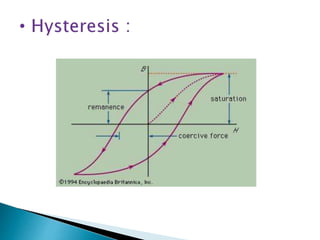
• Hysteresis
• Applications
• Magnetic Materials are those materials in
which a state of magnetization can be
induced.
• Such materials when magnetized create a
magnetic field in the surrounding space.
• Magnetic force
• Magnetic flux density
• Magnetic field strength
• Relative permeability
• Absolute permeability
• Remanance
• Retentivity
• Curie temperature (Tc)
• Hysteresis loop & losses
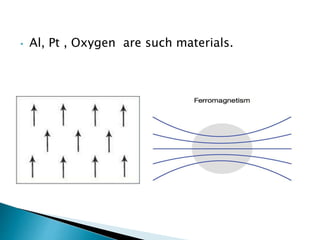
• Ferromagnetic
• Paramagnetic
• Diamagnetic
• Magnetically Soft material
• Magnetically Hard material
• A type of material that is highly attracted to
magnets and can become permanently
magnetized is called as ferromagnetic.
• The relative permeability is much greater than
unity and are dependent on the field
strength.
• These have high susceptibility.
• Fe, Co, Ni, Cr, Mn are such materials.
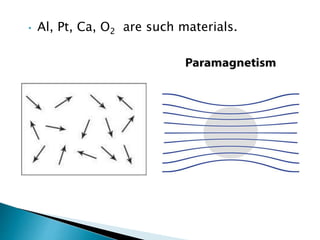
• It is a substance or body which very weakly
attracted by the poles of a magnet, but not
retaining any permanent magnetism.
• These have relative permeability slightly
greater than unity and are magnetized
slightly.
• They attract the lines of forces weakly.
• Al, Pt, Ca, O2 are such materials.
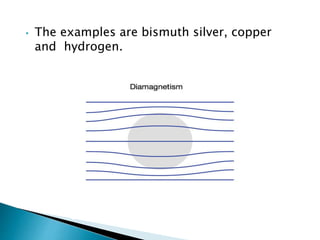
• It is a substance which create a magnetic field
in opposite to an externally applied field.
• Susceptibility is negative.
• These have relative permeability slightly less
than unity.
• They reppel the lines of force slightly.
• The examples are bismuth silver, copper
and hydrogen.
• Characteristics :
1. They have high permeability.
2. The magnetic energy stored is not high.
3. They have negligible coercive force.
4. They have low remanence.
5. Hysteresis loop is narrow.
• Examples :
pure or ingot iron, cast iron, carbon steel,
manganese & nickel steel, etc.
• Characteristics :
1. They possess high value of BH product.
2. High retentivity.
3. High coercivity.
4. Strong magnetic reluctance.
5. Hysteresis loop is more rectangular in
shape.
• Examples :
Tungsten steel, cobalt steel, chromium steel, etc.
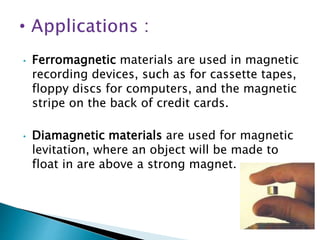
• Ferromagnetic materials are used in magnetic
recording devices, such as for cassette tapes,
floppy discs for computers, and the magnetic
stripe on the back of credit cards.
• Diamagnetic materials are used for magnetic
levitation, where an object will be made to
float in are above a strong magnet.
• Magnetic soft materials are used in making
electromagnets and these electromagnets are
used in telephone receiver, bells, loud
speakers etc.
• Magnetic hard materials are used in making
permanent magnets.
Thank You

Magnetic materials

  • 1.
  • 2.
    • Introduction • Termsconnected with magnetic materials • Classification with Properties • Hysteresis • Applications
  • 3.
    • Magnetic Materialsare those materials in which a state of magnetization can be induced. • Such materials when magnetized create a magnetic field in the surrounding space.
  • 4.
    • Magnetic force •Magnetic flux density • Magnetic field strength • Relative permeability • Absolute permeability • Remanance • Retentivity • Curie temperature (Tc) • Hysteresis loop & losses
  • 5.
    • Ferromagnetic • Paramagnetic •Diamagnetic • Magnetically Soft material • Magnetically Hard material
  • 6.
    • A typeof material that is highly attracted to magnets and can become permanently magnetized is called as ferromagnetic. • The relative permeability is much greater than unity and are dependent on the field strength. • These have high susceptibility.
  • 7.
    • Fe, Co,Ni, Cr, Mn are such materials.
  • 8.
    • It isa substance or body which very weakly attracted by the poles of a magnet, but not retaining any permanent magnetism. • These have relative permeability slightly greater than unity and are magnetized slightly. • They attract the lines of forces weakly.
  • 9.
    • Al, Pt,Ca, O2 are such materials.
  • 10.
    • It isa substance which create a magnetic field in opposite to an externally applied field. • Susceptibility is negative. • These have relative permeability slightly less than unity. • They reppel the lines of force slightly.
  • 11.
    • The examplesare bismuth silver, copper and hydrogen.
  • 12.
    • Characteristics : 1.They have high permeability. 2. The magnetic energy stored is not high. 3. They have negligible coercive force. 4. They have low remanence. 5. Hysteresis loop is narrow. • Examples : pure or ingot iron, cast iron, carbon steel, manganese & nickel steel, etc.
  • 13.
    • Characteristics : 1.They possess high value of BH product. 2. High retentivity. 3. High coercivity. 4. Strong magnetic reluctance. 5. Hysteresis loop is more rectangular in shape. • Examples : Tungsten steel, cobalt steel, chromium steel, etc.
  • 15.
    • Ferromagnetic materialsare used in magnetic recording devices, such as for cassette tapes, floppy discs for computers, and the magnetic stripe on the back of credit cards. • Diamagnetic materials are used for magnetic levitation, where an object will be made to float in are above a strong magnet.
  • 16.
    • Magnetic softmaterials are used in making electromagnets and these electromagnets are used in telephone receiver, bells, loud speakers etc. • Magnetic hard materials are used in making permanent magnets.
  • 17.