KRONIG-PENNEY MODEL EXTENDED TO
ARBITRARY POTENTIALS VIA NUMERICAL
MATRIX MECHANICS
NAME-Ashish Ahlawat
ROLL NO-18510015
NAME-Neeraj Kumar Meena
ROLL N0-18510045
Instructor- Dr. Anand sengupta
T.A. -Amit Reza
Outline
• Introduction
• FORMALISM
– Infinite square well
– Square well with periodic boundary conditions
• HARMONIC OSCILLATOR
– Infinite square well basis
– Periodic boundary conditions
– Numerical comparison periodic and square well basis sets
• PERIODIC POTENTIALS
– Matrix method for the Kronig-Penney model
– Numerical solution
– Comparing band structures
Introduction
KRONIG-PENNEY MODEL
• An effective way to understand the energy gap in semiconductors is to model
the interaction between the electrons and the lattice of atoms.
• An effective way to understand the energy gap in semiconductors is to model
the interaction between the electrons and the lattice of atoms.
• Kronig and Penney assumed that an electron experiences an infinite one-
dimensional array of finite potential wells.
• The free electron model implies that, a conduction electron in a metal
experiences constant (or zero) potential and free to move inside the crystal
but will not come out of the metal because an infinite potential exists at the
surface.
Introduction (Contd.)
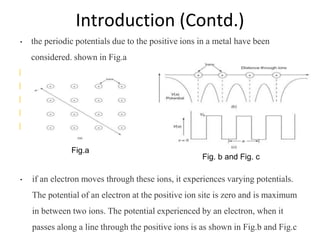
• the periodic potentials due to the positive ions in a metal have been
considered. shown in Fig.a
• if an electron moves through these ions, it experiences varying potentials.
The potential of an electron at the positive ion site is zero and is maximum
in between two ions. The potential experienced by an electron, when it
passes along a line through the positive ions is as shown in Fig.b and Fig.c
Fig.a
Fig. b and Fig. c
Formalism
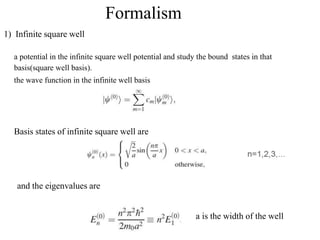
1) Infinite square well
a potential in the infinite square well potential and study the bound states in that
basis(square well basis).
the wave function in the infinite well basis
Basis states of infinite square well are
and the eigenvalues are
a is the width of the well
2) Square well with periodic boundary conditions
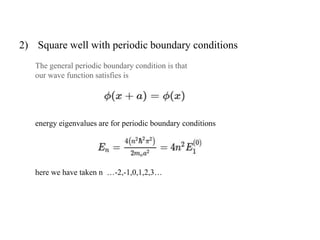
The general periodic boundary condition is that
our wave function satisfies is
energy eigenvalues are for periodic boundary conditions
here we have taken n …-2,-1,0,1,2,3…
Harmonic Oscillator
1) Infinite Square Well Basis
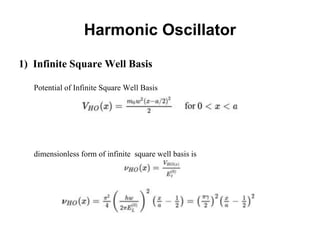
Potential of Infinite Square Well Basis
dimensionless form of infinite square well basis is
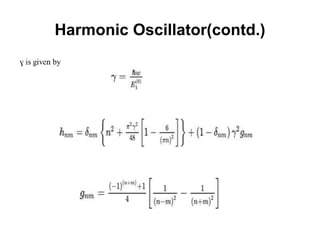
Harmonic Oscillator(contd.)
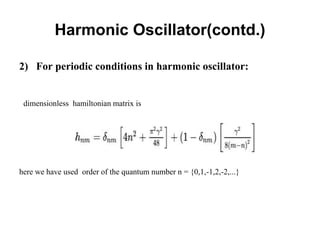
2) For periodic conditions in harmonic oscillator:
dimensionless hamiltonian matrix is
here we have used order of the quantum number n = {0,1,-1,2,-2,...}
Harmonic Oscillator(contd.)
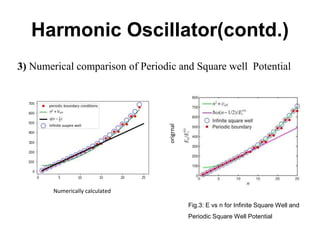
3) Numerical comparison of Periodic and Square well Potential
Fig.3: E vs n for Infinite Square Well and
Periodic Square Well Potential
Numerically calculated
Harmonic Oscillator(contd.)
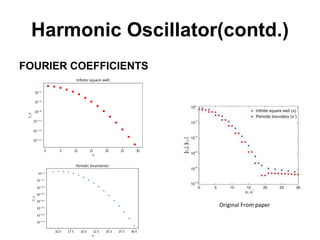
FOURIER COEFFICIENTS
Original From paper
PERIODIC POTENTIALS
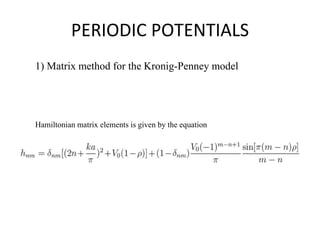
1) Matrix method for the Kronig-Penney model
Hamiltonian matrix elements is given by the equation
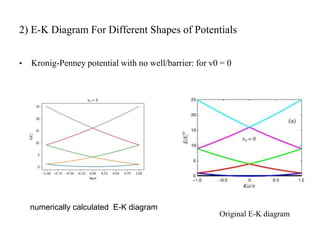
2) E-K Diagram For Different Shapes of Potentials
• Kronig-Penney potential with no well/barrier: for v0 = 0
Original E-K diagram
numerically calculated E-K diagram
E-K Diagram For Different Shapes of Potentials(contd.)
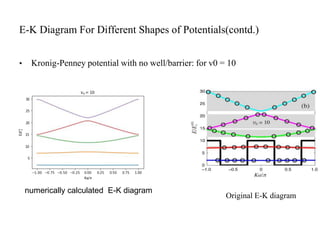
• Kronig-Penney potential with no well/barrier: for v0 = 10
numerically calculated E-K diagram
Original E-K diagram
E-K Diagram For Different Shapes of Potentials(contd.)
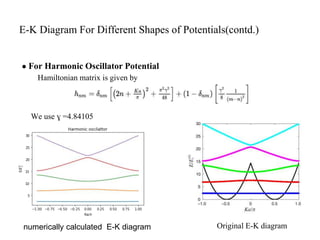
● For Harmonic Oscillator Potential
Hamiltonian matrix is given by
We use ɣ =4.84105
numerically calculated E-K diagram Original E-K diagram
E-K Diagram For Different Shapes of Potentials(contd.)
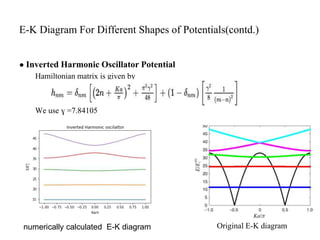
● Inverted Harmonic Oscillator Potential
Hamiltonian matrix is given by
We use ɣ =7.84105
numerically calculated E-K diagram Original E-K diagram
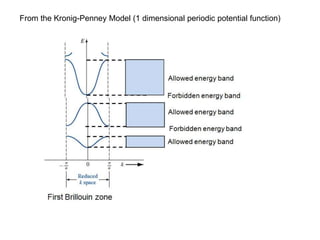
From the Kronig-Penney Model (1 dimensional periodic potential function)
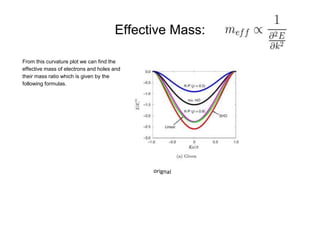
Effective Mass:
From this curvature plot we can find the
effective mass of electrons and holes and
their mass ratio which is given by the
following formulas.
References
1. https://aapt.scitation.org/doi/10.1119/1.4923026
2. https://sites.google.com/site/puenggphysics/home/unit-5/kronig-penny-model
3. https://en.wikipedia.org/wiki/Particle_in_a_one-dimensional_lattice
4. http://cmt.dur.ac.uk/sjc/thesis_prt/node26.html
THANK YOU

Kronig penny model_computational_phyics

  • 1.
    KRONIG-PENNEY MODEL EXTENDEDTO ARBITRARY POTENTIALS VIA NUMERICAL MATRIX MECHANICS NAME-Ashish Ahlawat ROLL NO-18510015 NAME-Neeraj Kumar Meena ROLL N0-18510045 Instructor- Dr. Anand sengupta T.A. -Amit Reza
  • 2.
    Outline • Introduction • FORMALISM –Infinite square well – Square well with periodic boundary conditions • HARMONIC OSCILLATOR – Infinite square well basis – Periodic boundary conditions – Numerical comparison periodic and square well basis sets • PERIODIC POTENTIALS – Matrix method for the Kronig-Penney model – Numerical solution – Comparing band structures
  • 3.
    Introduction KRONIG-PENNEY MODEL • Aneffective way to understand the energy gap in semiconductors is to model the interaction between the electrons and the lattice of atoms. • An effective way to understand the energy gap in semiconductors is to model the interaction between the electrons and the lattice of atoms. • Kronig and Penney assumed that an electron experiences an infinite one- dimensional array of finite potential wells. • The free electron model implies that, a conduction electron in a metal experiences constant (or zero) potential and free to move inside the crystal but will not come out of the metal because an infinite potential exists at the surface.
  • 4.
    Introduction (Contd.) • theperiodic potentials due to the positive ions in a metal have been considered. shown in Fig.a • if an electron moves through these ions, it experiences varying potentials. The potential of an electron at the positive ion site is zero and is maximum in between two ions. The potential experienced by an electron, when it passes along a line through the positive ions is as shown in Fig.b and Fig.c Fig.a Fig. b and Fig. c
  • 5.
    Formalism 1) Infinite squarewell a potential in the infinite square well potential and study the bound states in that basis(square well basis). the wave function in the infinite well basis Basis states of infinite square well are and the eigenvalues are a is the width of the well
  • 6.
    2) Square wellwith periodic boundary conditions The general periodic boundary condition is that our wave function satisfies is energy eigenvalues are for periodic boundary conditions here we have taken n …-2,-1,0,1,2,3…
  • 7.
    Harmonic Oscillator 1) InfiniteSquare Well Basis Potential of Infinite Square Well Basis dimensionless form of infinite square well basis is
  • 8.
  • 9.
    Harmonic Oscillator(contd.) 2) Forperiodic conditions in harmonic oscillator: dimensionless hamiltonian matrix is here we have used order of the quantum number n = {0,1,-1,2,-2,...}
  • 10.
    Harmonic Oscillator(contd.) 3) Numericalcomparison of Periodic and Square well Potential Fig.3: E vs n for Infinite Square Well and Periodic Square Well Potential Numerically calculated
  • 11.
  • 12.
    PERIODIC POTENTIALS 1) Matrixmethod for the Kronig-Penney model Hamiltonian matrix elements is given by the equation
  • 13.
    2) E-K DiagramFor Different Shapes of Potentials • Kronig-Penney potential with no well/barrier: for v0 = 0 Original E-K diagram numerically calculated E-K diagram
  • 14.
    E-K Diagram ForDifferent Shapes of Potentials(contd.) • Kronig-Penney potential with no well/barrier: for v0 = 10 numerically calculated E-K diagram Original E-K diagram
  • 15.
    E-K Diagram ForDifferent Shapes of Potentials(contd.) ● For Harmonic Oscillator Potential Hamiltonian matrix is given by We use ɣ =4.84105 numerically calculated E-K diagram Original E-K diagram
  • 16.
    E-K Diagram ForDifferent Shapes of Potentials(contd.) ● Inverted Harmonic Oscillator Potential Hamiltonian matrix is given by We use ɣ =7.84105 numerically calculated E-K diagram Original E-K diagram
  • 17.
    From the Kronig-PenneyModel (1 dimensional periodic potential function)
  • 18.
    Effective Mass: From thiscurvature plot we can find the effective mass of electrons and holes and their mass ratio which is given by the following formulas.
  • 19.
    References 1. https://aapt.scitation.org/doi/10.1119/1.4923026 2. https://sites.google.com/site/puenggphysics/home/unit-5/kronig-penny-model 3.https://en.wikipedia.org/wiki/Particle_in_a_one-dimensional_lattice 4. http://cmt.dur.ac.uk/sjc/thesis_prt/node26.html
  • 20.