Receivers
Dr. G.Aarthi,
Associate Professor, School of Electronics Engineering
A receiver is an electronic equipment which picks
up any desired radio frequency signal.
Functions:
Amplifying the desired signal to the requisite level.
Demodulating RF signal.
Feeding modulating voltage to an indicator (loud
speaker)
Receivers
Classification of Radio Receivers
Based on the Principle of Operation
 Straight or TRF Receivers
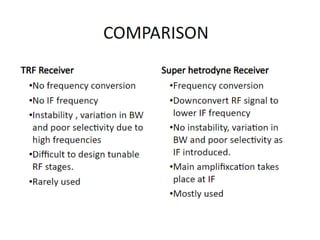
Operation is straight forward without any frequency conversion or
mixing.
Super heterodyne receivers
Incoming signal frequency is converted into standard
intermediate frequency (IF) with the help of frequency converter
Classification of Radio Receivers
According to the application (type of traffic they are
designed to handle)
AM Receivers
Receives speech or music radiated from AM transmitter operating on
long wave , medium wave (broadcast band) or short wave
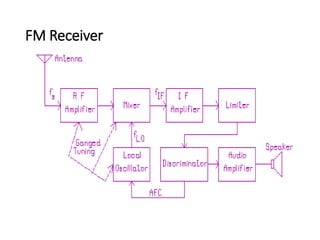
FM Receivers
Receives signals from FM transmitters operating in VHF or UHF bands
TV receivers
Receives television broadcast in VHF or UHF bands
Communication receivers
To receive telephony and telegraphic signals
Radar receivers
Receives radar signals
Characteristics of Radio Receivers
Sensitivity
• Ability to receive weak signals
Selectivity
• Ability to select desired signal and reject all other
unwanted signals
Fidelity
• Faithful reproduction of original signal
Signal to Noise ratio
• A good receiver should have high SNR
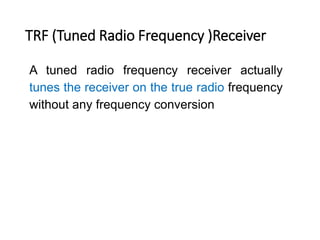
TRF (Tuned Radio Frequency )Receiver
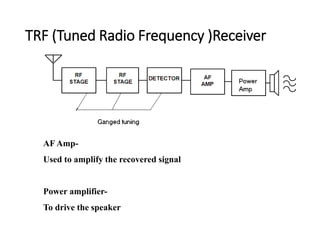
A tuned radio frequency receiver actually
tunes the receiver on the true radio frequency
without any frequency conversion
TRF (Tuned Radio Frequency )Receiver
RF
STAGE
RF
STAGE
DETECTOR AF
AMP
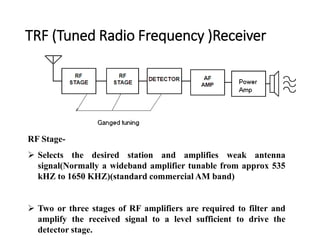
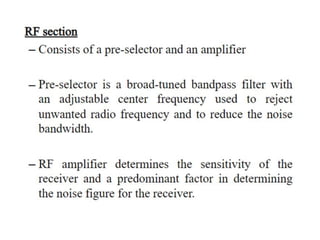
RF Stage-
 Selects the desired station and amplifies weak antenna
signal(Normally a wideband amplifier tunable from approx 535
kHZ to 1650 KHZ)(standard commercial AM band)
 Two or three stages of RF amplifiers are required to filter and
amplify the received signal to a level sufficient to drive the
detector stage.
TRF (Tuned Radio Frequency )Receiver
RF
STAGE
RF
STAGE
DETECTOR AF
AMP
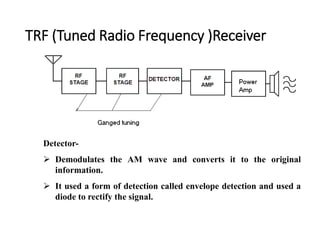
Detector-
 Demodulates the AM wave and converts it to the original
information.
 It used a form of detection called envelope detection and used a
diode to rectify the signal.
TRF (Tuned Radio Frequency )Receiver
RF
STAGE
RF
STAGE
DETECTOR AF
AMP
AF Amp-
Used to amplify the recovered signal
Power amplifier-
To drive the speaker
TRF receiver
•Advantages
• TRF receivers are simple and have a relatively high
sensitivity.
• Easy to design at broadcast frequency 535 kHz to
1640 kHz.
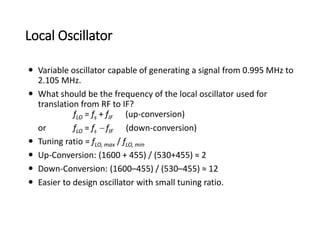
Local Oscillator
 Variable oscillator capable of generating a signal from 0.995 MHz to
2.105 MHz.
 What should be the frequency of the local oscillator used for
translation from RF to IF?
fLO = fs + fIF (up-conversion)
or fLO = fs - fIF (down-conversion)
 Tuning ratio = fLO, max / fLO, min
 Up-Conversion: (1600 + 455) / (530+455) ≈ 2
 Down-Conversion: (1600–455) / (530–455) ≈ 12
 Easier to design oscillator with small tuning ratio.
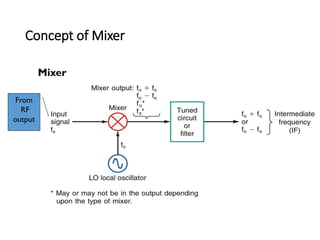
Concept of Mixer
Mixer
From
RF
output
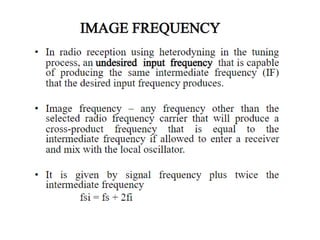
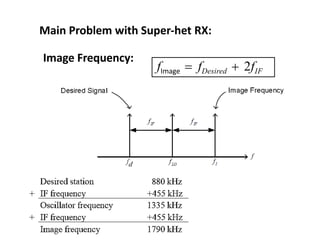
Main Problem with Super‐het RX:
Image Frequency:
fImage  fDesired + 2fIF
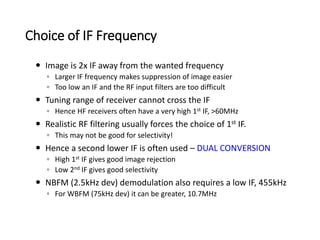
Choice of IF Frequency
 Image is 2x IF away from the wanted frequency
◦ Larger IF frequency makes suppression of image easier
◦ Too low an IF and the RF input filters are too difficult
 Tuning range of receiver cannot cross the IF
◦ Hence HF receivers often have a very high 1st IF, >60MHz
 Realistic RF filtering usually forces the choice of 1st IF.
◦ This may not be good for selectivity!
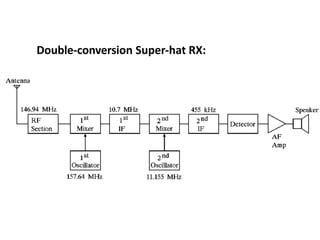
 Hence a second lower IF is often used – DUAL CONVERSION
◦ High 1st IF gives good image rejection
◦ Low 2nd IF gives good selectivity
 NBFM (2.5kHz dev) demodulation also requires a low IF, 455kHz
◦ For WBFM (75kHz dev) it can be greater, 10.7MHz
Double‐conversion Super‐hat RX:
Superheterodyne Receivers
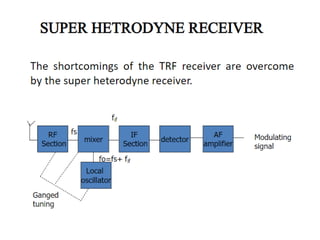
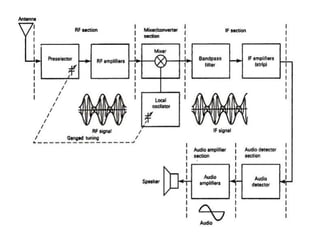
Ganged tuning is the process used to tune two or more
circuits with a single control.
In our example, when you change the frequency of the
receiver all three stages change by the same amount.
There is a fixed difference in frequency between the local
oscillator and the RF amplifier at all times.
This difference in frequency is the IF.
This fixed difference and ganged tuning ensures a constant
IF over the frequency range of the receiver.
Superheterodyne Receivers
Advantages
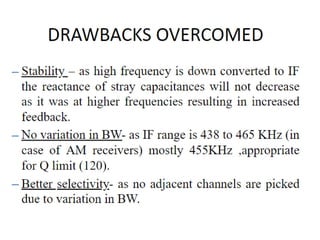
• The superheterodyne receiver offers superior sensitivity, frequency
stability and selectivity.
• Compared with the tuned radio frequency receiver (TRF) design,
superheterodyne offer better stability.
Superheterodyne Receivers
Disadvantages
• One major disadvantage to the superheterodyne receiver is the problem
of image frequency.
• In heterodyne receivers, an image frequency is an undesired input
frequency equal to the station frequency plus twice the intermediate
frequency.
• The image frequency results in two stations being received at the same
time, thus producing interference.
• Image frequencies can be eliminated by sufficient attenuation on the
incoming signal by the RF amplifier filter of the superheterodyne
receiver.
FM Receiver
Amplitude Limiter
• Most frequency discriminators use envelope detection to extract the
intelligence from the FM wave form
• Envelope detection will demodulate incident amplitude variations as
well as frequency variation
• Transmission noise and interference add to the signal to produce
unwanted amplitude variations
Amplitude Limiter
• In the receiver, unwanted AM and random noise are demodulated
along with the signal: unwanted distortion is produced
• A limiter circuit is used to produce a constant amplitude output for all
input signal above a specified threshold level
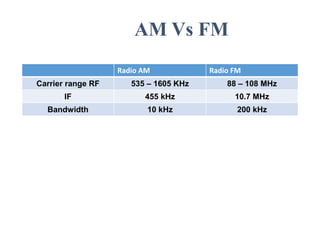
AM Vs FM
Radio AM Radio FM
Carrier range RF 535 – 1605 KHz 88 – 108 MHz
IF 455 kHz 10.7 MHz
Bandwidth 10 kHz 200 kHz

21 Receivers.pdf

  • 1.
    Receivers Dr. G.Aarthi, Associate Professor,School of Electronics Engineering
  • 2.
    A receiver isan electronic equipment which picks up any desired radio frequency signal. Functions: Amplifying the desired signal to the requisite level. Demodulating RF signal. Feeding modulating voltage to an indicator (loud speaker) Receivers
  • 3.
    Classification of RadioReceivers Based on the Principle of Operation  Straight or TRF Receivers Operation is straight forward without any frequency conversion or mixing. Super heterodyne receivers Incoming signal frequency is converted into standard intermediate frequency (IF) with the help of frequency converter
  • 4.
    Classification of RadioReceivers According to the application (type of traffic they are designed to handle) AM Receivers Receives speech or music radiated from AM transmitter operating on long wave , medium wave (broadcast band) or short wave FM Receivers Receives signals from FM transmitters operating in VHF or UHF bands TV receivers Receives television broadcast in VHF or UHF bands Communication receivers To receive telephony and telegraphic signals Radar receivers Receives radar signals
  • 5.
    Characteristics of RadioReceivers Sensitivity • Ability to receive weak signals Selectivity • Ability to select desired signal and reject all other unwanted signals Fidelity • Faithful reproduction of original signal Signal to Noise ratio • A good receiver should have high SNR
  • 6.
    TRF (Tuned RadioFrequency )Receiver A tuned radio frequency receiver actually tunes the receiver on the true radio frequency without any frequency conversion
  • 7.
    TRF (Tuned RadioFrequency )Receiver RF STAGE RF STAGE DETECTOR AF AMP RF Stage-  Selects the desired station and amplifies weak antenna signal(Normally a wideband amplifier tunable from approx 535 kHZ to 1650 KHZ)(standard commercial AM band)  Two or three stages of RF amplifiers are required to filter and amplify the received signal to a level sufficient to drive the detector stage.
  • 8.
    TRF (Tuned RadioFrequency )Receiver RF STAGE RF STAGE DETECTOR AF AMP Detector-  Demodulates the AM wave and converts it to the original information.  It used a form of detection called envelope detection and used a diode to rectify the signal.
  • 9.
    TRF (Tuned RadioFrequency )Receiver RF STAGE RF STAGE DETECTOR AF AMP AF Amp- Used to amplify the recovered signal Power amplifier- To drive the speaker
  • 10.
    TRF receiver •Advantages • TRFreceivers are simple and have a relatively high sensitivity. • Easy to design at broadcast frequency 535 kHz to 1640 kHz.
  • 22.
    Local Oscillator  Variableoscillator capable of generating a signal from 0.995 MHz to 2.105 MHz.  What should be the frequency of the local oscillator used for translation from RF to IF? fLO = fs + fIF (up-conversion) or fLO = fs - fIF (down-conversion)  Tuning ratio = fLO, max / fLO, min  Up-Conversion: (1600 + 455) / (530+455) ≈ 2  Down-Conversion: (1600–455) / (530–455) ≈ 12  Easier to design oscillator with small tuning ratio.
  • 24.
  • 27.
    Main Problem withSuper‐het RX: Image Frequency: fImage  fDesired + 2fIF
  • 28.
    Choice of IFFrequency  Image is 2x IF away from the wanted frequency ◦ Larger IF frequency makes suppression of image easier ◦ Too low an IF and the RF input filters are too difficult  Tuning range of receiver cannot cross the IF ◦ Hence HF receivers often have a very high 1st IF, >60MHz  Realistic RF filtering usually forces the choice of 1st IF. ◦ This may not be good for selectivity!  Hence a second lower IF is often used – DUAL CONVERSION ◦ High 1st IF gives good image rejection ◦ Low 2nd IF gives good selectivity  NBFM (2.5kHz dev) demodulation also requires a low IF, 455kHz ◦ For WBFM (75kHz dev) it can be greater, 10.7MHz
  • 29.
  • 31.
    Superheterodyne Receivers Ganged tuningis the process used to tune two or more circuits with a single control. In our example, when you change the frequency of the receiver all three stages change by the same amount. There is a fixed difference in frequency between the local oscillator and the RF amplifier at all times. This difference in frequency is the IF. This fixed difference and ganged tuning ensures a constant IF over the frequency range of the receiver.
  • 33.
    Superheterodyne Receivers Advantages • Thesuperheterodyne receiver offers superior sensitivity, frequency stability and selectivity. • Compared with the tuned radio frequency receiver (TRF) design, superheterodyne offer better stability.
  • 34.
    Superheterodyne Receivers Disadvantages • Onemajor disadvantage to the superheterodyne receiver is the problem of image frequency. • In heterodyne receivers, an image frequency is an undesired input frequency equal to the station frequency plus twice the intermediate frequency. • The image frequency results in two stations being received at the same time, thus producing interference. • Image frequencies can be eliminated by sufficient attenuation on the incoming signal by the RF amplifier filter of the superheterodyne receiver.
  • 36.
  • 37.
    Amplitude Limiter • Mostfrequency discriminators use envelope detection to extract the intelligence from the FM wave form • Envelope detection will demodulate incident amplitude variations as well as frequency variation • Transmission noise and interference add to the signal to produce unwanted amplitude variations
  • 38.
    Amplitude Limiter • Inthe receiver, unwanted AM and random noise are demodulated along with the signal: unwanted distortion is produced • A limiter circuit is used to produce a constant amplitude output for all input signal above a specified threshold level
  • 39.
    AM Vs FM RadioAM Radio FM Carrier range RF 535 – 1605 KHz 88 – 108 MHz IF 455 kHz 10.7 MHz Bandwidth 10 kHz 200 kHz