CE-MS Hyphenation
FARIS AMEEN A
SECOND SEM M.PHARM
Hyphenated technique
• The hyphenated technique is the combination or
the coupling of the different
analytical techniques. Mainly
chromatographic techniques are combined with
spectroscopic techniques.
• The hyphenated technique is developed from the
coupling of a separation technique and an on-line
spectroscopic detection technology
• e.g., GC-MS, LC-MS, LC-FTIR, LC-NMR, CE-MS, etc
Capillary electrophoresis–mass
spectrometry (CE-MS)
• It is an analytical chemistry technique formed by the
combination of the liquid separation process of capillary
electrophoresis with mass spectrometry
• CE-MS combines advantages of both CE and MS to provide
high separation efficiency and molecular mass information in
a single analysis
• It has high resolving power and sensitivity, requires minimal
volume and can analyze at high speed. Ions are typically
formed by electrospray ionization , but they can also be
formed by matrix-assisted laser desorption/ionization or
other ionization techniques.
• It has applications in basic research
in proteomics and quantitative analysis of biomolecules as
well as in clinical medicine
• Since its introduction in 1987, new developments and
application has made CE-MS powerful separation and
identification technique
• Use of CE-MS has increased for protein and peptides
analysis and other biomolecules. However, the
development of online CE-MS is not without challenges
• Understanding of CE, the interface setup, ionization
technique and mass detection system is important to
tackle problems while coupling capillary
electrophoresis to mass spectrometry
• It has applications in basic research
in proteomics and quantitative
analysis of biomolecules as well as in clinical medicine
• Since its introduction in 1987, new developments and
application has made CE-MS powerful separation and
identification technique. Use of CE-MS has increased for
protein and peptides analysis and other biomolecules.
However, the development of online CE-MS is not without
challenges. Understanding of CE, the interface setup,
ionization technique and mass detection system is important
to tackle problems while coupling capillary electrophoresis to
mass spectrometry
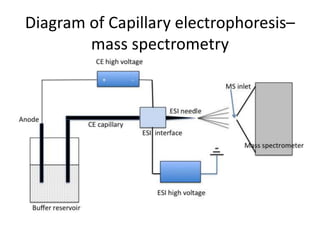
Diagram of Capillary electrophoresis–
mass spectrometry
History
The original interface between capillary zone
electrophoresis and mass spectrometry was
developed in 1987 by Richard D. Smith and
coworkers at Pacific Northwest National
Laboratory, and who also later were involved in
development of interfaces with other CE
variants, including capillary isotachophoresis
and capillary isoelectric focusing
Interfacing CE with MS
• Capillary electrophoresis is a separation technique
which uses high electric field to produce
electroosmotic flow for separation of ions
• Analytes migrate from one end of capillary to other
based on their charge, viscosity and size. Higher the
electric field, greater is the mobility. Mass
spectrometry is an analytical technique that identifies
chemical species depending on their mass-to-charge
ratio. During the process, an ion source will convert
molecules coming from CE to ions that can then be
manipulated using electric and magnetic field. The
separated ions are then measured using a detector
• The major problem faced when coupling CE to
MS arises due to insufficient understanding of
fundamental processes when two techniques
are interfaced. The separation and detection
of analytes can be improved with better
interface. CE has been coupled to MS using
various ionization techniques like FAB, ESI,
MALDI, APCI and DESI. The most used
ionization technique is ESI
Electrospray ionization interface
The first not CE-MS interface had cathode end of CE
capillary terminated within a stainless steel capillary.
An electrical contact was made at that point completing
the circuit and initiating the electrospray. This interface
system had few drawbacks like mismatch in the flow rates
of two systems. Since then, interface system has been
improved to have continuous flow rate and good
electrical contact. At present, three types of interface
system exist for CE/ESI-MS which are discussed briefly
Sheathless interface
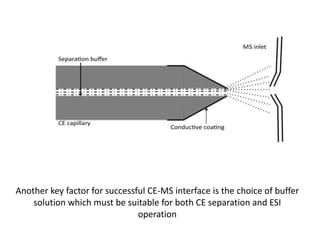
• CE capillary is coupled directly to an electrospray ionization source
with a sheathless interface system. The electric contact for ESI is
realized by using capillary coated with conductive metal.Because no
sheath liquid is used, the system has high sensitivity, low flow rates
and minimum background. However, these interface designs, all
have challenges including low mechanical robustness, poor
reproducibility.
• The latest sheathless interface design features porous ESI emitter
through chemical etching. This design effectively provides robust
interfacing with mass spectrometry and addresses the
reproducibility challenges associated with previous designs. This
porous emitter interface has been explored to couple of CITP/CZE
(or transient ITP) which greatly improves sample loading capacity of
CE and enabled ultrasensitive detection of trace analytes
• Another key factor for successful CE-MS interface is the choice of
buffer solution which must be suitable for both CE separation and
ESI operation
Another key factor for successful CE-MS interface is the choice of buffer
solution which must be suitable for both CE separation and ESI
operation
Sheath flow interface
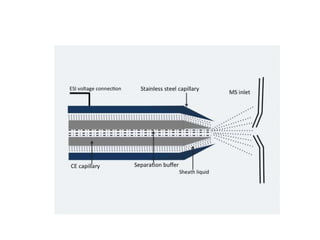
• With the sheath flow interface, the electrical connection is
established when the CE separation liquid is mixed with
sheath liquid flowing coaxially in a metal capillary tubing.
• Commonly used sheath liquid is 1:1 mixture of water-
methanol with 0.1% acetic acid or formic acid.
• The system is more reliable and has wide selection range of
separation electrolyte.
• There might be some decrease in sensitivity due to sheath
liquid.
Liquid junction interface
• This technique uses a stainless steel tee to mix
separation electrolyte from CE capillary with
make up liquid. The CE capillary and ESI needle
are inserted through opposite sides of the tee
and a narrow gap is maintained.
• The electrical contact is established by makeup
liquid surrounding the junction between two
capillaries. This system is easy to operate.
However, the sensitivity is reduced and the
mixing of two liquids could degrade separation
Continuous-flow fast atom
bombardment
• CE can be coupled to fast atom bombardment
ionization using a continuous flow interface. The
interface must match the flow rate between the
two systems
• The CF-FAB raquires a relatively high flow rate but
CE need low flow rate for better separation. A
make-up flow can be used using a sheath flow or
liquid junction
Applications
• CE-MS ability to separate analytes present in extremely low
concentration with high efficiency at high speed has made
it applicable in all fields of science. CE-MS has been used
for bioanalytical, pharmaceuticals, environmental and
forensic application.
• The major application of CE-MS has been for biological
studies, mostly for protein and peptide analysis. Along with
that, it is used often for routine analysis of pharmaceutical
drugs. There are number of studies reporting
characterization of mixtures of peptides and proteins.
• CE-MS can be used for routine clinical checkup. Body fluids
like blood and urine have been analyzed with CE-MS to
identify biomarkers for renal diseases and cancer.
REFERENCES
• Kalpesh N Patel, Jayvadan K Patel ,
Pharmaceutical methods, Introduction to
hyphenated techniques and their applications
in pharmacy, 2010 Oct-Dec; 1(1): 2–13
• https://en.wikipedia.org/wiki/Capillary_electr
ophoresis%E2%80%93mass_spectrometry

CE-MS Hyphenation

  • 1.
    CE-MS Hyphenation FARIS AMEENA SECOND SEM M.PHARM
  • 2.
    Hyphenated technique • Thehyphenated technique is the combination or the coupling of the different analytical techniques. Mainly chromatographic techniques are combined with spectroscopic techniques. • The hyphenated technique is developed from the coupling of a separation technique and an on-line spectroscopic detection technology • e.g., GC-MS, LC-MS, LC-FTIR, LC-NMR, CE-MS, etc
  • 3.
    Capillary electrophoresis–mass spectrometry (CE-MS) •It is an analytical chemistry technique formed by the combination of the liquid separation process of capillary electrophoresis with mass spectrometry • CE-MS combines advantages of both CE and MS to provide high separation efficiency and molecular mass information in a single analysis • It has high resolving power and sensitivity, requires minimal volume and can analyze at high speed. Ions are typically formed by electrospray ionization , but they can also be formed by matrix-assisted laser desorption/ionization or other ionization techniques. • It has applications in basic research in proteomics and quantitative analysis of biomolecules as well as in clinical medicine
  • 4.
    • Since itsintroduction in 1987, new developments and application has made CE-MS powerful separation and identification technique • Use of CE-MS has increased for protein and peptides analysis and other biomolecules. However, the development of online CE-MS is not without challenges • Understanding of CE, the interface setup, ionization technique and mass detection system is important to tackle problems while coupling capillary electrophoresis to mass spectrometry • It has applications in basic research in proteomics and quantitative analysis of biomolecules as well as in clinical medicine
  • 5.
    • Since itsintroduction in 1987, new developments and application has made CE-MS powerful separation and identification technique. Use of CE-MS has increased for protein and peptides analysis and other biomolecules. However, the development of online CE-MS is not without challenges. Understanding of CE, the interface setup, ionization technique and mass detection system is important to tackle problems while coupling capillary electrophoresis to mass spectrometry
  • 6.
    Diagram of Capillaryelectrophoresis– mass spectrometry
  • 7.
    History The original interfacebetween capillary zone electrophoresis and mass spectrometry was developed in 1987 by Richard D. Smith and coworkers at Pacific Northwest National Laboratory, and who also later were involved in development of interfaces with other CE variants, including capillary isotachophoresis and capillary isoelectric focusing
  • 8.
    Interfacing CE withMS • Capillary electrophoresis is a separation technique which uses high electric field to produce electroosmotic flow for separation of ions • Analytes migrate from one end of capillary to other based on their charge, viscosity and size. Higher the electric field, greater is the mobility. Mass spectrometry is an analytical technique that identifies chemical species depending on their mass-to-charge ratio. During the process, an ion source will convert molecules coming from CE to ions that can then be manipulated using electric and magnetic field. The separated ions are then measured using a detector
  • 9.
    • The majorproblem faced when coupling CE to MS arises due to insufficient understanding of fundamental processes when two techniques are interfaced. The separation and detection of analytes can be improved with better interface. CE has been coupled to MS using various ionization techniques like FAB, ESI, MALDI, APCI and DESI. The most used ionization technique is ESI
  • 10.
    Electrospray ionization interface Thefirst not CE-MS interface had cathode end of CE capillary terminated within a stainless steel capillary. An electrical contact was made at that point completing the circuit and initiating the electrospray. This interface system had few drawbacks like mismatch in the flow rates of two systems. Since then, interface system has been improved to have continuous flow rate and good electrical contact. At present, three types of interface system exist for CE/ESI-MS which are discussed briefly
  • 11.
    Sheathless interface • CEcapillary is coupled directly to an electrospray ionization source with a sheathless interface system. The electric contact for ESI is realized by using capillary coated with conductive metal.Because no sheath liquid is used, the system has high sensitivity, low flow rates and minimum background. However, these interface designs, all have challenges including low mechanical robustness, poor reproducibility. • The latest sheathless interface design features porous ESI emitter through chemical etching. This design effectively provides robust interfacing with mass spectrometry and addresses the reproducibility challenges associated with previous designs. This porous emitter interface has been explored to couple of CITP/CZE (or transient ITP) which greatly improves sample loading capacity of CE and enabled ultrasensitive detection of trace analytes • Another key factor for successful CE-MS interface is the choice of buffer solution which must be suitable for both CE separation and ESI operation
  • 12.
    Another key factorfor successful CE-MS interface is the choice of buffer solution which must be suitable for both CE separation and ESI operation
  • 13.
    Sheath flow interface •With the sheath flow interface, the electrical connection is established when the CE separation liquid is mixed with sheath liquid flowing coaxially in a metal capillary tubing. • Commonly used sheath liquid is 1:1 mixture of water- methanol with 0.1% acetic acid or formic acid. • The system is more reliable and has wide selection range of separation electrolyte. • There might be some decrease in sensitivity due to sheath liquid.
  • 15.
    Liquid junction interface •This technique uses a stainless steel tee to mix separation electrolyte from CE capillary with make up liquid. The CE capillary and ESI needle are inserted through opposite sides of the tee and a narrow gap is maintained. • The electrical contact is established by makeup liquid surrounding the junction between two capillaries. This system is easy to operate. However, the sensitivity is reduced and the mixing of two liquids could degrade separation
  • 16.
    Continuous-flow fast atom bombardment •CE can be coupled to fast atom bombardment ionization using a continuous flow interface. The interface must match the flow rate between the two systems • The CF-FAB raquires a relatively high flow rate but CE need low flow rate for better separation. A make-up flow can be used using a sheath flow or liquid junction
  • 17.
    Applications • CE-MS abilityto separate analytes present in extremely low concentration with high efficiency at high speed has made it applicable in all fields of science. CE-MS has been used for bioanalytical, pharmaceuticals, environmental and forensic application. • The major application of CE-MS has been for biological studies, mostly for protein and peptide analysis. Along with that, it is used often for routine analysis of pharmaceutical drugs. There are number of studies reporting characterization of mixtures of peptides and proteins. • CE-MS can be used for routine clinical checkup. Body fluids like blood and urine have been analyzed with CE-MS to identify biomarkers for renal diseases and cancer.
  • 18.
    REFERENCES • Kalpesh NPatel, Jayvadan K Patel , Pharmaceutical methods, Introduction to hyphenated techniques and their applications in pharmacy, 2010 Oct-Dec; 1(1): 2–13 • https://en.wikipedia.org/wiki/Capillary_electr ophoresis%E2%80%93mass_spectrometry