Prepared by :
SHINDE GANESH SHASHIKANT
PRAVARA RURAL COLLEGE OF PHARMACY,PRAVARANAGAR
SUPERCRITICAL FLUID
CHROMETOGRAPHY
SUPERCRITICAL FLUID CHROMATOGRAPHY
 Chromatography:- separation technique of complex
chemical mixtures into individual components .
 Various techniques.
 Chromatography – mobile phase
Gas chromatography - Gas
Liquid chromatography - Liquid
Supercritical fluid - Supercritical fluid
chromatography
S.F.C
 Cost efficient
 User friendly
 Better resolution
 Faster analysis
S.F.C is a column chromatographic technique in which
supercritical fluid is used as a mobile phase.
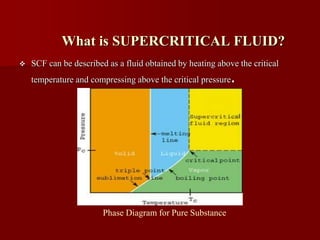
What is SUPERCRITICAL FLUID?
 SCF can be described as a fluid obtained by heating above the critical
temperature and compressing above the critical pressure.
Phase Diagram for Pure Substance
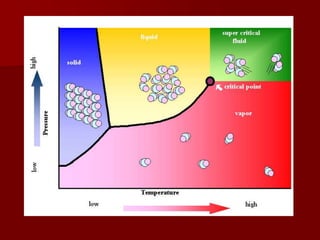
 For every substance, there is a temperature above which it can
no longer exist as a liquid, no matter how much pressure is
applied.
 Likewise, there is a pressure above which the substance can
no longer exist as a gas no matter how high the temperature is
raised.
 These points are called critical temperature and critical
pressure respectively.
 Above this point,the substance acts as a supercritical fluid .
A supercritical fluid is any substance at a
temperature and pressure above its critical point.
It can diffuse through solids like a gas, and dissolve
materials like a liquid.
Additionally, close to the critical point, small
changes in pressure or temperature result in large
changes in density, allowing many properties to be
"tuned".
Supercritical fluids are suitable as a substitute for
organic solvents in a range of industrial and
laboratory processes
In the Supercritical region the substance is neither a gas nor
a liquid – it is a fluid that has properties of both.
There are no sharp boundaries between gas and liquid.
Properties of SCFs can be very different from the normal
liquid phase.
PROPERTIES AND ADVANTAGES OF SCF
 high densities so they have a remarkable ability to dissolve
large, non-volatile molecules .
 dissolved analytes can be easily recovered by simply allowing
the solutions to equilibrate with the atmosphere at low
temperatures . So useful with thermally unstable analytes.
 inexpensive
 Ecofriendly
 non-toxic
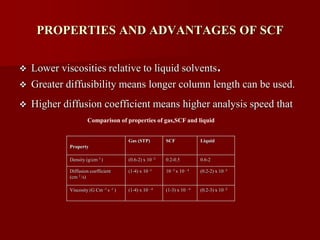
PROPERTIES AND ADVANTAGES OF SCF
 Lower viscosities relative to liquid solvents.
 Greater diffusibility means longer column length can be used.
 Higher diffusion coefficient means higher analysis speed that
Comparison of properties of gas,SCF and liquid
Property
Gas (STP) SCF Liquid
Density (g/cm 3 ) (0.6-2) x 10 -3 0.2-0.5 0.6-2
Diffusion coefficient
(cm 2 /s)
(1-4) x 10 -1 10 -3 x 10 - 4 (0.2-2) x 10 -5
Viscosity (G Cm -1 s -1 ) (1-4) x 10 - 4 (1-3) x 10 - 4 (0.2-3) x 10 -2
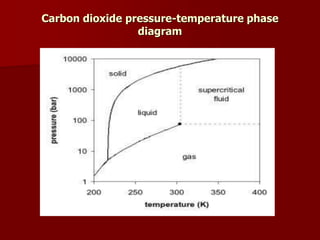
 The two supercritical fluids of particular interest are , carbon
dioxide and water.
 Carbon dioxide :-
 non-flammable,
 nontoxic
 low critical temperature of 31.9 C and moderate
critical pressure of 73bar.
 It is miscible with variety of organic solvents and is
readily recovered after processing.
 It diffuses faster than conventional liquid solvents.
Carbon dioxide pressure-temperature phase
diagram
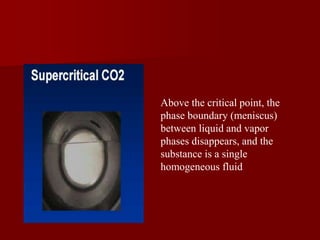
Above the critical point, the
phase boundary (meniscus)
between liquid and vapor
phases disappears, and the
substance is a single
homogeneous fluid
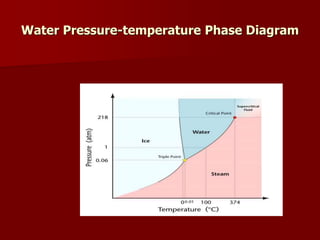
 Water .
 critical temperature of 647K and critical pressure of 220bar
due to its high polarity.
 The character of water at supercritical conditions changes from
one that supports only ionic species at ambient conditions to
one that dissolves paraffins, aromatics, gases and salts.
 Due to this unique property, research has been carried out on
supercritical water for reaction and separation processes to
treat toxic wastewater.
Water Pressure-temperature Phase Diagram
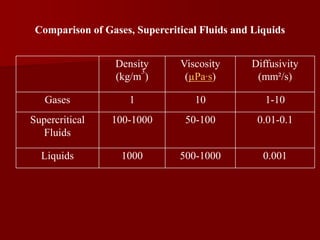
Density
(kg/m
3
)
Viscosity
(µPa∙s)
Diffusivity
(mm²/s)
Gases 1 10 1-10
Supercritical
Fluids
100-1000 50-100 0.01-0.1
Liquids 1000 500-1000 0.001
Comparison of Gases, Supercritical Fluids and Liquids
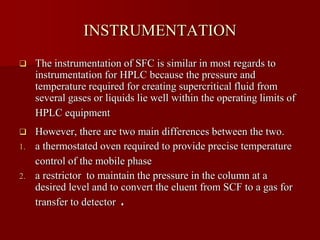
INSTRUMENTATION
 The instrumentation of SFC is similar in most regards to
instrumentation for HPLC because the pressure and
temperature required for creating supercritical fluid from
several gases or liquids lie well within the operating limits of
HPLC equipment
 However, there are two main differences between the two.
1. a thermostated oven required to provide precise temperature
control of the mobile phase
2. a restrictor to maintain the pressure in the column at a
desired level and to convert the eluent from SCF to a gas for
transfer to detector .
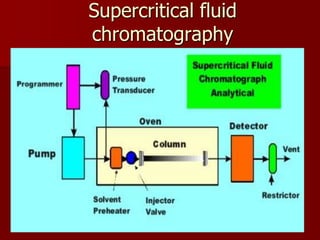
Supercritical fluid
chromatography
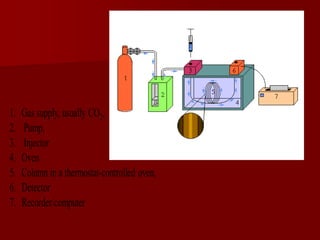
 the mobile phase is pumped as a liquid and is brought into the
supercritical region by heating it above its supercritical
temperature before it enters the analytical column.
 It passes through an injection valve where the sample is
introduced into the supercritical stream
 It is maintained supercritical as it passes through the column
into the detector by a pressure restrictor.
Mobile phase
 There are a number of possible fluids, which may be used in
SFC as a mobile phase.
 However, based on its low cost, low interference with
chromatographic detectors and good physical properties
(nontoxic, nonflammable, low critical values) CO2 is the most
used mobile phase for SFC .
 excellent solvent for a variety of nonpolar organic molecules.
Column
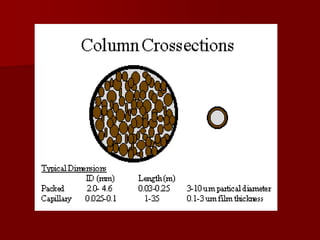
 Basically two types of analytical columns are used in SFC,
1) packed column
2) capillary column.
 Earlier work employed absorbents such as alumna, silica or
polystyrene .
 More recent packed column work has involved bonded
stationary phases such as octadecylsilyl (C 18 ).
Restrictor
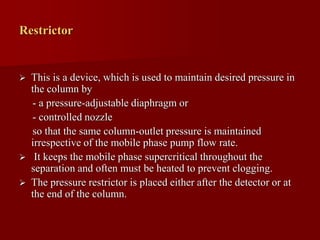
 This is a device, which is used to maintain desired pressure in
the column by
- a pressure-adjustable diaphragm or
- controlled nozzle
so that the same column-outlet pressure is maintained
irrespective of the mobile phase pump flow rate.
 It keeps the mobile phase supercritical throughout the
separation and often must be heated to prevent clogging.
 The pressure restrictor is placed either after the detector or at
the end of the column.
Microprocessor
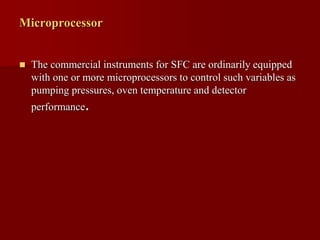
 The commercial instruments for SFC are ordinarily equipped
with one or more microprocessors to control such variables as
pumping pressures, oven temperature and detector
performance.
Detector
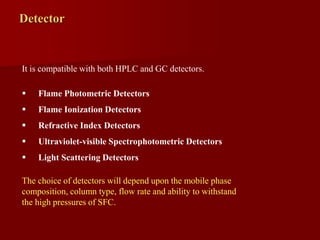
It is compatible with both HPLC and GC detectors.
 Flame Photometric Detectors
 Flame Ionization Detectors
 Refractive Index Detectors
 Ultraviolet-visible Spectrophotometric Detectors
 Light Scattering Detectors
The choice of detectors will depend upon the mobile phase
composition, column type, flow rate and ability to withstand
the high pressures of SFC.
Modifiers
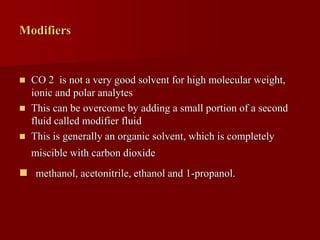
 CO 2 is not a very good solvent for high molecular weight,
ionic and polar analytes
 This can be overcome by adding a small portion of a second
fluid called modifier fluid
 This is generally an organic solvent, which is completely
miscible with carbon dioxide
 methanol, acetonitrile, ethanol and 1-propanol.
COMPARISION WITH OTHER TYPES OF
CHROMATOGRAPHY:-
 Several physical properties of SCF are intermediate between
gases and liquids.
 SFC is inherently faster than LC because the lower viscosity
makes use of higher flow rates.
 ability to separate thermally labile compounds (20% drugs)
 SFC is faster than HPLC, because of its lower viscosity and
higher diffusion rates
Unlike GC, by changing the mobile phase the selectivity can
be varied in SFC .
 Due to the thermally unstable or non- –volatile nature of many
nitrogen and / or sulfur containing compounds, they cannot be
analyzed by GC . Because SFC generally uses carbon dioxide,
collected as a byproduct of other chemical reactions or is
collected directly from the atmosphere, it contributes no new
chemicals to the environment.
 biggest advantage that SFC has over HPLC lies within the
differences in the mobile phases.
 Supercritical fluids are less viscous, possess a higher
diffusivity than liquids under HPLC conditions.This provides
not only the ability to increase column lengths, but also allows
for faster flow rates.
 SFC can be set up for sub ambient temperatures, which has
been key in many chiral separations .
APPLICATION OF SFC
 By now SFC has been applied to wide variety of
materials.
 natural products,
 drugs,
 foods,
 pesticides,
 herbicides,
 surfactants,
 polymers and polymer additives,
 Chiral compound
1) Natural Products
 Lipophilic – amphiphilic compounds with properties
between volatiles and hydrophilic compounds often create
problems in connection with their isolation and analytical
determination resulting in an analytical gray area,
 But SFC has been found to give relatively fast and simple
procedures for determination of oil constituents such as
chlorophyll and its derivatives .
 Separation of bile salts and common free bile acids like
ursodeoxycholic acid and chenodeoxycholic acid in
pharmaceutical preparation.
 separation of underivatized triterpene acids
 estimation of caffeine from tea and conjugated bile acids
 analysis of panaxadiol / panaxatriol in ginseng .
2) Pesticides
 analysis of pesticide residues in canned foods, fruits and
vegetables wherein pyrethroids, herbicides, fungicides and
carbamates have been tested .
1) Surfactants
 Separation of the oligomers in a sample of the
nonionic surfactant Triton X100 .
1) Lipids
for the analysis of high molecular weight lipids like
triacylglycerols.
analyze phospholipids
Separation of fatty acid methyl esters , biosynthetic
polyunsaturated fatty acids (PUFA) 37 ,
nonsaponifiable lipids , cholesterol and its esters in
human serum and food samples
1) Drugs
 phenothiazine antipscychotics,
 beta blockers,
 felodipine
 clevidipine ,
 methylated betacyclodextrins ,
 vasodialators like isosorbide mononitrate, isosorbide
dinitrate, cyclandelate, nimodipine, amlodipine
 oestrogens ,
 combinations of various nonsteroidal antiinflammatory
drugs like flufenamic acid, mefenamic acid, fenbufen,
indomethacin mixtures, flufenamic acid, mefenamic acid,
acetyl salicylic acid, ketoprofen and fenbufen
1) Chiral compounds
 , SFC has now become an attractive
alternative for chiral drug separation.
 SFC has been applied to separation of a large number of enantiomers,
diasterioisomers and geometrical isomers like achiral and chiral analysis
of camazepam and its metabolites, diasterioisomers of Du P105- a novel
oxazolidinone antibacterial agent , chiral separation of 1,3 dioxolane
derivatives,
 Organometallics
 Separation of metal chelates and organometals of
thermally labile category, chelates of transition
metals, heavy metals, lanthenides and actinides as
well as organometallic compounds of lead, mercury
and tin has been carried out by SFC. Determination
of solubility of organometallic compounds by SFC
is also reported
THANK YOU…

Supercritical chromatography

  • 1.
    Prepared by : SHINDEGANESH SHASHIKANT PRAVARA RURAL COLLEGE OF PHARMACY,PRAVARANAGAR SUPERCRITICAL FLUID CHROMETOGRAPHY
  • 2.
    SUPERCRITICAL FLUID CHROMATOGRAPHY Chromatography:- separation technique of complex chemical mixtures into individual components .  Various techniques.  Chromatography – mobile phase Gas chromatography - Gas Liquid chromatography - Liquid Supercritical fluid - Supercritical fluid chromatography
  • 3.
    S.F.C  Cost efficient User friendly  Better resolution  Faster analysis S.F.C is a column chromatographic technique in which supercritical fluid is used as a mobile phase.
  • 4.
    What is SUPERCRITICALFLUID?  SCF can be described as a fluid obtained by heating above the critical temperature and compressing above the critical pressure. Phase Diagram for Pure Substance
  • 6.
     For everysubstance, there is a temperature above which it can no longer exist as a liquid, no matter how much pressure is applied.  Likewise, there is a pressure above which the substance can no longer exist as a gas no matter how high the temperature is raised.  These points are called critical temperature and critical pressure respectively.  Above this point,the substance acts as a supercritical fluid .
  • 7.
    A supercritical fluidis any substance at a temperature and pressure above its critical point. It can diffuse through solids like a gas, and dissolve materials like a liquid. Additionally, close to the critical point, small changes in pressure or temperature result in large changes in density, allowing many properties to be "tuned". Supercritical fluids are suitable as a substitute for organic solvents in a range of industrial and laboratory processes
  • 8.
    In the Supercriticalregion the substance is neither a gas nor a liquid – it is a fluid that has properties of both. There are no sharp boundaries between gas and liquid. Properties of SCFs can be very different from the normal liquid phase.
  • 9.
    PROPERTIES AND ADVANTAGESOF SCF  high densities so they have a remarkable ability to dissolve large, non-volatile molecules .  dissolved analytes can be easily recovered by simply allowing the solutions to equilibrate with the atmosphere at low temperatures . So useful with thermally unstable analytes.  inexpensive  Ecofriendly  non-toxic
  • 10.
    PROPERTIES AND ADVANTAGESOF SCF  Lower viscosities relative to liquid solvents.  Greater diffusibility means longer column length can be used.  Higher diffusion coefficient means higher analysis speed that Comparison of properties of gas,SCF and liquid Property Gas (STP) SCF Liquid Density (g/cm 3 ) (0.6-2) x 10 -3 0.2-0.5 0.6-2 Diffusion coefficient (cm 2 /s) (1-4) x 10 -1 10 -3 x 10 - 4 (0.2-2) x 10 -5 Viscosity (G Cm -1 s -1 ) (1-4) x 10 - 4 (1-3) x 10 - 4 (0.2-3) x 10 -2
  • 11.
     The twosupercritical fluids of particular interest are , carbon dioxide and water.  Carbon dioxide :-  non-flammable,  nontoxic  low critical temperature of 31.9 C and moderate critical pressure of 73bar.  It is miscible with variety of organic solvents and is readily recovered after processing.  It diffuses faster than conventional liquid solvents.
  • 12.
  • 13.
    Above the criticalpoint, the phase boundary (meniscus) between liquid and vapor phases disappears, and the substance is a single homogeneous fluid
  • 14.
     Water . critical temperature of 647K and critical pressure of 220bar due to its high polarity.  The character of water at supercritical conditions changes from one that supports only ionic species at ambient conditions to one that dissolves paraffins, aromatics, gases and salts.  Due to this unique property, research has been carried out on supercritical water for reaction and separation processes to treat toxic wastewater.
  • 15.
  • 16.
    Density (kg/m 3 ) Viscosity (µPa∙s) Diffusivity (mm²/s) Gases 1 101-10 Supercritical Fluids 100-1000 50-100 0.01-0.1 Liquids 1000 500-1000 0.001 Comparison of Gases, Supercritical Fluids and Liquids
  • 17.
    INSTRUMENTATION  The instrumentationof SFC is similar in most regards to instrumentation for HPLC because the pressure and temperature required for creating supercritical fluid from several gases or liquids lie well within the operating limits of HPLC equipment  However, there are two main differences between the two. 1. a thermostated oven required to provide precise temperature control of the mobile phase 2. a restrictor to maintain the pressure in the column at a desired level and to convert the eluent from SCF to a gas for transfer to detector .
  • 19.
  • 20.
     the mobilephase is pumped as a liquid and is brought into the supercritical region by heating it above its supercritical temperature before it enters the analytical column.  It passes through an injection valve where the sample is introduced into the supercritical stream  It is maintained supercritical as it passes through the column into the detector by a pressure restrictor.
  • 21.
    Mobile phase  Thereare a number of possible fluids, which may be used in SFC as a mobile phase.  However, based on its low cost, low interference with chromatographic detectors and good physical properties (nontoxic, nonflammable, low critical values) CO2 is the most used mobile phase for SFC .  excellent solvent for a variety of nonpolar organic molecules.
  • 22.
    Column  Basically twotypes of analytical columns are used in SFC, 1) packed column 2) capillary column.  Earlier work employed absorbents such as alumna, silica or polystyrene .  More recent packed column work has involved bonded stationary phases such as octadecylsilyl (C 18 ).
  • 24.
    Restrictor  This isa device, which is used to maintain desired pressure in the column by - a pressure-adjustable diaphragm or - controlled nozzle so that the same column-outlet pressure is maintained irrespective of the mobile phase pump flow rate.  It keeps the mobile phase supercritical throughout the separation and often must be heated to prevent clogging.  The pressure restrictor is placed either after the detector or at the end of the column.
  • 25.
    Microprocessor  The commercialinstruments for SFC are ordinarily equipped with one or more microprocessors to control such variables as pumping pressures, oven temperature and detector performance.
  • 26.
    Detector It is compatiblewith both HPLC and GC detectors.  Flame Photometric Detectors  Flame Ionization Detectors  Refractive Index Detectors  Ultraviolet-visible Spectrophotometric Detectors  Light Scattering Detectors The choice of detectors will depend upon the mobile phase composition, column type, flow rate and ability to withstand the high pressures of SFC.
  • 27.
    Modifiers  CO 2is not a very good solvent for high molecular weight, ionic and polar analytes  This can be overcome by adding a small portion of a second fluid called modifier fluid  This is generally an organic solvent, which is completely miscible with carbon dioxide  methanol, acetonitrile, ethanol and 1-propanol.
  • 28.
    COMPARISION WITH OTHERTYPES OF CHROMATOGRAPHY:-  Several physical properties of SCF are intermediate between gases and liquids.  SFC is inherently faster than LC because the lower viscosity makes use of higher flow rates.  ability to separate thermally labile compounds (20% drugs)  SFC is faster than HPLC, because of its lower viscosity and higher diffusion rates Unlike GC, by changing the mobile phase the selectivity can be varied in SFC .
  • 29.
     Due tothe thermally unstable or non- –volatile nature of many nitrogen and / or sulfur containing compounds, they cannot be analyzed by GC . Because SFC generally uses carbon dioxide, collected as a byproduct of other chemical reactions or is collected directly from the atmosphere, it contributes no new chemicals to the environment.  biggest advantage that SFC has over HPLC lies within the differences in the mobile phases.  Supercritical fluids are less viscous, possess a higher diffusivity than liquids under HPLC conditions.This provides not only the ability to increase column lengths, but also allows for faster flow rates.
  • 30.
     SFC canbe set up for sub ambient temperatures, which has been key in many chiral separations .
  • 31.
    APPLICATION OF SFC By now SFC has been applied to wide variety of materials.  natural products,  drugs,  foods,  pesticides,  herbicides,  surfactants,  polymers and polymer additives,  Chiral compound
  • 32.
    1) Natural Products Lipophilic – amphiphilic compounds with properties between volatiles and hydrophilic compounds often create problems in connection with their isolation and analytical determination resulting in an analytical gray area,  But SFC has been found to give relatively fast and simple procedures for determination of oil constituents such as chlorophyll and its derivatives .  Separation of bile salts and common free bile acids like ursodeoxycholic acid and chenodeoxycholic acid in pharmaceutical preparation.
  • 33.
     separation ofunderivatized triterpene acids  estimation of caffeine from tea and conjugated bile acids  analysis of panaxadiol / panaxatriol in ginseng . 2) Pesticides  analysis of pesticide residues in canned foods, fruits and vegetables wherein pyrethroids, herbicides, fungicides and carbamates have been tested .
  • 34.
    1) Surfactants  Separationof the oligomers in a sample of the nonionic surfactant Triton X100 . 1) Lipids for the analysis of high molecular weight lipids like triacylglycerols. analyze phospholipids Separation of fatty acid methyl esters , biosynthetic polyunsaturated fatty acids (PUFA) 37 , nonsaponifiable lipids , cholesterol and its esters in human serum and food samples
  • 35.
    1) Drugs  phenothiazineantipscychotics,  beta blockers,  felodipine  clevidipine ,  methylated betacyclodextrins ,  vasodialators like isosorbide mononitrate, isosorbide dinitrate, cyclandelate, nimodipine, amlodipine
  • 36.
     oestrogens , combinations of various nonsteroidal antiinflammatory drugs like flufenamic acid, mefenamic acid, fenbufen, indomethacin mixtures, flufenamic acid, mefenamic acid, acetyl salicylic acid, ketoprofen and fenbufen 1) Chiral compounds  , SFC has now become an attractive alternative for chiral drug separation.
  • 37.
     SFC hasbeen applied to separation of a large number of enantiomers, diasterioisomers and geometrical isomers like achiral and chiral analysis of camazepam and its metabolites, diasterioisomers of Du P105- a novel oxazolidinone antibacterial agent , chiral separation of 1,3 dioxolane derivatives,  Organometallics  Separation of metal chelates and organometals of thermally labile category, chelates of transition metals, heavy metals, lanthenides and actinides as well as organometallic compounds of lead, mercury and tin has been carried out by SFC. Determination of solubility of organometallic compounds by SFC is also reported
  • 38.