SUPER CRITICAL FLUID
CHROMATOGRAPHY
BY
SSB.SAIKANTH BABU (M.PHARMACY PA.QC)
SUBMITTED TO
DR.A.SRINIVAS RAO
HEAD OF DEPARTMENT PA.QA
Super critical Fluid
Chromatography
(SFC) is a form of normal phase
chromatography, first used in 1962 that is
used for the analysis and purification of low
to moderate mol.wt, thermally labile
molecules.
It can also be used for the separation of
chiral compounds.
Principles are similar to those of (HPLC),
however SFC typically utilizes CO2as the
mobile supercritical fluid chromatography is
sometimes called "convergence
chromatography."
Important Properties of
Supercritical Fluids
A supercritical fluid is formed whenever a
substance is heated above its critical
temperature. At the critical temperature, a
substance can no longer be condensed
into its liquid state through the application
of pressure.
The physical properties of a substance in
the supercritical-fluid state can be
remarkably different from the same
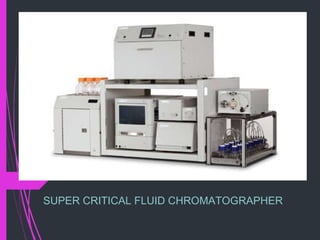
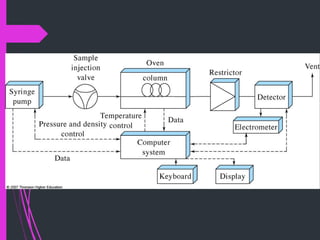
SUPER CRITICAL FLUID CHROMATOGRAPHER
Supercritical Fluids
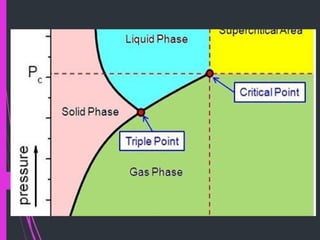
 At temperatures and pressures above
its critical temperature and pressure
(critical point), a substance is called a
supercritical fluid.
 The critical temperature is the
temperature above which a distinct
liquid phase cannot exist. The vapour
pressure at its critical temperature is its
critical pressure.
SFC Mobile Phases
 The mobile phase is composed primarily of CARBON
DIOXIDE, but since CO2 on its own is too non-polar to
effectively elute many analytes, cosolvents are
added to modify the mobile phase polarity.
 Cosolvents are typically simple alcohols like
METHANOL, ETHANOL, or ISOPROPYL ALCOHOL. Other
solvents such as ACETONITRILE, CHLOROFORM, or
ETHYL ACETATE can be used as modifiers.The solvent
limitations are system and column based.
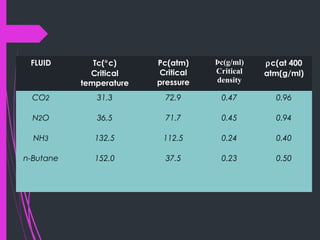
FLUID Tc(°c)
Critical
temperature
Pc(atm)
Critical
pressure
Þc(g/ml)
Critical
density
ρc(at 400
atm(g/ml)
CO2 31.3 72.9 0.47 0.96
N2O 36.5 71.7 0.45 0.94
NH3 132.5 112.5 0.24 0.40
n-Butane 152.0 37.5 0.23 0.50
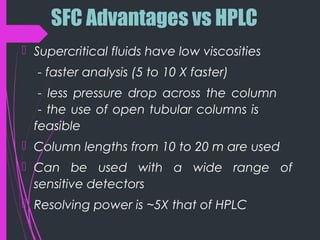
SFC Advantages vs HPLC
 Supercritical fluids have low viscosities
- faster analysis (5 to 10 X faster)
- less pressure drop across the column
- the use of open tubular columns is
feasible
 Column lengths from 10 to 20 m are used
 Can be used with a wide range of
sensitive detectors
 Resolving power is ~5X that of HPLC
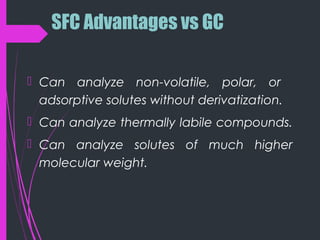
SFC Advantages vs GC
 Can analyze non-volatile, polar, or
adsorptive solutes without derivatization.
 Can analyze thermally labile compounds.
 Can analyze solutes of much higher
molecular weight.
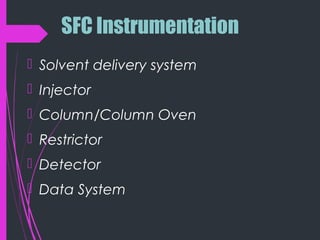
SFC Instrumentation
 Solvent delivery system
 Injector
 Column/Column Oven
 Restrictor
 Detector
 Data System
Injectors
 Typical HPLC design injectors for
packed columns.
 Split/Splitless valve injector (0.01
to 0.05 µL injections) for open
tubular columns.
 Timed - split injector (0.01 to 0.05
µL injections) for open tubular
columns.
Detectors
 Most any detector used in GC or
HPLC can be used.
 FID and UV detectors commonly
used.
 Coupled Detectors
- Mass spectroscopy
-FourierTransformedInfrared
Spectroscopy
SFC Columns
 Open tubular (derived from GC)
- Large # theoretical plates (~X500)
- Easier to control pressure (low P
drop)
 Packed (derived from HPLC)
- Faster analysis
- Higher flow rates
- Higher sample capacity
Open Tubular Columns
 Smaller than GC capillary columns,
typically 50 µm i.d., 10 to 20 m in
length
 MP must be more stable due to
extreme conditions of supercritical
fluids
Packed Columns
 Similar to HPLC columns (10, 5, or 3 µm
porous particles)
 Silica based chemically bonded
phases
 Typically 10 cm long X 4.6 mm i.d
SFC Mobile Phases
 Generally non-polar compounds with low
to moderate critical properties
- CO2, N2O, ethane, pentane
 Normal phase type separations
- non-polar mp and low polarity sp
(substrate + amino, diol, or cyano groups)
 Elution = function of molecular mass &
polarity
Carbon Dioxide: SFC Solvent
 Low Tc
- operating T as low as 40o
C
 Moderate Pc and ρc of 0.448g/cm3
- reach high ρ with P < 40 MPa
 Safe to use
-nontoxic, nonflammable,
noncorrosive, inert
 Detector compatible
 Wide ρ range
Other SFC Solvents
 Nitrous Oxide - Similar in solvating
and separations properties to CO2
 Alkanes - less safe and not as
detector compatible than CO2
- better solvent characteristics for
non-polar solutes
 Halocarbons, xenon, etc. - specialty
applications only
 More polar solvents for highly polar
Solvent Modifiers
 Add organic modifiers to > solvent
strength
- methanol
- isopropanol
- dichloromethane
- THF
- acetonitrile

Saikanth(sfc)

  • 1.
    SUPER CRITICAL FLUID CHROMATOGRAPHY BY SSB.SAIKANTHBABU (M.PHARMACY PA.QC) SUBMITTED TO DR.A.SRINIVAS RAO HEAD OF DEPARTMENT PA.QA
  • 2.
    Super critical Fluid Chromatography (SFC)is a form of normal phase chromatography, first used in 1962 that is used for the analysis and purification of low to moderate mol.wt, thermally labile molecules. It can also be used for the separation of chiral compounds. Principles are similar to those of (HPLC), however SFC typically utilizes CO2as the mobile supercritical fluid chromatography is sometimes called "convergence chromatography."
  • 3.
    Important Properties of SupercriticalFluids A supercritical fluid is formed whenever a substance is heated above its critical temperature. At the critical temperature, a substance can no longer be condensed into its liquid state through the application of pressure. The physical properties of a substance in the supercritical-fluid state can be remarkably different from the same
  • 4.
    SUPER CRITICAL FLUIDCHROMATOGRAPHER
  • 5.
    Supercritical Fluids  Attemperatures and pressures above its critical temperature and pressure (critical point), a substance is called a supercritical fluid.  The critical temperature is the temperature above which a distinct liquid phase cannot exist. The vapour pressure at its critical temperature is its critical pressure.
  • 7.
    SFC Mobile Phases The mobile phase is composed primarily of CARBON DIOXIDE, but since CO2 on its own is too non-polar to effectively elute many analytes, cosolvents are added to modify the mobile phase polarity.  Cosolvents are typically simple alcohols like METHANOL, ETHANOL, or ISOPROPYL ALCOHOL. Other solvents such as ACETONITRILE, CHLOROFORM, or ETHYL ACETATE can be used as modifiers.The solvent limitations are system and column based.
  • 8.
    FLUID Tc(°c) Critical temperature Pc(atm) Critical pressure Þc(g/ml) Critical density ρc(at 400 atm(g/ml) CO231.3 72.9 0.47 0.96 N2O 36.5 71.7 0.45 0.94 NH3 132.5 112.5 0.24 0.40 n-Butane 152.0 37.5 0.23 0.50
  • 9.
    SFC Advantages vsHPLC  Supercritical fluids have low viscosities - faster analysis (5 to 10 X faster) - less pressure drop across the column - the use of open tubular columns is feasible  Column lengths from 10 to 20 m are used  Can be used with a wide range of sensitive detectors  Resolving power is ~5X that of HPLC
  • 10.
    SFC Advantages vsGC  Can analyze non-volatile, polar, or adsorptive solutes without derivatization.  Can analyze thermally labile compounds.  Can analyze solutes of much higher molecular weight.
  • 11.
    SFC Instrumentation  Solventdelivery system  Injector  Column/Column Oven  Restrictor  Detector  Data System
  • 13.
    Injectors  Typical HPLCdesign injectors for packed columns.  Split/Splitless valve injector (0.01 to 0.05 µL injections) for open tubular columns.  Timed - split injector (0.01 to 0.05 µL injections) for open tubular columns.
  • 14.
    Detectors  Most anydetector used in GC or HPLC can be used.  FID and UV detectors commonly used.  Coupled Detectors - Mass spectroscopy -FourierTransformedInfrared Spectroscopy
  • 15.
    SFC Columns  Opentubular (derived from GC) - Large # theoretical plates (~X500) - Easier to control pressure (low P drop)  Packed (derived from HPLC) - Faster analysis - Higher flow rates - Higher sample capacity
  • 16.
    Open Tubular Columns Smaller than GC capillary columns, typically 50 µm i.d., 10 to 20 m in length  MP must be more stable due to extreme conditions of supercritical fluids
  • 17.
    Packed Columns  Similarto HPLC columns (10, 5, or 3 µm porous particles)  Silica based chemically bonded phases  Typically 10 cm long X 4.6 mm i.d
  • 18.
    SFC Mobile Phases Generally non-polar compounds with low to moderate critical properties - CO2, N2O, ethane, pentane  Normal phase type separations - non-polar mp and low polarity sp (substrate + amino, diol, or cyano groups)  Elution = function of molecular mass & polarity
  • 19.
    Carbon Dioxide: SFCSolvent  Low Tc - operating T as low as 40o C  Moderate Pc and ρc of 0.448g/cm3 - reach high ρ with P < 40 MPa  Safe to use -nontoxic, nonflammable, noncorrosive, inert  Detector compatible  Wide ρ range
  • 20.
    Other SFC Solvents Nitrous Oxide - Similar in solvating and separations properties to CO2  Alkanes - less safe and not as detector compatible than CO2 - better solvent characteristics for non-polar solutes  Halocarbons, xenon, etc. - specialty applications only  More polar solvents for highly polar
  • 21.
    Solvent Modifiers  Addorganic modifiers to > solvent strength - methanol - isopropanol - dichloromethane - THF - acetonitrile