SUPERCOMPUTERS


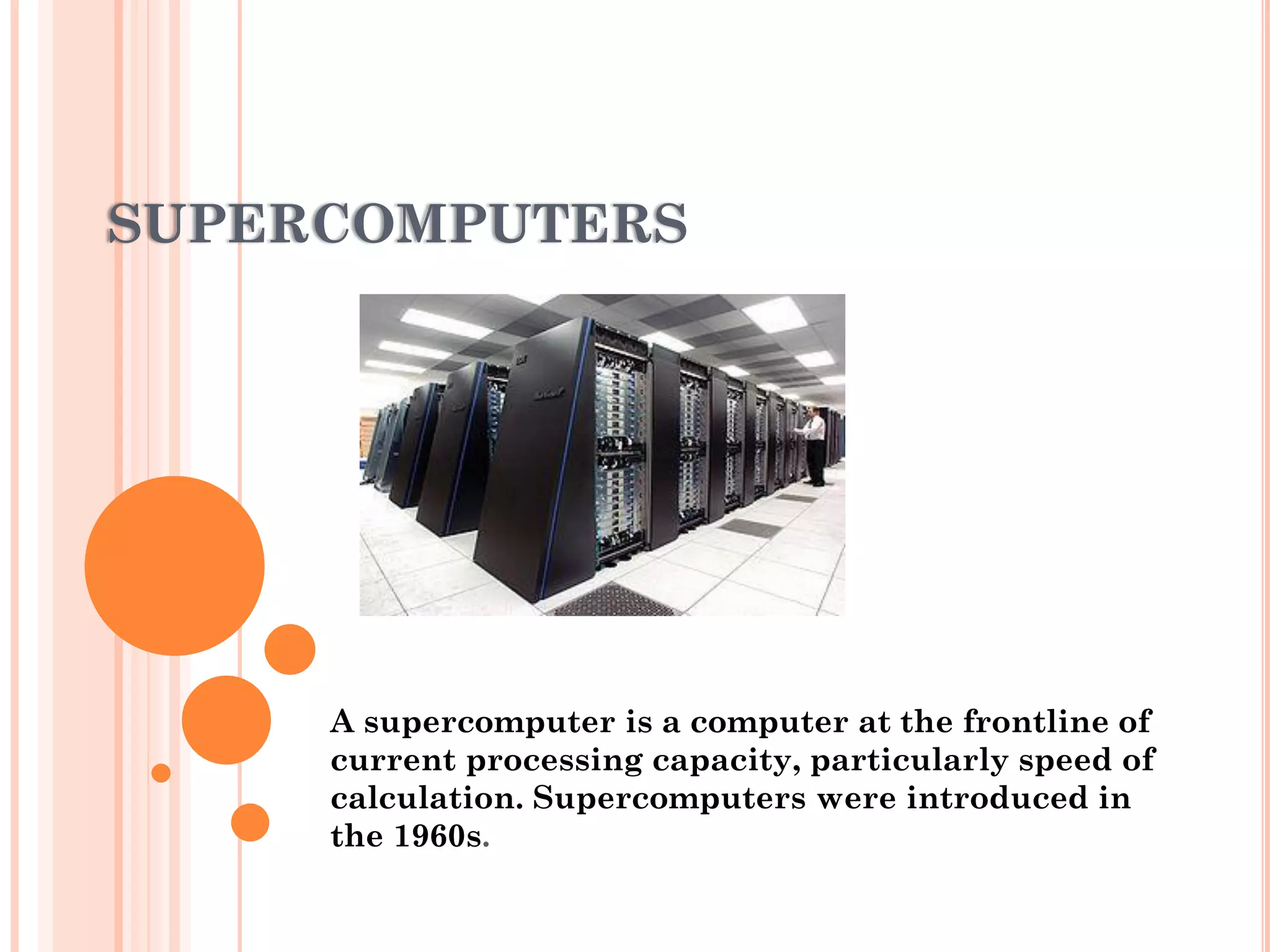
     A supercomputer is a computer at the frontline of
     current processing capacity, particularly speed of
     calculation. Supercomputers were introduced in
     the 1960s.
WHAT GENERALLY IS A
“SUPERCOMPUTER”?
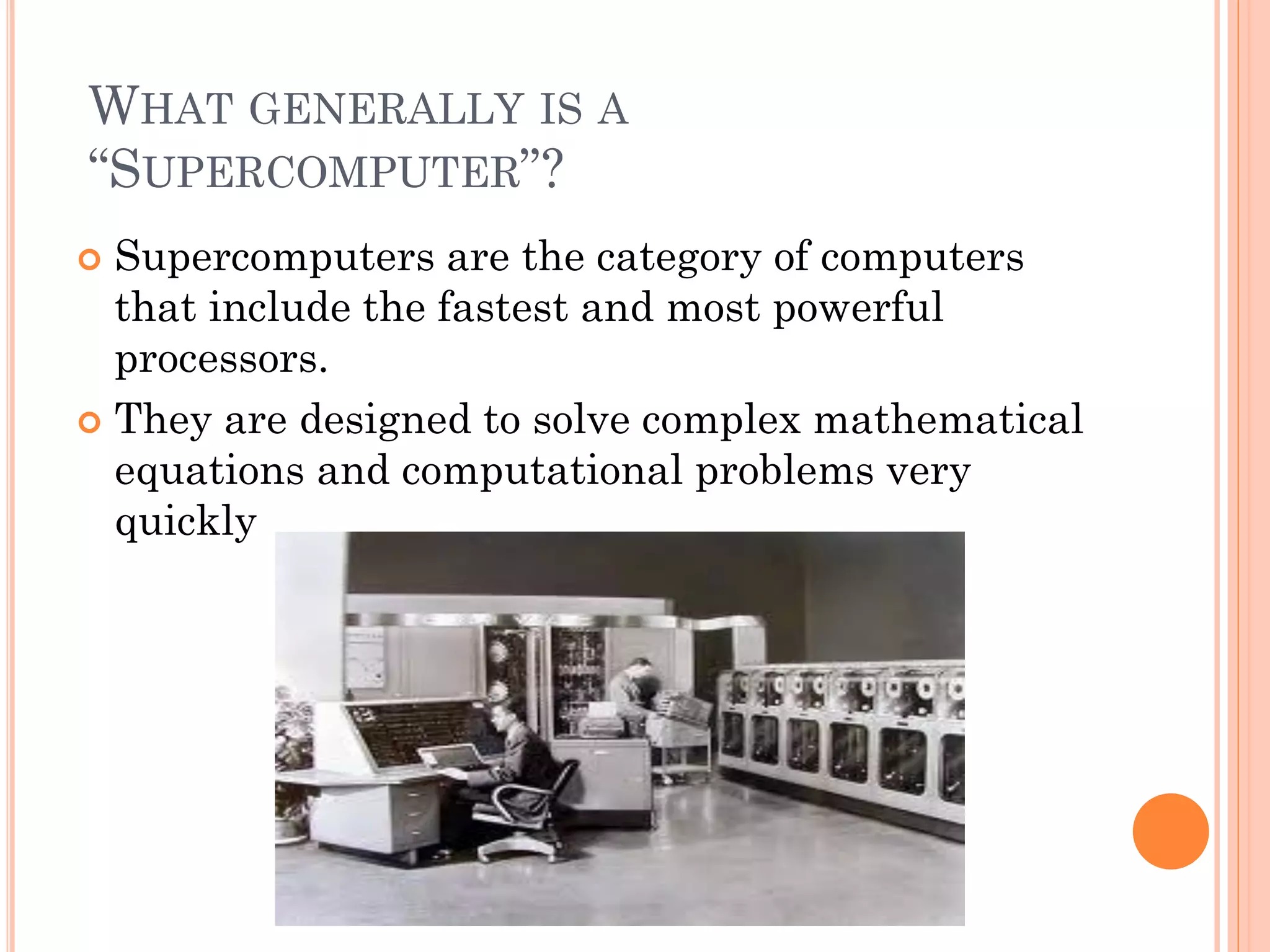
 Supercomputers are the category of computers
  that include the fastest and most powerful
  processors.
 They are designed to solve complex mathematical
  equations and computational problems very
  quickly
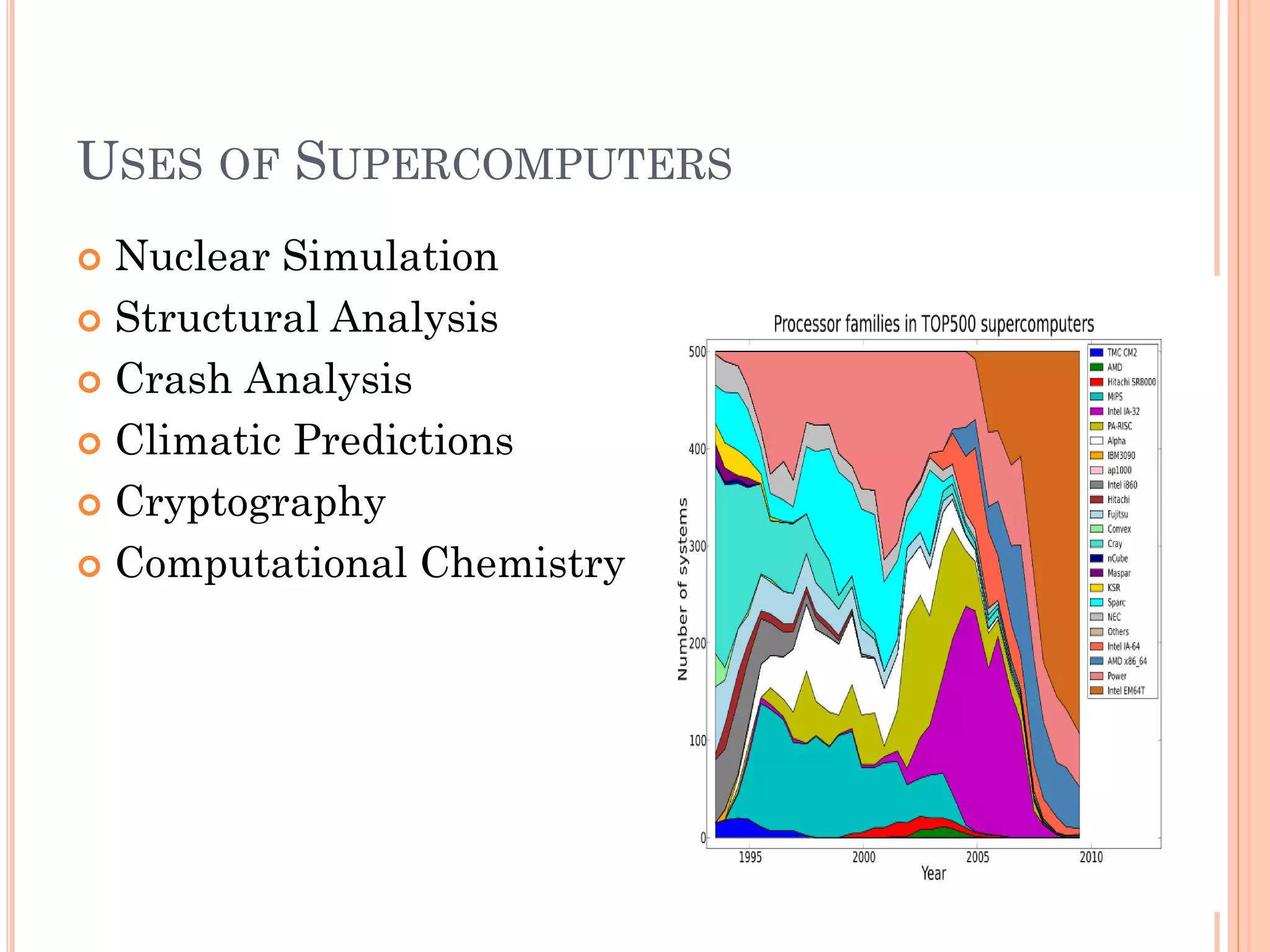
USES OF SUPERCOMPUTERS
 Nuclear Simulation
 Structural Analysis

 Crash Analysis

 Climatic Predictions

 Cryptography

 Computational Chemistry
21ST CENTURY SUPERCOMPUTING
             ARCHITECTURAL TRENDS


   The air cooled IBM Blue Gene supercomputer
    architecture trades processor speed for low power
    consumption so that a larger number of processors can
    be used at room temperature, by using normal air-
    conditioning. The second generation Blue Gene/P
    system is distinguished by the fact that each chip can
    act as a 4-way symmetric multiprocessor and also
    includes the logic for node-to-node communication. And
    at 371 MFLOPS/W the system is very energy efficient.
   The K computer is a water-cooled, homogeneous
    processor, distributed memory system with a
    cluster architecture. It uses more than 80,000
    SPARC-based processors, each with eight cores,
    for a total of over 700,000 cores – almost twice as
    many as any other system. It comprises more
    than 800 cabinets, each with 96 computing nodes
    (each with 16 GB of memory), and 6 I/O nodes.
    Although it is more powerful than the next five
    systems on the TOP500 list combined, at 824.56
    MFLOPS/W it has the lowest power to
    performance ratio of any current major
    supercomputer system. The follow up system for
    the K computer, called the PRIMEHPC FX10
    uses the same 6 dimensional torus interconnect,
    but still only one SPARC processor per node.
   Unlike the K computer, the Tianhe-1A system
    uses a hybrid architecture and integrates CPUs
    and GPUs. It uses more than 14,000 Xeon
    general-purpose processors and more than 7,000
    Nvidia Tesla graphic-based processors on about
    3,500 blades. It has 112 computer cabinets and
    262 terabytes of distributed memory; 2 petabytes
    of disk storage is implemented via Lustre
    clustered files. Tianhe-1 uses a proprietary high-
    speed communication network to connect the
    processors. The proprietary interconnect network
    was based on the Infiniband QDR, enhanced with
    Chinese made FeiTeng-1000 CPUs. In the case of
    the interconnect the system is twice as fast as the
    Infiniband, but slower than some interconnects
    on other supercomputers.
Supercomputers

Supercomputers

  • 1.
    SUPERCOMPUTERS A supercomputer is a computer at the frontline of current processing capacity, particularly speed of calculation. Supercomputers were introduced in the 1960s.
  • 2.
    WHAT GENERALLY ISA “SUPERCOMPUTER”?  Supercomputers are the category of computers that include the fastest and most powerful processors.  They are designed to solve complex mathematical equations and computational problems very quickly
  • 3.
    USES OF SUPERCOMPUTERS Nuclear Simulation  Structural Analysis  Crash Analysis  Climatic Predictions  Cryptography  Computational Chemistry
  • 4.
    21ST CENTURY SUPERCOMPUTING ARCHITECTURAL TRENDS  The air cooled IBM Blue Gene supercomputer architecture trades processor speed for low power consumption so that a larger number of processors can be used at room temperature, by using normal air- conditioning. The second generation Blue Gene/P system is distinguished by the fact that each chip can act as a 4-way symmetric multiprocessor and also includes the logic for node-to-node communication. And at 371 MFLOPS/W the system is very energy efficient.
  • 5.
    The K computer is a water-cooled, homogeneous processor, distributed memory system with a cluster architecture. It uses more than 80,000 SPARC-based processors, each with eight cores, for a total of over 700,000 cores – almost twice as many as any other system. It comprises more than 800 cabinets, each with 96 computing nodes (each with 16 GB of memory), and 6 I/O nodes. Although it is more powerful than the next five systems on the TOP500 list combined, at 824.56 MFLOPS/W it has the lowest power to performance ratio of any current major supercomputer system. The follow up system for the K computer, called the PRIMEHPC FX10 uses the same 6 dimensional torus interconnect, but still only one SPARC processor per node.
  • 6.
    Unlike the K computer, the Tianhe-1A system uses a hybrid architecture and integrates CPUs and GPUs. It uses more than 14,000 Xeon general-purpose processors and more than 7,000 Nvidia Tesla graphic-based processors on about 3,500 blades. It has 112 computer cabinets and 262 terabytes of distributed memory; 2 petabytes of disk storage is implemented via Lustre clustered files. Tianhe-1 uses a proprietary high- speed communication network to connect the processors. The proprietary interconnect network was based on the Infiniband QDR, enhanced with Chinese made FeiTeng-1000 CPUs. In the case of the interconnect the system is twice as fast as the Infiniband, but slower than some interconnects on other supercomputers.