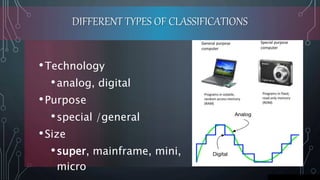
•Technology
•analog, digital
•Purpose
•special /general
•Size
•super, mainframe, mini,
micro
DIFFERENT TYPES OF CLASSIFICATIONS
WHAT IS A SUPER COMPUTER
A supercomputer is a computer that
performs at or near the currently
highest operational rate for
computers. Traditionally,
supercomputers have been used for
scientific and engineering applications
that must handle very large databases
or do a great amount of computation.
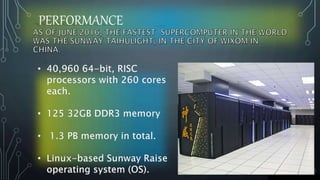
PERFORMANCE
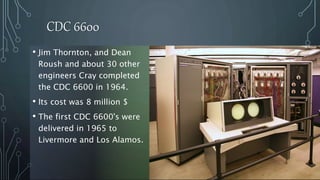
CDC 6600
• Jim Thornton, and Dean
Roush and about 30 other
engineers Cray completed
the CDC 6600 in 1964.
• Its cost was 8 million $
• The first CDC 6600's were
delivered in 1965 to
Livermore and Los Alamos.
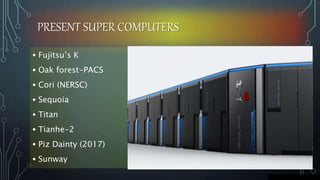
PRESENT SUPER COMPUTERS
• Fujitsu’s K
• Oak forest-PACS
• Cori (NERSC)
• Sequoia
• Titan
• Tianhe-2
• Piz Dainty (2017)
• Sunway
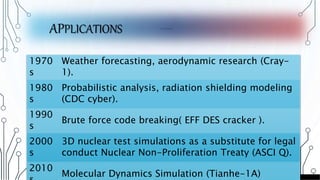
APPLICATIONS
1970
s
Weather forecasting, aerodynamic research (Cray-
1).
1980
s
Probabilistic analysis, radiation shielding modeling
(CDC cyber).
1990
s
Brute force code breaking( EFF DES cracker ).
2000
s
3D nuclear test simulations as a substitute for legal
conduct Nuclear Non-Proliferation Treaty (ASCI Q).
2010
Molecular Dynamics Simulation (Tianhe-1A)
Super computers
Super computers

Super computers

  • 2.
    •Technology •analog, digital •Purpose •special /general •Size •super,mainframe, mini, micro DIFFERENT TYPES OF CLASSIFICATIONS
  • 3.
    WHAT IS ASUPER COMPUTER A supercomputer is a computer that performs at or near the currently highest operational rate for computers. Traditionally, supercomputers have been used for scientific and engineering applications that must handle very large databases or do a great amount of computation.
  • 4.
  • 5.
    CDC 6600 • JimThornton, and Dean Roush and about 30 other engineers Cray completed the CDC 6600 in 1964. • Its cost was 8 million $ • The first CDC 6600's were delivered in 1965 to Livermore and Los Alamos.
  • 6.
    PRESENT SUPER COMPUTERS •Fujitsu’s K • Oak forest-PACS • Cori (NERSC) • Sequoia • Titan • Tianhe-2 • Piz Dainty (2017) • Sunway
  • 7.
    APPLICATIONS 1970 s Weather forecasting, aerodynamicresearch (Cray- 1). 1980 s Probabilistic analysis, radiation shielding modeling (CDC cyber). 1990 s Brute force code breaking( EFF DES cracker ). 2000 s 3D nuclear test simulations as a substitute for legal conduct Nuclear Non-Proliferation Treaty (ASCI Q). 2010 Molecular Dynamics Simulation (Tianhe-1A)