The document discusses different types of computers categorized by their processing power and common uses. Supercomputers are the most powerful and used by large organizations for intensive tasks. Mainframe computers have high-speed processing and storage and are commonly used by banks and insurance companies. Mid-range computers are for medium-sized businesses and specific applications. Microcomputers or desktop computers are the most widely used type, including desktop and notebook/laptop computers used in homes and most businesses. Handheld computers are the smallest, palm-sized devices including early palm-top computers and current personal digital assistants (PDAs).
In this document
Powered by AI
This slide introduces the concept of different types of computers and the presenter.
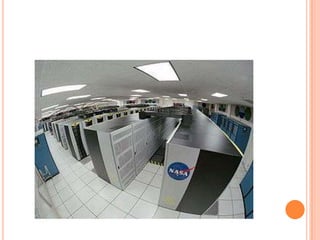
Supercomputers are high-capacity computers used by large entities like NASA and governments.
Mainframes are less powerful than supercomputers but excel in processing speed, used primarily by banks.
Mid-range computers serve medium-sized enterprises for specific operations, often called minicomputers.
Microcomputers include desktops for general use and notebooks for portability.
Tablets are advanced notebooks with touch features; handhelds are compact, combining many functionalities.
Types of ComputersByMaryDelle M. ObedozaNorthPoint Institute of Technology- BinalbaganBinalbagan, Negros Occidental
2.
Super computersAre themost powerful available. These computers are high capacity computers that run continuously and are being used by very big organizations mostly big corporations and government institutions. Users of super computers include NASA and US government, some big schools of companies.
4.
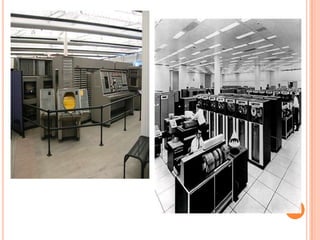
Mainframe computersAre lesspowerful than super computers but are capable of great processing speed, multi tasking capability and high data storage. They are used by most banks to process information of depositors and millions of daily bank transactions. Insurance companies use them for their policy holders database. These computers have specialized wiring system and usually occupies a big room with temperature control.
6.
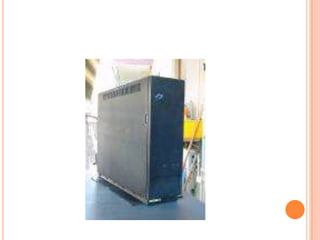
Mid-range computersAre usedfor medium sized companies for specific purposes. They may be used for certain assembly line operations or manufacturing stages in big companies. The size of mini computers may be as a washing machine. It may be a stand alone system for specialized applications including network servers. They are also called minicomputers.
8.
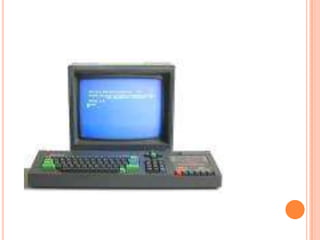
Microcomputers or desktopComputersAre the most common and widely used computer today. There are two types of microcomputers, they are the desktop computers and the notebook computer. Desktop computers are the common computer that you see in homes, schools, and in most businesses. They are small enough to be placed on a desk or table but are too big to be carried around.
10.
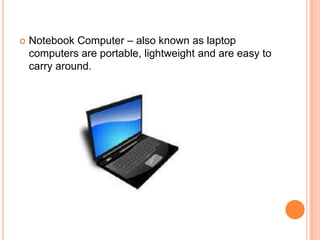
Notebook Computer –also known as laptop computers are portable, lightweight and are easy to carry around.
11.
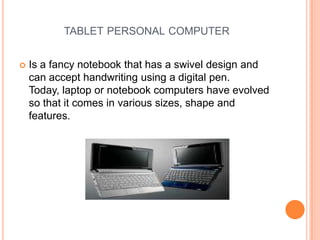
tablet personal computerIs a fancy notebook that has a swivel design and can accept handwriting using a digital pen. Today, laptop or notebook computers have evolved so that it comes in various sizes, shape and features.
12.
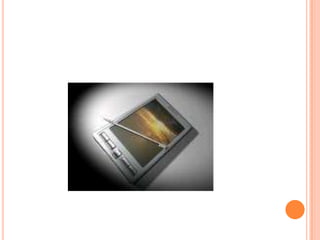
Handheld computerAre thesmallest computers that are designed to fit into one hand or palm that is why they are also called palm-top computers. These computers may combine pen input, personal organizer tools and communication capabilities such as telephone and internet applications. Personal digital assistants or PDAs are the most common palm-top or hand held computers available today. It is so because PDAs have all the features of a cell phone, organizer and some basic computers application into one. And in some cases, it even includes camera, audio and video capabilities.