Trinity: 
Advanced 
Technology 
System 
for 
the 
ASC 
Program 
Manuel Vigil 
Trinity Project Director 
High Performance Computing Division 
Los Alamos National Laboratory 
HPC 
User 
Forum 
September 
17, 
2014 
LA-­‐UR-­‐14-­‐27024
NERSC-8 and Trinity team activities 
Market 
surveys 
NERSC-­‐8 
Trinity 
Market 
surveys 
Joint 
Market 
surveys 
Crea6ng 
requirements 
Release 
RFP 
Vendor 
Selec6on 
Some 
joint 
nego6a6ons 
Common 
base 
SOW 
language? 
Nego6a6ons 
Con$nue 
to 
work 
together 
for 
CORI 
and 
Trinity 
deployments 
Nego6a6ons 
Separate 
SOWs 
Separate 
SOWs
Topics 
• Trinity 
Status 
• ASC 
Compu@ng 
Strategy 
• Trinity 
Project 
Drivers 
& 
Mission 
Need 
• The 
Trinity 
System 
– High-­‐level 
architecture 
overview 
– High-­‐level 
capabili@es 
– Schedule 
• Summary 
3
Trinity 
Status 
• Formal 
Design 
Review 
and 
Independent 
Project 
Review 
completed 
in 
2013 
• Trinity/NERSC8 
RFP 
released 
August 
2013 
• Technical 
Evalua@on 
of 
the 
proposals 
completed 
September 
2013 
• Ini@al 
nego@a@ons 
for 
both 
systems 
completed 
November 
2013 
• Ini@al 
Trinity 
system 
procurement 
completed 
in 
late 
2013/early 
2014 
– Before 
final 
approval 
Trinity 
went 
back 
to 
the 
proposing 
vendors 
for 
a 
Best 
and 
Final 
Offer 
(BAFO) 
– Target 
delivery 
date 
of 
September 
2015 
is 
unchanged 
• Trinity 
Best 
and 
Final 
Offer 
RFP 
released 
to 
vendors 
March 
2014 
• Trinity 
proposal 
evalua@ons 
and 
nego@a@ons 
completed 
April 
2014 
• Trinity 
Procurement 
Approval 
– 
No@ce 
of 
Consent 
from 
NNSA 
received 
May 
16, 
2014 
• Trinity 
Independent 
Cost 
Review 
completed 
May 
2014 
• Trinity 
CD-­‐2/3b 
approved 
July 
3, 
2014 
• Trinity 
Contract 
Awarded 
to 
Cray, 
Inc. 
on 
July 
9, 
2014 
4
ASC 
Compu;ng 
Strategy 
• Approach: Two classes of systems 
– Advanced Technology: First-of-a-kind systems that identify and foster 
technical capabilities and features that are beneficial to ASC 
applications 
– Commodity Technology: Robust, cost-effective systems to meet the 
day-to-day simulation workload needs of the program 
• Advanced Technology Systems 
– Leadership-class platforms 
– Pursue promising new technology paths 
– These systems are to meet unique mission needs and to help prepare 
the program for future system designs 
– Includes Non-Recurring Engineering (NRE) funding to enable delivery of 
leading-edge platforms 
– Acquire right-sized platforms to meet the mission needs 
– Trinity will be deployed by ACES (New Mexico Alliance for Computing at 
Extreme Scale, i.e., Los Alamos & Sandia) 
5
Advanced Technology 
Systems (ATS) 
Cielo 
(LANL/SNL) 
Sequoia 
(LLNL) 
‘12 ‘13 ‘14 ‘15 ‘16 ‘17 
Fiscal Year 
Use 
Retire 
‘18 ‘19 ‘20 
Commodity 
Technology 
Systems (CTS) 
Dev. & 
Deploy 
ATS 
1 
– 
Trinity 
(LANL/SNL) 
ATS 
2 
– 
(LLNL) 
ATS 
3 
– 
(LANL/SNL) 
Tri-­‐lab 
Linux 
Capacity 
Cluster 
II 
(TLCC 
II) 
CTS 
1 
CTS 
2 
‘21 
System 
Delivery 
ASC 
Plaborm 
Timeline 
ASC 
Compu@ng 
Strategy 
includes 
applica@on 
code 
transi@on 
for 
all 
plaborms 
6
Trinity 
Project 
Drivers 
and 
Mission 
Need 
• Sa@sfy 
the 
mission 
need 
for 
more 
capable 
plaborms 
– Trinity 
is 
designed 
to 
support 
the 
largest, 
most 
demanding 
ASC 
applica@ons 
– Increases 
in 
geometric 
and 
physics 
fideli@es 
while 
sa@sfying 
analysts’ 
@me-­‐to-­‐ 
solu@on 
expecta@ons 
• Mission 
Need 
developed 
with 
tri-­‐lab 
input 
• Trinity 
will 
support 
the 
tri-­‐lab 
applica@ons 
community 
at 
LLNL, 
SNL, 
and 
LANL 
• Mission 
Need 
Requirements 
are 
primarily 
driving 
memory 
capacity 
– Over 
2 
PB 
of 
aggregate 
main 
memory 
– Trinity 
is 
sized 
to 
run 
several 
jobs 
using 
about 
750 
TBytes 
of 
memory 
7
Overview 
of 
Trinity 
Award 
• Subcontractor 
– Cray, 
Inc. 
• Firm 
Fixed 
Price 
Subcontract: 
– Trinity 
Plaborm 
(including 
File 
System) 
– Burst 
Buffer 
– 2 
Applica@on 
Regression 
Test 
Systems 
– 1 
System 
Development 
Test 
System 
– On-­‐site 
System 
and 
Applica@on 
Analysts 
– Center 
of 
Excellence 
for 
Applica@on 
Transi@on 
Support 
– Advanced 
Power 
Management 
– Trinity 
System 
Maintenance 
8
Trinity 
PlaBorm 
• Trinity 
is 
a 
single 
system 
that 
contains 
both 
Intel 
Haswell 
and 
Knights 
Landing 
processors 
– Haswell 
par@@on 
sa@sfies 
FY15 
mission 
needs 
(well 
suited 
to 
exis@ng 
codes). 
– KNL 
par@@on 
delivered 
in 
FY16 
results 
in 
a 
system 
significantly 
more 
capable 
than 
current 
plaborms 
and 
provides 
the 
applica@on 
developers 
with 
an 
ahrac@ve 
next-­‐genera@on 
target 
(and 
significant 
challenges) 
– Aries 
interconnect 
with 
the 
Dragonfly 
network 
topology 
• Based 
on 
mature 
Cray 
XC30 
architecture 
with 
Trinity 
introducing 
new 
architectural 
features 
– Intel 
Knights 
Landing 
(KNL) 
processors 
– Burst 
Buffer 
storage 
nodes 
– Advanced 
power 
management 
system 
sokware 
enhancements 
9
Trinity 
PlaBorm 
• Trinity 
is 
enabling 
new 
architecture 
features 
in 
a 
produc@on 
compu@ng 
environment 
– Trinity’s 
architecture 
will 
introduce 
new 
challenges 
for 
code 
teams: 
transi@on 
from 
mul@-­‐ 
core 
to 
many-­‐core, 
high-­‐speed 
on-­‐chip 
memory 
subsystem, 
wider 
SIMD/vector 
units 
– Tightly 
coupled 
solid 
state 
storage 
serves 
as 
a 
“burst 
buffer” 
for 
checkpoint/restart 
file 
I/O 
& 
data 
analy@cs, 
enabling 
improved 
@me-­‐to-­‐ 
solu@on 
efficiencies 
– Advanced 
power 
management 
features 
enable 
measurement 
and 
control 
at 
the 
system, 
node, 
and 
component 
levels, 
allowing 
explora@on 
of 
applica@on 
performance/wah 
and 
reducing 
total 
cost 
of 
ownership 
• Managed 
Risk 
– Cray 
XC30 
architecture 
minimizes 
system 
sokware 
risk 
and 
provides 
a 
mature 
high-­‐speed 
interconnect 
– Haswell 
par@@on 
is 
low 
risk 
as 
technology; 
available 
in 
Fall 
CY14 
– KNL 
is 
higher 
risk 
due 
to 
new 
technology, 
but 
provides 
a 
reasonable 
path, 
and 
resource, 
for 
code 
teams 
to 
transi@on 
to 
the 
many-­‐core 
architecture 
10
11
Trinity 
Architecture 
Overview 
Metric 
Trinity 
Node 
Architecture 
KNL 
+ 
Haswell 
Haswell 
Par@@on 
KNL 
Par@@on 
Memory 
Capacity 
2.11 
PB 
>1 
PB 
>1 
PB 
Memory 
BW 
>7PB/sec 
>1 
PB/s 
>1PB/s 
+>4PB/s 
Peak 
FLOPS 
42.2 
PF 
11.5 
PF 
30.7 
PF 
Number 
of 
Nodes 
19,000+ 
>9,500 
>9500 
Number 
of 
Cores 
>760,000 
>190,000 
>570000 
Number 
of 
Cabs 
(incl 
I/O 
& 
BB) 
112 
PFS 
Capacity 
(usable) 
82 
PB 
usable 
PFS 
Bandwidth 
(sustained) 
1.45 
TB/s 
BB 
Capacity 
(usable) 
3.7 
PB 
BB 
Bandwidth 
(sustained) 
3.3 
TB/s 
12
Compute 
Node 
specifica;ons 
Haswell 
Knights 
Landing 
Memory 
Capacity 
(DDR) 
2x64=128 
GB 
Comparable 
to 
Intel® 
Xeon® 
processor 
Memory 
Bandwidth 
(DDR) 
136.5 
GB/s 
Comparable 
to 
Intel® 
Xeon® 
processor 
# 
of 
sockets 
per 
node 
2 
N/A 
# 
of 
cores 
2x16=32 
60+ 
cores 
Core 
frequency 
(GHz) 
2.3 
N/A 
# 
of 
memory 
channels 
2x4=8 
N/A 
Memory 
Technology 
2133 
MHz 
DDR4 
MCDRAM 
& 
DDR4 
Threads 
per 
core 
2 
4 
Vector 
units 
& 
width 
(per 
core) 
1x256 
AVX2 
AVX-­‐512 
On-­‐chip 
MCDRAM 
N/A 
Up 
to 
16GB 
at 
launch, 
over 
5x 
STREAM 
vs. 
DDR4 
13
Trinity 
Capabili;es 
• Each 
par@@on 
will 
accommodate 
1 
to 
2 
large 
mission 
problems 
• Capability 
rela@ve 
to 
Cielo 
– 8x 
to 
12x 
improvement 
in 
fidelity, 
physics 
and 
performance 
– > 
30x 
increase 
in 
peak 
FLOPS 
– > 
2x 
increase 
in 
node-­‐level 
parallelism 
– > 
6x 
increase 
in 
cores 
– > 
20x 
increase 
in 
threads 
• Capability 
rela@ve 
to 
Sequoia 
– 2x 
increase 
in 
peak 
FLOPS 
– Similar 
complexity 
rela@ve 
to 
core 
and 
thread 
level 
parallelism
The 
Trinity 
Center 
of 
Excellence 
& 
Applica;on 
Transi;on 
Challenges 
• Center 
of 
Excellence 
– Work 
with 
select 
NW 
applica@on 
code 
teams 
to 
ensure 
KNL 
Par@@on 
is 
used 
effec@vely 
upon 
ini@al 
deployment 
– Nominally 
one 
applica@on 
per 
laboratory 
(SNL, 
LANL, 
LLNL) 
– Chosen 
such 
that 
they 
impact 
the 
NW 
program 
in 
FY17 
– Facilitate 
the 
transi@on 
to 
next-­‐genera@on 
ATS 
code 
migra@on 
issues 
– This 
is 
NOT 
a 
benchmarking 
effort 
• Intel 
Knights 
Landing 
processor 
– From 
mul@-­‐core 
to 
many-­‐core 
– > 
10x 
increase 
in 
thread 
level 
parallelism 
– A 
reduc@on 
in 
per 
core 
throughput 
(1/4 
to 
1/3 
the 
performance 
of 
a 
Xeon 
core) 
– MCDRAM: 
Fast 
but 
limited 
capacity 
(~5x 
the 
BW, 
~1/5 
the 
capacity 
of 
DDR4 
memory) 
– Dual 
AVX-­‐512 
SIMD 
units: 
Does 
your 
code 
vectorize? 
• Burst 
Buffer 
– Data 
analy@cs 
use 
cases 
need 
to 
be 
developed 
and/or 
deployed 
into 
produc@on 
codes 
– Checkpoint/Restart 
should 
“just 
work”, 
although 
advanced 
features 
may 
require 
code 
changes
Trinity 
will 
be 
located 
at 
the 
Los 
Alamos 
Nicholas 
C. 
Metropolis 
Center 
for 
Modeling 
and 
Simula;on 
16 
Nicholas 
C. 
Metropolis 
Center 
for 
Modeling 
and 
Simula;on 
• Classified 
compu@ng 
• 15MW 
/ 
12MW 
water, 
3MW 
air 
• 42” 
subfloor, 
300 
lbs/sqf 
• 80’x100’ 
(8,000 
sqf) 
Trinity 
Power 
and 
Cooling 
• At 
least 
80% 
of 
the 
plaborm 
will 
be 
water 
cooled 
• First 
large 
water 
cooled 
plaborm 
at 
Los 
Alamos 
• Concerns 
• Idle 
power 
efficiency 
• Rapid 
ramp 
up 
/ 
ramp 
down 
load 
on 
power 
grid 
over 
2MW
Trinity 
PlaBorm 
Schedule 
Highlights 
2014-­‐2016 
17
Challenges 
and 
Opportuni;es 
• Applica@on 
transi@on 
work 
using 
next 
genera@on 
technologies 
(for 
Trinity, 
ATS-­‐2, 
ATS-­‐3, 
…) 
– Many-­‐core, 
hierarchical 
memory, 
burst 
buffer 
• Opera@ng 
a 
large 
supercomputer 
using 
liquid 
cooling 
technology 
• Opera@ng 
Trinity 
using 
a 
mix 
of 
Haswell 
and 
KNL 
nodes 
• The 
Burst 
Buffer 
concepts 
and 
technology 
for 
improving 
applica@on 
efficiency 
and 
exploring 
other 
user 
cases 
• On 
the 
road 
to 
Exascale… 
• ….
Trinity 
System 
Summary 
• Trinity 
is 
the 
first 
instan@a@on 
of 
the 
ASC’s 
ATS 
plaborm 
• Trinity 
meets 
or 
exceeds 
the 
goals 
set 
by 
the 
ACES 
Design 
Team 
• Rela@ve 
to 
Cielo, 
Trinity 
will 
require 
applica@ons 
to 
transi@on 
to 
an 
MPI+X 
programming 
environment 
and 
requires 
increases 
in 
thread 
and 
vector 
level 
parallelism 
to 
be 
exposed 
• Trinity 
introduces 
Ac@ve 
Power 
Management, 
Burst 
Buffer 
storage 
accelera@on, 
and 
the 
concept 
of 
a 
Center 
of 
Excellence 
to 
ASC 
produc@on 
plaborms 
19
Special 
thanks 
to 
the 
following 
for 
contribu@on 
of 
slides 
used 
in 
this 
talk 
• Doug 
Doerfler 
-­‐ 
SNL 
• Thuc 
Hoang 
– 
NNSA 
ASC 
• And 
a 
cast 
of 
others……. 
20
Ques;ons? 
• For 
more 
info 
visit 
the 
Trinity 
Web 
Site: 
trinity.lanl.gov 
21

Update on Trinity System Procurement and Plans

  • 1.
    Trinity: Advanced Technology System for the ASC Program Manuel Vigil Trinity Project Director High Performance Computing Division Los Alamos National Laboratory HPC User Forum September 17, 2014 LA-­‐UR-­‐14-­‐27024
  • 2.
    NERSC-8 and Trinityteam activities Market surveys NERSC-­‐8 Trinity Market surveys Joint Market surveys Crea6ng requirements Release RFP Vendor Selec6on Some joint nego6a6ons Common base SOW language? Nego6a6ons Con$nue to work together for CORI and Trinity deployments Nego6a6ons Separate SOWs Separate SOWs
  • 3.
    Topics • Trinity Status • ASC Compu@ng Strategy • Trinity Project Drivers & Mission Need • The Trinity System – High-­‐level architecture overview – High-­‐level capabili@es – Schedule • Summary 3
  • 4.
    Trinity Status •Formal Design Review and Independent Project Review completed in 2013 • Trinity/NERSC8 RFP released August 2013 • Technical Evalua@on of the proposals completed September 2013 • Ini@al nego@a@ons for both systems completed November 2013 • Ini@al Trinity system procurement completed in late 2013/early 2014 – Before final approval Trinity went back to the proposing vendors for a Best and Final Offer (BAFO) – Target delivery date of September 2015 is unchanged • Trinity Best and Final Offer RFP released to vendors March 2014 • Trinity proposal evalua@ons and nego@a@ons completed April 2014 • Trinity Procurement Approval – No@ce of Consent from NNSA received May 16, 2014 • Trinity Independent Cost Review completed May 2014 • Trinity CD-­‐2/3b approved July 3, 2014 • Trinity Contract Awarded to Cray, Inc. on July 9, 2014 4
  • 5.
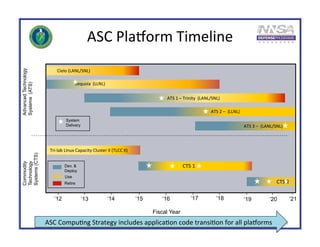
    ASC Compu;ng Strategy • Approach: Two classes of systems – Advanced Technology: First-of-a-kind systems that identify and foster technical capabilities and features that are beneficial to ASC applications – Commodity Technology: Robust, cost-effective systems to meet the day-to-day simulation workload needs of the program • Advanced Technology Systems – Leadership-class platforms – Pursue promising new technology paths – These systems are to meet unique mission needs and to help prepare the program for future system designs – Includes Non-Recurring Engineering (NRE) funding to enable delivery of leading-edge platforms – Acquire right-sized platforms to meet the mission needs – Trinity will be deployed by ACES (New Mexico Alliance for Computing at Extreme Scale, i.e., Los Alamos & Sandia) 5
  • 6.
    Advanced Technology Systems(ATS) Cielo (LANL/SNL) Sequoia (LLNL) ‘12 ‘13 ‘14 ‘15 ‘16 ‘17 Fiscal Year Use Retire ‘18 ‘19 ‘20 Commodity Technology Systems (CTS) Dev. & Deploy ATS 1 – Trinity (LANL/SNL) ATS 2 – (LLNL) ATS 3 – (LANL/SNL) Tri-­‐lab Linux Capacity Cluster II (TLCC II) CTS 1 CTS 2 ‘21 System Delivery ASC Plaborm Timeline ASC Compu@ng Strategy includes applica@on code transi@on for all plaborms 6
  • 7.
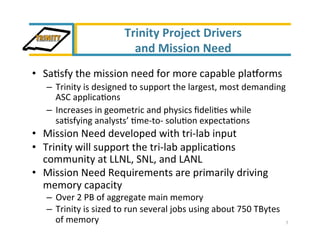
    Trinity Project Drivers and Mission Need • Sa@sfy the mission need for more capable plaborms – Trinity is designed to support the largest, most demanding ASC applica@ons – Increases in geometric and physics fideli@es while sa@sfying analysts’ @me-­‐to-­‐ solu@on expecta@ons • Mission Need developed with tri-­‐lab input • Trinity will support the tri-­‐lab applica@ons community at LLNL, SNL, and LANL • Mission Need Requirements are primarily driving memory capacity – Over 2 PB of aggregate main memory – Trinity is sized to run several jobs using about 750 TBytes of memory 7
  • 8.
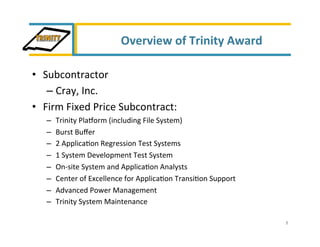
    Overview of Trinity Award • Subcontractor – Cray, Inc. • Firm Fixed Price Subcontract: – Trinity Plaborm (including File System) – Burst Buffer – 2 Applica@on Regression Test Systems – 1 System Development Test System – On-­‐site System and Applica@on Analysts – Center of Excellence for Applica@on Transi@on Support – Advanced Power Management – Trinity System Maintenance 8
  • 9.
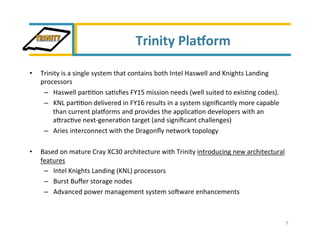
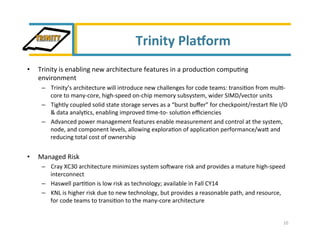
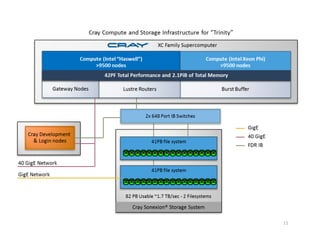
    Trinity PlaBorm •Trinity is a single system that contains both Intel Haswell and Knights Landing processors – Haswell par@@on sa@sfies FY15 mission needs (well suited to exis@ng codes). – KNL par@@on delivered in FY16 results in a system significantly more capable than current plaborms and provides the applica@on developers with an ahrac@ve next-­‐genera@on target (and significant challenges) – Aries interconnect with the Dragonfly network topology • Based on mature Cray XC30 architecture with Trinity introducing new architectural features – Intel Knights Landing (KNL) processors – Burst Buffer storage nodes – Advanced power management system sokware enhancements 9
  • 10.
    Trinity PlaBorm •Trinity is enabling new architecture features in a produc@on compu@ng environment – Trinity’s architecture will introduce new challenges for code teams: transi@on from mul@-­‐ core to many-­‐core, high-­‐speed on-­‐chip memory subsystem, wider SIMD/vector units – Tightly coupled solid state storage serves as a “burst buffer” for checkpoint/restart file I/O & data analy@cs, enabling improved @me-­‐to-­‐ solu@on efficiencies – Advanced power management features enable measurement and control at the system, node, and component levels, allowing explora@on of applica@on performance/wah and reducing total cost of ownership • Managed Risk – Cray XC30 architecture minimizes system sokware risk and provides a mature high-­‐speed interconnect – Haswell par@@on is low risk as technology; available in Fall CY14 – KNL is higher risk due to new technology, but provides a reasonable path, and resource, for code teams to transi@on to the many-­‐core architecture 10
  • 11.
  • 12.
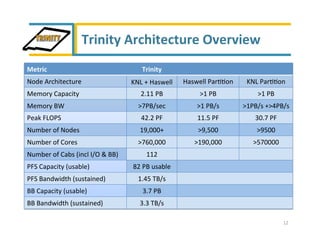
    Trinity Architecture Overview Metric Trinity Node Architecture KNL + Haswell Haswell Par@@on KNL Par@@on Memory Capacity 2.11 PB >1 PB >1 PB Memory BW >7PB/sec >1 PB/s >1PB/s +>4PB/s Peak FLOPS 42.2 PF 11.5 PF 30.7 PF Number of Nodes 19,000+ >9,500 >9500 Number of Cores >760,000 >190,000 >570000 Number of Cabs (incl I/O & BB) 112 PFS Capacity (usable) 82 PB usable PFS Bandwidth (sustained) 1.45 TB/s BB Capacity (usable) 3.7 PB BB Bandwidth (sustained) 3.3 TB/s 12
  • 13.
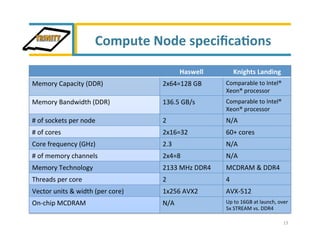
    Compute Node specifica;ons Haswell Knights Landing Memory Capacity (DDR) 2x64=128 GB Comparable to Intel® Xeon® processor Memory Bandwidth (DDR) 136.5 GB/s Comparable to Intel® Xeon® processor # of sockets per node 2 N/A # of cores 2x16=32 60+ cores Core frequency (GHz) 2.3 N/A # of memory channels 2x4=8 N/A Memory Technology 2133 MHz DDR4 MCDRAM & DDR4 Threads per core 2 4 Vector units & width (per core) 1x256 AVX2 AVX-­‐512 On-­‐chip MCDRAM N/A Up to 16GB at launch, over 5x STREAM vs. DDR4 13
  • 14.
    Trinity Capabili;es •Each par@@on will accommodate 1 to 2 large mission problems • Capability rela@ve to Cielo – 8x to 12x improvement in fidelity, physics and performance – > 30x increase in peak FLOPS – > 2x increase in node-­‐level parallelism – > 6x increase in cores – > 20x increase in threads • Capability rela@ve to Sequoia – 2x increase in peak FLOPS – Similar complexity rela@ve to core and thread level parallelism
  • 15.
    The Trinity Center of Excellence & Applica;on Transi;on Challenges • Center of Excellence – Work with select NW applica@on code teams to ensure KNL Par@@on is used effec@vely upon ini@al deployment – Nominally one applica@on per laboratory (SNL, LANL, LLNL) – Chosen such that they impact the NW program in FY17 – Facilitate the transi@on to next-­‐genera@on ATS code migra@on issues – This is NOT a benchmarking effort • Intel Knights Landing processor – From mul@-­‐core to many-­‐core – > 10x increase in thread level parallelism – A reduc@on in per core throughput (1/4 to 1/3 the performance of a Xeon core) – MCDRAM: Fast but limited capacity (~5x the BW, ~1/5 the capacity of DDR4 memory) – Dual AVX-­‐512 SIMD units: Does your code vectorize? • Burst Buffer – Data analy@cs use cases need to be developed and/or deployed into produc@on codes – Checkpoint/Restart should “just work”, although advanced features may require code changes
  • 16.
    Trinity will be located at the Los Alamos Nicholas C. Metropolis Center for Modeling and Simula;on 16 Nicholas C. Metropolis Center for Modeling and Simula;on • Classified compu@ng • 15MW / 12MW water, 3MW air • 42” subfloor, 300 lbs/sqf • 80’x100’ (8,000 sqf) Trinity Power and Cooling • At least 80% of the plaborm will be water cooled • First large water cooled plaborm at Los Alamos • Concerns • Idle power efficiency • Rapid ramp up / ramp down load on power grid over 2MW
  • 17.
    Trinity PlaBorm Schedule Highlights 2014-­‐2016 17
  • 18.
    Challenges and Opportuni;es • Applica@on transi@on work using next genera@on technologies (for Trinity, ATS-­‐2, ATS-­‐3, …) – Many-­‐core, hierarchical memory, burst buffer • Opera@ng a large supercomputer using liquid cooling technology • Opera@ng Trinity using a mix of Haswell and KNL nodes • The Burst Buffer concepts and technology for improving applica@on efficiency and exploring other user cases • On the road to Exascale… • ….
  • 19.
    Trinity System Summary • Trinity is the first instan@a@on of the ASC’s ATS plaborm • Trinity meets or exceeds the goals set by the ACES Design Team • Rela@ve to Cielo, Trinity will require applica@ons to transi@on to an MPI+X programming environment and requires increases in thread and vector level parallelism to be exposed • Trinity introduces Ac@ve Power Management, Burst Buffer storage accelera@on, and the concept of a Center of Excellence to ASC produc@on plaborms 19
  • 20.
    Special thanks to the following for contribu@on of slides used in this talk • Doug Doerfler -­‐ SNL • Thuc Hoang – NNSA ASC • And a cast of others……. 20
  • 21.
    Ques;ons? • For more info visit the Trinity Web Site: trinity.lanl.gov 21