• History
• Introduction
• Features
• Super Computer Advantage
• Super Computer Disadvantage
• Applications
CONTENTSCONTENTS
Supercomputers were introduced in the 1960s, made initially and,
for A supercomputer is a computer at the frontline of contemporary
processing capacity – particularly speed of calculation which can
happen at speeds of nanoseconds.
decades, primarily by Seymour Cray .
The supercomputers of the 1970s used only a few processors, in
the 1990s machines with thousands of processors began to appear
and, by the end of the 20th century, massively
As of November 2013, China's Tianhe-2supercomputer is.
INTRODUCTION
IBM CDC 1604 one of the first computers to
replace vacuum tubes with transistors.
responded with IBM 7030 (or Stretch) in
1961.
In 1964, Cray’s CDC 6600 replaced Stretch
as the fastest computer on earth with 3 million
floating-point operations per second (FLOPS)
HISTORY
Large storage capacity
More than one CPU necessitated by
physical limits of circuit technology
Very fast input/output capability
Fortran is the language most
preferred for scientific programming
FEATURES
Solve bigger problems
Run more problems in shorter time
May save money
Allows for virtual testing
SUPERCOMPUTER:ADVANTAGE
Can be expensive
Takes up a lot of space
May only be good for specific
applications
Does not replace physical testing
Requires trained staff
SUPERCOMPUTER:DISADVANTAGE
fluid dynamics
weather patterns
seismic activity prediction
nuclear explosion dynamics
human genome sequencing
credit card transaction processing
design and testing of modern aircraft
APPLICATION
First computer to defeat a world
champion!!
Garry Kasparov Deep Blue
In February 1996, IBM’s Deep Blue defeated grandmaster Garry Kasparov. It was
then assigned to predict the weather in Atlanta, Georgia, during the 1996 Summer
Olympic Games
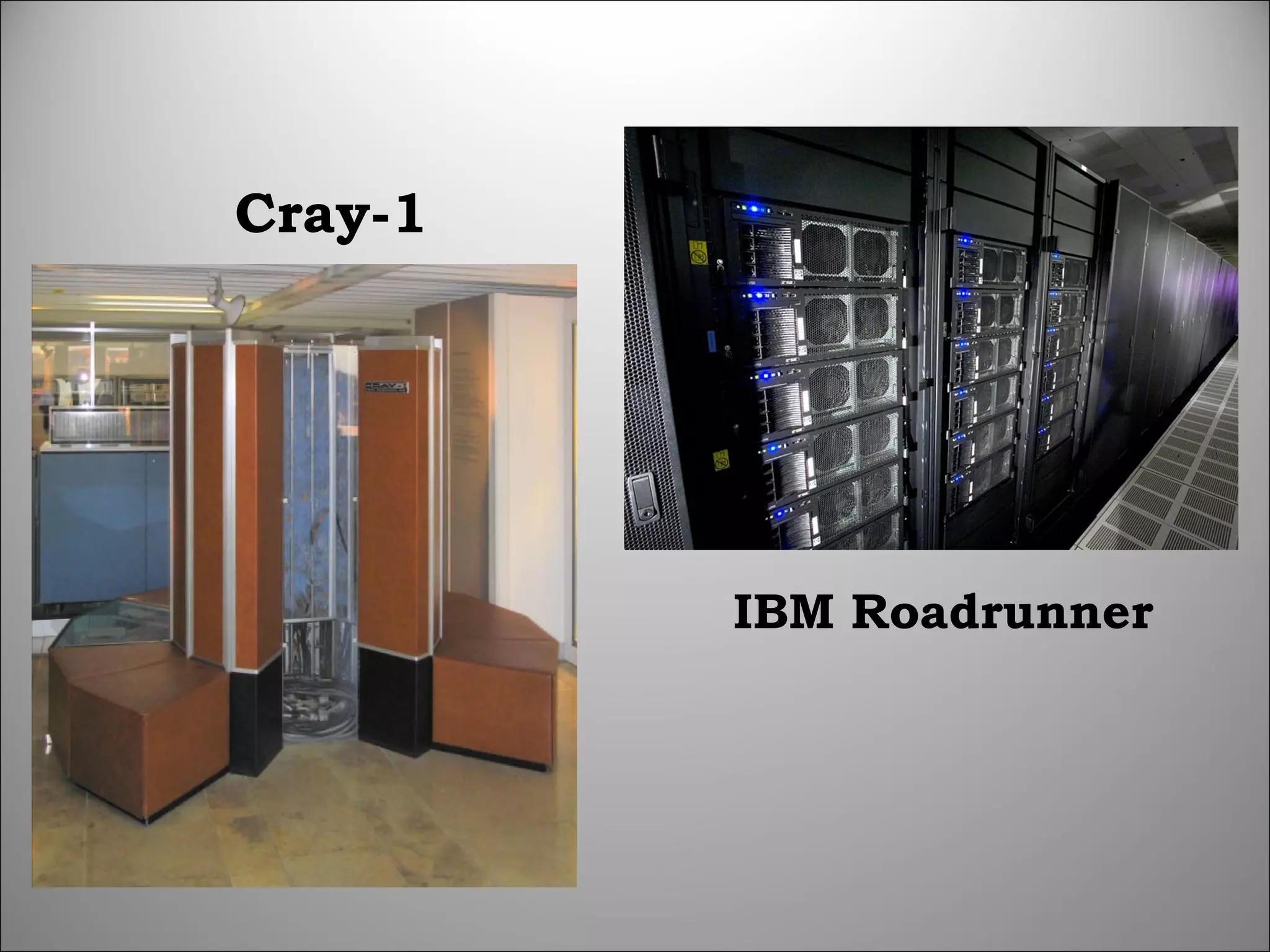
Cray-1
IBM Roadrunner
THANK YOUTHANK YOU
FORFOR
BEINGBEING
WITH USWITH US
Submitted by:- ABHINAV SINGH

SUPERCOMPUTER

  • 2.
    • History • Introduction •Features • Super Computer Advantage • Super Computer Disadvantage • Applications CONTENTSCONTENTS
  • 3.
    Supercomputers were introducedin the 1960s, made initially and, for A supercomputer is a computer at the frontline of contemporary processing capacity – particularly speed of calculation which can happen at speeds of nanoseconds. decades, primarily by Seymour Cray . The supercomputers of the 1970s used only a few processors, in the 1990s machines with thousands of processors began to appear and, by the end of the 20th century, massively As of November 2013, China's Tianhe-2supercomputer is. INTRODUCTION
  • 4.
    IBM CDC 1604one of the first computers to replace vacuum tubes with transistors. responded with IBM 7030 (or Stretch) in 1961. In 1964, Cray’s CDC 6600 replaced Stretch as the fastest computer on earth with 3 million floating-point operations per second (FLOPS) HISTORY
  • 5.
    Large storage capacity Morethan one CPU necessitated by physical limits of circuit technology Very fast input/output capability Fortran is the language most preferred for scientific programming FEATURES
  • 6.
    Solve bigger problems Runmore problems in shorter time May save money Allows for virtual testing SUPERCOMPUTER:ADVANTAGE
  • 7.
    Can be expensive Takesup a lot of space May only be good for specific applications Does not replace physical testing Requires trained staff SUPERCOMPUTER:DISADVANTAGE
  • 8.
    fluid dynamics weather patterns seismicactivity prediction nuclear explosion dynamics human genome sequencing credit card transaction processing design and testing of modern aircraft APPLICATION
  • 9.
    First computer todefeat a world champion!! Garry Kasparov Deep Blue In February 1996, IBM’s Deep Blue defeated grandmaster Garry Kasparov. It was then assigned to predict the weather in Atlanta, Georgia, during the 1996 Summer Olympic Games
  • 10.
  • 11.
    THANK YOUTHANK YOU FORFOR BEINGBEING WITHUSWITH US Submitted by:- ABHINAV SINGH

Editor's Notes

  • #2 Surabh is a pagal
  • #5 Cdc 1604 became popular in scientific laboratories
  • #6 Electronic signal speed limited by speed of light
  • #11 IBM is currently working to create a supercomputer on a chip