Superacids
Hammett acidity Function
 According to the classical definition, a super acid is an acid with an acidity greater
than that of 100% pure sulfuric acid, which has Hammett acidity function of -12.
 According to the modern definition, a super acid is a medium in which the
chemical potential of the proton is higher than in pure sulfuric acid.
 More efficient proton donor than pure sulphuric acid.
 Viscous, corrosive liquid.
 1018 times more acidic than sulphuric acid.
 Formed when powerful Lewis acid is dissolved in a powerful Bronsted acid.
HAMMETT ACIDITY FUNCTION:
 Is a measure of acidity that is used for very concentrated solution of strong acid,
including super acid.
 Proposed by the physical organic chemist
Louis Plack Hammett.
 H0= pK BH + log [B]/[BH+]
EXAMPLES
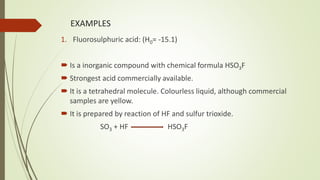
1. Fluorosulphuric acid: (H0= -15.1)
 Is a inorganic compound with chemical formula HSO3F
 Strongest acid commercially available.
 It is a tetrahedral molecule. Colourless liquid, although commercial
samples are yellow.
 It is prepared by reaction of HF and sulfur trioxide.
SO3 + HF HSO3F
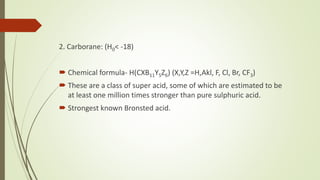
2. Carborane: (H0< -18)
 Chemical formula- H(CXB11Y5Z6) (X,Y,Z =H,Akl, F, Cl, Br, CF3)
 These are a class of super acid, some of which are estimated to be
at least one million times stronger than pure sulphuric acid.
 Strongest known Bronsted acid.
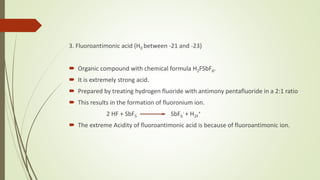
3. Fluoroantimonic acid (H0 between -21 and -23)
 Organic compound with chemical formula H2FSbF6.
 It is extremely strong acid.
 Prepared by treating hydrogen fluoride with antimony pentafluoride in a 2:1 ratio
 This results in the formation of fluoronium ion.
2 HF + SbF5 SbF6
- + H2F
+
 The extreme Acidity of fluoroantimonic acid is because of fluoroantimonic ion.
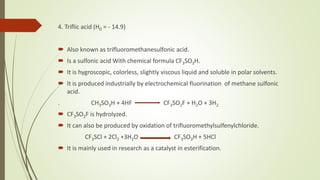
4. Triflic acid (H0 = - 14.9)
 Also known as trifluoromethanesulfonic acid.
 Is a sulfonic acid With chemical formula CF3SO3H.
 It is hygroscopic, colorless, slightly viscous liquid and soluble in polar solvents.
 It is produced industrially by electrochemical fluorination of methane sulfonic
acid.
. CH3SO3H + 4HF CF3SO2F + H2O + 3H2
 CF3SO2F is hydrolyzed.
 It can also be produced by oxidation of trifluoromethylsulfenylchloride.
CF3SCl + 2Cl2 +3H2O CF3SO3H + 5HCl
 It is mainly used in research as a catalyst in esterification.
5. Magic acid (H0 = -19.2)
 It consists a mixture of fluorosulpuric acid and antimony pentafluoride in 1:1
ratio.
 It is conjugate Bronsted- Lewis super acid system developed by George Olah.
 It has been used to stabilize carbonation and hypercoordinated carbonium ions
in liquid medium.
 It can proton weak bases including methane, xenon, halogens and molecular
hydrogen.
APPLICATIONS:
 In petrochemist, super acidic media are used as catalysts, especially
for alkylation.
 Typical catalysts are sulfated oxides of titanium or zirconium
specially treated alumina or zeolite.
 Solid acids are alkylation benzene with ethene and propene.
Thank you

Super Acids - Mureal

  • 1.
  • 2.
     According tothe classical definition, a super acid is an acid with an acidity greater than that of 100% pure sulfuric acid, which has Hammett acidity function of -12.  According to the modern definition, a super acid is a medium in which the chemical potential of the proton is higher than in pure sulfuric acid.
  • 3.
     More efficientproton donor than pure sulphuric acid.  Viscous, corrosive liquid.  1018 times more acidic than sulphuric acid.  Formed when powerful Lewis acid is dissolved in a powerful Bronsted acid.
  • 4.
    HAMMETT ACIDITY FUNCTION: Is a measure of acidity that is used for very concentrated solution of strong acid, including super acid.  Proposed by the physical organic chemist Louis Plack Hammett.  H0= pK BH + log [B]/[BH+]
  • 5.
    EXAMPLES 1. Fluorosulphuric acid:(H0= -15.1)  Is a inorganic compound with chemical formula HSO3F  Strongest acid commercially available.  It is a tetrahedral molecule. Colourless liquid, although commercial samples are yellow.  It is prepared by reaction of HF and sulfur trioxide. SO3 + HF HSO3F
  • 6.
    2. Carborane: (H0<-18)  Chemical formula- H(CXB11Y5Z6) (X,Y,Z =H,Akl, F, Cl, Br, CF3)  These are a class of super acid, some of which are estimated to be at least one million times stronger than pure sulphuric acid.  Strongest known Bronsted acid.
  • 7.
    3. Fluoroantimonic acid(H0 between -21 and -23)  Organic compound with chemical formula H2FSbF6.  It is extremely strong acid.  Prepared by treating hydrogen fluoride with antimony pentafluoride in a 2:1 ratio  This results in the formation of fluoronium ion. 2 HF + SbF5 SbF6 - + H2F +  The extreme Acidity of fluoroantimonic acid is because of fluoroantimonic ion.
  • 8.
    4. Triflic acid(H0 = - 14.9)  Also known as trifluoromethanesulfonic acid.  Is a sulfonic acid With chemical formula CF3SO3H.  It is hygroscopic, colorless, slightly viscous liquid and soluble in polar solvents.  It is produced industrially by electrochemical fluorination of methane sulfonic acid. . CH3SO3H + 4HF CF3SO2F + H2O + 3H2  CF3SO2F is hydrolyzed.  It can also be produced by oxidation of trifluoromethylsulfenylchloride. CF3SCl + 2Cl2 +3H2O CF3SO3H + 5HCl  It is mainly used in research as a catalyst in esterification.
  • 9.
    5. Magic acid(H0 = -19.2)  It consists a mixture of fluorosulpuric acid and antimony pentafluoride in 1:1 ratio.  It is conjugate Bronsted- Lewis super acid system developed by George Olah.  It has been used to stabilize carbonation and hypercoordinated carbonium ions in liquid medium.  It can proton weak bases including methane, xenon, halogens and molecular hydrogen.
  • 10.
    APPLICATIONS:  In petrochemist,super acidic media are used as catalysts, especially for alkylation.  Typical catalysts are sulfated oxides of titanium or zirconium specially treated alumina or zeolite.  Solid acids are alkylation benzene with ethene and propene.
  • 11.