Borates
Introduction and Classification
Introduction
Borates are the name for a large number of boron-
containing oxyanions. The term "borates" may also refer to
tetrahedral boron anions, or more loosely to chemical
compounds which contain borate anions.
joined together via shared oxygen atoms and may be
cyclic or linear in structure.
Importance:
 stimulate plant growth
 inhibit bacteria and fungi
 increase crop yields
 to remove stains
 increase its resistance to heat and chemicals
 to personal care products to prevent bacterial growth
 as flame retardants
Classification
Orthroborates
Metaborates
Triborates
Tertraborates
Pentaborates
Hexaborates
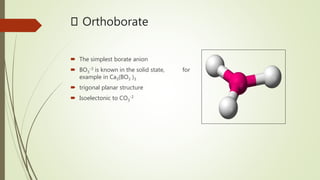
Orthoborate
 The simplest borate anion
 BO3
-3 is known in the solid state, for
example in Ca3(BO3 )3
 trigonal planar structure
 Isoelectonic to CO3
-2
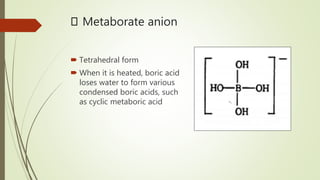
Metaborate anion
 Tetrahedral form
 When it is heated, boric acid
loses water to form various
condensed boric acids, such
as cyclic metaboric acid
Triborate anion
 the triborate anion is a six-member BO ring (referred to as a boroxyl ring)
 triborate B3O5−7, found in CaAlB3O7 (johachidolite)
Tetraborate anion
 the tetraborate anion is a bridged eight-
member B-O ring
 The tetraborate anion (tetramer) includes two
tetrahedral and two trigonal boron atoms
symmetrically assembled in cyclic structure
 sodium tetraborate, Na2[B4O5(OH)4]·8H2O,
which is commonly called borax , formula is
often written as Na2B4O7·10H2O
Pentaborate anion
 consists of two six-member B-O rings sharing a common boron atom.
Hexaborate anion
 consists of three B-O rings that share three boron atoms and one oxygen atom.
Boric acid:
 Boric acid is a weak proton donor (pKa ~ 9) in the sense of Brønsted acid, but is a
Lewis acid, i.e., it can accept an electron pair
 Boric acid does not dissociate in aqueous solution, but is acidic due to its
interaction with water molecules, forming tetrahydroxyborate
 Acidic, its reaction with OH– from water, forming the tetrahydroxyborate complex
(B(OH)-4 ), proton left by the water autoprotolysis
B(OH)3 + 2H2O ⇌ B(OH)-4 + H3O+ (pKa = 8.98)
Polymeric ions:
 Under acid conditions boric acid undergoes condensation reactions to form
polymeric oxyanions:
4B(OH)4
− + 2H+ ⇌ B4O5(OH)4
2− + 7H2O
Borate esters:
 organic compounds of the type B(OR)3 where R is alkyl or aryl
 prepared by condensation reaction of boric acid and the alcohol:
B(OH)3 + 3 ROH → B(OR)3 +3 H2O
 Borate esters are volatile and can be purified by distillation
 alkyl borates burn with a characteristic green flame
 Trimethyl borate B(OCH3)3 is a popular borate ester used in organic synthesis
 borate esters are prepared from alkylation of trimethyl borate:
ArMgBr + B(OCH3)3 → MgBrOCH3 + ArB(OCH3)2
ArB(OCH3)2 + 2 H2O → ArB(OH)2 + 2 HOCH3
 These esters hydrolyze to boronic acids, which are used in Suzuki couplings
Suzuki couplings
 The Suzuki reaction is an organic reaction, classified as a coupling reaction, where
the coupling partners are a boronic acid and an organohalide catalyzed by a
palladium complex.
Natural Occurance:
Ulexite:
 (NaCaB5O6(OH)4.8H2O) (hydrated sodium calcium borate
hydroxide)
 sometimes known as TV rock
 is usually found as evaporite deposits along with borax
 occurs in the form of white, rounded crystalline masses or as
closely packed fibrous crystals
 The isolated borate poly anion [B5O9]-3 has five boron atoms,
therefore placing ulexite in the pentaborate group.
 Widely used on basis of optical properties.
Colemanite
 (CaB3O4(OH)3·H2O) secondary mineral that forms by alteration of borax and ulexite
 It has many industrial uses, like the manufacturing of heat resistant glass.
 deposits in parts of Turkey, the United States (particularly Death Valley, Argentina,
and Kazakhastan, as well as other parts of the globe

Borates

  • 1.
  • 2.
    Introduction Borates are thename for a large number of boron- containing oxyanions. The term "borates" may also refer to tetrahedral boron anions, or more loosely to chemical compounds which contain borate anions. joined together via shared oxygen atoms and may be cyclic or linear in structure.
  • 3.
    Importance:  stimulate plantgrowth  inhibit bacteria and fungi  increase crop yields  to remove stains  increase its resistance to heat and chemicals  to personal care products to prevent bacterial growth  as flame retardants
  • 4.
  • 5.
    Orthoborate  The simplestborate anion  BO3 -3 is known in the solid state, for example in Ca3(BO3 )3  trigonal planar structure  Isoelectonic to CO3 -2
  • 6.
    Metaborate anion  Tetrahedralform  When it is heated, boric acid loses water to form various condensed boric acids, such as cyclic metaboric acid
  • 7.
    Triborate anion  thetriborate anion is a six-member BO ring (referred to as a boroxyl ring)  triborate B3O5−7, found in CaAlB3O7 (johachidolite)
  • 8.
    Tetraborate anion  thetetraborate anion is a bridged eight- member B-O ring  The tetraborate anion (tetramer) includes two tetrahedral and two trigonal boron atoms symmetrically assembled in cyclic structure  sodium tetraborate, Na2[B4O5(OH)4]·8H2O, which is commonly called borax , formula is often written as Na2B4O7·10H2O
  • 9.
    Pentaborate anion  consistsof two six-member B-O rings sharing a common boron atom.
  • 10.
    Hexaborate anion  consistsof three B-O rings that share three boron atoms and one oxygen atom.
  • 11.
    Boric acid:  Boricacid is a weak proton donor (pKa ~ 9) in the sense of Brønsted acid, but is a Lewis acid, i.e., it can accept an electron pair  Boric acid does not dissociate in aqueous solution, but is acidic due to its interaction with water molecules, forming tetrahydroxyborate  Acidic, its reaction with OH– from water, forming the tetrahydroxyborate complex (B(OH)-4 ), proton left by the water autoprotolysis B(OH)3 + 2H2O ⇌ B(OH)-4 + H3O+ (pKa = 8.98)
  • 12.
    Polymeric ions:  Underacid conditions boric acid undergoes condensation reactions to form polymeric oxyanions: 4B(OH)4 − + 2H+ ⇌ B4O5(OH)4 2− + 7H2O
  • 13.
    Borate esters:  organiccompounds of the type B(OR)3 where R is alkyl or aryl  prepared by condensation reaction of boric acid and the alcohol: B(OH)3 + 3 ROH → B(OR)3 +3 H2O  Borate esters are volatile and can be purified by distillation  alkyl borates burn with a characteristic green flame
  • 14.
     Trimethyl borateB(OCH3)3 is a popular borate ester used in organic synthesis  borate esters are prepared from alkylation of trimethyl borate: ArMgBr + B(OCH3)3 → MgBrOCH3 + ArB(OCH3)2 ArB(OCH3)2 + 2 H2O → ArB(OH)2 + 2 HOCH3  These esters hydrolyze to boronic acids, which are used in Suzuki couplings
  • 15.
    Suzuki couplings  TheSuzuki reaction is an organic reaction, classified as a coupling reaction, where the coupling partners are a boronic acid and an organohalide catalyzed by a palladium complex.
  • 16.
  • 17.
    Ulexite:  (NaCaB5O6(OH)4.8H2O) (hydratedsodium calcium borate hydroxide)  sometimes known as TV rock  is usually found as evaporite deposits along with borax  occurs in the form of white, rounded crystalline masses or as closely packed fibrous crystals  The isolated borate poly anion [B5O9]-3 has five boron atoms, therefore placing ulexite in the pentaborate group.  Widely used on basis of optical properties.
  • 18.
    Colemanite  (CaB3O4(OH)3·H2O) secondarymineral that forms by alteration of borax and ulexite  It has many industrial uses, like the manufacturing of heat resistant glass.  deposits in parts of Turkey, the United States (particularly Death Valley, Argentina, and Kazakhastan, as well as other parts of the globe