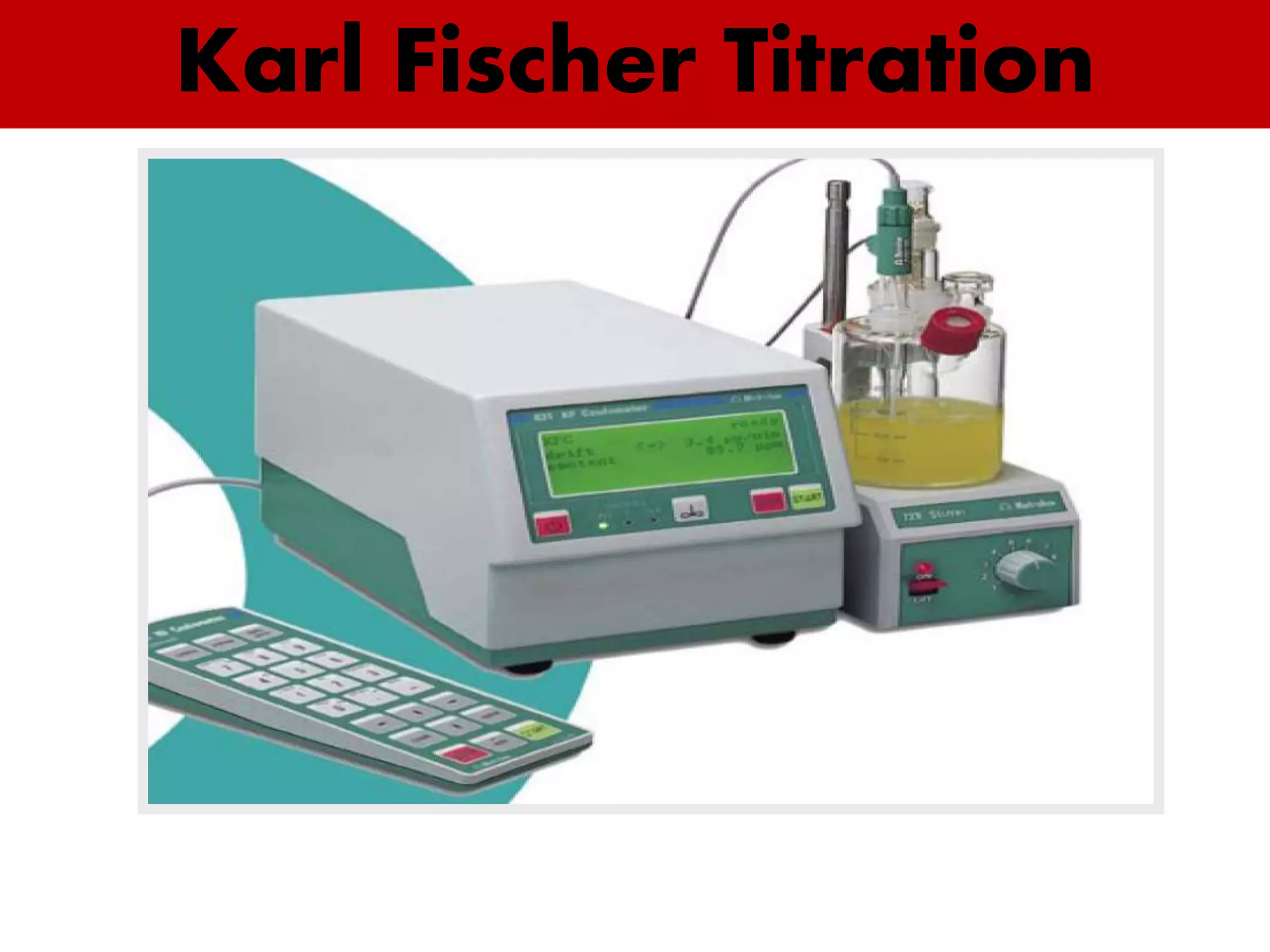

Karl Fischer Titration
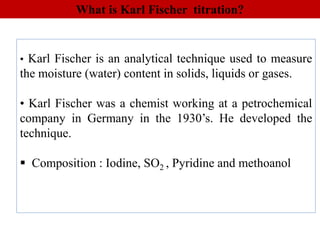
• Karl Fischer is an analytical technique used to measure
the moisture (water) content in solids, liquids or gases.
• Karl Fischer was a chemist working at a petrochemical
company in Germany in the 1930’s. He developed the
technique.
 Composition : Iodine, SO2 , Pyridine and methoanol
What is Karl Fischer titration?
Theory/principle of Karl Fischer titration
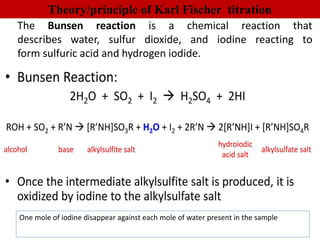
One mole of iodine disappear against each mole of water present in the sample
The Bunsen reaction is a chemical reaction that
describes water, sulfur dioxide, and iodine reacting to
form sulfuric acid and hydrogen iodide.
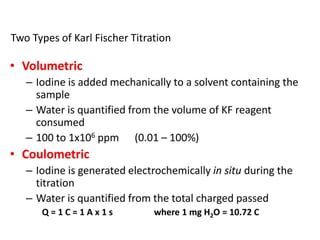
Two Types of Karl Fischer Titration
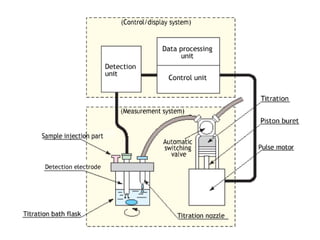
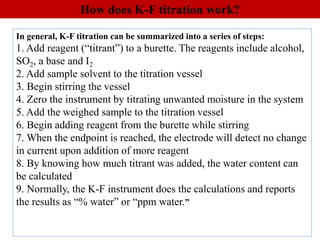
In general, K-F titration can be summarized into a series of steps:
1. Add reagent (“titrant”) to a burette. The reagents include alcohol,
SO2, a base and I2
2. Add sample solvent to the titration vessel
3. Begin stirring the vessel
4. Zero the instrument by titrating unwanted moisture in the system
5. Add the weighed sample to the titration vessel
6. Begin adding reagent from the burette while stirring
7. When the endpoint is reached, the electrode will detect no change
in current upon addition of more reagent
8. By knowing how much titrant was added, the water content can
be calculated
9. Normally, the K-F instrument does the calculations and reports
the results as “% water” or “ppm water.”
How does K-F titration work?
High accuracy and precision
Selectivity for water
Small sample quantity
Easy sample preparation
Short time of analysis
Large measuring range
Used for all forms of samples
Suitability for automation
Independence of presence of other volatile
Advantages of Karl Fischer Titration
Karl Fischer Reagent Preparation
All the reagent should be free from moisture.
400ml of methanol (water content less than 0.03%) in a stopper flask
of 750ml capacity and then add 80gms of pyridine and mix it.
Immerse the flask in freezing mixture and pass slowly the SO2 gas
into the cold mixture with stirring till the weight increases by 20gm.
Then add 45gm of iodine and shake well to dissolve. Allow the
mixture to stand for 2 hours before use. Store in moisture free
atmosphere and protect from light.
Stability of Karl Fischer reagent
Karl Fischer reagent is equivalent to 3.5 mg /ml water
The concentration KF reagent is decreases upon passage of
time. Hence following precaution should be taken :-
1. Prevent the contamination of sample or reagent by
atmospheric moisture
2. Dried glassware
3. Storage of solution in air tight bottle
4. Minimize the contact of solution and reagent with air during
titration
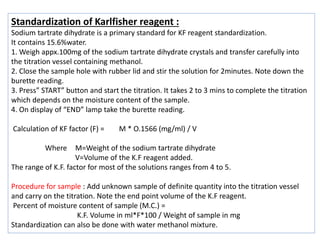
Standardization of Karlfisher reagent :
Sodium tartrate dihydrate is a primary standard for KF reagent standardization.
It contains 15.6%water.
1. Weigh appx.100mg of the sodium tartrate dihydrate crystals and transfer carefully into
the titration vessel containing methanol.
2. Close the sample hole with rubber lid and stir the solution for 2minutes. Note down the
burette reading.
3. Press” START” button and start the titration. It takes 2 to 3 mins to complete the titration
which depends on the moisture content of the sample.
4. On display of “END” lamp take the burette reading.
Calculation of KF factor (F) = M * O.1566 (mg/ml) / V
Where M=Weight of the sodium tartrate dihydrate
V=Volume of the K.F reagent added.
The range of K.F. factor for most of the solutions ranges from 4 to 5.
Procedure for sample : Add unknown sample of definite quantity into the titration vessel
and carry on the titration. Note the end point volume of the K.F reagent.
Percent of moisture content of sample (M.C.) =
K.F. Volume in ml*F*100 / Weight of sample in mg
Standardization can also be done with water methanol mixture.
End point detection
By electrometric technique using dead stop end point method.
End point is achieved, when the pointer of the manometer
gets deflected for 10 to 15 seconds due to the iodine present
in the reagent
Application in the following industries
Plastic
 Oil Fats
 Wood
Cotton
Paper
Explosives
Leather
Textile
Pharmaceuticals
 Agriculture
Applications
Karl Fischer Titration - Mayur

Karl Fischer Titration - Mayur

  • 1.
  • 2.
    • Karl Fischeris an analytical technique used to measure the moisture (water) content in solids, liquids or gases. • Karl Fischer was a chemist working at a petrochemical company in Germany in the 1930’s. He developed the technique.  Composition : Iodine, SO2 , Pyridine and methoanol What is Karl Fischer titration?
  • 3.
    Theory/principle of KarlFischer titration One mole of iodine disappear against each mole of water present in the sample The Bunsen reaction is a chemical reaction that describes water, sulfur dioxide, and iodine reacting to form sulfuric acid and hydrogen iodide.
  • 4.
    Two Types ofKarl Fischer Titration
  • 6.
    In general, K-Ftitration can be summarized into a series of steps: 1. Add reagent (“titrant”) to a burette. The reagents include alcohol, SO2, a base and I2 2. Add sample solvent to the titration vessel 3. Begin stirring the vessel 4. Zero the instrument by titrating unwanted moisture in the system 5. Add the weighed sample to the titration vessel 6. Begin adding reagent from the burette while stirring 7. When the endpoint is reached, the electrode will detect no change in current upon addition of more reagent 8. By knowing how much titrant was added, the water content can be calculated 9. Normally, the K-F instrument does the calculations and reports the results as “% water” or “ppm water.” How does K-F titration work?
  • 8.
    High accuracy andprecision Selectivity for water Small sample quantity Easy sample preparation Short time of analysis Large measuring range Used for all forms of samples Suitability for automation Independence of presence of other volatile Advantages of Karl Fischer Titration
  • 9.
    Karl Fischer ReagentPreparation All the reagent should be free from moisture. 400ml of methanol (water content less than 0.03%) in a stopper flask of 750ml capacity and then add 80gms of pyridine and mix it. Immerse the flask in freezing mixture and pass slowly the SO2 gas into the cold mixture with stirring till the weight increases by 20gm. Then add 45gm of iodine and shake well to dissolve. Allow the mixture to stand for 2 hours before use. Store in moisture free atmosphere and protect from light.
  • 10.
    Stability of KarlFischer reagent Karl Fischer reagent is equivalent to 3.5 mg /ml water The concentration KF reagent is decreases upon passage of time. Hence following precaution should be taken :- 1. Prevent the contamination of sample or reagent by atmospheric moisture 2. Dried glassware 3. Storage of solution in air tight bottle 4. Minimize the contact of solution and reagent with air during titration
  • 11.
    Standardization of Karlfisherreagent : Sodium tartrate dihydrate is a primary standard for KF reagent standardization. It contains 15.6%water. 1. Weigh appx.100mg of the sodium tartrate dihydrate crystals and transfer carefully into the titration vessel containing methanol. 2. Close the sample hole with rubber lid and stir the solution for 2minutes. Note down the burette reading. 3. Press” START” button and start the titration. It takes 2 to 3 mins to complete the titration which depends on the moisture content of the sample. 4. On display of “END” lamp take the burette reading. Calculation of KF factor (F) = M * O.1566 (mg/ml) / V Where M=Weight of the sodium tartrate dihydrate V=Volume of the K.F reagent added. The range of K.F. factor for most of the solutions ranges from 4 to 5. Procedure for sample : Add unknown sample of definite quantity into the titration vessel and carry on the titration. Note the end point volume of the K.F reagent. Percent of moisture content of sample (M.C.) = K.F. Volume in ml*F*100 / Weight of sample in mg Standardization can also be done with water methanol mixture.
  • 12.
    End point detection Byelectrometric technique using dead stop end point method. End point is achieved, when the pointer of the manometer gets deflected for 10 to 15 seconds due to the iodine present in the reagent
  • 13.
    Application in thefollowing industries Plastic  Oil Fats  Wood Cotton Paper Explosives Leather Textile Pharmaceuticals  Agriculture Applications