1
05-08-2022
By
Mr. Nilkesh K. Dhurve(MSc., CSIR-NET, SET)
Assistant Professor
Department of Chemistry
Shri Pundlik Maharaj Mahavidyalaya Nandura Rly
Dist-Buldana
ORGANOMETTALIC
CHEMISTRY
Chromium hexacarbonyl Dimeric cobalt carbonyl
Mr. N. K. Dhurve(Assistant Professor)
05-08-2022 2
CONTENT
• Introduction
• Classification of Organometallic Compounds
• Nomenclature of Organometallic Compounds
• Modern Classification of Organometallic Compounds
• Metal Carbonyls
• Classification of Metal Carbonyls
1. Nickel Carbonyl
2. Iron Carbonyl
3. Chromium Carbonyls
• EAN
• Structure of Metal Carbonyls on the basis of VBT
Mr. N. K. Dhurve(Assistant Professor)
ORGANOMETALLIC COMPOUNDS
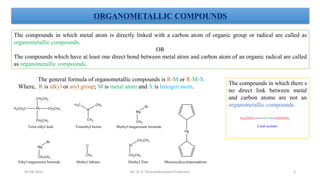
The compounds in which metal atom is directly linked with a carbon atom of organic group or radical are called as
organometallic compounds.
OR
The compounds which have at least one direct bond between metal atom and carbon atom of an organic radical are called
as organometallic compounds.
The general formula of organometallic compounds is R-M or R-M-X
Where, R is alkyl or aryl group; M is metal atom and X is halogen atom.
The compounds in which there s
no direct link between metal
and carbon atoms are not an
organometallic compounds.
3
05-08-2022 Mr. N. K. Dhurve(Assistant Professor)
CLASSIFICATION OF ORGANOMETALLIC COMPOUNDS
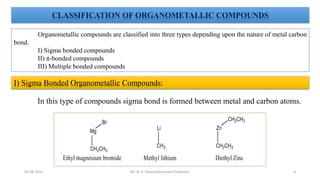
Organometallic compounds are classified into three types depending upon the nature of metal carbon
bond.
I) Sigma bonded compounds
II) π-bonded compounds
III) Multiple bonded compounds
I) Sigma Bonded Organometallic Compounds:
In this type of compounds sigma bond is formed between metal and carbon atoms.
4
05-08-2022 Mr. N. K. Dhurve(Assistant Professor)
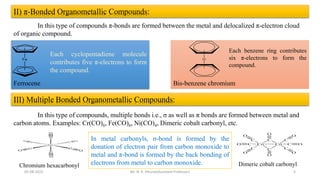
II) π-Bonded Organometallic Compounds:
In this type of compounds π-bonds are formed between the metal and delocalized π-electron cloud
of organic compound.
Each cyclopentadiene molecule
contributes five π-electrons to form
the compound.
Ferrocene Bis-benzene chromium
Each benzene ring contributes
six π-electrons to form the
compound.
III) Multiple Bonded Organometallic Compounds:
In this type of compounds, multiple bonds i.e., σ as well as π bonds are formed between metal and
carbon atoms. Examples: Cr(CO)6, Fe(CO)6, Ni(CO)4, Dimeric cobalt carbonyl, etc.
Chromium hexacarbonyl Dimeric cobalt carbonyl
In metal carbonyls, σ-bond is formed by the
donation of electron pair from carbon monoxide to
metal and π-bond is formed by the back bonding of
electrons from metal to carbon monoxide.
5
05-08-2022 Mr. N. K. Dhurve(Assistant Professor)
NOMENCLATURE OF ORGANOMETALLIC COMPOUNDS
1. Nomenclature of simple compounds:
The simple alkyl or aryl organometallic compounds of metal are named by writing the name of alkyl or aryl
group formed by the name of metal.
e.g.: CH3-Li Methyl lithium C2H5MgBr Ethyl magnesium bromide
(C2H5)2Zn Diethyl zinc C6H5MgCl Phenyl magnesium chloride
2. Nomenclature of carbonyls:
a) The compounds containing CO ligands are called metal carbonyls.
In neutral metal carbonyls, oxidation state of metal is zero and therefore need not be mentioned.
e.g., Ni(CO)4 Tetracarbonyl nickel Cr(CO)6 Hexacarbonyl chromium
Mn2(CO)10 Decacarbonyl dimanganese Co2(CO)8 Octacarbonyl dicobalt
Fe2(CO)9 Nonacarbonyl diiron [V(CO)6]- Hexacarbonyl vanadate(-I)
b) For bridging ligands use the Greek letter ‘’ before its name. If more than one bridging ligand are present, indicate
their number by using prefixes di-, tri-, tetra- etc.
e.g., [(CO)3Co(CO)2Co(CO)3 Di--carbonyl bis-(tricarbonylcobalt)
[(CO)3Fe(CO)3Fe(CO)3] Tri--carbonyl bis-(tricarbonyliron)
6
05-08-2022 Mr. N. K. Dhurve(Assistant Professor)
NOMENCLATURE OF ORGANOMETALLIC COMPOUNDS
2. Nomenclature of carbonyls:
c) If the metal carbonyls contains metal-metal bonds, then such carbonyls are classified as symmetrical or
unsymmetrical.
For the symmetrical metal carbonyls, the name are given by using the prefixes bis, tris, etc.
e.g., [(CO)4Co-Co(CO)4] Bis-(tetracarbonyl cobalt)
For the unsymmetrical metal carbonyls, one central metal atom and its ligands are treated as a ligand on the other
central metal atom.
e.g., [(CO)4Co-Re-(CO)5] Pentacarbonyl(tetracarbonyl cobaltio) rhenium
3. Nomenclature of σ and π bonded ligands:
a) To distinguish between one carbon bonded and multiple carbon bonded ligands the notation σ and π used.
e.g., Cyclopentadiene(C5H5)
(C5H5) Li σ-C5H5
(C5H5)2Fe π-C5H5
7
05-08-2022 Mr. N. K. Dhurve(Assistant Professor)
3. Nomenclature of σ and π bonded ligands:
b) In case of unsaturated ligands, the prefix ‘η’ is used. For one carbon bonded ligand use monohapto (η1), two
carbon bonded use dihapto (η2) and so on.
According to latest IUPAC convention, η notation is recommended.
e.g., Fe(C5H5)2 Bis(η5-cyclopentadienyl)iron [Ferrocene]
Cr(C6H6)2 Bis(η6-benzene)chromium
Co(CO)3(π-C3H5) (η3-allyl)tricarbonyl cobalt
(C6H6)Cr(CO)3 (η6-benzene)tricarbonyl chromium
Fe2(CO)4(C5H5)2 Bis(η5-cyclopentadienyl)tetracarbonyl diiron
Fe(CO)2(σ-C5H5)(π-C5H5) (η1-cyclopentadienyl) (η5-cyclopentadienyl)dicarbonyl iron
Fe(CO)3(C4H6) (η4-butadiene)tricarbonyl iron
Mn(CO)5(-CH2-CH=CH2) (η3-allyl)pentacarbonyl manganese
NOMENCLATURE OF ORGANOMETALLIC COMPOUNDS
8
05-08-2022 Mr. N. K. Dhurve(Assistant Professor)
MODERN CLASSIFICATION OF ORGANOMETALLIC COMPOUNDS
On the basis of number of electrons formally available on the neutral hydrocarbon or hydrocarbon radical for
bonding with metal, the ligands are classified as follows:
No. of electrons available Ligand
1 Alkyl, -R; Aryl, -C6H5; Acyl,
2 Carbonyl, -CO; Alkene,
3 Allyl, ; Cyclopropenyl,
4 Butadiene, ;Cyclobutadiene,
5 Cyclopentadienyl, or
6 Benzene,
9
05-08-2022 Mr. N. K. Dhurve(Assistant Professor)
METAL CARBONYLS
Metal carbonyls are organometallic compounds of transition metals and carbon monoxide ligand (π acceptor
ligand or π acid) .
They have the general formula Mx(CO)y.
e.g., Cr(CO)6, Fe(CO)5, Ni(CO)4, etc.
Metal carbonyls possess following interesting properties:
1) They are gases, liquids or solids of low melting point. This property indicates that the bonding in them is covalent.
2) In these compounds oxidation state of metal is zero {except [V(CO)6]-1}.
3) All the metal carbonyls are diamagnetic in nature {except [V(CO)6]-1 which is paramagnetic}
10
05-08-2022
Classification of Metal Carbonyls
Metal carbonyls are classified into three types:
1) Monomeric or mononuclear metal carbonyls
2) Bridge Metal Carbonyls
3) Polynuclear Metal Carbonyls
Mr. N. K. Dhurve(Assistant Professor)
05-08-2022 11
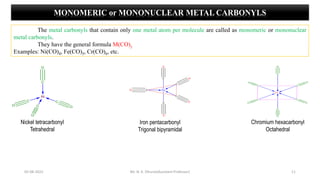
MONOMERIC or MONONUCLEAR METAL CARBONYLS
The metal carbonyls that contain only one metal atom per molecule are called as monomeric or mononuclear
metal carbonyls.
They have the general formula M(CO)y
Examples: Ni(CO)4, Fe(CO)5, Cr(CO)6, etc.
Nickel tetracarbonyl
Tetrahedral
Iron pentacarbonyl
Trigonal bipyramidal
Chromium hexacarbonyl
Octahedral
Mr. N. K. Dhurve(Assistant Professor)
05-08-2022 12
05-08-2022 12
BRIDGE METAL CARBONYLS
The metal carbonyls that contain two metal atoms joint together by bridging CO molecule are called as
bridging metal carbonyls. These are also called as bi-nuclear metal carbonyls.
They have the general formula M2(CO)y
Examples: Fe2(CO)9, Co2(CO)8, Os2(CO)9, Mn2(CO)10, etc.
Isomer of Co2(CO)8
Exist in solid state
Exist in solution
Mn2(CO)10
Fe2(CO)9
Mr. N. K. Dhurve(Assistant Professor)
05-08-2022 13
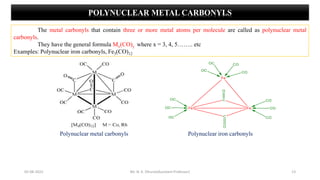
POLYNUCLEAR METAL CARBONYLS
The metal carbonyls that contain three or more metal atoms per molecule are called as polynuclear metal
carbonyls.
They have the general formula Mx(CO)y where x = 3, 4, 5…….. etc
Examples: Polynuclear iron carbonyls, Fe3(CO)12
Polynuclear iron carbonyls
Polynuclear metal carbonyls
Mr. N. K. Dhurve(Assistant Professor)
05-08-2022 14
I) Nickel Carbonyl : [Ni(CO)4]{Nickel tetracarbonyl}
Method of Preparation:
i) Direct synthesis by the action of carbon monoxide on metal:[Monds Process, 1890]
It is prepared by passing carbon monoxide over freshly reduced nickel at 303-323K at one atmospheric
pressure.
Ni + 4CO Ni(CO)4
303-323K (40
o
C)
1atm pressure
ii) Action of carbon monoxide on nickel salt (NaI2) in the presence of copper.
NiI2 + 4CO + 2Cu Ni(CO)4 + Cu2I2
NiS + 4CO + 2Cu Ni(CO)4 + Cu2S
Physical Properties:
i) It is colorless liquid.
ii) B.P. is 43
o
C(316K).
iii) Freezing point is -3
o
C(270K)
iv) It is soluble in organic solvents like benzene, ether, etc.
v) It is insoluble in water.
vi) It is highly toxic and inflammable in nature.
Mr. N. K. Dhurve(Assistant Professor)
05-08-2022 15
I) Nickel Carbonyl : [Ni(CO)4]{Nickel tetracarbonyl}
Chemical Properties:
i) Action of Heat: It decomposes on heating to give nickel and carbon monoxide.
Ni(CO)4 Ni + 4CO
ii) Action of Sulfuric acid: It reacts with sulfuric acid to give nickel sulfate.
Ni(CO)4 + H2SO4 NiSO4 + 4CO + H2
It slowly react with HCl and does not react with HBr or HI.
iii) Action of Halogen: It react with chloride to give nickel chloride and nickel carbonyl chloride.
Ni(CO)4 + Cl2 NiCl2 + 4CO
2Ni(CO)4 + Cl2 Ni(CO)6Cl2 + 2CO
It reacts with bromine to give nickel bromide.
Ni(CO)4 + Br2 NiBr2 + 4CO
Mr. N. K. Dhurve(Assistant Professor)
05-08-2022 16
I) Nickel Carbonyl : [Ni(CO)4]{Nickel tetracarbonyl}
iv) Action of ligands: It reacts with ligand like pyridine or o-phenanthroline to give disubstituted products in which two
CO molecules are replaced by ligand.
Ni(CO)4 + 2Py Ni(CO)2(Py)2 + 2CO
Ni(CO)4 + (Phen) Ni(CO)2(Phen) + 2CO
Ni + 4CO
NiSO4 + 4CO + H2
Ni(CO)4
NiX2 + 4CO
Ni(CO)2(Py)2 / Ni(CO)2(Phen)
H2SO4
X2 (X= Cl, Br)
Py/Phen
-2CO
Mr. N. K. Dhurve(Assistant Professor)
05-08-2022 17
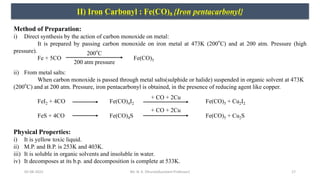
II) Iron Carbonyl : Fe(CO)5 {Iron pentacarbonyl}
Method of Preparation:
i) Direct synthesis by the action of carbon monoxide on metal:
It is prepared by passing carbon monoxide on iron metal at 473K (200
o
C) and at 200 atm. Pressure (high
pressure).
Fe + 5CO Fe(CO)5
ii) From metal salts:
When carbon monoxide is passed through metal salts(sulphide or halide) suspended in organic solvent at 473K
(200
o
C) and at 200 atm. Pressure, iron pentacarbonyl is obtained, in the presence of reducing agent like copper.
FeI2 + 4CO Fe(CO)4I2 Fe(CO)5 + Cu2I2
FeS + 4CO Fe(CO)4S Fe(CO)5 + Cu2S
200
o
C
200 atm pressure
+ CO + 2Cu
+ CO + 2Cu
Physical Properties:
i) It is yellow toxic liquid.
ii) M.P. and B.P. is 253K and 403K.
iii) It is soluble in organic solvents and insoluble in water.
iv) It decomposes at its b.p. and decomposition is complete at 533K.
Mr. N. K. Dhurve(Assistant Professor)
05-08-2022 18
II) Iron Carbonyl : Fe(CO)5 {Iron pentacarbonyl}
Chemical Properties:
i) Action of heat: When iron pentacarbonyl is heated at 553K, it decomposes to give iron and carbon monoxide.
Fe(CO)5 Fe + 5CO
ii) Action of light: When iron pentacarbonyls is exposed to sunlight or irradiated with UV light, dimerization takes
place to give Nonacarbonyl diiron[Fe2(CO)9]
2Fe(CO)5 Fe2(CO)9 + CO
iii) Action of acid: When iron pentacarbonyl is heated with dilute acid gives salt.
Fe(CO)5+ 2HCl FeCl2 + 5CO + H2
iv) Action of alkali: On reaction with NaOH, iron pentacarbonyl gives yellow compound i.e., sodium carbonyl hydride.
Fe(CO)5+ 3NaOH Na[Fe(CO)4H] + Na2CO3 + H2O
v) Action with ammonia: Iron pentacarbonyl reacts with ammonia ( & water) to give carbamic acid.
Fe(CO)5+ NH3 + H2O [Fe(CO)4H2] + NH2COOH
Sunlight
UV
Mr. N. K. Dhurve(Assistant Professor)
05-08-2022 19
II) Iron Carbonyl : Fe(CO)5 {Iron pentacarbonyl}
vi) Action with halogen: Iron pentacarbonyls react with halogen to form iron carbonyl halide.
Fe(CO)5 + X2 [Fe(CO)4X2] + CO [X= Cl, Br, I]
vii) Reducing action: Iron pentacarbonyl acts as a reducing agent. It reduces the following:
a) It reduces carbon tetrachloride to dicarbon hexachloride.
Fe(CO)5 + 2CCl4 C2Cl6 + FeCl2 + 5CO
b) It reduces sulphuryl chloride to Sulphur dioxide.
Fe(CO)5 + SO2Cl2 FeCl2 + 5CO + SO2
c) It reduces SnCl4 to SnCl2. Fe(CO)4Cl2 further reacts with SnCl2 to form addition compound.
Fe(CO)5 + SnCl4 Fe(CO)4Cl2 + SnCl2 + CO
d) It reduces SbCl5 to SbCl3. Fe(CO)4Cl2 further reacts with SbCl3 to form addition compound.
Fe(CO)5 + SbCl5 Fe(CO)4Cl2 + SbCl3
Mr. N. K. Dhurve(Assistant Professor)
05-08-2022 20
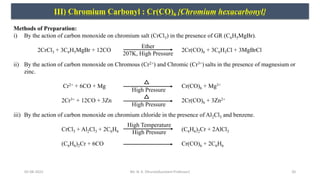
III) Chromium Carbonyl : Cr(CO)6 {Chromium hexacarbonyl}
Methods of Preparation:
i) By the action of carbon monoxide on chromium salt (CrCl3) in the presence of GR (C6H5MgBr).
2CrCl3 + 3C6H5MgBr + 12CO 2Cr(CO)6 + 3C6H5Cl + 3MgBrCl
ii) By the action of carbon monoxide on Chromous (Cr2+) and Chromic (Cr3+) salts in the presence of magnesium or
zinc.
Cr2+ + 6CO + Mg Cr(CO)6 + Mg3+
2Cr3+ + 12CO + 3Zn 2Cr(CO)6 + 3Zn2+
iii) By the action of carbon monoxide on chromium chloride in the presence of Al2Cl3 and benzene.
CrCl3 + Al2Cl3 + 2C6H6 (C6H6)2Cr + 2AlCl3
(C6H6)2Cr + 6CO Cr(CO)6 + 2C6H6
Ether
207K, High Pressure
High Pressure
High Pressure
High Temperature
High Pressure
Mr. N. K. Dhurve(Assistant Professor)
05-08-2022 21
III) Chromium Carbonyl : Cr(CO)6 {Chromium hexacarbonyl}
Physical Properties:
i) It forms colorless rhombic crystal.
ii) M.P. is 422K.
iii) It sublime on heating.
iv) It is diamagnetic in nature.
v) It is soluble in organic solvent and insoluble in water.
Chemical Properties:
i) Reaction with halogen: It decomposes by fluorine and chlorine (except Br2 & I2) to form respective salts.
2Cr(CO)6 + 5F2 2CrF5 + 12CO
2Cr(CO)6 + 5Cl2 2CrCl5 + 12CO
ii) Reaction with sodium: It reacts with sodium to form chromium carbonylate.
2Na + Cr(CO)6 [2Na+][Cr(CO)6]
2-
+ CO
iii) Reaction with ligand: When chromium carbonyl reacts with ligand, gives substitution product ( by replacing 3CO
molecules).
Cr(CO)6 + 3Py Cr(CO)3(Py)3 + 3CO
iv) Reaction with unsaturated hydrocarbons: It combines with unsaturated hydrocarbon like cyclopentadiene at high
temperature and pressure to give a π-complex.
2Cr(CO)6 + 2C5H5 (C5H5)2Cr(CO)6
Mr. N. K. Dhurve(Assistant Professor)
05-08-2022 22
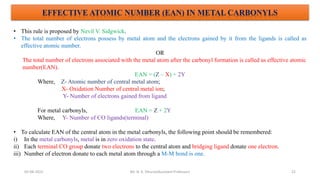
EFFECTIVE ATOMIC NUMBER (EAN) IN METAL CARBONYLS
• This rule is proposed by Nevil V. Sidgwick.
• The total number of electrons possess by metal atom and the electrons gained by it from the ligands is called as
effective atomic number.
OR
The total number of electrons associated with the metal atom after the carbonyl formation is called as effective atomic
number(EAN).
EAN = (Z – X) + 2Y
Where, Z- Atomic number of central metal atom;
X- Oxidation Number of central metal ion;
Y- Number of electrons gained from ligand
For metal carbonyls, EAN = Z + 2Y
Where, Y- Number of CO ligands(terminal)
• To calculate EAN of the central atom in the metal carbonyls, the following point should be remembered:
i) In the metal carbonyls, metal is in zero oxidation state.
ii) Each terminal CO group donate two electrons to the central atom and bridging ligand donate one electron.
iii) Number of electron donate to each metal atom through a M-M bond is one.
Mr. N. K. Dhurve(Assistant Professor)
05-08-2022 23
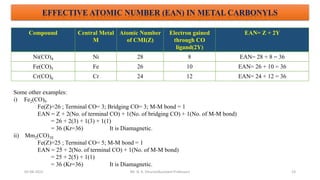
EFFECTIVE ATOMIC NUMBER (EAN) IN METAL CARBONYLS
Compound Central Metal
M
Atomic Number
of CMI(Z)
Electron gained
through CO
ligand(2Y)
EAN= Z + 2Y
Ni(CO)4 Ni 28 8 EAN= 28 + 8 = 36
Fe(CO)5 Fe 26 10 EAN= 26 + 10 = 36
Cr(CO)6 Cr 24 12 EAN= 24 + 12 = 36
Some other examples:
i) Fe2(CO)9
Fe(Z)=26 ; Terminal CO= 3; Bridging CO= 3; M-M bond = 1
EAN = Z + 2(No. of terminal CO) + 1(No. of bridging CO) + 1(No. of M-M bond)
= 26 + 2(3) + 1(3) + 1(1)
= 36 (Kr=36) It is Diamagnetic.
ii) Mm2(CO)10
Fe(Z)=25 ; Terminal CO= 5; M-M bond = 1
EAN = 25 + 2(No. of terminal CO) + 1(No. of M-M bond)
= 25 + 2(5) + 1(1)
= 36 (Kr=36) It is Diamagnetic.
Mr. N. K. Dhurve(Assistant Professor)
05-08-2022 24
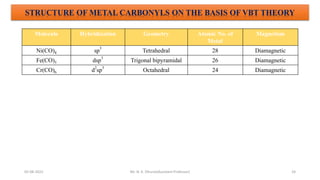
STRUCTURE OF METAL CARBONYLS ON THE BASIS OF VBT THEORY
Molecule Hybridization Geometry Atomic No. of
Metal
Magnetism
Ni(CO)4 sp
3
Tetrahedral 28 Diamagnetic
Fe(CO)5 dsp
3
Trigonal bipyramidal 26 Diamagnetic
Cr(CO)6 d
2
sp
3
Octahedral 24 Diamagnetic
Mr. N. K. Dhurve(Assistant Professor)
05-08-2022 25
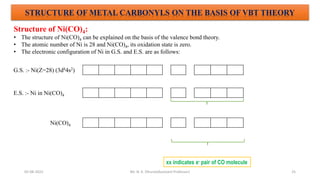
STRUCTURE OF METAL CARBONYLS ON THE BASIS OF VBT THEORY
Structure of Ni(CO)4:
• The structure of Ni(CO)4 can be explained on the basis of the valence bond theory.
• The atomic number of Ni is 28 and Ni(CO)4, its oxidation state is zero.
• The electronic configuration of Ni in G.S. and E.S. are as follows:
G.S. :- Ni(Z=28) (3d84s2)
E.S. :- Ni in Ni(CO)4
Ni(CO)4
xx indicates e- pair of CO molecule
Mr. N. K. Dhurve(Assistant Professor)
05-08-2022 26
STRUCTURE OF METAL CARBONYLS ON THE BASIS OF VBT THEORY
Structure of Ni(CO)4:
• Ni atom undergoes sp3 hybridization.
• It has four vacant sp3 hybrid orbital.
• These vacant hybrid orbitals overlap with filled sp hybrid orbital of carbon of CO molecule to form four Ni-CO sigma
bonds.
• The shape of Ni(CO)4 is tetrahedral.
• Since all the electrons are paired in Ni(CO)4, it is diamagnetic.
Structure of Ni(CO)4 : Tetrahedral
Mr. N. K. Dhurve(Assistant Professor)
05-08-2022 27
STRUCTURE OF METAL CARBONYLS ON THE BASIS OF VBT THEORY
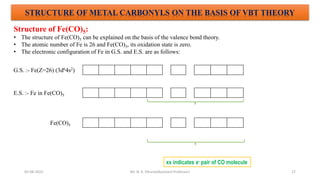
Structure of Fe(CO)5:
• The structure of Fe(CO)5 can be explained on the basis of the valence bond theory.
• The atomic number of Fe is 26 and Fe(CO)5, its oxidation state is zero.
• The electronic configuration of Fe in G.S. and E.S. are as follows:
G.S. :- Fe(Z=26) (3d64s2)
E.S. :- Fe in Fe(CO)5
Fe(CO)5
xx indicates e- pair of CO molecule
Mr. N. K. Dhurve(Assistant Professor)
05-08-2022 28
STRUCTURE OF METAL CARBONYLS ON THE BASIS OF VBT THEORY
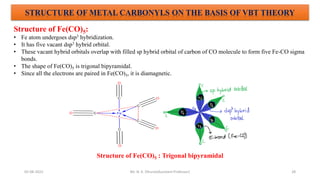
Structure of Fe(CO)5:
• Fe atom undergoes dsp3 hybridization.
• It has five vacant dsp3 hybrid orbital.
• These vacant hybrid orbitals overlap with filled sp hybrid orbital of carbon of CO molecule to form five Fe-CO sigma
bonds.
• The shape of Fe(CO)5 is trigonal bipyramidal.
• Since all the electrons are paired in Fe(CO)5, it is diamagnetic.
Structure of Fe(CO)5 : Trigonal bipyramidal
Mr. N. K. Dhurve(Assistant Professor)
05-08-2022 29
STRUCTURE OF METAL CARBONYLS ON THE BASIS OF VBT THEORY
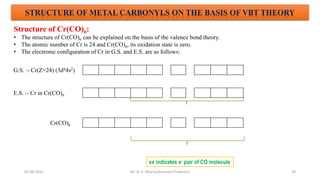
Structure of Cr(CO)6:
• The structure of Cr(CO)6 can be explained on the basis of the valence bond theory.
• The atomic number of Cr is 24 and Cr(CO)6, its oxidation state is zero.
• The electronic configuration of Cr in G.S. and E.S. are as follows:
G.S. :- Cr(Z=24) (3d44s2)
E.S. :- Cr in Cr(CO)6
Cr(CO)6
xx indicates e- pair of CO molecule
Mr. N. K. Dhurve(Assistant Professor)
05-08-2022 30
STRUCTURE OF METAL CARBONYLS ON THE BASIS OF VBT THEORY
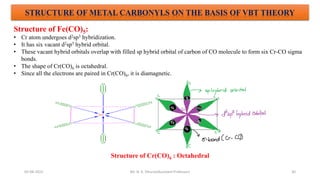
Structure of Fe(CO)5:
• Cr atom undergoes d2sp3 hybridization.
• It has six vacant d2sp3 hybrid orbital.
• These vacant hybrid orbitals overlap with filled sp hybrid orbital of carbon of CO molecule to form six Cr-CO sigma
bonds.
• The shape of Cr(CO)6 is octahedral.
• Since all the electrons are paired in Cr(CO)6, it is diamagnetic.
Structure of Cr(CO)6 : Octahedral
Mr. N. K. Dhurve(Assistant Professor)
05-08-2022 31
NATURE OF M-C BOND IN METAL CARBONYLS
BACKBONDING OR SYNERGISM IN METAL CARBONYLS
The CO molecule has filled σ-orbital of C-atom (lone pair of C-atom) and vacant π-antibonding MO’s (pπ*
orbitals). Similarly the metal atom has filled d-orbitals (called as dπ orbitals) and vacant hybrid orbitals (sp3
, dsp3
, d2
sp3
)
called as σ-orbitals.
The formation of metal-carbon (M-C) bond in metal carbonyls is explained as below:
i) Firstly, a dative overlapping of filled σ orbital of carbon with an empty metal σ orbital takes place to form MCO
bond as shown below.
Dative σ-bond
Vacant σ orbital on metal Filled σ orbital on C-atom σ-overlap to form MC σ-bond
Carbon monoxide has a triple bond with lone pair of electrons on both carbon and oxygen atom in sp hybrid
orbitals or sigma orbitals.
sp sp
Mr. N. K. Dhurve(Assistant Professor)
05-08-2022 32
NATURE OF M-C BOND IN METAL CARBONYLS
BACK BONDING OR SYNERGISM IN METAL CARBONYLS
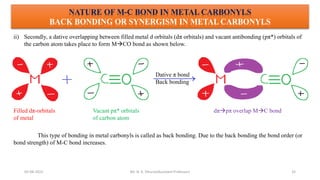
ii) Secondly, a dative overlapping between filled metal d orbitals (dπ orbitals) and vacant antibonding (pπ*) orbitals of
the carbon atom takes place to form MCO bond as shown below.
Dative π bond
Back bonding
Filled dπ-orbitals
of metal
Vacant pπ* orbitals
of carbon atom
dπpπ overlap MC bond
This type of bonding in metal carbonyls is called as back bonding. Due to the back bonding the bond order (or
bond strength) of M-C bond increases.
Mr. N. K. Dhurve(Assistant Professor)
05-08-2022 33
NATURE OF M-C BOND IN METAL CARBONYLS
BACK BONDING OR SYNERGISM IN METAL CARBONYLS
Evidences in favor of M-C bond:
i) Evidence based on bond length or bond order
The formation of a π bond by back bonding in metal carbonyl (MCO) results in shortening of M-C bond than
the normal value and increase in C-O bond length in CO molecule.
e.g., The MC bond length for single bond is 232pm and that in metal carbonyls it is 197pm. Similarly, the normal value
CO bond length is 112pm and it increases in metal carbonyl (115pm).
In metal carbonyls the bond order of M-C bond is not one, it is more than one this shows the formation of M-C π bond.
ii) IR frequencies:
IR stretching frequency in free CO molecule is 2143cm
-1
that decreases in metal carbonyls. This indirectly
proves that, the bond order of CO decreases and that of M-C bond increases.
Mr. N. K. Dhurve(Assistant Professor)
05-08-2022 34
Mr. N. K. Dhurve(Assistant Professor)
05-08-2022 35
Mr. N. K. Dhurve(Assistant Professor)

UNIT-II-INORGANIC CHEMISTRY9SEM-VI).pptx

  • 1.
    1 05-08-2022 By Mr. Nilkesh K.Dhurve(MSc., CSIR-NET, SET) Assistant Professor Department of Chemistry Shri Pundlik Maharaj Mahavidyalaya Nandura Rly Dist-Buldana ORGANOMETTALIC CHEMISTRY Chromium hexacarbonyl Dimeric cobalt carbonyl Mr. N. K. Dhurve(Assistant Professor)
  • 2.
    05-08-2022 2 CONTENT • Introduction •Classification of Organometallic Compounds • Nomenclature of Organometallic Compounds • Modern Classification of Organometallic Compounds • Metal Carbonyls • Classification of Metal Carbonyls 1. Nickel Carbonyl 2. Iron Carbonyl 3. Chromium Carbonyls • EAN • Structure of Metal Carbonyls on the basis of VBT Mr. N. K. Dhurve(Assistant Professor)
  • 3.
    ORGANOMETALLIC COMPOUNDS The compoundsin which metal atom is directly linked with a carbon atom of organic group or radical are called as organometallic compounds. OR The compounds which have at least one direct bond between metal atom and carbon atom of an organic radical are called as organometallic compounds. The general formula of organometallic compounds is R-M or R-M-X Where, R is alkyl or aryl group; M is metal atom and X is halogen atom. The compounds in which there s no direct link between metal and carbon atoms are not an organometallic compounds. 3 05-08-2022 Mr. N. K. Dhurve(Assistant Professor)
  • 4.
    CLASSIFICATION OF ORGANOMETALLICCOMPOUNDS Organometallic compounds are classified into three types depending upon the nature of metal carbon bond. I) Sigma bonded compounds II) π-bonded compounds III) Multiple bonded compounds I) Sigma Bonded Organometallic Compounds: In this type of compounds sigma bond is formed between metal and carbon atoms. 4 05-08-2022 Mr. N. K. Dhurve(Assistant Professor)
  • 5.
    II) π-Bonded OrganometallicCompounds: In this type of compounds π-bonds are formed between the metal and delocalized π-electron cloud of organic compound. Each cyclopentadiene molecule contributes five π-electrons to form the compound. Ferrocene Bis-benzene chromium Each benzene ring contributes six π-electrons to form the compound. III) Multiple Bonded Organometallic Compounds: In this type of compounds, multiple bonds i.e., σ as well as π bonds are formed between metal and carbon atoms. Examples: Cr(CO)6, Fe(CO)6, Ni(CO)4, Dimeric cobalt carbonyl, etc. Chromium hexacarbonyl Dimeric cobalt carbonyl In metal carbonyls, σ-bond is formed by the donation of electron pair from carbon monoxide to metal and π-bond is formed by the back bonding of electrons from metal to carbon monoxide. 5 05-08-2022 Mr. N. K. Dhurve(Assistant Professor)
  • 6.
    NOMENCLATURE OF ORGANOMETALLICCOMPOUNDS 1. Nomenclature of simple compounds: The simple alkyl or aryl organometallic compounds of metal are named by writing the name of alkyl or aryl group formed by the name of metal. e.g.: CH3-Li Methyl lithium C2H5MgBr Ethyl magnesium bromide (C2H5)2Zn Diethyl zinc C6H5MgCl Phenyl magnesium chloride 2. Nomenclature of carbonyls: a) The compounds containing CO ligands are called metal carbonyls. In neutral metal carbonyls, oxidation state of metal is zero and therefore need not be mentioned. e.g., Ni(CO)4 Tetracarbonyl nickel Cr(CO)6 Hexacarbonyl chromium Mn2(CO)10 Decacarbonyl dimanganese Co2(CO)8 Octacarbonyl dicobalt Fe2(CO)9 Nonacarbonyl diiron [V(CO)6]- Hexacarbonyl vanadate(-I) b) For bridging ligands use the Greek letter ‘’ before its name. If more than one bridging ligand are present, indicate their number by using prefixes di-, tri-, tetra- etc. e.g., [(CO)3Co(CO)2Co(CO)3 Di--carbonyl bis-(tricarbonylcobalt) [(CO)3Fe(CO)3Fe(CO)3] Tri--carbonyl bis-(tricarbonyliron) 6 05-08-2022 Mr. N. K. Dhurve(Assistant Professor)
  • 7.
    NOMENCLATURE OF ORGANOMETALLICCOMPOUNDS 2. Nomenclature of carbonyls: c) If the metal carbonyls contains metal-metal bonds, then such carbonyls are classified as symmetrical or unsymmetrical. For the symmetrical metal carbonyls, the name are given by using the prefixes bis, tris, etc. e.g., [(CO)4Co-Co(CO)4] Bis-(tetracarbonyl cobalt) For the unsymmetrical metal carbonyls, one central metal atom and its ligands are treated as a ligand on the other central metal atom. e.g., [(CO)4Co-Re-(CO)5] Pentacarbonyl(tetracarbonyl cobaltio) rhenium 3. Nomenclature of σ and π bonded ligands: a) To distinguish between one carbon bonded and multiple carbon bonded ligands the notation σ and π used. e.g., Cyclopentadiene(C5H5) (C5H5) Li σ-C5H5 (C5H5)2Fe π-C5H5 7 05-08-2022 Mr. N. K. Dhurve(Assistant Professor)
  • 8.
    3. Nomenclature ofσ and π bonded ligands: b) In case of unsaturated ligands, the prefix ‘η’ is used. For one carbon bonded ligand use monohapto (η1), two carbon bonded use dihapto (η2) and so on. According to latest IUPAC convention, η notation is recommended. e.g., Fe(C5H5)2 Bis(η5-cyclopentadienyl)iron [Ferrocene] Cr(C6H6)2 Bis(η6-benzene)chromium Co(CO)3(π-C3H5) (η3-allyl)tricarbonyl cobalt (C6H6)Cr(CO)3 (η6-benzene)tricarbonyl chromium Fe2(CO)4(C5H5)2 Bis(η5-cyclopentadienyl)tetracarbonyl diiron Fe(CO)2(σ-C5H5)(π-C5H5) (η1-cyclopentadienyl) (η5-cyclopentadienyl)dicarbonyl iron Fe(CO)3(C4H6) (η4-butadiene)tricarbonyl iron Mn(CO)5(-CH2-CH=CH2) (η3-allyl)pentacarbonyl manganese NOMENCLATURE OF ORGANOMETALLIC COMPOUNDS 8 05-08-2022 Mr. N. K. Dhurve(Assistant Professor)
  • 9.
    MODERN CLASSIFICATION OFORGANOMETALLIC COMPOUNDS On the basis of number of electrons formally available on the neutral hydrocarbon or hydrocarbon radical for bonding with metal, the ligands are classified as follows: No. of electrons available Ligand 1 Alkyl, -R; Aryl, -C6H5; Acyl, 2 Carbonyl, -CO; Alkene, 3 Allyl, ; Cyclopropenyl, 4 Butadiene, ;Cyclobutadiene, 5 Cyclopentadienyl, or 6 Benzene, 9 05-08-2022 Mr. N. K. Dhurve(Assistant Professor)
  • 10.
    METAL CARBONYLS Metal carbonylsare organometallic compounds of transition metals and carbon monoxide ligand (π acceptor ligand or π acid) . They have the general formula Mx(CO)y. e.g., Cr(CO)6, Fe(CO)5, Ni(CO)4, etc. Metal carbonyls possess following interesting properties: 1) They are gases, liquids or solids of low melting point. This property indicates that the bonding in them is covalent. 2) In these compounds oxidation state of metal is zero {except [V(CO)6]-1}. 3) All the metal carbonyls are diamagnetic in nature {except [V(CO)6]-1 which is paramagnetic} 10 05-08-2022 Classification of Metal Carbonyls Metal carbonyls are classified into three types: 1) Monomeric or mononuclear metal carbonyls 2) Bridge Metal Carbonyls 3) Polynuclear Metal Carbonyls Mr. N. K. Dhurve(Assistant Professor)
  • 11.
    05-08-2022 11 MONOMERIC orMONONUCLEAR METAL CARBONYLS The metal carbonyls that contain only one metal atom per molecule are called as monomeric or mononuclear metal carbonyls. They have the general formula M(CO)y Examples: Ni(CO)4, Fe(CO)5, Cr(CO)6, etc. Nickel tetracarbonyl Tetrahedral Iron pentacarbonyl Trigonal bipyramidal Chromium hexacarbonyl Octahedral Mr. N. K. Dhurve(Assistant Professor)
  • 12.
    05-08-2022 12 05-08-2022 12 BRIDGEMETAL CARBONYLS The metal carbonyls that contain two metal atoms joint together by bridging CO molecule are called as bridging metal carbonyls. These are also called as bi-nuclear metal carbonyls. They have the general formula M2(CO)y Examples: Fe2(CO)9, Co2(CO)8, Os2(CO)9, Mn2(CO)10, etc. Isomer of Co2(CO)8 Exist in solid state Exist in solution Mn2(CO)10 Fe2(CO)9 Mr. N. K. Dhurve(Assistant Professor)
  • 13.
    05-08-2022 13 POLYNUCLEAR METALCARBONYLS The metal carbonyls that contain three or more metal atoms per molecule are called as polynuclear metal carbonyls. They have the general formula Mx(CO)y where x = 3, 4, 5…….. etc Examples: Polynuclear iron carbonyls, Fe3(CO)12 Polynuclear iron carbonyls Polynuclear metal carbonyls Mr. N. K. Dhurve(Assistant Professor)
  • 14.
    05-08-2022 14 I) NickelCarbonyl : [Ni(CO)4]{Nickel tetracarbonyl} Method of Preparation: i) Direct synthesis by the action of carbon monoxide on metal:[Monds Process, 1890] It is prepared by passing carbon monoxide over freshly reduced nickel at 303-323K at one atmospheric pressure. Ni + 4CO Ni(CO)4 303-323K (40 o C) 1atm pressure ii) Action of carbon monoxide on nickel salt (NaI2) in the presence of copper. NiI2 + 4CO + 2Cu Ni(CO)4 + Cu2I2 NiS + 4CO + 2Cu Ni(CO)4 + Cu2S Physical Properties: i) It is colorless liquid. ii) B.P. is 43 o C(316K). iii) Freezing point is -3 o C(270K) iv) It is soluble in organic solvents like benzene, ether, etc. v) It is insoluble in water. vi) It is highly toxic and inflammable in nature. Mr. N. K. Dhurve(Assistant Professor)
  • 15.
    05-08-2022 15 I) NickelCarbonyl : [Ni(CO)4]{Nickel tetracarbonyl} Chemical Properties: i) Action of Heat: It decomposes on heating to give nickel and carbon monoxide. Ni(CO)4 Ni + 4CO ii) Action of Sulfuric acid: It reacts with sulfuric acid to give nickel sulfate. Ni(CO)4 + H2SO4 NiSO4 + 4CO + H2 It slowly react with HCl and does not react with HBr or HI. iii) Action of Halogen: It react with chloride to give nickel chloride and nickel carbonyl chloride. Ni(CO)4 + Cl2 NiCl2 + 4CO 2Ni(CO)4 + Cl2 Ni(CO)6Cl2 + 2CO It reacts with bromine to give nickel bromide. Ni(CO)4 + Br2 NiBr2 + 4CO Mr. N. K. Dhurve(Assistant Professor)
  • 16.
    05-08-2022 16 I) NickelCarbonyl : [Ni(CO)4]{Nickel tetracarbonyl} iv) Action of ligands: It reacts with ligand like pyridine or o-phenanthroline to give disubstituted products in which two CO molecules are replaced by ligand. Ni(CO)4 + 2Py Ni(CO)2(Py)2 + 2CO Ni(CO)4 + (Phen) Ni(CO)2(Phen) + 2CO Ni + 4CO NiSO4 + 4CO + H2 Ni(CO)4 NiX2 + 4CO Ni(CO)2(Py)2 / Ni(CO)2(Phen) H2SO4 X2 (X= Cl, Br) Py/Phen -2CO Mr. N. K. Dhurve(Assistant Professor)
  • 17.
    05-08-2022 17 II) IronCarbonyl : Fe(CO)5 {Iron pentacarbonyl} Method of Preparation: i) Direct synthesis by the action of carbon monoxide on metal: It is prepared by passing carbon monoxide on iron metal at 473K (200 o C) and at 200 atm. Pressure (high pressure). Fe + 5CO Fe(CO)5 ii) From metal salts: When carbon monoxide is passed through metal salts(sulphide or halide) suspended in organic solvent at 473K (200 o C) and at 200 atm. Pressure, iron pentacarbonyl is obtained, in the presence of reducing agent like copper. FeI2 + 4CO Fe(CO)4I2 Fe(CO)5 + Cu2I2 FeS + 4CO Fe(CO)4S Fe(CO)5 + Cu2S 200 o C 200 atm pressure + CO + 2Cu + CO + 2Cu Physical Properties: i) It is yellow toxic liquid. ii) M.P. and B.P. is 253K and 403K. iii) It is soluble in organic solvents and insoluble in water. iv) It decomposes at its b.p. and decomposition is complete at 533K. Mr. N. K. Dhurve(Assistant Professor)
  • 18.
    05-08-2022 18 II) IronCarbonyl : Fe(CO)5 {Iron pentacarbonyl} Chemical Properties: i) Action of heat: When iron pentacarbonyl is heated at 553K, it decomposes to give iron and carbon monoxide. Fe(CO)5 Fe + 5CO ii) Action of light: When iron pentacarbonyls is exposed to sunlight or irradiated with UV light, dimerization takes place to give Nonacarbonyl diiron[Fe2(CO)9] 2Fe(CO)5 Fe2(CO)9 + CO iii) Action of acid: When iron pentacarbonyl is heated with dilute acid gives salt. Fe(CO)5+ 2HCl FeCl2 + 5CO + H2 iv) Action of alkali: On reaction with NaOH, iron pentacarbonyl gives yellow compound i.e., sodium carbonyl hydride. Fe(CO)5+ 3NaOH Na[Fe(CO)4H] + Na2CO3 + H2O v) Action with ammonia: Iron pentacarbonyl reacts with ammonia ( & water) to give carbamic acid. Fe(CO)5+ NH3 + H2O [Fe(CO)4H2] + NH2COOH Sunlight UV Mr. N. K. Dhurve(Assistant Professor)
  • 19.
    05-08-2022 19 II) IronCarbonyl : Fe(CO)5 {Iron pentacarbonyl} vi) Action with halogen: Iron pentacarbonyls react with halogen to form iron carbonyl halide. Fe(CO)5 + X2 [Fe(CO)4X2] + CO [X= Cl, Br, I] vii) Reducing action: Iron pentacarbonyl acts as a reducing agent. It reduces the following: a) It reduces carbon tetrachloride to dicarbon hexachloride. Fe(CO)5 + 2CCl4 C2Cl6 + FeCl2 + 5CO b) It reduces sulphuryl chloride to Sulphur dioxide. Fe(CO)5 + SO2Cl2 FeCl2 + 5CO + SO2 c) It reduces SnCl4 to SnCl2. Fe(CO)4Cl2 further reacts with SnCl2 to form addition compound. Fe(CO)5 + SnCl4 Fe(CO)4Cl2 + SnCl2 + CO d) It reduces SbCl5 to SbCl3. Fe(CO)4Cl2 further reacts with SbCl3 to form addition compound. Fe(CO)5 + SbCl5 Fe(CO)4Cl2 + SbCl3 Mr. N. K. Dhurve(Assistant Professor)
  • 20.
    05-08-2022 20 III) ChromiumCarbonyl : Cr(CO)6 {Chromium hexacarbonyl} Methods of Preparation: i) By the action of carbon monoxide on chromium salt (CrCl3) in the presence of GR (C6H5MgBr). 2CrCl3 + 3C6H5MgBr + 12CO 2Cr(CO)6 + 3C6H5Cl + 3MgBrCl ii) By the action of carbon monoxide on Chromous (Cr2+) and Chromic (Cr3+) salts in the presence of magnesium or zinc. Cr2+ + 6CO + Mg Cr(CO)6 + Mg3+ 2Cr3+ + 12CO + 3Zn 2Cr(CO)6 + 3Zn2+ iii) By the action of carbon monoxide on chromium chloride in the presence of Al2Cl3 and benzene. CrCl3 + Al2Cl3 + 2C6H6 (C6H6)2Cr + 2AlCl3 (C6H6)2Cr + 6CO Cr(CO)6 + 2C6H6 Ether 207K, High Pressure High Pressure High Pressure High Temperature High Pressure Mr. N. K. Dhurve(Assistant Professor)
  • 21.
    05-08-2022 21 III) ChromiumCarbonyl : Cr(CO)6 {Chromium hexacarbonyl} Physical Properties: i) It forms colorless rhombic crystal. ii) M.P. is 422K. iii) It sublime on heating. iv) It is diamagnetic in nature. v) It is soluble in organic solvent and insoluble in water. Chemical Properties: i) Reaction with halogen: It decomposes by fluorine and chlorine (except Br2 & I2) to form respective salts. 2Cr(CO)6 + 5F2 2CrF5 + 12CO 2Cr(CO)6 + 5Cl2 2CrCl5 + 12CO ii) Reaction with sodium: It reacts with sodium to form chromium carbonylate. 2Na + Cr(CO)6 [2Na+][Cr(CO)6] 2- + CO iii) Reaction with ligand: When chromium carbonyl reacts with ligand, gives substitution product ( by replacing 3CO molecules). Cr(CO)6 + 3Py Cr(CO)3(Py)3 + 3CO iv) Reaction with unsaturated hydrocarbons: It combines with unsaturated hydrocarbon like cyclopentadiene at high temperature and pressure to give a π-complex. 2Cr(CO)6 + 2C5H5 (C5H5)2Cr(CO)6 Mr. N. K. Dhurve(Assistant Professor)
  • 22.
    05-08-2022 22 EFFECTIVE ATOMICNUMBER (EAN) IN METAL CARBONYLS • This rule is proposed by Nevil V. Sidgwick. • The total number of electrons possess by metal atom and the electrons gained by it from the ligands is called as effective atomic number. OR The total number of electrons associated with the metal atom after the carbonyl formation is called as effective atomic number(EAN). EAN = (Z – X) + 2Y Where, Z- Atomic number of central metal atom; X- Oxidation Number of central metal ion; Y- Number of electrons gained from ligand For metal carbonyls, EAN = Z + 2Y Where, Y- Number of CO ligands(terminal) • To calculate EAN of the central atom in the metal carbonyls, the following point should be remembered: i) In the metal carbonyls, metal is in zero oxidation state. ii) Each terminal CO group donate two electrons to the central atom and bridging ligand donate one electron. iii) Number of electron donate to each metal atom through a M-M bond is one. Mr. N. K. Dhurve(Assistant Professor)
  • 23.
    05-08-2022 23 EFFECTIVE ATOMICNUMBER (EAN) IN METAL CARBONYLS Compound Central Metal M Atomic Number of CMI(Z) Electron gained through CO ligand(2Y) EAN= Z + 2Y Ni(CO)4 Ni 28 8 EAN= 28 + 8 = 36 Fe(CO)5 Fe 26 10 EAN= 26 + 10 = 36 Cr(CO)6 Cr 24 12 EAN= 24 + 12 = 36 Some other examples: i) Fe2(CO)9 Fe(Z)=26 ; Terminal CO= 3; Bridging CO= 3; M-M bond = 1 EAN = Z + 2(No. of terminal CO) + 1(No. of bridging CO) + 1(No. of M-M bond) = 26 + 2(3) + 1(3) + 1(1) = 36 (Kr=36) It is Diamagnetic. ii) Mm2(CO)10 Fe(Z)=25 ; Terminal CO= 5; M-M bond = 1 EAN = 25 + 2(No. of terminal CO) + 1(No. of M-M bond) = 25 + 2(5) + 1(1) = 36 (Kr=36) It is Diamagnetic. Mr. N. K. Dhurve(Assistant Professor)
  • 24.
    05-08-2022 24 STRUCTURE OFMETAL CARBONYLS ON THE BASIS OF VBT THEORY Molecule Hybridization Geometry Atomic No. of Metal Magnetism Ni(CO)4 sp 3 Tetrahedral 28 Diamagnetic Fe(CO)5 dsp 3 Trigonal bipyramidal 26 Diamagnetic Cr(CO)6 d 2 sp 3 Octahedral 24 Diamagnetic Mr. N. K. Dhurve(Assistant Professor)
  • 25.
    05-08-2022 25 STRUCTURE OFMETAL CARBONYLS ON THE BASIS OF VBT THEORY Structure of Ni(CO)4: • The structure of Ni(CO)4 can be explained on the basis of the valence bond theory. • The atomic number of Ni is 28 and Ni(CO)4, its oxidation state is zero. • The electronic configuration of Ni in G.S. and E.S. are as follows: G.S. :- Ni(Z=28) (3d84s2) E.S. :- Ni in Ni(CO)4 Ni(CO)4 xx indicates e- pair of CO molecule Mr. N. K. Dhurve(Assistant Professor)
  • 26.
    05-08-2022 26 STRUCTURE OFMETAL CARBONYLS ON THE BASIS OF VBT THEORY Structure of Ni(CO)4: • Ni atom undergoes sp3 hybridization. • It has four vacant sp3 hybrid orbital. • These vacant hybrid orbitals overlap with filled sp hybrid orbital of carbon of CO molecule to form four Ni-CO sigma bonds. • The shape of Ni(CO)4 is tetrahedral. • Since all the electrons are paired in Ni(CO)4, it is diamagnetic. Structure of Ni(CO)4 : Tetrahedral Mr. N. K. Dhurve(Assistant Professor)
  • 27.
    05-08-2022 27 STRUCTURE OFMETAL CARBONYLS ON THE BASIS OF VBT THEORY Structure of Fe(CO)5: • The structure of Fe(CO)5 can be explained on the basis of the valence bond theory. • The atomic number of Fe is 26 and Fe(CO)5, its oxidation state is zero. • The electronic configuration of Fe in G.S. and E.S. are as follows: G.S. :- Fe(Z=26) (3d64s2) E.S. :- Fe in Fe(CO)5 Fe(CO)5 xx indicates e- pair of CO molecule Mr. N. K. Dhurve(Assistant Professor)
  • 28.
    05-08-2022 28 STRUCTURE OFMETAL CARBONYLS ON THE BASIS OF VBT THEORY Structure of Fe(CO)5: • Fe atom undergoes dsp3 hybridization. • It has five vacant dsp3 hybrid orbital. • These vacant hybrid orbitals overlap with filled sp hybrid orbital of carbon of CO molecule to form five Fe-CO sigma bonds. • The shape of Fe(CO)5 is trigonal bipyramidal. • Since all the electrons are paired in Fe(CO)5, it is diamagnetic. Structure of Fe(CO)5 : Trigonal bipyramidal Mr. N. K. Dhurve(Assistant Professor)
  • 29.
    05-08-2022 29 STRUCTURE OFMETAL CARBONYLS ON THE BASIS OF VBT THEORY Structure of Cr(CO)6: • The structure of Cr(CO)6 can be explained on the basis of the valence bond theory. • The atomic number of Cr is 24 and Cr(CO)6, its oxidation state is zero. • The electronic configuration of Cr in G.S. and E.S. are as follows: G.S. :- Cr(Z=24) (3d44s2) E.S. :- Cr in Cr(CO)6 Cr(CO)6 xx indicates e- pair of CO molecule Mr. N. K. Dhurve(Assistant Professor)
  • 30.
    05-08-2022 30 STRUCTURE OFMETAL CARBONYLS ON THE BASIS OF VBT THEORY Structure of Fe(CO)5: • Cr atom undergoes d2sp3 hybridization. • It has six vacant d2sp3 hybrid orbital. • These vacant hybrid orbitals overlap with filled sp hybrid orbital of carbon of CO molecule to form six Cr-CO sigma bonds. • The shape of Cr(CO)6 is octahedral. • Since all the electrons are paired in Cr(CO)6, it is diamagnetic. Structure of Cr(CO)6 : Octahedral Mr. N. K. Dhurve(Assistant Professor)
  • 31.
    05-08-2022 31 NATURE OFM-C BOND IN METAL CARBONYLS BACKBONDING OR SYNERGISM IN METAL CARBONYLS The CO molecule has filled σ-orbital of C-atom (lone pair of C-atom) and vacant π-antibonding MO’s (pπ* orbitals). Similarly the metal atom has filled d-orbitals (called as dπ orbitals) and vacant hybrid orbitals (sp3 , dsp3 , d2 sp3 ) called as σ-orbitals. The formation of metal-carbon (M-C) bond in metal carbonyls is explained as below: i) Firstly, a dative overlapping of filled σ orbital of carbon with an empty metal σ orbital takes place to form MCO bond as shown below. Dative σ-bond Vacant σ orbital on metal Filled σ orbital on C-atom σ-overlap to form MC σ-bond Carbon monoxide has a triple bond with lone pair of electrons on both carbon and oxygen atom in sp hybrid orbitals or sigma orbitals. sp sp Mr. N. K. Dhurve(Assistant Professor)
  • 32.
    05-08-2022 32 NATURE OFM-C BOND IN METAL CARBONYLS BACK BONDING OR SYNERGISM IN METAL CARBONYLS ii) Secondly, a dative overlapping between filled metal d orbitals (dπ orbitals) and vacant antibonding (pπ*) orbitals of the carbon atom takes place to form MCO bond as shown below. Dative π bond Back bonding Filled dπ-orbitals of metal Vacant pπ* orbitals of carbon atom dπpπ overlap MC bond This type of bonding in metal carbonyls is called as back bonding. Due to the back bonding the bond order (or bond strength) of M-C bond increases. Mr. N. K. Dhurve(Assistant Professor)
  • 33.
    05-08-2022 33 NATURE OFM-C BOND IN METAL CARBONYLS BACK BONDING OR SYNERGISM IN METAL CARBONYLS Evidences in favor of M-C bond: i) Evidence based on bond length or bond order The formation of a π bond by back bonding in metal carbonyl (MCO) results in shortening of M-C bond than the normal value and increase in C-O bond length in CO molecule. e.g., The MC bond length for single bond is 232pm and that in metal carbonyls it is 197pm. Similarly, the normal value CO bond length is 112pm and it increases in metal carbonyl (115pm). In metal carbonyls the bond order of M-C bond is not one, it is more than one this shows the formation of M-C π bond. ii) IR frequencies: IR stretching frequency in free CO molecule is 2143cm -1 that decreases in metal carbonyls. This indirectly proves that, the bond order of CO decreases and that of M-C bond increases. Mr. N. K. Dhurve(Assistant Professor)
  • 34.
    05-08-2022 34 Mr. N.K. Dhurve(Assistant Professor)
  • 35.
    05-08-2022 35 Mr. N.K. Dhurve(Assistant Professor)