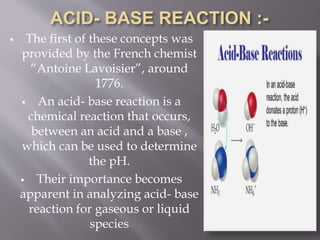
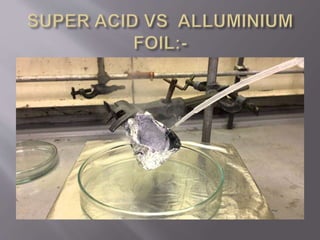
This document discusses acid-base chemistry and super acids and bases. It defines acids as molecules that can donate protons or accept electron pairs in reactions. Bases are defined as substances that release hydroxide ions in aqueous solutions. Super acids are defined as having a greater acidity than 100% sulfuric acid, while super bases have a high affinity for protons. Examples of super acids include fluorosulfuric acid and triflic acid, while examples of super bases include lithium nitride and potassium hydride. The document discusses applications of super acids and bases in organic synthesis and catalysis.



![Acidandbase chm141 thursday[1]goodday](https://cdn.slidesharecdn.com/ss_thumbnails/acidandbasechm141-thursday1goodday-121121141355-phpapp02-thumbnail.jpg?width=640&height=640&fit=bounds)


