Staff Development Workshop
Assessment FOR Learning
Assessment OF Learning
MOHAN Joseph Bernard
Aug 2014
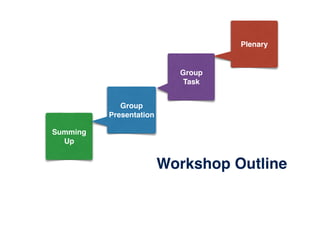
Workshop Outline
Summing 
Up

Group
Presentation

Group
Task
Plenary
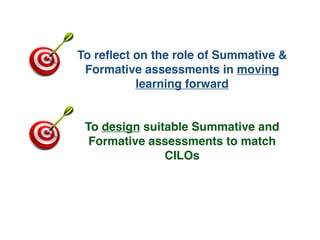
To reflect on the role of Summative &
Formative assessments in moving
learning forward
To design suitable Summative and
Formative assessments to match
CILOs
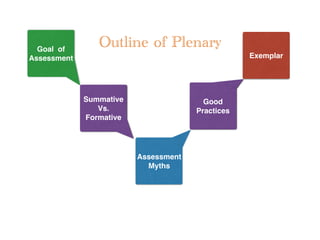
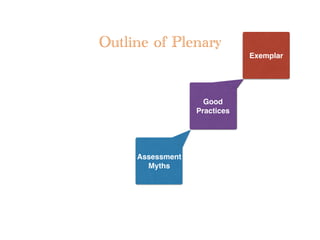
Outline of PlenaryGoal of
Assessment
Assessment
Myths
Summative
Vs.
Formative
Exemplar
Good
Practices
Let's set the
ball rolling...
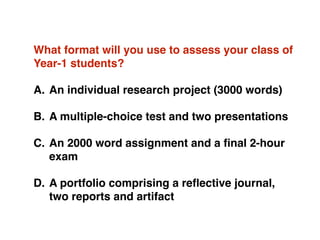
What format will you use to assess your class of
Year-1 students?
A. An individual research project (3000 words)
B. A multiple-choice test and two presentations 
C. An 2000 word assignment and a final 2-hour
exam
D. A portfolio comprising a reflective journal,
two reports and artifact
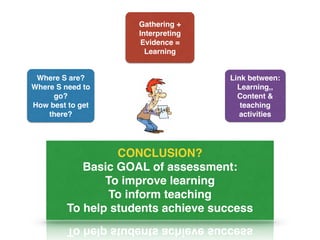
Link between:
Learning,,
Content &
teaching
activities
Gathering +
Interpreting
Evidence =
Learning
Where S are?
Where S need to
go?
How best to get
there? 
CONCLUSION?
Basic GOAL of assessment:
To improve learning
To inform teaching
To help students achieve success
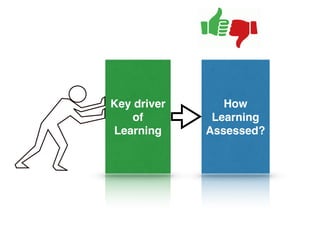
How 
Learning
Assessed?
Key driver 
of 
Learning
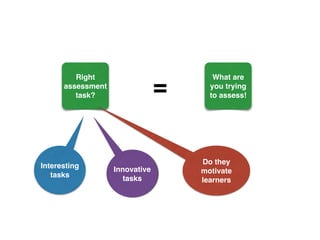
Right
assessment
task?
What are
you trying
to assess!=
Do they 
motivate 
learners
Innovative
tasks
Interesting
tasks
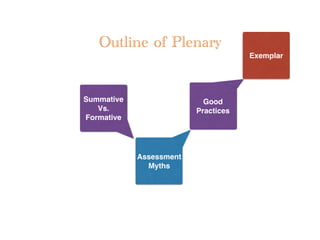
Outline of Plenary
Assessment
Myths
Summative
Vs.
Formative
Exemplar
Good
Practices
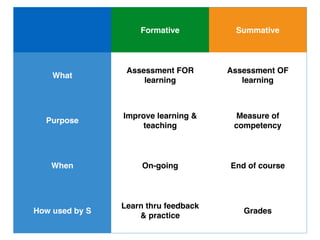
What's the difference?
Formative assessment 
vs. 
Summative assessment
Formative Summative
What
Assessment FOR
learning
Assessment OF 
learning
Purpose
Improve learning &
teaching
Measure of 
competency
When

On-going 
 End of course
How used by S
Learn thru feedback 
& practice
Grades
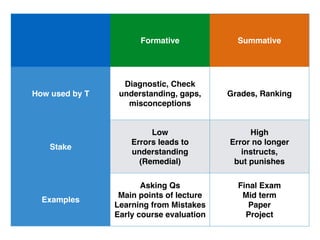
Formative Summative
How used by T
Diagnostic, Check
understanding, gaps,
misconceptions
Grades, Ranking
Stake
Low
Errors leads to
understanding
(Remedial)
High
Error no longer
instructs, 
but punishes
Examples
Asking Qs
Main points of lecture
Learning from Mistakes
Early course evaluation
Final Exam
Mid term
Paper
Project
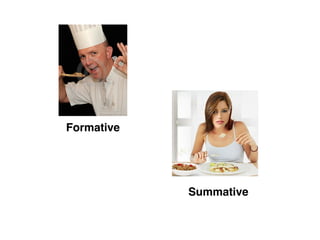
Formative
Summative
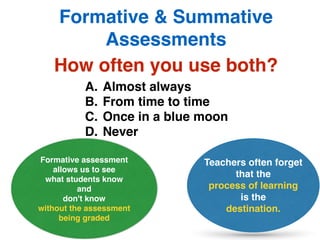
How often you use both?
Formative & Summative
Assessments

A. Almost always
B. From time to time
C. Once in a blue moon
D. Never
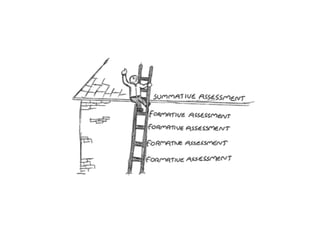
Teachers often forget
that the 
process of learning 
is the 
destination.
Formative assessment
allows us to see 
what students know 
and 
don't know 
without the assessment 
being graded
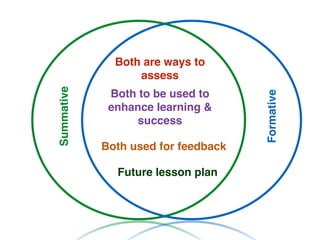
Both are ways to
assess
Both to be used to
enhance learning &
success
Both used for feedback
Future lesson plan
Summative
Formative
Outline of Plenary
Assessment
Myths
Exemplar
Good
Practices
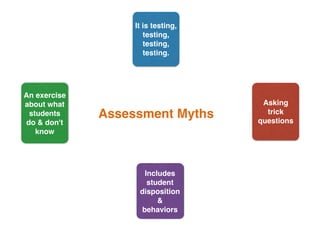
Assessment Myths
It is testing,
testing,
testing,
testing.
An exercise
about what
students 
do & don't
know
Asking 
trick
questions
Includes
student
disposition
& 
behaviors
Outline of Plenary
Exemplar
Good
Practices
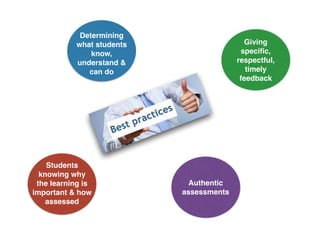
Determining
what students
know,
understand &
can do
Students
knowing why
the learning is
important & how
assessed
Giving
specific,
respectful, 
timely 
feedback
Authentic
assessments
Outline of Plenary
Exemplar
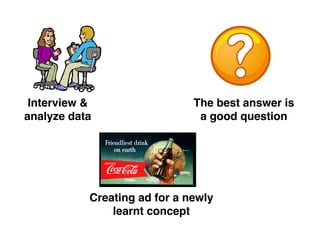
Interview & 
analyze data
Creating ad for a newly 
learnt concept
The best answer is
a good question
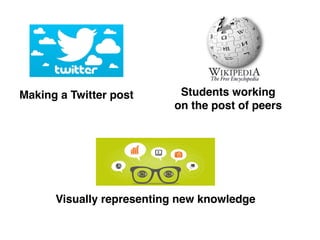
Making a Twitter post
Visually representing new knowledge
Students working
on the post of peers
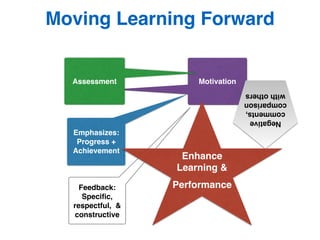
Moving Learning Forward
MotivationAssessment
Emphasizes:
Progress +
Achievement
Feedback:
Specific,
respectful, &
constructive
Negative
comments,
comparison
withothers
Enhance 
Learning & 
Performance
?
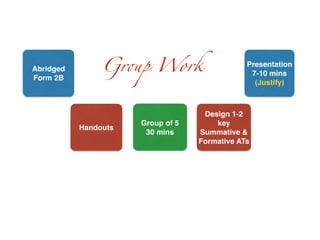
Gr!p Work
Group of 5
30 mins
Handouts
Abridged
Form 2B
Presentation
7-10 mins
(Justify)
Design 1-2
key
Summative &
Formative ATs
Questions?

Summative & formative assessment