ASSESSMENT:
FORMATIVE & SUMMATIVE
Methods of Assessing the Physical Education Setting
BY
Michael Misseri
What is Assessment
• Assessment information is used by teachers to adjust their teaching
strategies, and by students to adjust their learning strategies.
• Assessment, teaching and learning are linked, as each informs the
others.
• A powerful process that can either optimize or inhibit learning
Planned and Communicated
• Assessment for learning should
be built planning as everyday
classroom practice.
• Students should know in
advance what they will learn,
and why they are to be
assessed.
• Teachers’ plans should be
flexible so that they can make
changes in response to new
information,
• The planning needs to include
strategies to check students’
understanding
• How students will receive
feedback, how they will take
part in assessing their learning
• A teacher’s planning should
provide students opportunities
to obtain information about
progress towards learning
goals,.
Summative Assessment
• Assessment of learning
• Taken by students at the end of a unit to
demonstrate what they learned and forgotten.
• Summative assessment methods are the most
traditional way of evaluating student work.
• "Good summative assessments--tests and other
graded evaluations--must be reliable, valid, and
free of bias"
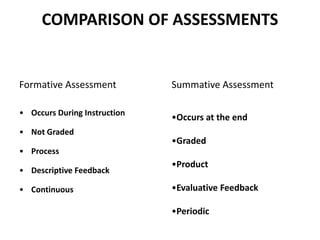
COMPARISON OF ASSESSMENTS
• Occurs During Instruction
• Not Graded
• Process
• Descriptive Feedback
• Continuous
Formative Assessment Summative Assessment
•Occurs at the end
•Graded
•Product
•Evaluative Feedback
•Periodic
COMPARISON OF ASSESSMENTS
Occurs During Instruction
Not Graded
Process
Descriptive Feedback
Continuous
Formative Assessment
COMPARISON OF ASSESSMENTS
Occurs at the end
Graded
Product
Evaluative Feedback
Periodic
SUMMATIVE ASSESSMENTS
Assessment Defined
• Assessment in education is the process of
gathering, interpreting, recording, and
using information about pupils’ responses
to an educational task.
Formative assessments
Questions
Classroom Discussions
Learning Activities
Feedback
Conferences
Interviews
Student Self-Assessment
Summative Assessment
Selected Response
Multiple Choice
True/False
Matching
Fill-in
Extended Written Response
Performance Assessment
Formative Example’s
Values and Attitudes about
Assessment
1. Teachers value and believe in students.
2. Sharing learning goals with the students.
3. Involving students in self-assessment.
4. Providing feedback that helps students
recognize their next steps and how to
take them.
5. Being confident that every student can
improve.
6. Providing students with examples of
what we expect from them.
Formative Assessment
• Assessment for learning
• Taken at varying intervals throughout a
course to provide information and
feedback that will help improve
– the quality of student learning
– the quality of the course itself
Formative continued
• learner-centered, teacher-directed,
mutually beneficial, formative, context-
specific, ongoing, and firmly rooted in
good practice" (Angelo and Cross, 1993).
• Provides information on what an individual
student needs
– To practice
– To have re-taught
– To learn next
Key Elements of Formative
Assessment
1. The identification by teachers & learners of
learning goals, intentions or outcomes and
criteria for achieving these.
2. Rich conversations between teachers & students
that continually build and go deeper.
3. The provision of effective, timely feedback to
enable students to advance their learning.
4. The active involvement of students in their own
learning.
5. Teachers responding to identified learning needs
and strengths by modifying their teaching
approach(es).
Summative Assessment
• Assessment of learning
• Generally taken by students at the end of a
unit or semester to demonstrate the "sum" of
what they have or have not learned.
• Summative assessment methods are the
most traditional way of evaluating student
work.
• "Good summative assessments--tests and
other graded evaluations--must be
demonstrably reliable, valid, and free of
bias"
Factors Inhibiting Assessment
• A tendency for teachers to assess quantity and
presentation of work rather than quality of
learning.
• Greater attention given to marking and grading,
much of it tending to lower self esteem of
students, rather than providing advice for
improvement.
• A strong emphasis on comparing students with
each other, which demoralizes the less successful
learners.
Implications for classroom practice
• Share learning goals with students.
• Involve students in self-assessment.
• Provide feedback that helps students
recognize their next steps and how to take
them.
• Be confident that every student can
improve.

Misseri.assessment1

  • 1.
    ASSESSMENT: FORMATIVE & SUMMATIVE Methodsof Assessing the Physical Education Setting BY Michael Misseri
  • 2.
    What is Assessment •Assessment information is used by teachers to adjust their teaching strategies, and by students to adjust their learning strategies. • Assessment, teaching and learning are linked, as each informs the others. • A powerful process that can either optimize or inhibit learning
  • 4.
    Planned and Communicated •Assessment for learning should be built planning as everyday classroom practice. • Students should know in advance what they will learn, and why they are to be assessed. • Teachers’ plans should be flexible so that they can make changes in response to new information, • The planning needs to include strategies to check students’ understanding • How students will receive feedback, how they will take part in assessing their learning • A teacher’s planning should provide students opportunities to obtain information about progress towards learning goals,.
  • 5.
    Summative Assessment • Assessmentof learning • Taken by students at the end of a unit to demonstrate what they learned and forgotten. • Summative assessment methods are the most traditional way of evaluating student work. • "Good summative assessments--tests and other graded evaluations--must be reliable, valid, and free of bias"
  • 6.
    COMPARISON OF ASSESSMENTS •Occurs During Instruction • Not Graded • Process • Descriptive Feedback • Continuous Formative Assessment Summative Assessment •Occurs at the end •Graded •Product •Evaluative Feedback •Periodic
  • 7.
    COMPARISON OF ASSESSMENTS OccursDuring Instruction Not Graded Process Descriptive Feedback Continuous Formative Assessment
  • 8.
    COMPARISON OF ASSESSMENTS Occursat the end Graded Product Evaluative Feedback Periodic SUMMATIVE ASSESSMENTS
  • 9.
    Assessment Defined • Assessmentin education is the process of gathering, interpreting, recording, and using information about pupils’ responses to an educational task.
  • 10.
    Formative assessments Questions Classroom Discussions LearningActivities Feedback Conferences Interviews Student Self-Assessment
  • 11.
    Summative Assessment Selected Response MultipleChoice True/False Matching Fill-in Extended Written Response Performance Assessment
  • 12.
  • 13.
    Values and Attitudesabout Assessment 1. Teachers value and believe in students. 2. Sharing learning goals with the students. 3. Involving students in self-assessment. 4. Providing feedback that helps students recognize their next steps and how to take them. 5. Being confident that every student can improve. 6. Providing students with examples of what we expect from them.
  • 14.
    Formative Assessment • Assessmentfor learning • Taken at varying intervals throughout a course to provide information and feedback that will help improve – the quality of student learning – the quality of the course itself
  • 15.
    Formative continued • learner-centered,teacher-directed, mutually beneficial, formative, context- specific, ongoing, and firmly rooted in good practice" (Angelo and Cross, 1993). • Provides information on what an individual student needs – To practice – To have re-taught – To learn next
  • 16.
    Key Elements ofFormative Assessment 1. The identification by teachers & learners of learning goals, intentions or outcomes and criteria for achieving these. 2. Rich conversations between teachers & students that continually build and go deeper. 3. The provision of effective, timely feedback to enable students to advance their learning. 4. The active involvement of students in their own learning. 5. Teachers responding to identified learning needs and strengths by modifying their teaching approach(es).
  • 17.
    Summative Assessment • Assessmentof learning • Generally taken by students at the end of a unit or semester to demonstrate the "sum" of what they have or have not learned. • Summative assessment methods are the most traditional way of evaluating student work. • "Good summative assessments--tests and other graded evaluations--must be demonstrably reliable, valid, and free of bias"
  • 18.
    Factors Inhibiting Assessment •A tendency for teachers to assess quantity and presentation of work rather than quality of learning. • Greater attention given to marking and grading, much of it tending to lower self esteem of students, rather than providing advice for improvement. • A strong emphasis on comparing students with each other, which demoralizes the less successful learners.
  • 19.
    Implications for classroompractice • Share learning goals with students. • Involve students in self-assessment. • Provide feedback that helps students recognize their next steps and how to take them. • Be confident that every student can improve.