Classroom Teaching,
Assessment and Evaluation

.
What are pre, formative and
 summative assessments?
Assessment
Refers to the full range of information gathered
and synthesized by teachers about their students
and their classroom. Assessment is a continuous
process (Arends, 2007).

There are two general uses or functions of
assessment: Formative assessment and
Summative assessment (Woolfolk et al 2008).
Formative assessment
Is an ungraded testing used before and during
teaching to aid in planning and diagnosis
(Woolfolk et al 2008).

 Formative assessment is a process used by
teachers and students during instruction that
provides explicit feedback to adjust on-going
teaching and learning in order to improve
  student
Formative assessment
Formative assessment refers to assessment for
learning which is focused on monitoring
student response to and progress with
instructions. It provides immediate feedback to
both teacher and student.
 (Johnson &Jenkins, 2009)

In formative assessment here is a pre-test which
is termed Pre-Assessment.
Formative assessment
This pre-assessment or pre-test helps the teacher
to determine what are the students’ knowledge
and skills in order to assist with planning
(Arends, 2007).

There is also a diagnostic test which identifies a
student area of achievement and weakness in a
particular subject, which can give an idea of
difficulty the student is experiencing.
Formative assessment
It should be noted that the pre-test and
diagnostic test are not graded and the
formative test do not count toward final
grades (Woolfolk et al 2008).
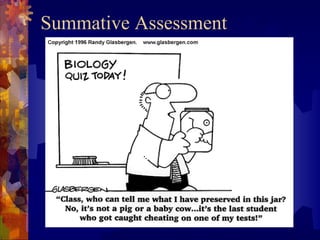
Summative assessment
Are cumulative evaluation used to measure
growth after instruction and are generally given
at the end of a course in order to determine
whether long term goals have been met
(Coffey, 2012)
Summative assessment focus on what the student
has learned at the end of a unit of instruction or at
the end of a grade level (e.g. standard one,
National Test) ( Johnson & Jenkins, 2009).
Summative assessment
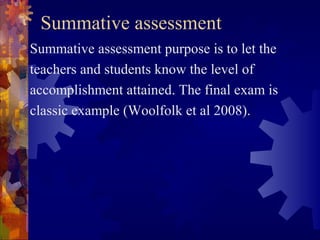
Summative assessment purpose is to let the
teachers and students know the level of
accomplishment attained. The final exam is
classic example (Woolfolk et al 2008).
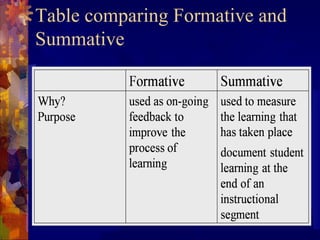
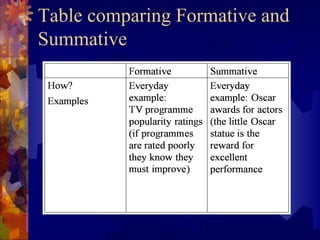
Table comparing Formative and
Summative
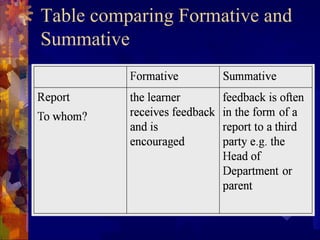
Table comparing Formative and
Summative
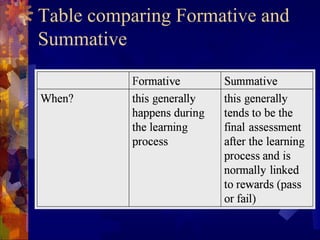
Table comparing Formative and
Summative
Table comparing Formative and
Summative
Table comparing Formative and
Summative
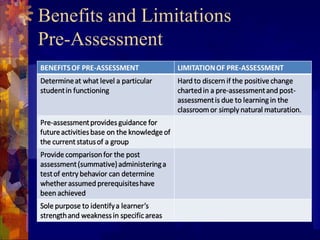
Benefits and Limitations
   Pre-Assessment
Benefits and Limitations
Pre-Assessment
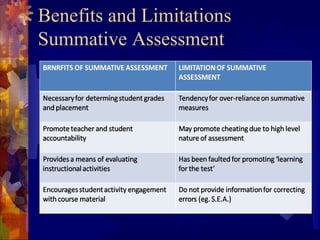
Benefits and Limitations
Summative Assessment
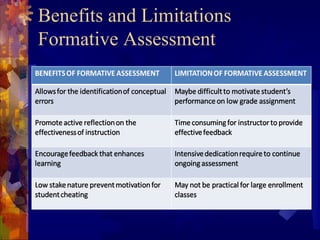
Benefits and Limitations
Formative Assessment
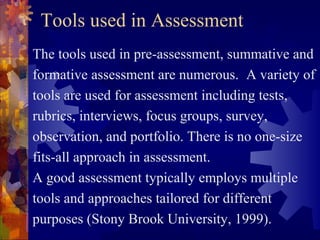
Tools used in Assessment
The tools used in pre-assessment, summative and
formative assessment are numerous. A variety of
tools are used for assessment including tests,
rubrics, interviews, focus groups, survey,
observation, and portfolio. There is no one-size
fits-all approach in assessment.
A good assessment typically employs multiple
tools and approaches tailored for different
purposes (Stony Brook University, 1999).
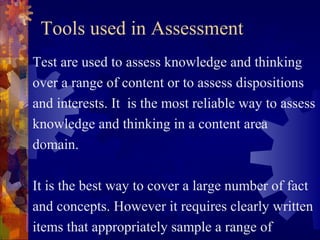
Tools used in Assessment
Test are used to assess knowledge and thinking
over a range of content or to assess dispositions
and interests. It is the most reliable way to assess
knowledge and thinking in a content area
domain.

It is the best way to cover a large number of fact
and concepts. However it requires clearly written
items that appropriately sample a range of
Tools used in Assessment
content material. (Stony Brook University,
1999).
 Performance tasks are used to assess in-depth
thinking in one area or to assess skills attained or
products created. It allows measurement of in
depth thinking, skills or products not readily
assessable by tests.
However it requires clear expectations for tasks
and scoring to provide meaningful assessment
information (Stony Brook University, 1999).
Tools used in Assessment
Portfolios are used to document progress or
development or to show case complex
achievement of a range of skills. It allows for
assessment of student’s development and some
ownership and control by students
However it require clear purpose, focused
construction, and long-term attention to give any
more useful information than stand-alone
assessments (Stony Brook University, 1999).
Tools used in Assessment
Surveys are used to assess opinions and attitudes
from target populations. It is a very efficient
method to collect information from a large
number of people.
However it require a sound sampling strategies,
and good response rates. Survey questions should
be carefully written to keep respondent mistakes
and bias to a minimum
(Stony Brook University, 1999).
Tools used in Assessment
Observations are used to assess behavioural
outcomes through direct observation. It is the
least intrusive assessment method that allows for
assessment of student performance.
However it requires a clear guidance to
distinguish what is actually happening and what
the observer's impressions. A rubric or an

observation protocol will help minimize
subjective judgment (Stony Brook University,
1999).
Tools used in Assessment
Focus groups are used to brainstorm ideas or
collect in-depth attitudes and opinions from a
group of people. It is an interactive way of
assessing attitudes and opinions, and a cost
effective way of collecting suggestions and
requirements when individual interviews are not
feasible.
However it require good planning and
organization to effectively solicit information
Tools used in Assessment
from participants (Stony Brook University,1999).
Teaching plan and Sample
 Summative Assessment
Teaching Plan
Facilitator’s Name: Mrs. Penny
Topic: Sexually Transmitted Diseases
Duration of lesson: Three sessions for two hours
each
Time: 8:00 am-10:00 am
Venue: Mount Plesant Secondary School
Audience: The Students of Mount Plesant
Secondary School attending Ms. Penny’s class
(form three)
Teaching Plan
Audience: The Students of Mount Plesant
Secondary School attending Ms. Penny’s
Class (form three)
Number of Students: Approximately 40
  students
Date: Wednesday 22nd, 23rd and 24th October,
  2012
Teaching Plan
Aim
The primary goal of these sessions
Would be to provide information related to
Sexually Transmitted Diseases, clarify myths
and misconceptions and promote behavior
that prevents the spread of STDs.
Teaching Plan
Core Objectives
The pupils will:
 Understand the nature and modes of

transmission of STDs.
 Recognize common signs and symptoms of

STDs.
 Be knowledgeable about appropriate resources,

counseling and medical care.
 Recognize and refute myths relating to STDs.
Teaching Plan
Engage in critical thinking regarding
informed decision making about personal and
social behavior that diminishes the risk of
contracting an STD.
Teaching Plan
Learning Outcomes
At the end of the teaching sessions the pupils will
be able to:
 Define the term STD.
 List the most common STDs and their

causative agents.
 Identify the common signs and symptoms of

STDs.
 List possible complications of STDs.
Teaching Plan
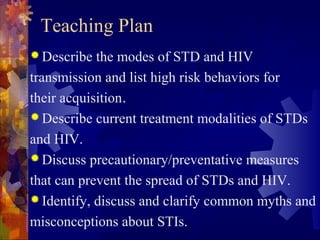
 Describe  the modes of STD and HIV
transmission and list high risk behaviors for
their acquisition.
 Describe current treatment modalities of STDs

and HIV.
 Discuss precautionary/preventative measures

that can prevent the spread of STDs and HIV.
 Identify, discuss and clarify common myths and

misconceptions about STIs.
Teaching Plan
 Identify   resources to attain help regarding
STDs.

Teaching Methodology:
 The subject will facilitated using a mixture of

lectures and discussions delivered by specialists
from the departments of public health and
infectious diseases.
Teaching Plan
 Role  play and movie presentations would also
be integrated to depict real life scenarios and the
impact of their decisions directly and indirectly
on their future.

Teaching Strategies:
 Activating prior learning
 PowerPoint presentation
 Encourage student participation and discussion
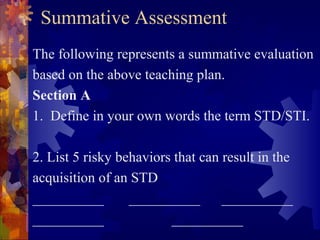
Summative Assessment
The following represents a summative evaluation
based on the above teaching plan.
Section A
1. Define in your own words the term STD/STI.

2. List 5 risky behaviors that can result in the
acquisition of an STD
__________        __________       __________
__________               __________
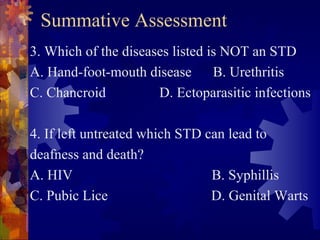
Summative Assessment
3. Which of the diseases listed is NOT an STD
A. Hand-foot-mouth disease       B. Urethritis
C. Chancroid          D. Ectoparasitic infections

4. If left untreated which STD can lead to
deafness and death?
A. HIV                          B. Syphillis
C. Pubic Lice                   D. Genital Warts
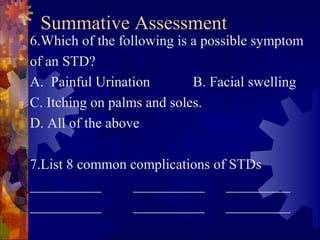
Summative Assessment
6.Which of the following is a possible symptom
of an STD?
A. Painful Urination        B. Facial swelling
C. Itching on palms and soles.
D. All of the above

7.List 8 common complications of STDs
__________      __________      _________
__________      __________      _________
Summative Assessment
Section B
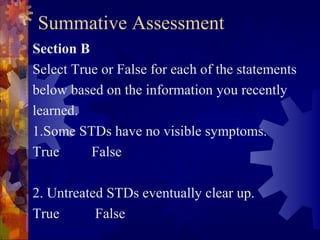
Select True or False for each of the statements
below based on the information you recently
learned.
1.Some STDs have no visible symptoms.
True      False

2. Untreated STDs eventually clear up.
True       False
Summative Assessment

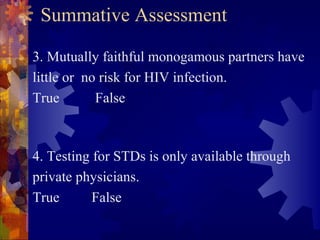
3. Mutually faithful monogamous partners have
little or no risk for HIV infection.
True        False


4. Testing for STDs is only available through
private physicians.
True       False
Summative Assessment
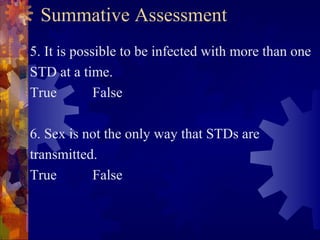
5. It is possible to be infected with more than one
STD at a time.
True         False

6. Sex is not the only way that STDs are
transmitted.
True       False
Summative Assessment
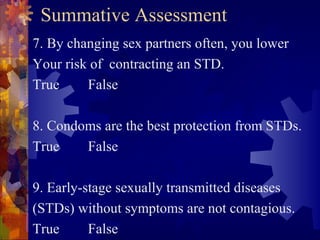
7. By changing sex partners often, you lower
Your risk of contracting an STD.
True     False

8. Condoms are the best protection from STDs.
True    False

9. Early-stage sexually transmitted diseases
(STDs) without symptoms are not contagious.
True      False
Summative Assessment
10.Gonorrhea is contracted sexually and from
public or shared toilet seats.
True      False

Section C

Match the STD with its causative agent
____Genital herpes     a. neisseria gonorrhoeae
____Syphillis          b. phthirus pubis
____Chalmydia           c. treponella Pallidum
Summative Assessment
____Yeast infections e. chlmydia trachomatis
____HIV /AIDS        f. candida albicans
____Pubic lice       g. human
immunodeficiency virus
 
Summative Assessment
Section D
Answer all questions in this section.
1. STDs are fast becoming a major concern
among adolescents. Discuss the need for of a
Sexual Education programme in schools noting
the benefits and limitations of the endeavour.

2. You encounter a sexually active 13 year old
who began experiencing itching, redness,
swelling and burning sensation in the genital
Summative Assessment
region. What advice would you give to rectify
these signs and symptoms and identify the
resource systems available to the individual
and their family.
Rubric
Rubric
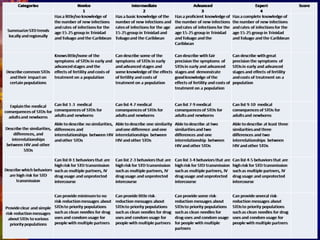
 According  to Dr. O’Donnell Dean of
 education and curriculum development
 at Pittsburgh University rubric is
 essentially a scaled tool with levels of
 achievement and clearly defined criteria
 related to each level and placed in a
 grid. Rubrics are typically used to
 assess some type of performance,
 procedure or product.
Rubric
A  number of studies have
 demonstrated the positive impact that
 well-designed rubrics have on dental
 students pre-clinical learning. Designing
 a rubric to capture the key elements of
 a skill in an assessment with a grader
 friendly format can be a challenge.
 Rubrics can help identify areas of
 students strengths and weaknesses
 and simultaneously provide valuable
 detailed feedback to the student.
Rubric
 Since Biblical times we know about
 sexually transmitted diseases. With
 reference to 1 Samuel 6:19. “And it was
 so, that after they had carried it about,
 the hand of the Lord was against the
 city with a very great destruction: and
 he smote the men of the city, both small
 and great, and they had emerods in
 their secret parts.”
Ppt summative assessment

Ppt summative assessment

  • 1.
  • 2.
    What are pre,formative and summative assessments?
  • 3.
    Assessment Refers to thefull range of information gathered and synthesized by teachers about their students and their classroom. Assessment is a continuous process (Arends, 2007). There are two general uses or functions of assessment: Formative assessment and Summative assessment (Woolfolk et al 2008).
  • 4.
    Formative assessment Is anungraded testing used before and during teaching to aid in planning and diagnosis (Woolfolk et al 2008). Formative assessment is a process used by teachers and students during instruction that provides explicit feedback to adjust on-going teaching and learning in order to improve student
  • 5.
    Formative assessment Formative assessmentrefers to assessment for learning which is focused on monitoring student response to and progress with instructions. It provides immediate feedback to both teacher and student. (Johnson &Jenkins, 2009) In formative assessment here is a pre-test which is termed Pre-Assessment.
  • 6.
    Formative assessment This pre-assessmentor pre-test helps the teacher to determine what are the students’ knowledge and skills in order to assist with planning (Arends, 2007). There is also a diagnostic test which identifies a student area of achievement and weakness in a particular subject, which can give an idea of difficulty the student is experiencing.
  • 7.
    Formative assessment It shouldbe noted that the pre-test and diagnostic test are not graded and the formative test do not count toward final grades (Woolfolk et al 2008).
  • 8.
    Summative assessment Are cumulativeevaluation used to measure growth after instruction and are generally given at the end of a course in order to determine whether long term goals have been met (Coffey, 2012) Summative assessment focus on what the student has learned at the end of a unit of instruction or at the end of a grade level (e.g. standard one, National Test) ( Johnson & Jenkins, 2009).
  • 9.
    Summative assessment Summative assessmentpurpose is to let the teachers and students know the level of accomplishment attained. The final exam is classic example (Woolfolk et al 2008).
  • 10.
  • 11.
  • 12.
  • 13.
  • 14.
  • 15.
  • 16.
  • 17.
  • 18.
  • 19.
    Tools used inAssessment
  • 20.
    Tools used inAssessment The tools used in pre-assessment, summative and formative assessment are numerous. A variety of tools are used for assessment including tests, rubrics, interviews, focus groups, survey, observation, and portfolio. There is no one-size fits-all approach in assessment. A good assessment typically employs multiple tools and approaches tailored for different purposes (Stony Brook University, 1999).
  • 21.
    Tools used inAssessment Test are used to assess knowledge and thinking over a range of content or to assess dispositions and interests. It is the most reliable way to assess knowledge and thinking in a content area domain. It is the best way to cover a large number of fact and concepts. However it requires clearly written items that appropriately sample a range of
  • 22.
    Tools used inAssessment content material. (Stony Brook University, 1999). Performance tasks are used to assess in-depth thinking in one area or to assess skills attained or products created. It allows measurement of in depth thinking, skills or products not readily assessable by tests. However it requires clear expectations for tasks and scoring to provide meaningful assessment information (Stony Brook University, 1999).
  • 23.
    Tools used inAssessment Portfolios are used to document progress or development or to show case complex achievement of a range of skills. It allows for assessment of student’s development and some ownership and control by students However it require clear purpose, focused construction, and long-term attention to give any more useful information than stand-alone assessments (Stony Brook University, 1999).
  • 24.
    Tools used inAssessment Surveys are used to assess opinions and attitudes from target populations. It is a very efficient method to collect information from a large number of people. However it require a sound sampling strategies, and good response rates. Survey questions should be carefully written to keep respondent mistakes and bias to a minimum (Stony Brook University, 1999).
  • 25.
    Tools used inAssessment Observations are used to assess behavioural outcomes through direct observation. It is the least intrusive assessment method that allows for assessment of student performance. However it requires a clear guidance to distinguish what is actually happening and what the observer's impressions. A rubric or an observation protocol will help minimize subjective judgment (Stony Brook University, 1999).
  • 26.
    Tools used inAssessment Focus groups are used to brainstorm ideas or collect in-depth attitudes and opinions from a group of people. It is an interactive way of assessing attitudes and opinions, and a cost effective way of collecting suggestions and requirements when individual interviews are not feasible. However it require good planning and organization to effectively solicit information
  • 27.
    Tools used inAssessment from participants (Stony Brook University,1999).
  • 28.
    Teaching plan andSample Summative Assessment
  • 30.
    Teaching Plan Facilitator’s Name:Mrs. Penny Topic: Sexually Transmitted Diseases Duration of lesson: Three sessions for two hours each Time: 8:00 am-10:00 am Venue: Mount Plesant Secondary School Audience: The Students of Mount Plesant Secondary School attending Ms. Penny’s class (form three)
  • 31.
    Teaching Plan Audience: TheStudents of Mount Plesant Secondary School attending Ms. Penny’s Class (form three) Number of Students: Approximately 40 students Date: Wednesday 22nd, 23rd and 24th October, 2012
  • 32.
    Teaching Plan Aim The primarygoal of these sessions Would be to provide information related to Sexually Transmitted Diseases, clarify myths and misconceptions and promote behavior that prevents the spread of STDs.
  • 33.
    Teaching Plan Core Objectives Thepupils will:  Understand the nature and modes of transmission of STDs.  Recognize common signs and symptoms of STDs.  Be knowledgeable about appropriate resources, counseling and medical care.  Recognize and refute myths relating to STDs.
  • 34.
    Teaching Plan Engage incritical thinking regarding informed decision making about personal and social behavior that diminishes the risk of contracting an STD.
  • 35.
    Teaching Plan Learning Outcomes Atthe end of the teaching sessions the pupils will be able to:  Define the term STD.  List the most common STDs and their causative agents.  Identify the common signs and symptoms of STDs.  List possible complications of STDs.
  • 36.
    Teaching Plan  Describe the modes of STD and HIV transmission and list high risk behaviors for their acquisition.  Describe current treatment modalities of STDs and HIV.  Discuss precautionary/preventative measures that can prevent the spread of STDs and HIV.  Identify, discuss and clarify common myths and misconceptions about STIs.
  • 37.
    Teaching Plan  Identify resources to attain help regarding STDs. Teaching Methodology:  The subject will facilitated using a mixture of lectures and discussions delivered by specialists from the departments of public health and infectious diseases.
  • 38.
    Teaching Plan  Role play and movie presentations would also be integrated to depict real life scenarios and the impact of their decisions directly and indirectly on their future. Teaching Strategies:  Activating prior learning  PowerPoint presentation  Encourage student participation and discussion
  • 39.
  • 40.
    Summative Assessment The followingrepresents a summative evaluation based on the above teaching plan. Section A 1. Define in your own words the term STD/STI. 2. List 5 risky behaviors that can result in the acquisition of an STD __________ __________ __________ __________ __________
  • 41.
    Summative Assessment 3. Whichof the diseases listed is NOT an STD A. Hand-foot-mouth disease B. Urethritis C. Chancroid D. Ectoparasitic infections 4. If left untreated which STD can lead to deafness and death? A. HIV B. Syphillis C. Pubic Lice D. Genital Warts
  • 42.
    Summative Assessment 6.Which ofthe following is a possible symptom of an STD? A. Painful Urination B. Facial swelling C. Itching on palms and soles. D. All of the above 7.List 8 common complications of STDs __________ __________ _________ __________ __________ _________
  • 43.
    Summative Assessment Section B SelectTrue or False for each of the statements below based on the information you recently learned. 1.Some STDs have no visible symptoms. True False 2. Untreated STDs eventually clear up. True False
  • 44.
    Summative Assessment 3. Mutuallyfaithful monogamous partners have little or no risk for HIV infection. True False 4. Testing for STDs is only available through private physicians. True False
  • 45.
    Summative Assessment 5. Itis possible to be infected with more than one STD at a time. True False 6. Sex is not the only way that STDs are transmitted. True False
  • 46.
    Summative Assessment 7. Bychanging sex partners often, you lower Your risk of contracting an STD. True False 8. Condoms are the best protection from STDs. True False 9. Early-stage sexually transmitted diseases (STDs) without symptoms are not contagious. True False
  • 47.
    Summative Assessment 10.Gonorrhea iscontracted sexually and from public or shared toilet seats. True False Section C Match the STD with its causative agent ____Genital herpes a. neisseria gonorrhoeae ____Syphillis b. phthirus pubis ____Chalmydia c. treponella Pallidum
  • 48.
    Summative Assessment ____Yeast infectionse. chlmydia trachomatis ____HIV /AIDS f. candida albicans ____Pubic lice g. human immunodeficiency virus  
  • 49.
    Summative Assessment Section D Answerall questions in this section. 1. STDs are fast becoming a major concern among adolescents. Discuss the need for of a Sexual Education programme in schools noting the benefits and limitations of the endeavour. 2. You encounter a sexually active 13 year old who began experiencing itching, redness, swelling and burning sensation in the genital
  • 50.
    Summative Assessment region. Whatadvice would you give to rectify these signs and symptoms and identify the resource systems available to the individual and their family.
  • 52.
  • 53.
    Rubric  According to Dr. O’Donnell Dean of education and curriculum development at Pittsburgh University rubric is essentially a scaled tool with levels of achievement and clearly defined criteria related to each level and placed in a grid. Rubrics are typically used to assess some type of performance, procedure or product.
  • 54.
    Rubric A numberof studies have demonstrated the positive impact that well-designed rubrics have on dental students pre-clinical learning. Designing a rubric to capture the key elements of a skill in an assessment with a grader friendly format can be a challenge. Rubrics can help identify areas of students strengths and weaknesses and simultaneously provide valuable detailed feedback to the student.
  • 55.
    Rubric  Since Biblicaltimes we know about sexually transmitted diseases. With reference to 1 Samuel 6:19. “And it was so, that after they had carried it about, the hand of the Lord was against the city with a very great destruction: and he smote the men of the city, both small and great, and they had emerods in their secret parts.”