Formative and
Summative Assessment
MELINDA R. RIBAYA
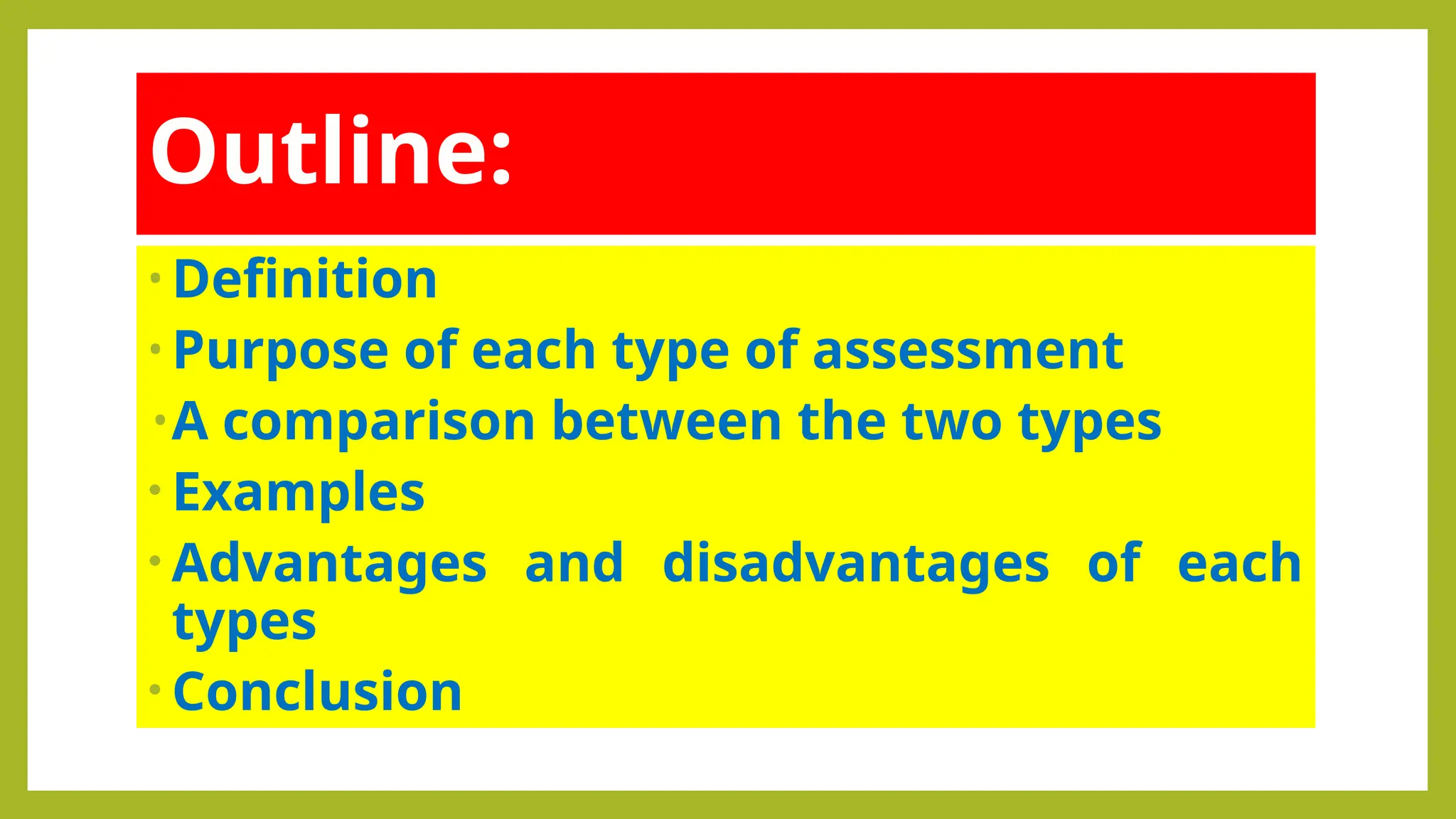
Outline:
• Definition
• Purpose of each type of assessment
•A comparison between the two types
• Examples
• Advantages and disadvantages of each
types
• Conclusion
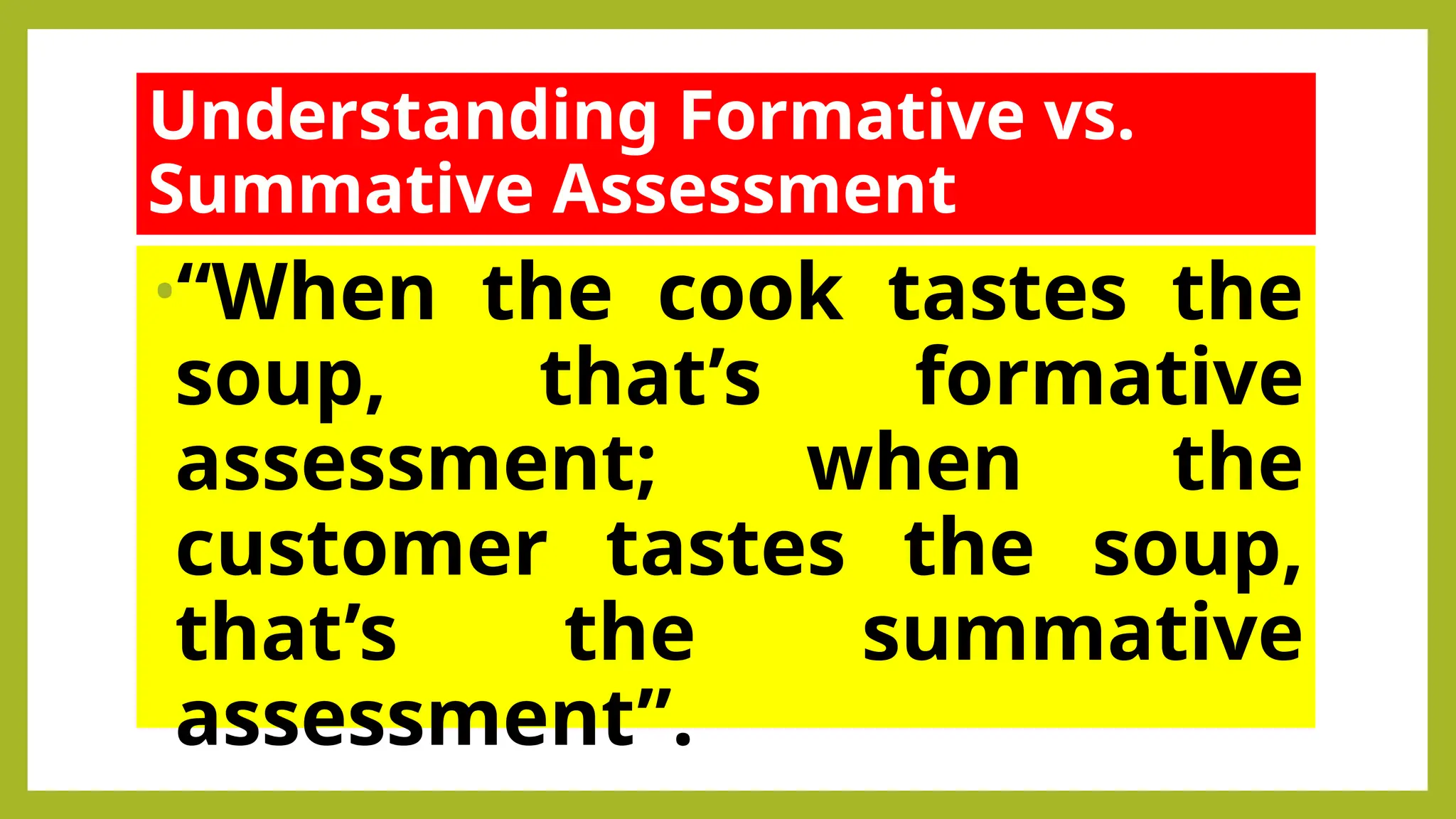
Understanding Formative vs.
Summative Assessment
•“When the cook tastes the
soup, that’s formative
assessment; when the
customer tastes the soup,
that’s the summative
assessment”.
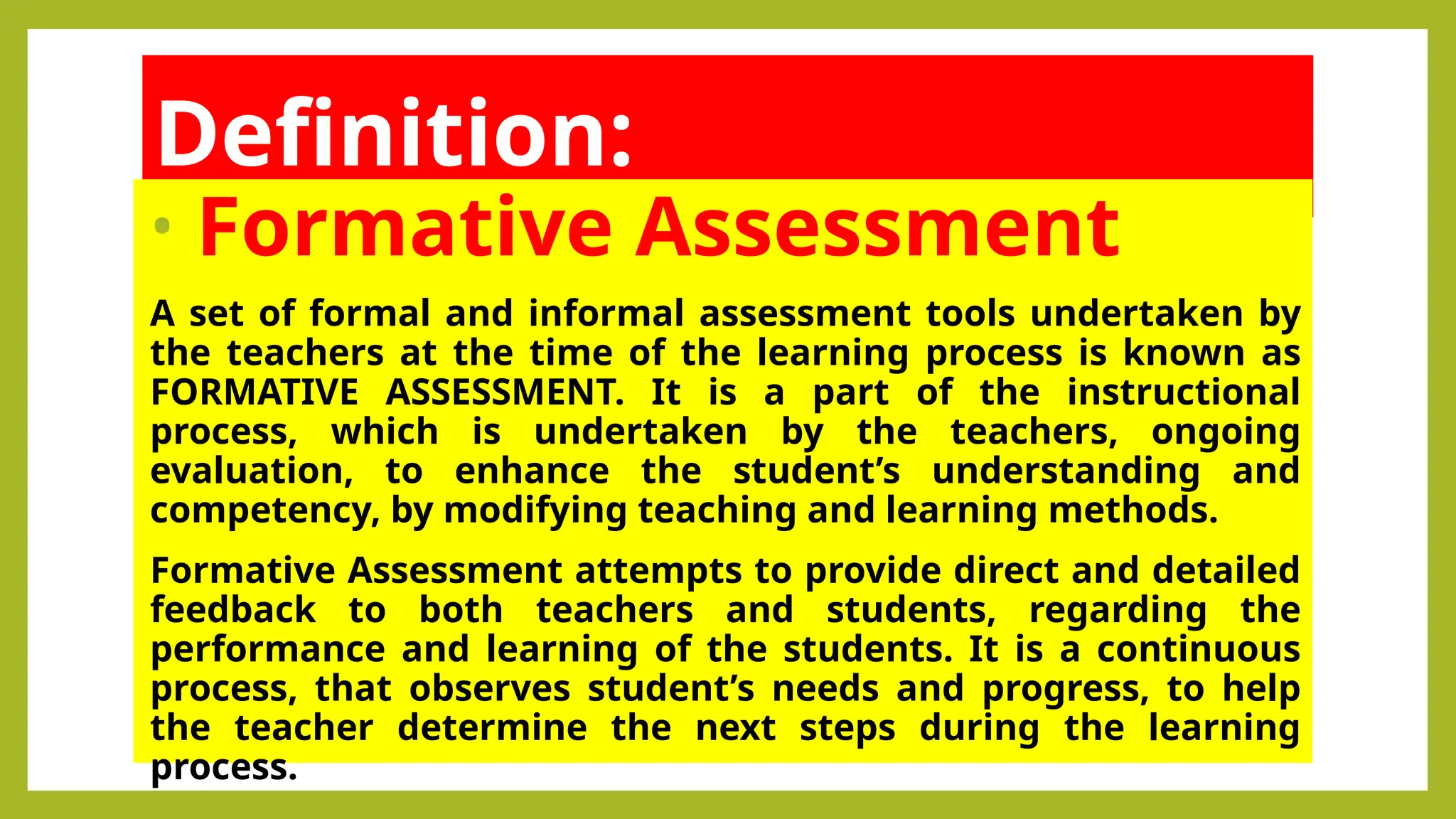
Definition:
• Formative Assessment
A set of formal and informal assessment tools undertaken by
the teachers at the time of the learning process is known as
FORMATIVE ASSESSMENT. It is a part of the instructional
process, which is undertaken by the teachers, ongoing
evaluation, to enhance the student’s understanding and
competency, by modifying teaching and learning methods.
Formative Assessment attempts to provide direct and detailed
feedback to both teachers and students, regarding the
performance and learning of the students. It is a continuous
process, that observes student’s needs and progress, to help
the teacher determine the next steps during the learning
process.
Summative Assessment:
• refers to the evaluation of the student; that focuses on
the result. It is a part of the grading process which is
given periodically to the learners, usually at the
conclusion of the course, term or unit. The purpose is
to check the knowledge of the students, and to what
extent they have learned the material, taught to them.
• seeks to evaluate the effectiveness of the course or
program, checks the learning progress, etc. Scores,
grades or percentage obtained to act as an indicator
that shows the quality of the curriculum and form as a
basis for rankings in schools.
Purposes of the Formative Assessment
• Monitor student learning and provide ongoing feedback to staff and
students.
• It helps students identify their strengths and weaknesses, can enable
students improve their self-regulatory skills so that they manage
their education in a less haphazard fashion than is commonly found.
• It also provides information to the faculty about the areas students
are struggling with so that sufficient support can be put into place.
• Helps teachers identify the current state of learner’s knowledge and
skills, make changes in instructions so that students meet with
success, create appropriate lessons, activities and groupings and
inform students about their progress to help them set goals.
Purpose of the Summative Assessment
• To evaluate student learning at the end of the instructional unit
by comparing it against some standard or benchmark.
• It is a tool to evaluate the curriculum and training process.
• To determine the extent to which the instructional objectives
have been met.
• The more we have information about the students, the clearer
the picture we have about achievement or where gaps may occur.
• To certify student mastery of the intended learning outcomes as
well as use it for assigning grades.
• Summative assessments often have high stakes and are treated
by the students as the priority over formative assessments.
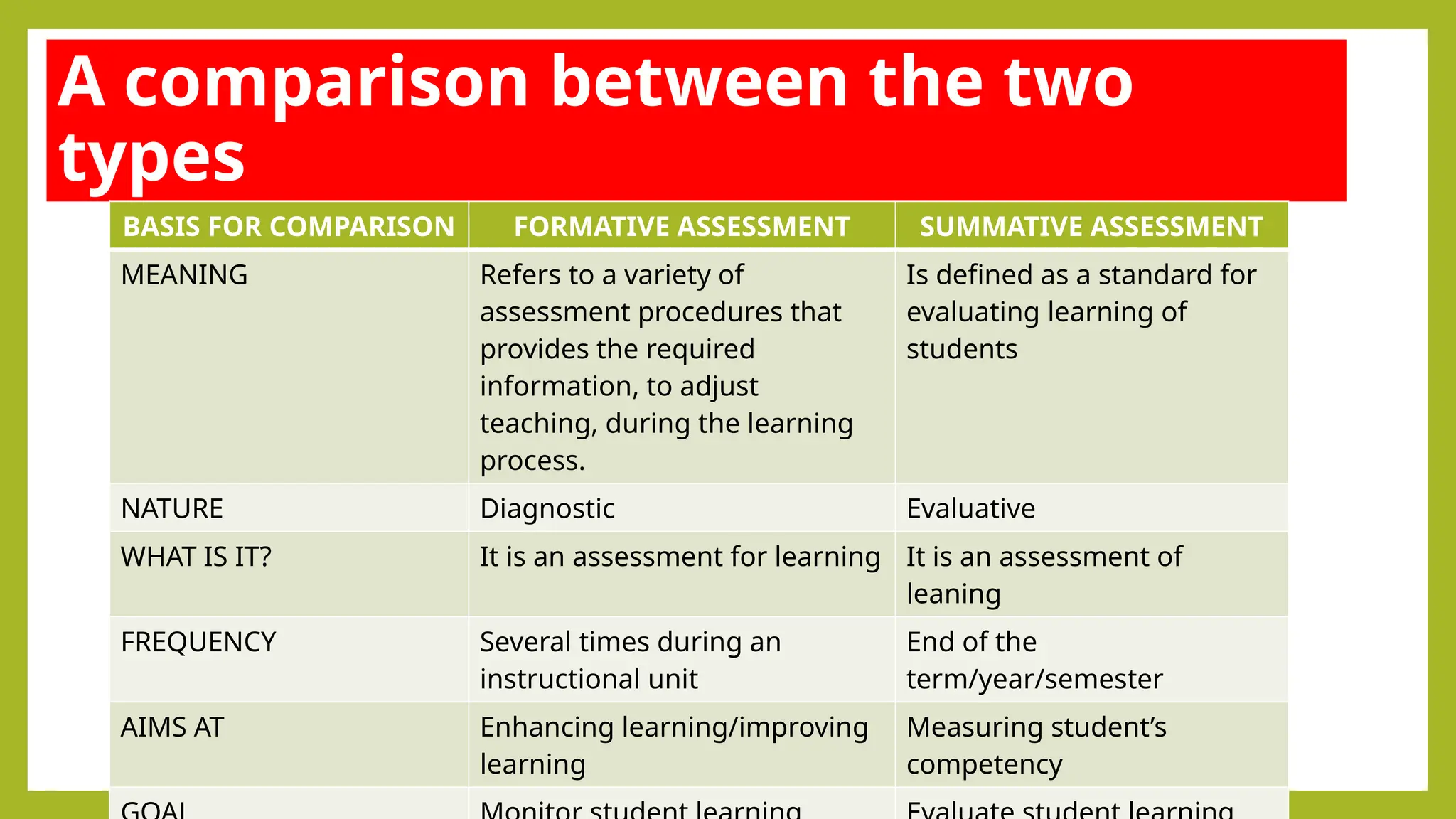
A comparison between the two
types
BASIS FOR COMPARISON FORMATIVE ASSESSMENT SUMMATIVE ASSESSMENT
MEANING Refers to a variety of
assessment procedures that
provides the required
information, to adjust
teaching, during the learning
process.
Is defined as a standard for
evaluating learning of
students
NATURE Diagnostic Evaluative
WHAT IS IT? It is an assessment for learning It is an assessment of
leaning
FREQUENCY Several times during an
instructional unit
End of the
term/year/semester
AIMS AT Enhancing learning/improving
learning
Measuring student’s
competency
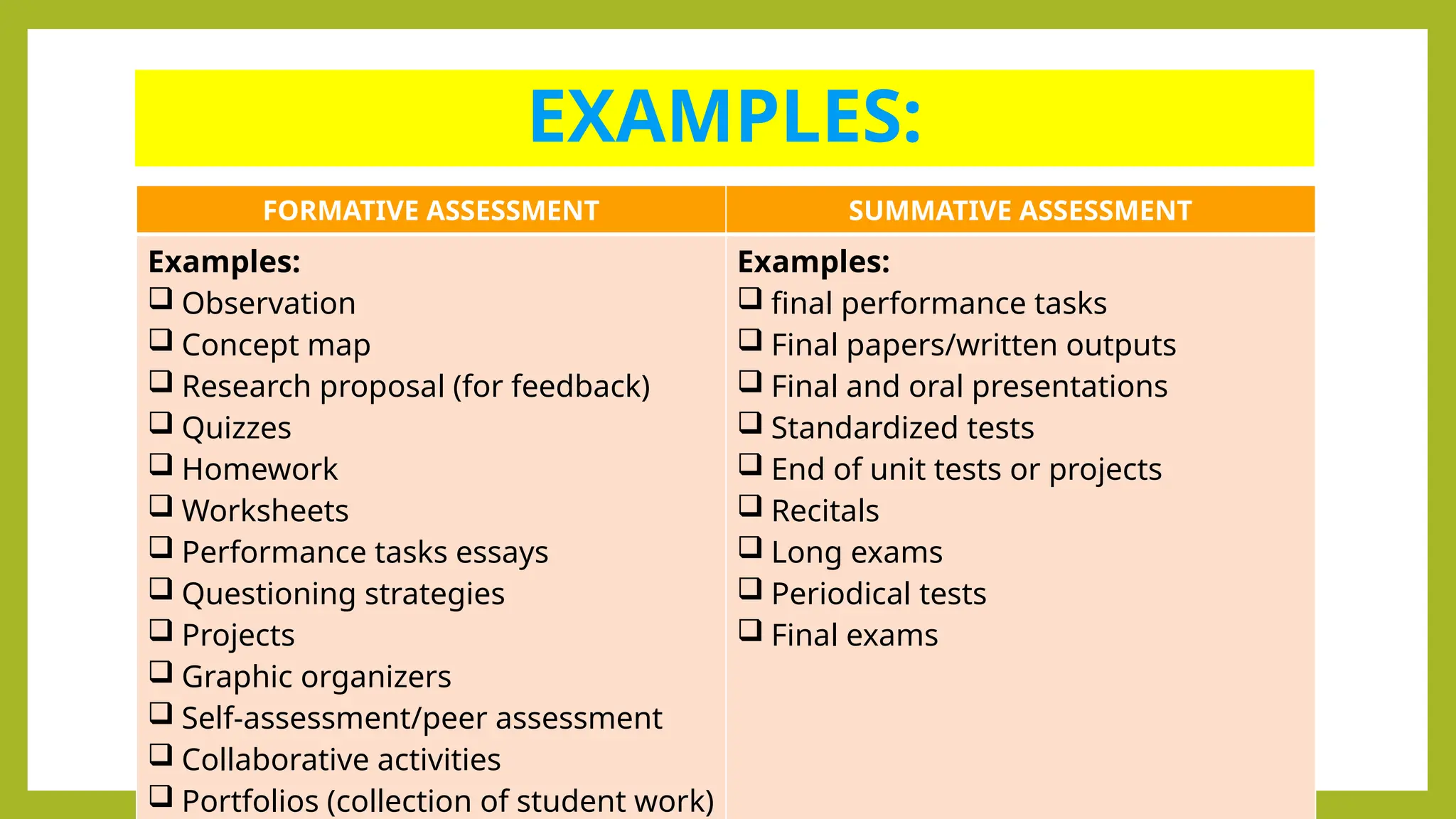
EXAMPLES:
FORMATIVE ASSESSMENT SUMMATIVE ASSESSMENT
Examples:
 Observation
 Concept map
 Research proposal (for feedback)
 Quizzes
 Homework
 Worksheets
 Performance tasks essays
 Questioning strategies
 Projects
 Graphic organizers
 Self-assessment/peer assessment
 Collaborative activities
 Portfolios (collection of student work)
Examples:
 final performance tasks
 Final papers/written outputs
 Final and oral presentations
 Standardized tests
 End of unit tests or projects
 Recitals
 Long exams
 Periodical tests
 Final exams
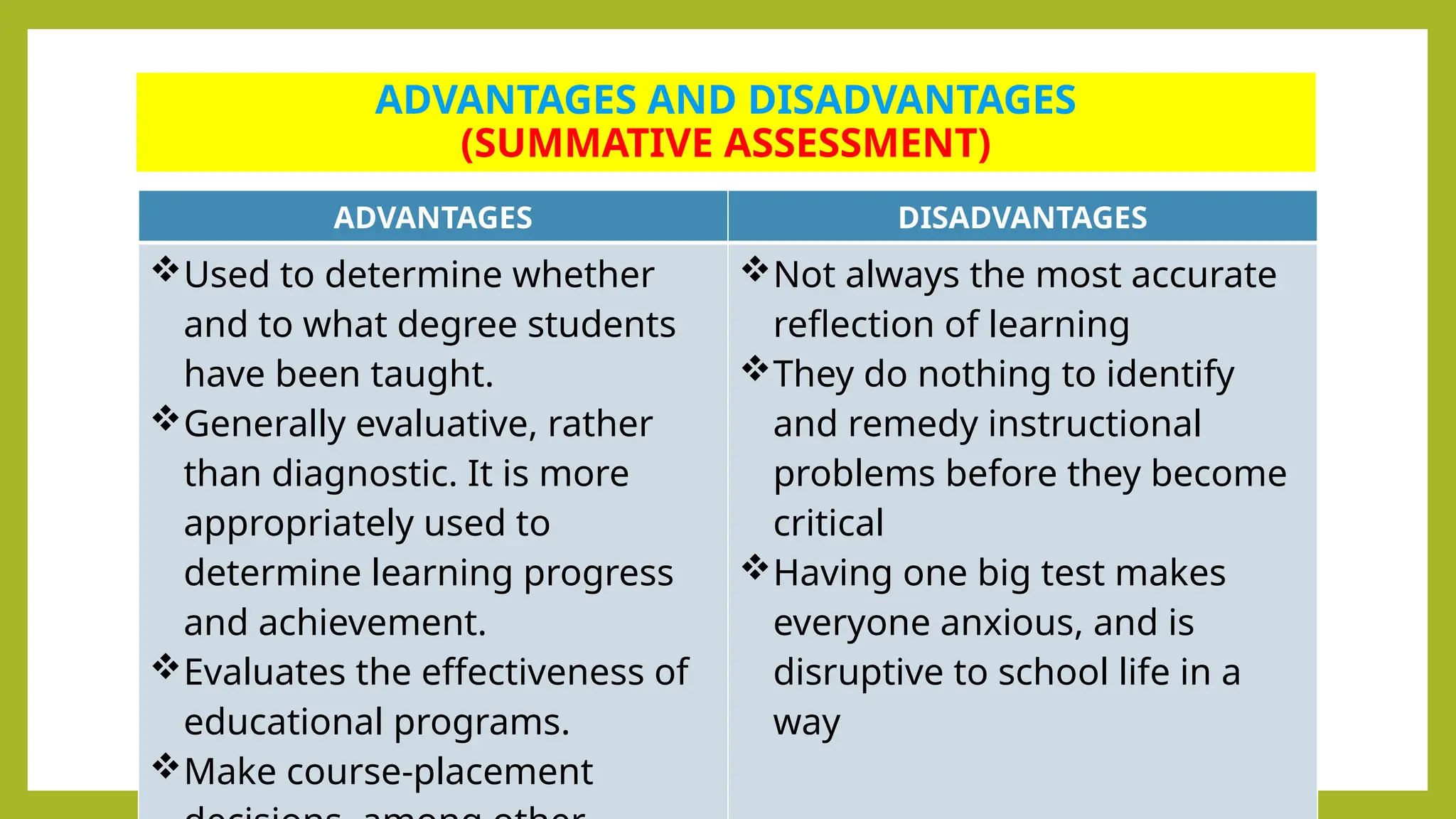
ADVANTAGES AND DISADVANTAGES
(SUMMATIVE ASSESSMENT)
ADVANTAGES DISADVANTAGES
Used to determine whether
and to what degree students
have been taught.
Generally evaluative, rather
than diagnostic. It is more
appropriately used to
determine learning progress
and achievement.
Evaluates the effectiveness of
educational programs.
Make course-placement
Not always the most accurate
reflection of learning
They do nothing to identify
and remedy instructional
problems before they become
critical
Having one big test makes
everyone anxious, and is
disruptive to school life in a
way
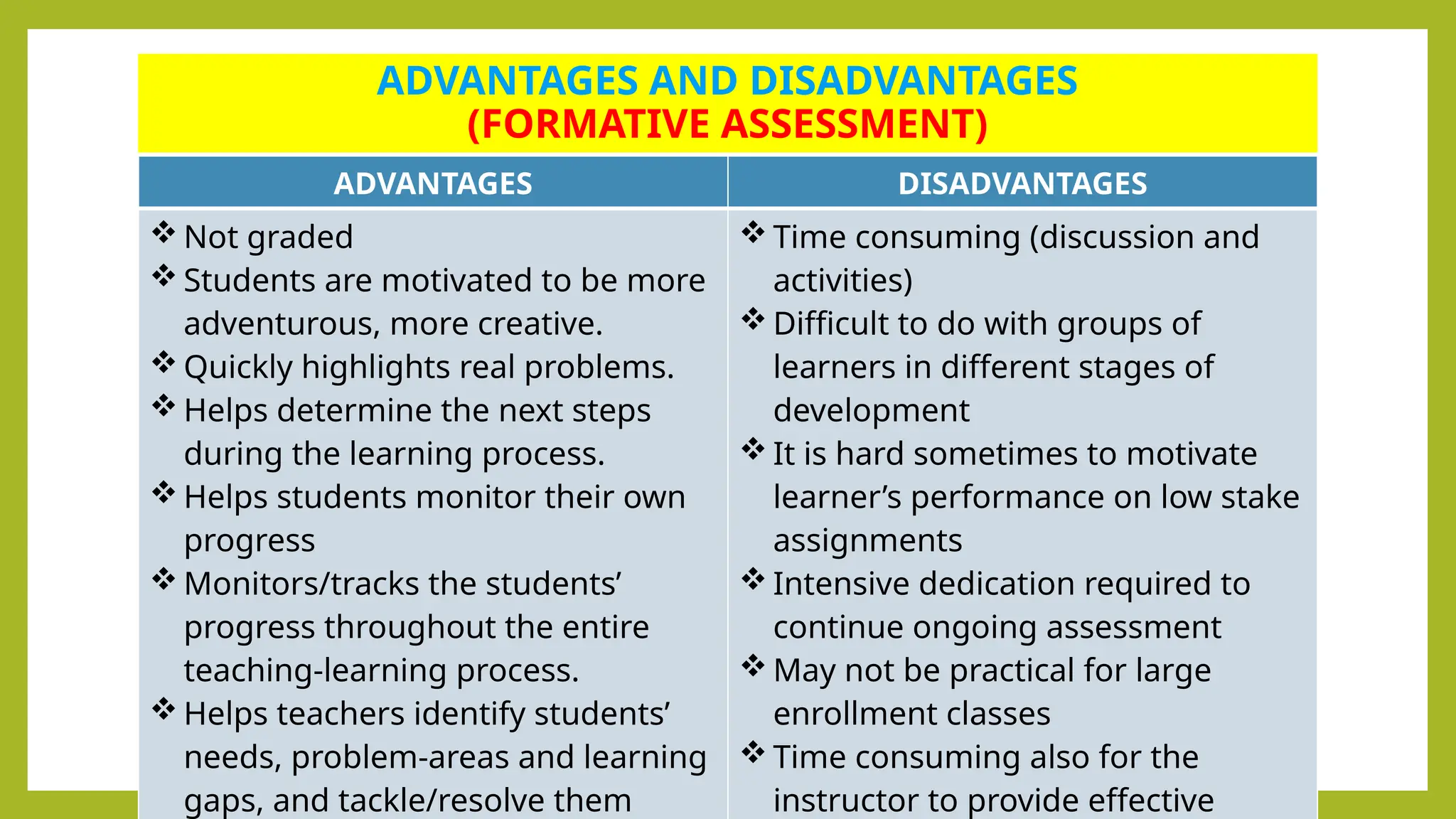
ADVANTAGES AND DISADVANTAGES
(FORMATIVE ASSESSMENT)
ADVANTAGES DISADVANTAGES
 Not graded
 Students are motivated to be more
adventurous, more creative.
 Quickly highlights real problems.
 Helps determine the next steps
during the learning process.
 Helps students monitor their own
progress
 Monitors/tracks the students’
progress throughout the entire
teaching-learning process.
 Helps teachers identify students’
needs, problem-areas and learning
gaps, and tackle/resolve them
 Time consuming (discussion and
activities)
 Difficult to do with groups of
learners in different stages of
development
 It is hard sometimes to motivate
learner’s performance on low stake
assignments
 Intensive dedication required to
continue ongoing assessment
 May not be practical for large
enrollment classes
 Time consuming also for the
instructor to provide effective
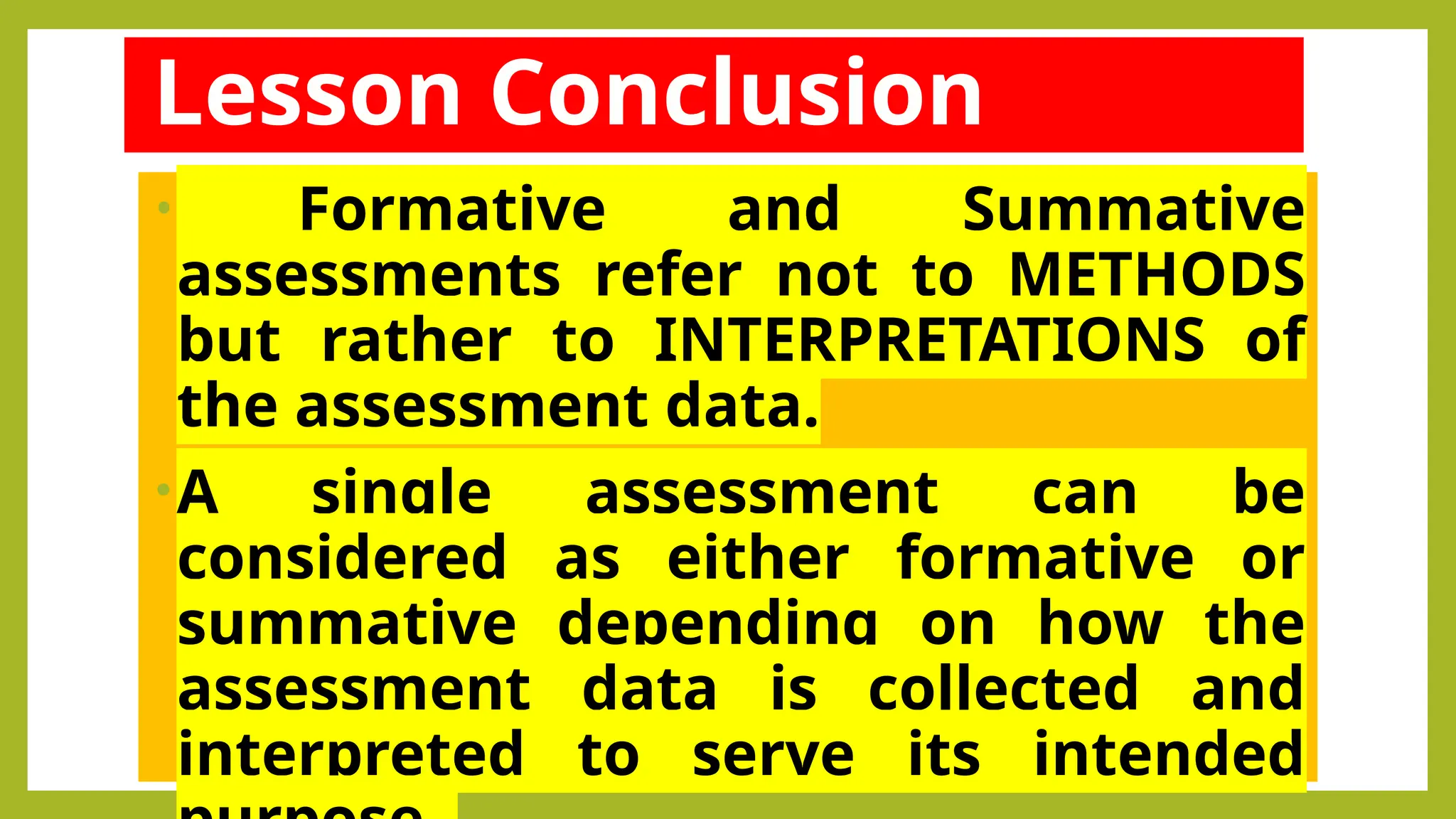
• Formative and Summative
assessments refer not to METHODS
but rather to INTERPRETATIONS of
the assessment data.
•A single assessment can be
considered as either formative or
summative depending on how the
assessment data is collected and
interpreted to serve its intended
Lesson Conclusion
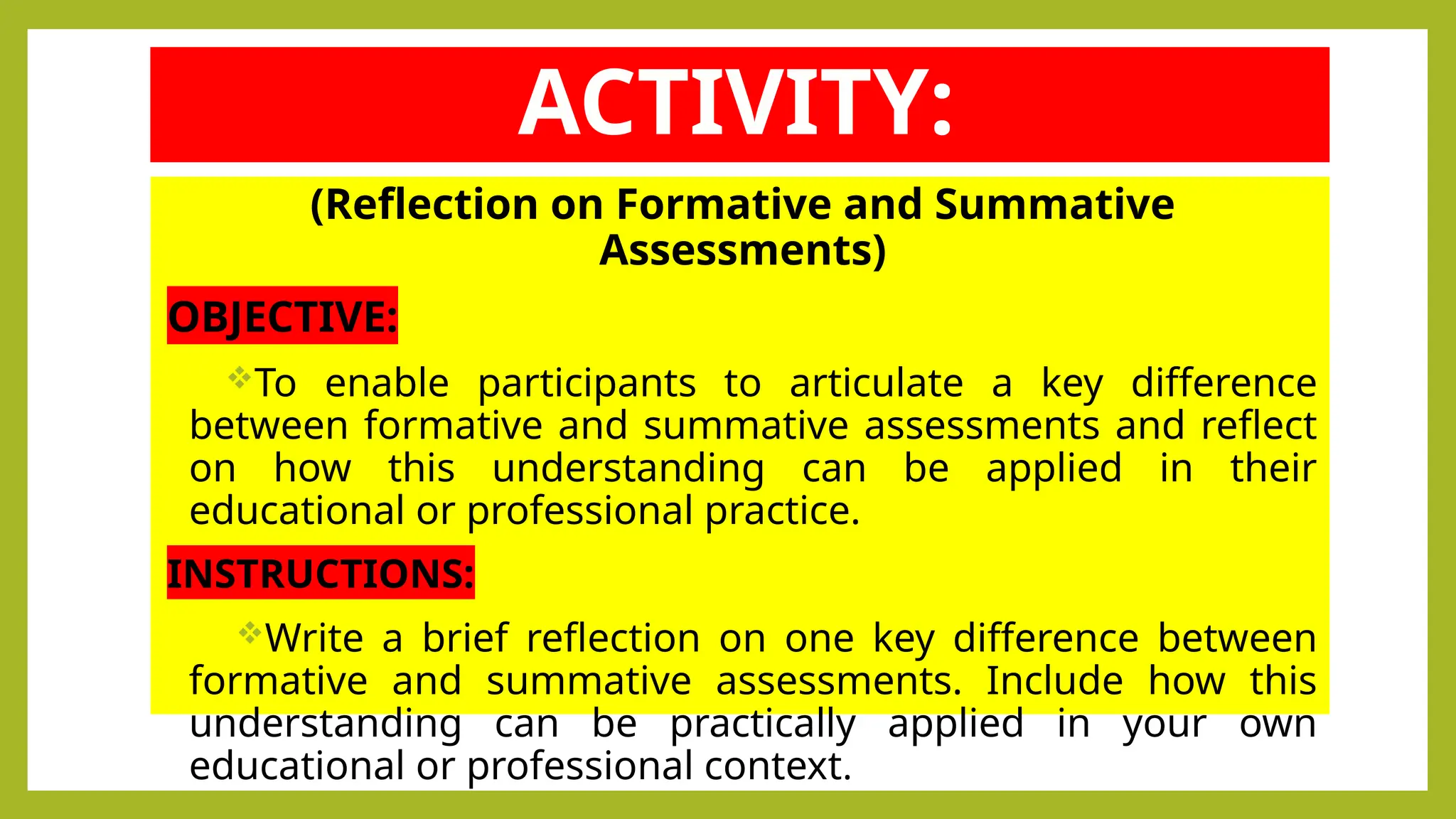
(Reflection on Formative and Summative
Assessments)
OBJECTIVE:
To enable participants to articulate a key difference
between formative and summative assessments and reflect
on how this understanding can be applied in their
educational or professional practice.
INSTRUCTIONS:
Write a brief reflection on one key difference between
formative and summative assessments. Include how this
understanding can be practically applied in your own
educational or professional context.
ACTIVITY:
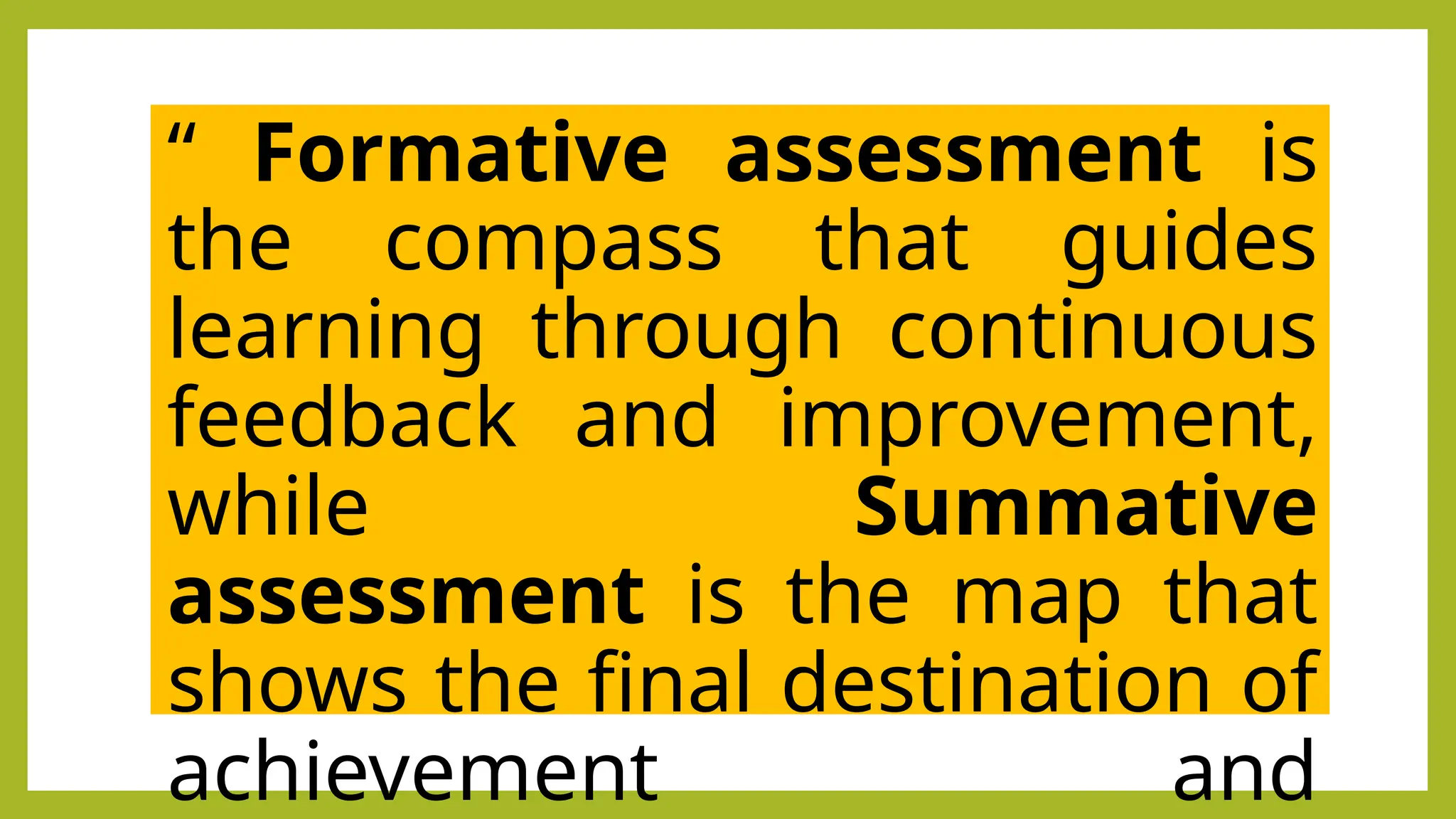
“ Formative assessment is
the compass that guides
learning through continuous
feedback and improvement,
while Summative
assessment is the map that
shows the final destination of
achievement and
THANK
YOU!!!

educ-207-formative-and-summative-assessment.pptx

  • 1.
  • 2.
    Outline: • Definition • Purposeof each type of assessment •A comparison between the two types • Examples • Advantages and disadvantages of each types • Conclusion
  • 3.
    Understanding Formative vs. SummativeAssessment •“When the cook tastes the soup, that’s formative assessment; when the customer tastes the soup, that’s the summative assessment”.
  • 4.
    Definition: • Formative Assessment Aset of formal and informal assessment tools undertaken by the teachers at the time of the learning process is known as FORMATIVE ASSESSMENT. It is a part of the instructional process, which is undertaken by the teachers, ongoing evaluation, to enhance the student’s understanding and competency, by modifying teaching and learning methods. Formative Assessment attempts to provide direct and detailed feedback to both teachers and students, regarding the performance and learning of the students. It is a continuous process, that observes student’s needs and progress, to help the teacher determine the next steps during the learning process.
  • 5.
    Summative Assessment: • refersto the evaluation of the student; that focuses on the result. It is a part of the grading process which is given periodically to the learners, usually at the conclusion of the course, term or unit. The purpose is to check the knowledge of the students, and to what extent they have learned the material, taught to them. • seeks to evaluate the effectiveness of the course or program, checks the learning progress, etc. Scores, grades or percentage obtained to act as an indicator that shows the quality of the curriculum and form as a basis for rankings in schools.
  • 6.
    Purposes of theFormative Assessment • Monitor student learning and provide ongoing feedback to staff and students. • It helps students identify their strengths and weaknesses, can enable students improve their self-regulatory skills so that they manage their education in a less haphazard fashion than is commonly found. • It also provides information to the faculty about the areas students are struggling with so that sufficient support can be put into place. • Helps teachers identify the current state of learner’s knowledge and skills, make changes in instructions so that students meet with success, create appropriate lessons, activities and groupings and inform students about their progress to help them set goals.
  • 7.
    Purpose of theSummative Assessment • To evaluate student learning at the end of the instructional unit by comparing it against some standard or benchmark. • It is a tool to evaluate the curriculum and training process. • To determine the extent to which the instructional objectives have been met. • The more we have information about the students, the clearer the picture we have about achievement or where gaps may occur. • To certify student mastery of the intended learning outcomes as well as use it for assigning grades. • Summative assessments often have high stakes and are treated by the students as the priority over formative assessments.
  • 8.
    A comparison betweenthe two types BASIS FOR COMPARISON FORMATIVE ASSESSMENT SUMMATIVE ASSESSMENT MEANING Refers to a variety of assessment procedures that provides the required information, to adjust teaching, during the learning process. Is defined as a standard for evaluating learning of students NATURE Diagnostic Evaluative WHAT IS IT? It is an assessment for learning It is an assessment of leaning FREQUENCY Several times during an instructional unit End of the term/year/semester AIMS AT Enhancing learning/improving learning Measuring student’s competency
  • 9.
    EXAMPLES: FORMATIVE ASSESSMENT SUMMATIVEASSESSMENT Examples:  Observation  Concept map  Research proposal (for feedback)  Quizzes  Homework  Worksheets  Performance tasks essays  Questioning strategies  Projects  Graphic organizers  Self-assessment/peer assessment  Collaborative activities  Portfolios (collection of student work) Examples:  final performance tasks  Final papers/written outputs  Final and oral presentations  Standardized tests  End of unit tests or projects  Recitals  Long exams  Periodical tests  Final exams
  • 10.
    ADVANTAGES AND DISADVANTAGES (SUMMATIVEASSESSMENT) ADVANTAGES DISADVANTAGES Used to determine whether and to what degree students have been taught. Generally evaluative, rather than diagnostic. It is more appropriately used to determine learning progress and achievement. Evaluates the effectiveness of educational programs. Make course-placement Not always the most accurate reflection of learning They do nothing to identify and remedy instructional problems before they become critical Having one big test makes everyone anxious, and is disruptive to school life in a way
  • 11.
    ADVANTAGES AND DISADVANTAGES (FORMATIVEASSESSMENT) ADVANTAGES DISADVANTAGES  Not graded  Students are motivated to be more adventurous, more creative.  Quickly highlights real problems.  Helps determine the next steps during the learning process.  Helps students monitor their own progress  Monitors/tracks the students’ progress throughout the entire teaching-learning process.  Helps teachers identify students’ needs, problem-areas and learning gaps, and tackle/resolve them  Time consuming (discussion and activities)  Difficult to do with groups of learners in different stages of development  It is hard sometimes to motivate learner’s performance on low stake assignments  Intensive dedication required to continue ongoing assessment  May not be practical for large enrollment classes  Time consuming also for the instructor to provide effective
  • 12.
    • Formative andSummative assessments refer not to METHODS but rather to INTERPRETATIONS of the assessment data. •A single assessment can be considered as either formative or summative depending on how the assessment data is collected and interpreted to serve its intended Lesson Conclusion
  • 13.
    (Reflection on Formativeand Summative Assessments) OBJECTIVE: To enable participants to articulate a key difference between formative and summative assessments and reflect on how this understanding can be applied in their educational or professional practice. INSTRUCTIONS: Write a brief reflection on one key difference between formative and summative assessments. Include how this understanding can be practically applied in your own educational or professional context. ACTIVITY:
  • 14.
    “ Formative assessmentis the compass that guides learning through continuous feedback and improvement, while Summative assessment is the map that shows the final destination of achievement and
  • 15.