ASSESSMENT:
FORMATIVE & SUMMATIVE
Practices for the Classroom
Dr. Rasha Osman Abdel Haliem
Higher Technological Institute 2024
Why Discuss Assessment?
 There is a lot of testing happening, but that
assessment does not necessarily drive
curriculum and instruction.
 Educators indicated that the timeliness of
receiving data impacts their ability to use it
effectively.
 Educators expressed a frustration related to
their ability to analyze and synthesize the
data.
The word ‘assess’ comes from the Latin verb
‘assidere’ meaning ‘to sit with’.
In assessment one is supposed to sit with
the learner. This implies it is something we
do ‘with’ and ‘for’ students and not ‘to’
students (Green, 1999).
What is Assessment?
Assessment in education is the process of
gathering, interpreting, recording, and
using information about pupils’ responses
to an educational task. (Harlen, Gipps,
Broadfoot, Nuttal,1992)
The State of Assessment
“A wealth of research – a poverty of practice.”
(Black and Wiliam, 1998)
Shift from “teaching” to “learning”
Preservice and inservice training
Confusion of terms and conditions
Evaluation
Assessment
Formative
Summative
Formative and summative assessment are
interconnected. They seldom stand alone in
construction or effect.
The vast majority of genuine formative
assessment is informal, with interactive and timely
feedback and response.
It is widely and empirically argued that formative
assessment has the greatest impact on learning
and achievement.
1. Teachers value and believe in students.
2. Sharing learning goals with the students.
3. Involving students in self-assessment.
4. Providing feedback that helps students
recognize their next steps and how to take
them.
5. Being confident that every student can
improve.
6. Providing students with examples of what we
expect from them.
Values and Attitudes about Assessment
Formative Assessment
Assessment for learning
Taken at varying intervals throughout a
course to provide information and feedback
that will help improve
the quality of student learning
the quality of the course itself
“…learner-centered, teacher-directed,
mutually beneficial, formative, context-
specific, ongoing, and firmly rooted in good
practice" (Angelo and Cross, 1993).
Provides information on what an individual
student needs
To practice
To have re-taught
To learn next
1. The identification by teachers & learners of
learning goals, intentions or outcomes and criteria
for achieving these.
2. Rich conversations between teachers & students
that continually build and go deeper.
3. The provision of effective, timely feedback to
enable students to advance their learning.
4. The active involvement of students in their own
learning.
5. Teachers responding to identified learning needs
and strengths by modifying their teaching
approach(es).
Black & Wiliam, 1998
Key Elements of Formative Assessment
Summative Assessment
 Assessment of learning
 Generally taken by students at the end of a unit
or semester to demonstrate the "sum" of what
they have or have not learned.
 Summative assessment methods are the most
traditional way of evaluating student work.
 "Good summative assessments--tests and other
graded evaluations--must be demonstrably
reliable, valid, and free of bias" (Angelo and
Cross, 1993).
Formative
‘… often means no more than
that the assessment is carried
out frequently and is planned at
the same time as teaching.’
(Black and Wiliam, 1999)
‘… provides feedback which
leads to students recognizing
the (learning) gap and closing it
… it is forward looking …’
(Harlen, 1998)
‘ … includes both feedback
and self-monitoring.’ (Sadler,
1989)
‘… is used essentially to feed
back into the teaching and
learning process.’ (Tunstall and
Gipps, 1996)
Summative
‘…assessment (that) has
increasingly been used to sum
up learning…’(Black and Wiliam,
1999)
‘… looks at past achievements
… adds procedures or tests to
existing work ... involves only
marking and feedback grades to
student … is separated from
teaching … is carried out at
intervals when achievement has
to be summarized and reported.’
(Harlen, 1998)
If we think of our children as plants …
Summative assessment of the plants is the process of
simply measuring them. It might be interesting to
compare and analyze measurements but, in themselves,
these do not affect the growth of the plants.
Formative assessment, on the other hand, is the
equivalent of feeding and watering the plants appropriate
to their needs - directly affecting their growth.
The Garden Analogy
Factors Inhibiting Assessment
 A tendency for teachers to assess quantity and
presentation of work rather than quality of
learning.
 Greater attention given to marking and grading,
much of it tending to lower self esteem of
students, rather than providing advice for
improvement.
 A strong emphasis on comparing students with
each other, which demoralizes the less
successful learners.
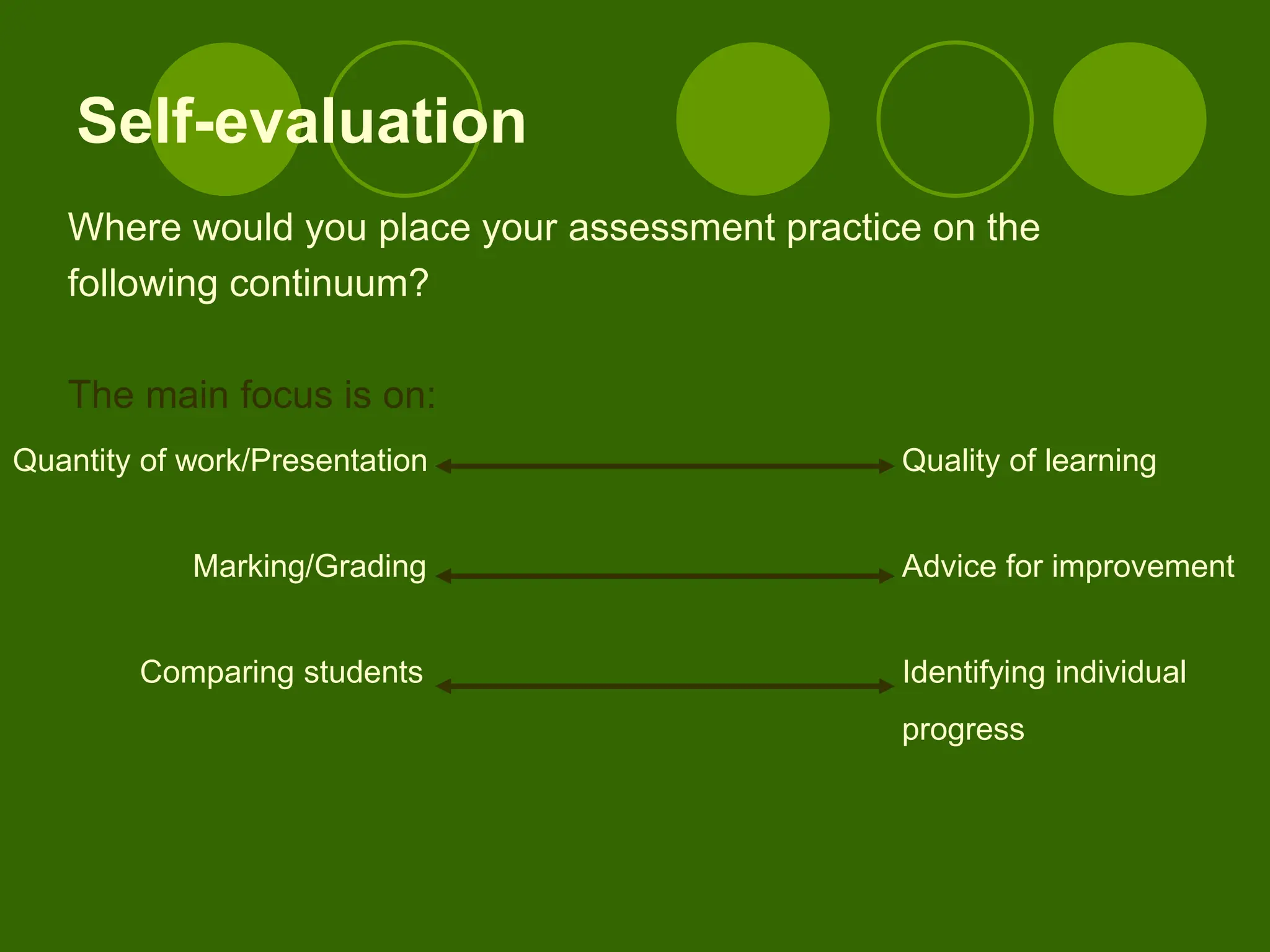
Self-evaluation
Where would you place your assessment practice on the
following continuum?
The main focus is on:
Quantity of work/Presentation Quality of learning
Marking/Grading
Comparing students
Advice for improvement
Identifying individual
progress
Forms of Summative Assessment
Performance Assessment
Portfolio
Traditional Tests
Implications for classroom practice
Share learning goals with students.
Involve students in self-assessment.
Provide feedback that helps students
recognize their next steps and how to take
them.
Be confident that every student can
improve.
THANK YOU

ASSESSMENT_IN_EDUCATION revised ande.ppt

  • 1.
    ASSESSMENT: FORMATIVE & SUMMATIVE Practicesfor the Classroom Dr. Rasha Osman Abdel Haliem Higher Technological Institute 2024
  • 3.
    Why Discuss Assessment? There is a lot of testing happening, but that assessment does not necessarily drive curriculum and instruction.  Educators indicated that the timeliness of receiving data impacts their ability to use it effectively.  Educators expressed a frustration related to their ability to analyze and synthesize the data.
  • 4.
    The word ‘assess’comes from the Latin verb ‘assidere’ meaning ‘to sit with’. In assessment one is supposed to sit with the learner. This implies it is something we do ‘with’ and ‘for’ students and not ‘to’ students (Green, 1999). What is Assessment?
  • 5.
    Assessment in educationis the process of gathering, interpreting, recording, and using information about pupils’ responses to an educational task. (Harlen, Gipps, Broadfoot, Nuttal,1992)
  • 6.
    The State ofAssessment “A wealth of research – a poverty of practice.” (Black and Wiliam, 1998) Shift from “teaching” to “learning” Preservice and inservice training Confusion of terms and conditions Evaluation Assessment Formative Summative
  • 7.
    Formative and summativeassessment are interconnected. They seldom stand alone in construction or effect. The vast majority of genuine formative assessment is informal, with interactive and timely feedback and response. It is widely and empirically argued that formative assessment has the greatest impact on learning and achievement.
  • 8.
    1. Teachers valueand believe in students. 2. Sharing learning goals with the students. 3. Involving students in self-assessment. 4. Providing feedback that helps students recognize their next steps and how to take them. 5. Being confident that every student can improve. 6. Providing students with examples of what we expect from them. Values and Attitudes about Assessment
  • 9.
    Formative Assessment Assessment forlearning Taken at varying intervals throughout a course to provide information and feedback that will help improve the quality of student learning the quality of the course itself
  • 10.
    “…learner-centered, teacher-directed, mutually beneficial,formative, context- specific, ongoing, and firmly rooted in good practice" (Angelo and Cross, 1993). Provides information on what an individual student needs To practice To have re-taught To learn next
  • 12.
    1. The identificationby teachers & learners of learning goals, intentions or outcomes and criteria for achieving these. 2. Rich conversations between teachers & students that continually build and go deeper. 3. The provision of effective, timely feedback to enable students to advance their learning. 4. The active involvement of students in their own learning. 5. Teachers responding to identified learning needs and strengths by modifying their teaching approach(es). Black & Wiliam, 1998 Key Elements of Formative Assessment
  • 13.
    Summative Assessment  Assessmentof learning  Generally taken by students at the end of a unit or semester to demonstrate the "sum" of what they have or have not learned.  Summative assessment methods are the most traditional way of evaluating student work.  "Good summative assessments--tests and other graded evaluations--must be demonstrably reliable, valid, and free of bias" (Angelo and Cross, 1993).
  • 14.
    Formative ‘… often meansno more than that the assessment is carried out frequently and is planned at the same time as teaching.’ (Black and Wiliam, 1999) ‘… provides feedback which leads to students recognizing the (learning) gap and closing it … it is forward looking …’ (Harlen, 1998) ‘ … includes both feedback and self-monitoring.’ (Sadler, 1989) ‘… is used essentially to feed back into the teaching and learning process.’ (Tunstall and Gipps, 1996) Summative ‘…assessment (that) has increasingly been used to sum up learning…’(Black and Wiliam, 1999) ‘… looks at past achievements … adds procedures or tests to existing work ... involves only marking and feedback grades to student … is separated from teaching … is carried out at intervals when achievement has to be summarized and reported.’ (Harlen, 1998)
  • 15.
    If we thinkof our children as plants … Summative assessment of the plants is the process of simply measuring them. It might be interesting to compare and analyze measurements but, in themselves, these do not affect the growth of the plants. Formative assessment, on the other hand, is the equivalent of feeding and watering the plants appropriate to their needs - directly affecting their growth. The Garden Analogy
  • 16.
    Factors Inhibiting Assessment A tendency for teachers to assess quantity and presentation of work rather than quality of learning.  Greater attention given to marking and grading, much of it tending to lower self esteem of students, rather than providing advice for improvement.  A strong emphasis on comparing students with each other, which demoralizes the less successful learners.
  • 17.
    Self-evaluation Where would youplace your assessment practice on the following continuum? The main focus is on: Quantity of work/Presentation Quality of learning Marking/Grading Comparing students Advice for improvement Identifying individual progress
  • 19.
    Forms of SummativeAssessment Performance Assessment Portfolio Traditional Tests
  • 20.
    Implications for classroompractice Share learning goals with students. Involve students in self-assessment. Provide feedback that helps students recognize their next steps and how to take them. Be confident that every student can improve.
  • 22.