Carbohydrates – Structure and
Occurrence
Dr.N.C.J.Packia Lekshmi
ALLIED HEALTH SCIENCES
NOORUL ISLAM CENTRE FOR
HIGHER EDUCATION
Definition
• A carbohydrate is a biomolecule consisting of carbon (C),
hydrogen (H) and oxygen (O) atoms, usually with a
hydrogen–oxygen atom ratio of 2:1 (as in water) and thus
with the empirical formula Cm(H2O)n.
• Saccharide, a group that includes sugars, starch, and
cellulose.
• Carbohydrates are the sugars, starches and fibers found in
fruits, grains, vegetables and milk products.
• carbohydrates — one of the basic food groups — are
important to a healthy diet.
STRUCTURE AND OCCURRENCE
• Carbohydrates consist of carbon, hydrogen, and oxygen.
• The general empirical structure for carbohydrates is (CH2O)n.
• They are organic compounds organized in the form of
aldehydes or ketones with multiple hydroxyl groups coming off
the carbon chain.
• The building blocks of all carbohydrates are simple sugars
called monosaccharides.
• A monosaccharide can be a polyhydroxy aldehyde (aldose) or
a polyhydroxy ketone (ketose).
• The carbohydrates can be structurally represented in any of the three
forms:
• Open chain structure/fischer projection - It is the long straight-chain
form of carbohydrates
• The L and D confirmations represent the absolute configuration of the
asymmetric carbon farthest away from the ketone or aldehyde group
on the monosaccharide. On the Fischer projection, if the farthest
hydroxyl(-OH) group is on the right, then it is classified as D sugar, if
the hydroxyl group is on the left, then it is a L sugar.
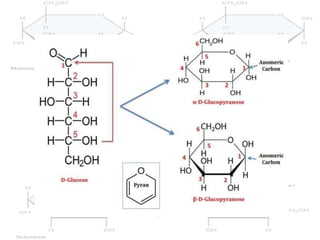
• Haworth structure - It is the presence of the pyranose ring structure
• Hemi-acetal structure - Here the 1st carbon of the glucose condenses
with the -OH group of the 5th carbon to form a ring structure
Fischer Projection
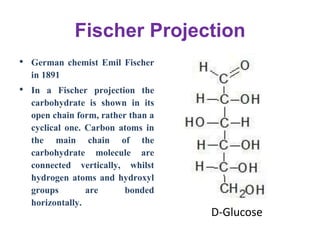
• German chemist Emil Fischer
in 1891
• In a Fischer projection the
carbohydrate is shown in its
open chain form, rather than a
cyclical one. Carbon atoms in
the main chain of the
carbohydrate molecule are
connected vertically, whilst
hydrogen atoms and hydroxyl
groups are bonded
horizontally.
D-Glucose
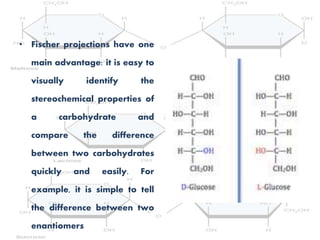
• Fischer projections have one
main advantage: it is easy to
visually identify the
stereochemical properties of
a carbohydrate and
compare the difference
between two carbohydrates
quickly and easily. For
example, it is simple to tell
the difference between two
enantiomers
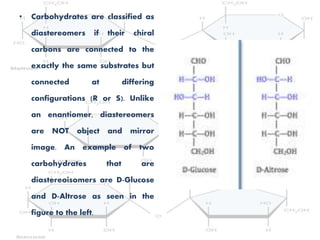
• Carbohydrates are classified as
diastereomers if their chiral
carbons are connected to the
exactly the same substrates but
connected at differing
configurations (R or S). Unlike
an enantiomer, diastereomers
are NOT object and mirror
image. An example of two
carbohydrates that are
diastereoisomers are D-Glucose
and D-Altrose as seen in the
figure to the left.
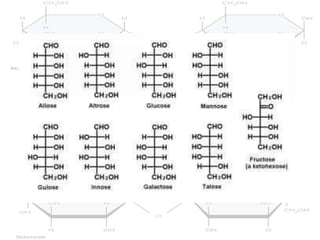
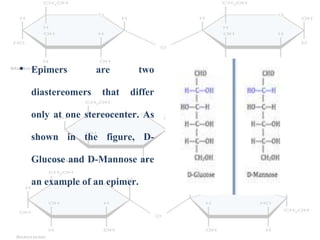
• Epimers are two
diastereomers that differ
only at one stereocenter. As
shown in the figure, D-
Glucose and D-Mannose are
an example of an epimer.
Haworth Projection
• A Haworth projection differs from a Fischer
projection in that it is used to represent the
carbohydrate in its cyclical form.
• This is especially useful for sugars which have a ring
structure.
• It was devised by the English chemist Sir Norman
Haworth who expanded on the work of Fischer,
characterizing many more carbohydrates.
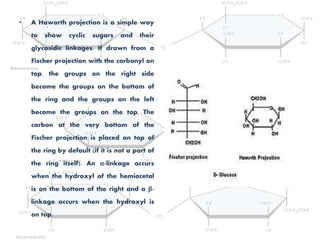
• A Haworth projection is a simple way
to show cyclic sugars and their
glycosidic linkages. If drawn from a
Fischer projection with the carbonyl on
top, the groups on the right side
become the groups on the bottom of
the ring and the groups on the left
become the groups on the top. The
carbon at the very bottom of the
Fischer projection is placed on top of
the ring by default (if it is not a part of
the ring itself). An α-linkage occurs
when the hydroxyl of the hemiacetal
is on the bottom of the right and a β-
linkage occurs when the hydroxyl is
on top.
Hemi-acetal structure
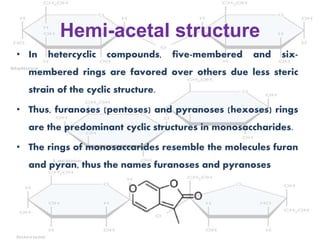
• In hetercyclic compounds, five-membered and six-
membered rings are favored over others due less steric
strain of the cyclic structure.
• Thus, furanoses (pentoses) and pyranoses (hexoses) rings
are the predominant cyclic structures in monosaccharides.
• The rings of monosaccarides resemble the molecules furan
and pyran, thus the names furanoses and pyranoses
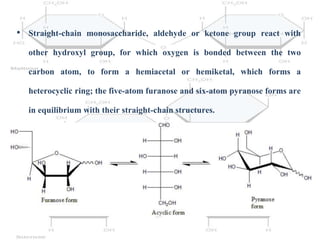
• Straight-chain monosaccharide, aldehyde or ketone group react with
other hydroxyl group, for which oxygen is bonded between the two
carbon atom, to form a hemiacetal or hemiketal, which forms a
heterocyclic ring; the five-atom furanose and six-atom pyranose forms are
in equilibrium with their straight-chain structures.
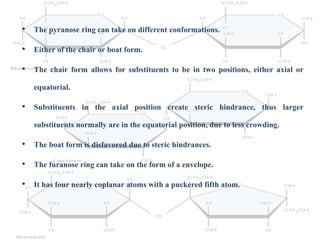
• The pyranose ring can take on different conformations.
• Either of the chair or boat form.
• The chair form allows for substituents to be in two positions, either axial or
equatorial.
• Substituents in the axial position create steric hindrance, thus larger
substituents normally are in the equatorial position, due to less crowding.
• The boat form is disfavored due to steric hindrances.
• The furanose ring can take on the form of a envelope.
• It has four nearly coplanar atoms with a puckered fifth atom.
Carbohydrates   structure

Carbohydrates structure

  • 1.
    Carbohydrates – Structureand Occurrence Dr.N.C.J.Packia Lekshmi ALLIED HEALTH SCIENCES NOORUL ISLAM CENTRE FOR HIGHER EDUCATION
  • 2.
    Definition • A carbohydrateis a biomolecule consisting of carbon (C), hydrogen (H) and oxygen (O) atoms, usually with a hydrogen–oxygen atom ratio of 2:1 (as in water) and thus with the empirical formula Cm(H2O)n. • Saccharide, a group that includes sugars, starch, and cellulose. • Carbohydrates are the sugars, starches and fibers found in fruits, grains, vegetables and milk products. • carbohydrates — one of the basic food groups — are important to a healthy diet.
  • 3.
    STRUCTURE AND OCCURRENCE •Carbohydrates consist of carbon, hydrogen, and oxygen. • The general empirical structure for carbohydrates is (CH2O)n. • They are organic compounds organized in the form of aldehydes or ketones with multiple hydroxyl groups coming off the carbon chain. • The building blocks of all carbohydrates are simple sugars called monosaccharides. • A monosaccharide can be a polyhydroxy aldehyde (aldose) or a polyhydroxy ketone (ketose).
  • 4.
    • The carbohydratescan be structurally represented in any of the three forms: • Open chain structure/fischer projection - It is the long straight-chain form of carbohydrates • The L and D confirmations represent the absolute configuration of the asymmetric carbon farthest away from the ketone or aldehyde group on the monosaccharide. On the Fischer projection, if the farthest hydroxyl(-OH) group is on the right, then it is classified as D sugar, if the hydroxyl group is on the left, then it is a L sugar. • Haworth structure - It is the presence of the pyranose ring structure • Hemi-acetal structure - Here the 1st carbon of the glucose condenses with the -OH group of the 5th carbon to form a ring structure
  • 5.
    Fischer Projection • Germanchemist Emil Fischer in 1891 • In a Fischer projection the carbohydrate is shown in its open chain form, rather than a cyclical one. Carbon atoms in the main chain of the carbohydrate molecule are connected vertically, whilst hydrogen atoms and hydroxyl groups are bonded horizontally. D-Glucose
  • 7.
    • Fischer projectionshave one main advantage: it is easy to visually identify the stereochemical properties of a carbohydrate and compare the difference between two carbohydrates quickly and easily. For example, it is simple to tell the difference between two enantiomers
  • 8.
    • Carbohydrates areclassified as diastereomers if their chiral carbons are connected to the exactly the same substrates but connected at differing configurations (R or S). Unlike an enantiomer, diastereomers are NOT object and mirror image. An example of two carbohydrates that are diastereoisomers are D-Glucose and D-Altrose as seen in the figure to the left.
  • 9.
    • Epimers aretwo diastereomers that differ only at one stereocenter. As shown in the figure, D- Glucose and D-Mannose are an example of an epimer.
  • 10.
    Haworth Projection • AHaworth projection differs from a Fischer projection in that it is used to represent the carbohydrate in its cyclical form. • This is especially useful for sugars which have a ring structure. • It was devised by the English chemist Sir Norman Haworth who expanded on the work of Fischer, characterizing many more carbohydrates.
  • 11.
    • A Haworthprojection is a simple way to show cyclic sugars and their glycosidic linkages. If drawn from a Fischer projection with the carbonyl on top, the groups on the right side become the groups on the bottom of the ring and the groups on the left become the groups on the top. The carbon at the very bottom of the Fischer projection is placed on top of the ring by default (if it is not a part of the ring itself). An α-linkage occurs when the hydroxyl of the hemiacetal is on the bottom of the right and a β- linkage occurs when the hydroxyl is on top.
  • 13.
    Hemi-acetal structure • Inhetercyclic compounds, five-membered and six- membered rings are favored over others due less steric strain of the cyclic structure. • Thus, furanoses (pentoses) and pyranoses (hexoses) rings are the predominant cyclic structures in monosaccharides. • The rings of monosaccarides resemble the molecules furan and pyran, thus the names furanoses and pyranoses
  • 14.
    • Straight-chain monosaccharide,aldehyde or ketone group react with other hydroxyl group, for which oxygen is bonded between the two carbon atom, to form a hemiacetal or hemiketal, which forms a heterocyclic ring; the five-atom furanose and six-atom pyranose forms are in equilibrium with their straight-chain structures.
  • 15.
    • The pyranosering can take on different conformations. • Either of the chair or boat form. • The chair form allows for substituents to be in two positions, either axial or equatorial. • Substituents in the axial position create steric hindrance, thus larger substituents normally are in the equatorial position, due to less crowding. • The boat form is disfavored due to steric hindrances. • The furanose ring can take on the form of a envelope. • It has four nearly coplanar atoms with a puckered fifth atom.