Carbohydrates
Noor Ullah
M.Phil Biochemistry& Molecular Biology
Lecturer IPMS, KMU
noor1.qau@gmail.com
Tuesday, May 23, 2017 1
Carbohydrates
• Carbohydrates- Carbon hydrates ( C- H20)
• Polyhydroxy aldehyde or ketones.
• Many, but not all, carbohydrates have the empirical formula (C- H20)n
• Three major classes of carbohydrates:
• Monosaccharides, oligosaccharides, and polysaccharides
• (The word “saccharide” is derived from the Greek sakcharon, meaning
“sugar”).
Tuesday, May 23, 2017 2
Monosaccharides
• Monosaccharides are the simplest carbohydrates. They are colorless,
crystalline solids that are freely soluble in water but insoluble in
nonpolar solvents.
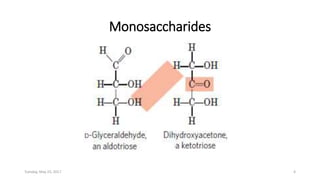
• The simplest monosaccharides are the two three-carbon trioses:
glyceraldehyde and dihydroxyacetone.
Tuesday, May 23, 2017 3
Monosaccharides
Tuesday, May 23, 2017 4
Monosaccharides
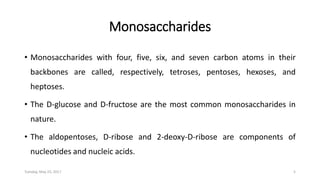
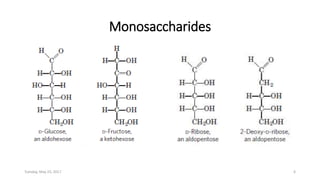
• Monosaccharides with four, five, six, and seven carbon atoms in their
backbones are called, respectively, tetroses, pentoses, hexoses, and
heptoses.
• The D-glucose and D-fructose are the most common monosaccharides in
nature.
• The aldopentoses, D-ribose and 2-deoxy-D-ribose are components of
nucleotides and nucleic acids.
Tuesday, May 23, 2017 5
Monosaccharides
Tuesday, May 23, 2017 6
Asymmetric or Chiral Centers
• Carbon to which four different atoms or groups are attached is called
asymmetric.
• All the monosaccharides except dihydroxyacetone contain one or more
asymmetric (chiral) carbon atoms and thus occur in optically active
isomeric forms- Enantiomers or Mirror images.
• To represent three-dimensional sugar structures on paper, we often use
Fischer projection formulas.
Tuesday, May 23, 2017 7
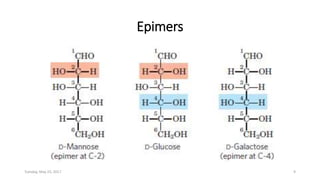
Epimers
• Two sugars that differ only in the configuration around one carbon
atom are called epimers. Examples are D-glucose and D-mannose,
which differ only at C-2 and D-glucose and D-galactose (which differ
at C-4) .
Tuesday, May 23, 2017 8
Epimers
Tuesday, May 23, 2017 9
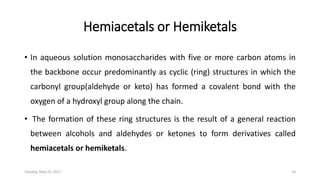
Hemiacetals or Hemiketals
• In aqueous solution monosaccharides with five or more carbon atoms in
the backbone occur predominantly as cyclic (ring) structures in which the
carbonyl group(aldehyde or keto) has formed a covalent bond with the
oxygen of a hydroxyl group along the chain.
• The formation of these ring structures is the result of a general reaction
between alcohols and aldehydes or ketones to form derivatives called
hemiacetals or hemiketals.
Tuesday, May 23, 2017 10
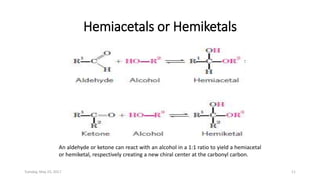
Hemiacetals or Hemiketals
An aldehyde or ketone can react with an alcohol in a 1:1 ratio to yield a hemiacetal
or hemiketal, respectively creating a new chiral center at the carbonyl carbon.
Tuesday, May 23, 2017 11
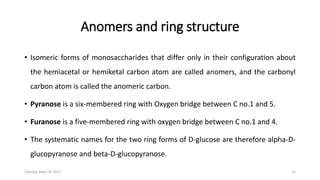
Anomers and ring structure
• Isomeric forms of monosaccharides that differ only in their configuration about
the hemiacetal or hemiketal carbon atom are called anomers, and the carbonyl
carbon atom is called the anomeric carbon.
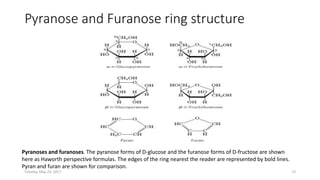
• Pyranose is a six-membered ring with Oxygen bridge between C no.1 and 5.
• Furanose is a five-membered ring with oxygen bridge between C no.1 and 4.
• The systematic names for the two ring forms of D-glucose are therefore alpha-D-
glucopyranose and beta-D-glucopyranose.
Tuesday, May 23, 2017 12
Pyranose and Furanose ring structure
Pyranoses and furanoses. The pyranose forms of D-glucose and the furanose forms of D-fructose are shown
here as Haworth perspective formulas. The edges of the ring nearest the reader are represented by bold lines.
Pyran and furan are shown for comparison.
Tuesday, May 23, 2017 13
Mutarotation
• The alpha and beta anomers of D-glucose interconvert in aqueous solution
by a process called Mutarotation.
• In this process one ring form (say, the alpha anomer) opens briefly into the
linear form, then closes again to produce the beta anomer.
• Thus, a solution of beta-D-glucose and a solution of alpha-D-glucose
eventually form identical equilibrium mixtures having identical optical
properties.
Tuesday, May 23, 2017 14
Racemic Mixture
• The solution in which equal amount of levo and dextrorotatory
isomers are present, the optical rotation of plane polarized light will
be equal but in opposite direction.
• The net rotation will be zero. Such a mixture is called racemic mixture
Tuesday, May 23, 2017 15
Mesocompounds
• Compounds which do not rotate the plane polarized light although
they are having asymmetric carbon atoms are called
Mesocompounds.
• It is due to internal compensation in which the d and l forms are
balanced. Example Mesotartaric acid.
Tuesday, May 23, 2017 16
Glycosides
• When the hydroxyl group of one monosaccharide reacts with the hydroxyl
group of another monosaccharide, it forms glycosidic linkage.
• Glycosides are compounds in which a monosaccharide is attached at the
anomeric carbon to an alcohol residue of non carbohydrate. The non
carbohydrate residue is called aglycon. Clinically important glycosides are
Digitalis.
Tuesday, May 23, 2017 17
Reducing Sugars
• Monosaccharides can be oxidized by relatively mild oxidizing agents such
as cupric (Cu2) ion. The carbonyl carbon is oxidized to a carboxyl group.
• Glucose and other sugars capable of reducing cupric ion are called reducing
sugars.
• Cupric ion oxidizes glucose and certain other sugars to a complex mixture
of carboxylic acids. This is the basis of Fehling’s reaction.
Tuesday, May 23, 2017 18
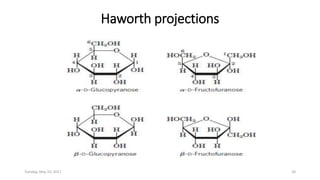
Ring structure- Haworth formula
• Cyclic structures of sugars are more accurately represented in Haworth
perspective formulas than in the Fischer projection commonly used for
linear sugar structures.
• In Haworth projections the six-membered ring is tilted to make its plane
almost perpendicular to that of the paper, with the bonds closest to the
reader drawn thicker than those farther away and numbering of the
carbons is done in a clockwise direction beginning with the anomeric
carbon.
Tuesday, May 23, 2017 19
Haworth projections
Tuesday, May 23, 2017 20
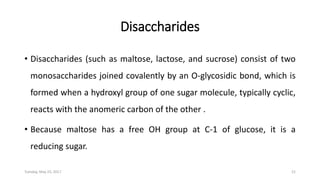
Disaccharides
• Disaccharides (such as maltose, lactose, and sucrose) consist of two
monosaccharides joined covalently by an O-glycosidic bond, which is
formed when a hydroxyl group of one sugar molecule, typically cyclic,
reacts with the anomeric carbon of the other .
• Because maltose has a free OH group at C-1 of glucose, it is a
reducing sugar.
Tuesday, May 23, 2017 21
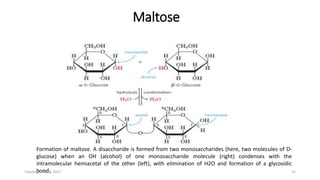
Maltose
Formation of maltose. A disaccharide is formed from two monosaccharides (here, two molecules of D-
glucose) when an OH (alcohol) of one monosaccharide molecule (right) condenses with the
intramolecular hemiacetal of the other (left), with elimination of H2O and formation of a glycosidic
bond.Tuesday, May 23, 2017 22
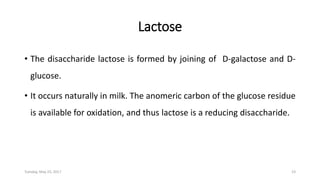
Lactose
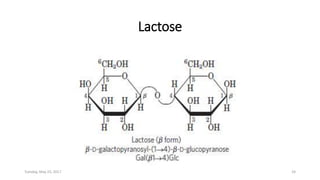
• The disaccharide lactose is formed by joining of D-galactose and D-
glucose.
• It occurs naturally in milk. The anomeric carbon of the glucose residue
is available for oxidation, and thus lactose is a reducing disaccharide.
Tuesday, May 23, 2017 23
Lactose
Tuesday, May 23, 2017 24
Sucrose
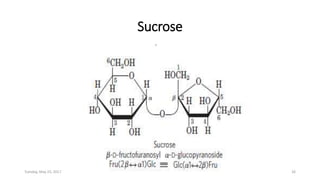
• Sucrose (table sugar) is a disaccharide of glucose and fructose.
• In contrast to maltose and lactose, sucrose contains no free anomeric
carbon atom; the anomeric carbons of both monosaccharide units
are involved in the glycosidic bond.
• Sucrose is therefore a non reducing sugar.
Tuesday, May 23, 2017 25
Sucrose
Tuesday, May 23, 2017 26
Polysaccharides
• Most carbohydrates found in nature occur as polysaccharides
• Polysaccharides, also called glycans, differ from each other in the identity
of their recurring monosaccharide units, in the length of their chains, in the
types of bonds linking the units, and in the degree of branching.
• Homopolysaccharides contain only a single monomeric species
• Heteropolysaccharides contain two or more different kinds
Tuesday, May 23, 2017 27
Starch and glycogen
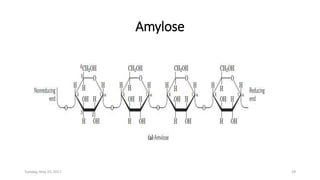
• The most important storage polysaccharides are starch in plant cells and glycogen in animal cells.
• Starch contains two types of glucose polymer, amylose and amylopectin.
• Amylose consists of long, unbranched chains of D-glucose residues connected by (alpha 1 4)
linkages. Such chains vary in molecular weight from a few thousand to more than a million.
• Amylopectin is highly branched and has a high molecular weight (up to 200 million).
• The glycosidic linkages joining successive glucose residues in amylopectin chains are (alpha 1 4);
the branch points (occurring every 24 to 30 residues) are (alpha 1 6) linkages.
Tuesday, May 23, 2017 28
Amylose
Tuesday, May 23, 2017 29
Glycogen
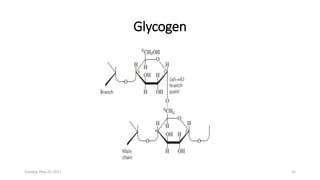
• Glycogen is the main storage polysaccharide of animal cells. Like
amylopectin, glycogen is a polymer of (alpha 1 4)-linked subunits of
glucose, with (alpha1 6)-linked branches, but glycogen is more
extensively branched (on average, every 8 to 12 residues) and more
compact than starch.
Tuesday, May 23, 2017 30
Glycogen
Tuesday, May 23, 2017 31
Glycogen
• Glycogen is especially abundant in the liver, where it may constitute
as much as 7% of the wet weight; it is also present in skeletal muscle.
• In hepatocytes glycogen is found in large granules, which are
themselves clusters of smaller granules composed of single, highly
branched glycogen molecules with an average molecular weight of
several million.
Tuesday, May 23, 2017 32
Dextran
• Dextrans are bacterial and yeast polysaccharides made up of alpha 1
6-linked poly-D-glucose.
• Dental plaque, formed by bacteria growing on the surface of teeth, is
rich in dextrans, which are adhesive and allow the bacteria to stick to
teeth and to each other.
• Dextrans also provide a source of glucose for bacterial metabolism.
Tuesday, May 23, 2017 33
Cellolose
• Cellulose, a fibrous, tough, water-insoluble substance, is found in the cell walls of plants, particularly in
stalks, stems, trunks, and all the woody portions of the plant body.
• Cellulose molecule is a linear, unbranched homopolysaccharide, consisting of 10,000 to 15,000 D-glucose
units.
• The glucose residues in cellulose are linked by (beta 1 4) glycosidic bonds, in contrast to the (alpha 1 4)
bonds of amylose. This difference causes individual molecules of cellulose and amylose to fold differently in
space, giving them very different macroscopic structures and physical properties.
• The tough, fibrous nature of cellulose makes it useful in such commercial products as cardboard and
insulation material, and it is a major constituent of cotton and linen fabrics.
Tuesday, May 23, 2017 34
Cellolose
• Glycogen and starch ingested in the diet are hydrolyzed by alpha amylases and
glycosidases, enzymes in saliva and the intestine that break (alpha1 4) glycosidic
bonds between glucose units.
• Most vertebrate animals cannot use cellulose as a fuel source, because they lack
an enzyme to hydrolyze the (beta 1 4) linkages.
• Termites readily digest cellulose (and therefore wood), but only because their
intestinal tract harbors a symbiotic microorganism, Trichonympha, that secretes
cellulase, which hydrolyzes the (beta 1 4) linkages.
Tuesday, May 23, 2017 35
Chitin
• Chitin is a linear homopolysaccharide composed of N-acetylglucosamine residues
in (beta 1 4) linkage.
• Chitin forms extended fibers similar to those of cellulose, and like cellulose
cannot be digested by vertebrates.
• Chitin is the principal component of the hard exoskeletons of nearly a million
species of arthropods—insects, lobsters, and crabs, for example—and is probably
the second most abundant polysaccharide, next to cellulose.
Tuesday, May 23, 2017 36
Heteropolysaccharides
• These heteropolysaccharides, the glycosaminoglycans, are a family of linear polymers composed of
repeating disaccharide units. They are unique to animals and bacteria and are not found in plants.
• Hyaluronic acid forms clear, highly viscous solutions that serve as lubricants in the synovial fluid of joints and
give the vitreous humor of the vertebrate eye its jellylike consistency (the Greek hyalos means “glass”.
• Hyaluronan is also a component of the extracellular matrix of cartilage and tendons, to which it contributes
tensile strength and elasticity.
• Hyaluronidase, an enzyme secreted by some pathogenic bacteria, can hydrolyze the glycosidic linkages of
hyaluronan, rendering tissues more susceptible to bacterial invasion.
Tuesday, May 23, 2017 37
Chondroitin Sulfate
• Chondroitin sulfate (Greek chondros, “cartilage”) contributes to the
tensile strength of cartilage, tendons, ligaments, and the walls of the
aorta.
• Dermatan sulfate (Greek derma, “skin”) contributes to the pliability
of skin and is also present in blood vessels and heart valves.
Tuesday, May 23, 2017 38
Agar
• Agar is a complex mixture of polysaccharides.
• The remarkable gel-forming property of agarose makes it useful in the biochemistry laboratory.
• Agarose gels are used as inert supports for the electrophoretic separation of nucleic acids, an
essential part of the DNA-sequencing process.
• Agar is also used to form a surface for the growth of bacterial colonies.
• Another commercial use of agar is for the capsules in which some vitamins and drugs are
packaged.
Tuesday, May 23, 2017 39
Biomedical Importance of Carbohydrates
• Chief source of energy.
• Constituents of compound lipids and conjugated proteins.
• Certain carbohydrate derivatives are used as drugs like cardiac
glycosides/antibiotics.
• Lactose principal sugar of milk—in lactating mammary gland.
• Degradation products utilised for synthesis of other substances such as
fatty acids, cholesterol, amino acid, etc.
Tuesday, May 23, 2017 40
Biomedical Importance of Carbohydrates
• Constituents of mucopolysaccharides which form the ground substance of
mesenchymal tissues.
• Inherited deficiency of certain enzymes in metabolic pathways of different
carbohydrates can cause diseases, e.g. galactosemia, glycogen storage diseases
(GSDs), lactose intolerance, etc.
• Derangement of glucose metabolism is seen in diabetes mellitus.
• Seminal fluid is rich in fructose and sperms utilise fructose for energy. Fructose is
formed in the seminiferous tubular epithelial cells from glucose.
Tuesday, May 23, 2017 41
Biomedical Importance of Carbohydrates
• Various food preparations, such as baby are produced by hydrolysis of grains and contain large
amounts of maltose.
• From nutritional point of view they are thus easily digestible.
• In lactating mammary gland, the lactose is synthesised from glucose by the duct epithelium and
lactose present in breast milk is a good source of energy for the newborn baby.
• Lactose is fermented by ‘Coliform’ bacilli (E. coli) which is usually non-pathogenic (lactose
fermenter) and not by Typhoid bacillus which is pathogenic (lactose non-fermenter). This test is
used to distinguish these two microorganisms.
Tuesday, May 23, 2017 42
Biomedical Importance of Carbohydrates
• Souring’ of milk: Many organisms that are found in milk, e.g. E. coli, A. aerogenes, and
Str. lactis convert lactose of milk to lactic acid (LA) thus causing souring of milk.
• Sucrose if introduced parenterally cannot be utilised, but it can change the osmotic
condition of the blood and causes a flow of water from the tissues into the blood.
• Thus clinicians use it in oedema like cerebral oedema.
• If sucrose or some other disaccharides are not hydrolysed in the gut, due to deficiency
of the appropriate enzyme, diarrhoea is likely to occur.
Tuesday, May 23, 2017 43
Biomedical Importance of Carbohydrates
• Glycosides are found in many drugs, spices and in the constituents of animal tissues.
• Cardiac glycosides:
• It is important in medicine because of their action on heart and thus used in cardiac
insufficiency. They all contain steroids as aglycone component in combination with sugar
molecules. They are derivatives of digitalis, strophanthus and squill plants, e.g.
• Ouabain: A glycoside obtained from strophanthus sp. is of interest as it inhibits active
transport of Na+ in cardiac muscle in vivo (Sodium Pump inhibitor).
Tuesday, May 23, 2017 44
Biomedical Importance of Carbohydrates
• Agar
• In human: Used as laxative in constipation. Like cellulose, it is not digested,
hence add bulk to the faeces (“roughage” value) and helps in its
propulsion.
• In microbiology: Agar is available in purified form. It dissolves in hot water
and on cooling it sets like gel. It is used in agar plate for culture of bacteria.
Tuesday, May 23, 2017 45

Carbohydrates 1

  • 1.
    Carbohydrates Noor Ullah M.Phil Biochemistry&Molecular Biology Lecturer IPMS, KMU noor1.qau@gmail.com Tuesday, May 23, 2017 1
  • 2.
    Carbohydrates • Carbohydrates- Carbonhydrates ( C- H20) • Polyhydroxy aldehyde or ketones. • Many, but not all, carbohydrates have the empirical formula (C- H20)n • Three major classes of carbohydrates: • Monosaccharides, oligosaccharides, and polysaccharides • (The word “saccharide” is derived from the Greek sakcharon, meaning “sugar”). Tuesday, May 23, 2017 2
  • 3.
    Monosaccharides • Monosaccharides arethe simplest carbohydrates. They are colorless, crystalline solids that are freely soluble in water but insoluble in nonpolar solvents. • The simplest monosaccharides are the two three-carbon trioses: glyceraldehyde and dihydroxyacetone. Tuesday, May 23, 2017 3
  • 4.
  • 5.
    Monosaccharides • Monosaccharides withfour, five, six, and seven carbon atoms in their backbones are called, respectively, tetroses, pentoses, hexoses, and heptoses. • The D-glucose and D-fructose are the most common monosaccharides in nature. • The aldopentoses, D-ribose and 2-deoxy-D-ribose are components of nucleotides and nucleic acids. Tuesday, May 23, 2017 5
  • 6.
  • 7.
    Asymmetric or ChiralCenters • Carbon to which four different atoms or groups are attached is called asymmetric. • All the monosaccharides except dihydroxyacetone contain one or more asymmetric (chiral) carbon atoms and thus occur in optically active isomeric forms- Enantiomers or Mirror images. • To represent three-dimensional sugar structures on paper, we often use Fischer projection formulas. Tuesday, May 23, 2017 7
  • 8.
    Epimers • Two sugarsthat differ only in the configuration around one carbon atom are called epimers. Examples are D-glucose and D-mannose, which differ only at C-2 and D-glucose and D-galactose (which differ at C-4) . Tuesday, May 23, 2017 8
  • 9.
  • 10.
    Hemiacetals or Hemiketals •In aqueous solution monosaccharides with five or more carbon atoms in the backbone occur predominantly as cyclic (ring) structures in which the carbonyl group(aldehyde or keto) has formed a covalent bond with the oxygen of a hydroxyl group along the chain. • The formation of these ring structures is the result of a general reaction between alcohols and aldehydes or ketones to form derivatives called hemiacetals or hemiketals. Tuesday, May 23, 2017 10
  • 11.
    Hemiacetals or Hemiketals Analdehyde or ketone can react with an alcohol in a 1:1 ratio to yield a hemiacetal or hemiketal, respectively creating a new chiral center at the carbonyl carbon. Tuesday, May 23, 2017 11
  • 12.
    Anomers and ringstructure • Isomeric forms of monosaccharides that differ only in their configuration about the hemiacetal or hemiketal carbon atom are called anomers, and the carbonyl carbon atom is called the anomeric carbon. • Pyranose is a six-membered ring with Oxygen bridge between C no.1 and 5. • Furanose is a five-membered ring with oxygen bridge between C no.1 and 4. • The systematic names for the two ring forms of D-glucose are therefore alpha-D- glucopyranose and beta-D-glucopyranose. Tuesday, May 23, 2017 12
  • 13.
    Pyranose and Furanosering structure Pyranoses and furanoses. The pyranose forms of D-glucose and the furanose forms of D-fructose are shown here as Haworth perspective formulas. The edges of the ring nearest the reader are represented by bold lines. Pyran and furan are shown for comparison. Tuesday, May 23, 2017 13
  • 14.
    Mutarotation • The alphaand beta anomers of D-glucose interconvert in aqueous solution by a process called Mutarotation. • In this process one ring form (say, the alpha anomer) opens briefly into the linear form, then closes again to produce the beta anomer. • Thus, a solution of beta-D-glucose and a solution of alpha-D-glucose eventually form identical equilibrium mixtures having identical optical properties. Tuesday, May 23, 2017 14
  • 15.
    Racemic Mixture • Thesolution in which equal amount of levo and dextrorotatory isomers are present, the optical rotation of plane polarized light will be equal but in opposite direction. • The net rotation will be zero. Such a mixture is called racemic mixture Tuesday, May 23, 2017 15
  • 16.
    Mesocompounds • Compounds whichdo not rotate the plane polarized light although they are having asymmetric carbon atoms are called Mesocompounds. • It is due to internal compensation in which the d and l forms are balanced. Example Mesotartaric acid. Tuesday, May 23, 2017 16
  • 17.
    Glycosides • When thehydroxyl group of one monosaccharide reacts with the hydroxyl group of another monosaccharide, it forms glycosidic linkage. • Glycosides are compounds in which a monosaccharide is attached at the anomeric carbon to an alcohol residue of non carbohydrate. The non carbohydrate residue is called aglycon. Clinically important glycosides are Digitalis. Tuesday, May 23, 2017 17
  • 18.
    Reducing Sugars • Monosaccharidescan be oxidized by relatively mild oxidizing agents such as cupric (Cu2) ion. The carbonyl carbon is oxidized to a carboxyl group. • Glucose and other sugars capable of reducing cupric ion are called reducing sugars. • Cupric ion oxidizes glucose and certain other sugars to a complex mixture of carboxylic acids. This is the basis of Fehling’s reaction. Tuesday, May 23, 2017 18
  • 19.
    Ring structure- Haworthformula • Cyclic structures of sugars are more accurately represented in Haworth perspective formulas than in the Fischer projection commonly used for linear sugar structures. • In Haworth projections the six-membered ring is tilted to make its plane almost perpendicular to that of the paper, with the bonds closest to the reader drawn thicker than those farther away and numbering of the carbons is done in a clockwise direction beginning with the anomeric carbon. Tuesday, May 23, 2017 19
  • 20.
  • 21.
    Disaccharides • Disaccharides (suchas maltose, lactose, and sucrose) consist of two monosaccharides joined covalently by an O-glycosidic bond, which is formed when a hydroxyl group of one sugar molecule, typically cyclic, reacts with the anomeric carbon of the other . • Because maltose has a free OH group at C-1 of glucose, it is a reducing sugar. Tuesday, May 23, 2017 21
  • 22.
    Maltose Formation of maltose.A disaccharide is formed from two monosaccharides (here, two molecules of D- glucose) when an OH (alcohol) of one monosaccharide molecule (right) condenses with the intramolecular hemiacetal of the other (left), with elimination of H2O and formation of a glycosidic bond.Tuesday, May 23, 2017 22
  • 23.
    Lactose • The disaccharidelactose is formed by joining of D-galactose and D- glucose. • It occurs naturally in milk. The anomeric carbon of the glucose residue is available for oxidation, and thus lactose is a reducing disaccharide. Tuesday, May 23, 2017 23
  • 24.
  • 25.
    Sucrose • Sucrose (tablesugar) is a disaccharide of glucose and fructose. • In contrast to maltose and lactose, sucrose contains no free anomeric carbon atom; the anomeric carbons of both monosaccharide units are involved in the glycosidic bond. • Sucrose is therefore a non reducing sugar. Tuesday, May 23, 2017 25
  • 26.
  • 27.
    Polysaccharides • Most carbohydratesfound in nature occur as polysaccharides • Polysaccharides, also called glycans, differ from each other in the identity of their recurring monosaccharide units, in the length of their chains, in the types of bonds linking the units, and in the degree of branching. • Homopolysaccharides contain only a single monomeric species • Heteropolysaccharides contain two or more different kinds Tuesday, May 23, 2017 27
  • 28.
    Starch and glycogen •The most important storage polysaccharides are starch in plant cells and glycogen in animal cells. • Starch contains two types of glucose polymer, amylose and amylopectin. • Amylose consists of long, unbranched chains of D-glucose residues connected by (alpha 1 4) linkages. Such chains vary in molecular weight from a few thousand to more than a million. • Amylopectin is highly branched and has a high molecular weight (up to 200 million). • The glycosidic linkages joining successive glucose residues in amylopectin chains are (alpha 1 4); the branch points (occurring every 24 to 30 residues) are (alpha 1 6) linkages. Tuesday, May 23, 2017 28
  • 29.
  • 30.
    Glycogen • Glycogen isthe main storage polysaccharide of animal cells. Like amylopectin, glycogen is a polymer of (alpha 1 4)-linked subunits of glucose, with (alpha1 6)-linked branches, but glycogen is more extensively branched (on average, every 8 to 12 residues) and more compact than starch. Tuesday, May 23, 2017 30
  • 31.
  • 32.
    Glycogen • Glycogen isespecially abundant in the liver, where it may constitute as much as 7% of the wet weight; it is also present in skeletal muscle. • In hepatocytes glycogen is found in large granules, which are themselves clusters of smaller granules composed of single, highly branched glycogen molecules with an average molecular weight of several million. Tuesday, May 23, 2017 32
  • 33.
    Dextran • Dextrans arebacterial and yeast polysaccharides made up of alpha 1 6-linked poly-D-glucose. • Dental plaque, formed by bacteria growing on the surface of teeth, is rich in dextrans, which are adhesive and allow the bacteria to stick to teeth and to each other. • Dextrans also provide a source of glucose for bacterial metabolism. Tuesday, May 23, 2017 33
  • 34.
    Cellolose • Cellulose, afibrous, tough, water-insoluble substance, is found in the cell walls of plants, particularly in stalks, stems, trunks, and all the woody portions of the plant body. • Cellulose molecule is a linear, unbranched homopolysaccharide, consisting of 10,000 to 15,000 D-glucose units. • The glucose residues in cellulose are linked by (beta 1 4) glycosidic bonds, in contrast to the (alpha 1 4) bonds of amylose. This difference causes individual molecules of cellulose and amylose to fold differently in space, giving them very different macroscopic structures and physical properties. • The tough, fibrous nature of cellulose makes it useful in such commercial products as cardboard and insulation material, and it is a major constituent of cotton and linen fabrics. Tuesday, May 23, 2017 34
  • 35.
    Cellolose • Glycogen andstarch ingested in the diet are hydrolyzed by alpha amylases and glycosidases, enzymes in saliva and the intestine that break (alpha1 4) glycosidic bonds between glucose units. • Most vertebrate animals cannot use cellulose as a fuel source, because they lack an enzyme to hydrolyze the (beta 1 4) linkages. • Termites readily digest cellulose (and therefore wood), but only because their intestinal tract harbors a symbiotic microorganism, Trichonympha, that secretes cellulase, which hydrolyzes the (beta 1 4) linkages. Tuesday, May 23, 2017 35
  • 36.
    Chitin • Chitin isa linear homopolysaccharide composed of N-acetylglucosamine residues in (beta 1 4) linkage. • Chitin forms extended fibers similar to those of cellulose, and like cellulose cannot be digested by vertebrates. • Chitin is the principal component of the hard exoskeletons of nearly a million species of arthropods—insects, lobsters, and crabs, for example—and is probably the second most abundant polysaccharide, next to cellulose. Tuesday, May 23, 2017 36
  • 37.
    Heteropolysaccharides • These heteropolysaccharides,the glycosaminoglycans, are a family of linear polymers composed of repeating disaccharide units. They are unique to animals and bacteria and are not found in plants. • Hyaluronic acid forms clear, highly viscous solutions that serve as lubricants in the synovial fluid of joints and give the vitreous humor of the vertebrate eye its jellylike consistency (the Greek hyalos means “glass”. • Hyaluronan is also a component of the extracellular matrix of cartilage and tendons, to which it contributes tensile strength and elasticity. • Hyaluronidase, an enzyme secreted by some pathogenic bacteria, can hydrolyze the glycosidic linkages of hyaluronan, rendering tissues more susceptible to bacterial invasion. Tuesday, May 23, 2017 37
  • 38.
    Chondroitin Sulfate • Chondroitinsulfate (Greek chondros, “cartilage”) contributes to the tensile strength of cartilage, tendons, ligaments, and the walls of the aorta. • Dermatan sulfate (Greek derma, “skin”) contributes to the pliability of skin and is also present in blood vessels and heart valves. Tuesday, May 23, 2017 38
  • 39.
    Agar • Agar isa complex mixture of polysaccharides. • The remarkable gel-forming property of agarose makes it useful in the biochemistry laboratory. • Agarose gels are used as inert supports for the electrophoretic separation of nucleic acids, an essential part of the DNA-sequencing process. • Agar is also used to form a surface for the growth of bacterial colonies. • Another commercial use of agar is for the capsules in which some vitamins and drugs are packaged. Tuesday, May 23, 2017 39
  • 40.
    Biomedical Importance ofCarbohydrates • Chief source of energy. • Constituents of compound lipids and conjugated proteins. • Certain carbohydrate derivatives are used as drugs like cardiac glycosides/antibiotics. • Lactose principal sugar of milk—in lactating mammary gland. • Degradation products utilised for synthesis of other substances such as fatty acids, cholesterol, amino acid, etc. Tuesday, May 23, 2017 40
  • 41.
    Biomedical Importance ofCarbohydrates • Constituents of mucopolysaccharides which form the ground substance of mesenchymal tissues. • Inherited deficiency of certain enzymes in metabolic pathways of different carbohydrates can cause diseases, e.g. galactosemia, glycogen storage diseases (GSDs), lactose intolerance, etc. • Derangement of glucose metabolism is seen in diabetes mellitus. • Seminal fluid is rich in fructose and sperms utilise fructose for energy. Fructose is formed in the seminiferous tubular epithelial cells from glucose. Tuesday, May 23, 2017 41
  • 42.
    Biomedical Importance ofCarbohydrates • Various food preparations, such as baby are produced by hydrolysis of grains and contain large amounts of maltose. • From nutritional point of view they are thus easily digestible. • In lactating mammary gland, the lactose is synthesised from glucose by the duct epithelium and lactose present in breast milk is a good source of energy for the newborn baby. • Lactose is fermented by ‘Coliform’ bacilli (E. coli) which is usually non-pathogenic (lactose fermenter) and not by Typhoid bacillus which is pathogenic (lactose non-fermenter). This test is used to distinguish these two microorganisms. Tuesday, May 23, 2017 42
  • 43.
    Biomedical Importance ofCarbohydrates • Souring’ of milk: Many organisms that are found in milk, e.g. E. coli, A. aerogenes, and Str. lactis convert lactose of milk to lactic acid (LA) thus causing souring of milk. • Sucrose if introduced parenterally cannot be utilised, but it can change the osmotic condition of the blood and causes a flow of water from the tissues into the blood. • Thus clinicians use it in oedema like cerebral oedema. • If sucrose or some other disaccharides are not hydrolysed in the gut, due to deficiency of the appropriate enzyme, diarrhoea is likely to occur. Tuesday, May 23, 2017 43
  • 44.
    Biomedical Importance ofCarbohydrates • Glycosides are found in many drugs, spices and in the constituents of animal tissues. • Cardiac glycosides: • It is important in medicine because of their action on heart and thus used in cardiac insufficiency. They all contain steroids as aglycone component in combination with sugar molecules. They are derivatives of digitalis, strophanthus and squill plants, e.g. • Ouabain: A glycoside obtained from strophanthus sp. is of interest as it inhibits active transport of Na+ in cardiac muscle in vivo (Sodium Pump inhibitor). Tuesday, May 23, 2017 44
  • 45.
    Biomedical Importance ofCarbohydrates • Agar • In human: Used as laxative in constipation. Like cellulose, it is not digested, hence add bulk to the faeces (“roughage” value) and helps in its propulsion. • In microbiology: Agar is available in purified form. It dissolves in hot water and on cooling it sets like gel. It is used in agar plate for culture of bacteria. Tuesday, May 23, 2017 45