
 PROGRAM MANAGEMENT
OFFICE
 AGILE SOFTWARE
DEVELOPMENT
 LEAN / 6
ALL LIVING IN HARMONY?
Successfully combining a PMO, Agile, and Lean / 6 starts with understanding what benefit each
paradigm brings to the table. Architecting a solution for the enterprise requires assembling a
“Systems” with processes, people, and principles – all sharing the goal of business improvement.
1
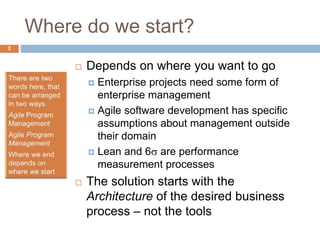
Where do we start?
 Depends on where you want to go
 Enterprise projects need some form of
enterprise management
 Agile software development has specific
assumptions about management outside
their domain
 Lean and 6 are performance
measurement processes
 The solution starts with the
Architecture of the desired business
process – not the tools
2
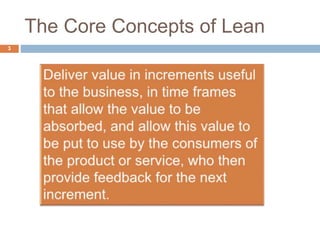
The Core Concepts of Lean
3
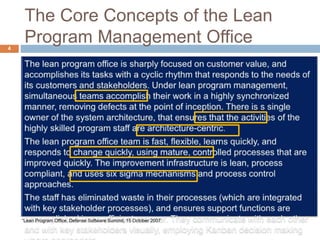
The Core Concepts of the Lean
Program Management Office
“Lean Program Office, Defense Software Summit, 15 October 2007
4
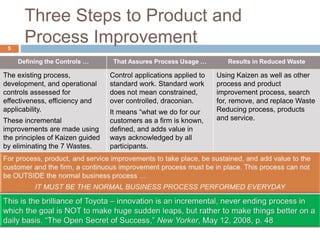
Three Steps to Product and
Process Improvement
5
Defining the Controls … That Assures Process Usage … Results in Reduced Waste
The existing process,
development, and operational
controls assessed for
effectiveness, efficiency and
applicability.
These incremental
improvements are made using
the principles of Kaizen guided
by eliminating the 7 Wastes.
Control applications applied to
standard work. Standard work
does not mean constrained,
over controlled, draconian.
It means “what we do for our
customers as a firm is known,
defined, and adds value in
ways acknowledged by all
participants.
Using Kaizen as well as other
process and product
improvement process, search
for, remove, and replace Waste
Reducing process, products
and service.
What do Lean and PMO’s have in Common?
Copyright © 2008, Lewis & Fowler, All Rights Reserved, Do Not Use without written permission
6
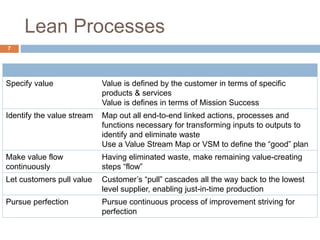
Lean Processes
7
Specify value Value is defined by the customer in terms of specific
products & services
Value is defines in terms of Mission Success
Identify the value stream Map out all end-to-end linked actions, processes and
functions necessary for transforming inputs to outputs to
identify and eliminate waste
Use a Value Stream Map or VSM to define the “good” plan
Make value flow
continuously
Having eliminated waste, make remaining value-creating
steps “flow”
Let customers pull value Customer’s “pull” cascades all the way back to the lowest
level supplier, enabling just-in-time production
Pursue perfection Pursue continuous process of improvement striving for
perfection
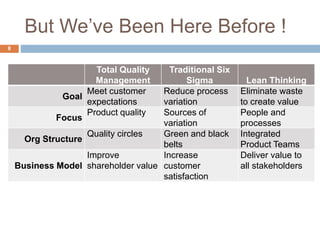
But We’ve Been Here Before !
Total Quality
Management
Traditional Six
Sigma Lean Thinking
Goal
Meet customer
expectations
Reduce process
variation
Eliminate waste
to create value
Focus
Product quality Sources of
variation
People and
processes
Org Structure
Quality circles Green and black
belts
Integrated
Product Teams
Business Model
Improve
shareholder value
Increase
customer
satisfaction
Deliver value to
all stakeholders
8
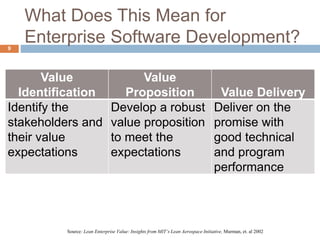
What Does This Mean for
Enterprise Software Development?
Value
Identification
Value
Proposition Value Delivery
Identify the
stakeholders and
their value
expectations
Develop a robust
value proposition
to meet the
expectations
Deliver on the
promise with
good technical
and program
performance
Source: Lean Enterprise Value: Insights from MIT’s Lean Aerospace Initiative, Murman, et. al 2002
9
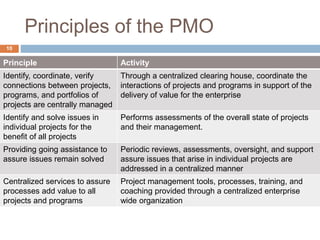
Principles of the PMO
Principle Activity
Identify, coordinate, verify
connections between projects,
programs, and portfolios of
projects are centrally managed
Through a centralized clearing house, coordinate the
interactions of projects and programs in support of the
delivery of value for the enterprise
Identify and solve issues in
individual projects for the
benefit of all projects
Performs assessments of the overall state of projects
and their management.
Providing going assistance to
assure issues remain solved
Periodic reviews, assessments, oversight, and support
assure issues that arise in individual projects are
addressed in a centralized manner
Centralized services to assure
processes add value to all
projects and programs
Project management tools, processes, training, and
coaching provided through a centralized enterprise
wide organization
10
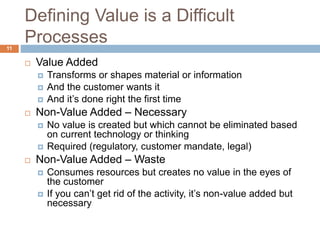
Defining Value is a Difficult
Processes
11
 Value Added
 Transforms or shapes material or information
 And the customer wants it
 And it’s done right the first time
 Non-Value Added – Necessary
 No value is created but which cannot be eliminated based
on current technology or thinking
 Required (regulatory, customer mandate, legal)
 Non-Value Added – Waste
 Consumes resources but creates no value in the eyes of
the customer
 If you can’t get rid of the activity, it’s non-value added but
necessary
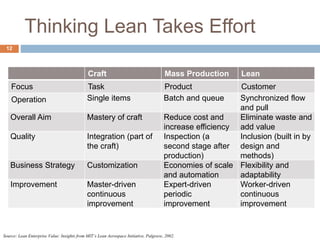
Thinking Lean Takes Effort
Craft Mass Production Lean
Focus Task Product Customer
Operation Single items Batch and queue Synchronized flow
and pull
Overall Aim Mastery of craft Reduce cost and
increase efficiency
Eliminate waste and
add value
Quality Integration (part of
the craft)
Inspection (a
second stage after
production)
Inclusion (built in by
design and
methods)
Business Strategy Customization Economies of scale
and automation
Flexibility and
adaptability
Improvement Master-driven
continuous
improvement
Expert-driven
periodic
improvement
Worker-driven
continuous
improvement
Source: Lean Enterprise Value: Insights from MIT’s Lean Aerospace Initiative, Palgrave, 2002.
12
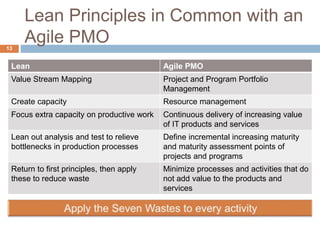
Lean Principles in Common with an
Agile PMO
13
Lean Agile PMO
Value Stream Mapping Project and Program Portfolio
Management
Create capacity Resource management
Focus extra capacity on productive work Continuous delivery of increasing value
of IT products and services
Lean out analysis and test to relieve
bottlenecks in production processes
Define incremental increasing maturity
and maturity assessment points of
projects and programs
Return to first principles, then apply
these to reduce waste
Minimize processes and activities that do
not add value to the products and
services
Turn the
processes from
a linear, waterfall
development
approach …
To iterative,
incremental,
continuously
improvement
activities …
That deliver
continuous value
to the project,
program, and
portfolio
stakeholders.
14
CONNECTING LEAN AND
THE PROGRAM
MANAGEMENT OFFICE
Lean and PMO are connected through the Seven Wastes
and their resolution on projects, programs, and portfolios
15
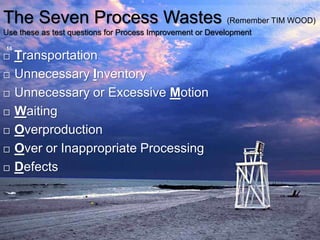
The Seven Process Wastes (Remember TIM WOOD)
Use these as test questions for Process Improvement or Development
16
 Transportation
 Unnecessary Inventory
 Unnecessary or Excessive Motion
 Waiting
 Overproduction
 Over or Inappropriate Processing
 Defects
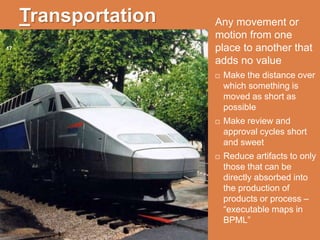
Transportation
17
Any movement or
motion from one
place to another that
adds no value
 Make the distance over
which something is
moved as short as
possible
 Make review and
approval cycles short
and sweet
 Reduce artifacts to only
those that can be
directly absorbed into
the production of
products or process –
“executable maps in
BPML”
Unnecessary
Inventory
18
Reduce the amount of
work-in-process within
the system
 Ensure that work arrives at
the downstream process
when it is required and
does not sit (no in basket
overflow)
 Use “pull” work stream
management for all
software production and
test
 Define the “pulled products”
in a maturity map by
working from Right to Left in
the schedule
19
Unnecessary or Excessive
Motion
Processing steps that add
no value to the product or
service
 Avoid looking, searching, or
wasted effort that burdens
the value of the product or
service
 Have producers hold all
components until “pull”
demand is made
 Have repositories of usable
components under
configuration control
20
Waiting
Someone or
something waiting
with nothing to do
 Keep people
productively active
 Avoid paper, or
decisions around the
paper, from sitting
around before being
processed
 Provide adequate
staffing at the
bottlenecked operations
 Minimize non-value-
added transactions by
asking “how does this
effort move the product
or service forward in it’s
maturity?”
21
Overproduction
Production of products,
services, documentation, or
facilities ahead of demand
 Establish a flow sequence
to satisfy the downstream
customer – pull don’t push
 Create workplace
guidelines and standards
for each process and follow
them at all times – pull
don’t push
 Forward 100% mature
products – no rework
22
Over or Inappropriate Processing
Activities still performed
but no longer needed or
poor planning and
organizational flow
 Remove unnecessary
steps – make NVA
 Stop copying
everyone on emails
 Stop sending reports
and see who
complains
 Stop unnecessary
signoffs and reviews
Defects
23
Activities that result in error,
rework, work arounds, or
quality defects prevent the
customer from accepting
the product or service
 Error proof the process steps
 Build robust and fault recovery
products and services
 Use standardized work
instructions
 Continuous customer
feedback used to make
incremental improvement to
errors, exceptions, and
recoveries
 Focus on the avoiding
“exception handling” – this is
where waste occurs and burns
valuable resources
Lean Principles for Software
Development
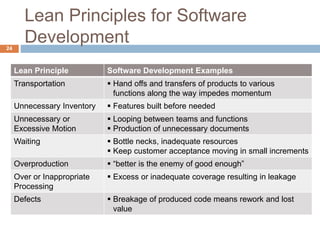
Lean Principle Software Development Examples
Transportation  Hand offs and transfers of products to various
functions along the way impedes momentum
Unnecessary Inventory  Features built before needed
Unnecessary or
Excessive Motion
 Looping between teams and functions
 Production of unnecessary documents
Waiting  Bottle necks, inadequate resources
 Keep customer acceptance moving in small increments
Overproduction  “better is the enemy of good enough”
Over or Inappropriate
Processing
 Excess or inadequate coverage resulting in leakage
Defects  Breakage of produced code means rework and lost
value
24
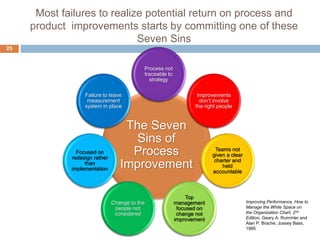
Most failures to realize potential return on process and
product improvements starts by committing one of these
Seven Sins
The Seven
Sins of
Process
Improvement
Process not
traceable to
strategy
Improvements
don’t involve
the right people
Teams not
given a clear
charter and
held
accountable
Top
management
focused on
change not
improvement
Change to the
people not
considered
Focused on
redesign rather
than
implementation
Failure to leave
measurement
system in place
Improving Performance, How to
Manage the White Space on
the Organization Chart, 2nd
Edition, Geary A. Rummler and
Alan P. Brache, Jossey Bass,
1995
25
CONDUCTING THE
PRODUCT
DEVELOPMENT KAIZEN
(PDK)
26
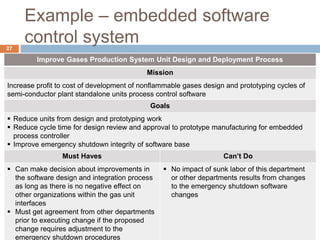
Example – embedded software
control system
27
Improve Gases Production System Unit Design and Deployment Process
Mission
Increase profit to cost of development of nonflammable gases design and prototyping cycles of
semi-conductor plant standalone units process control software
Goals
 Reduce units from design and prototyping work
 Reduce cycle time for design review and approval to prototype manufacturing for embedded
process controller
 Improve emergency shutdown integrity of software base
Must Haves Can’t Do
 Can make decision about improvements in
the software design and integration process
as long as there is no negative effect on
other organizations within the gas unit
interfaces
 Must get agreement from other departments
prior to executing change if the proposed
change requires adjustment to the
emergency shutdown procedures
 No impact of sunk labor of this department
or other departments results from changes
to the emergency shutdown software
changes
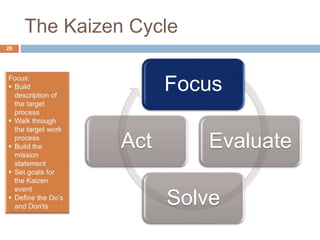
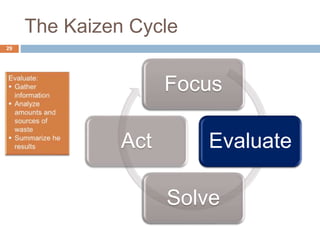
The Kaizen Cycle
28
Focus
Evaluate
Solve
Act
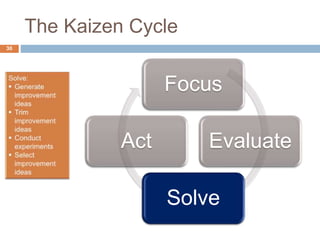
The Kaizen Cycle
29
Focus
Evaluate
Solve
Act
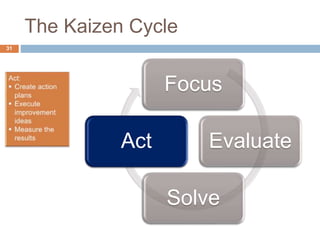
The Kaizen Cycle
30
Focus
Evaluate
Solve
Act
The Kaizen Cycle
31
Focus
Evaluate
Solve
Act
MODEL OF THE LEAN
ENTERPRISE
32
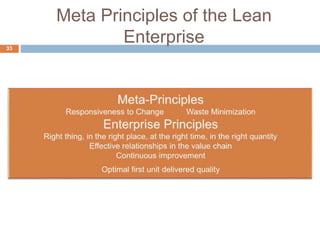
Meta Principles of the Lean
Enterprise
33
Overarching Practices of the Lean
Enterprise
34
Overarching Practices
Human Oriented Practices Process Oriented Practices
Promote Lean
Leadership at all
Levels
Optimize Capability
& Utilization of
People
Assure Seamless
Information Flow
Maintain Challenge
of Existing
Processes
Develop
Relationships
Based on Mutual
Trust &
Commitment
Continuously Focus
on the Customer
Implement
Integrated Product
& Process
Development
Identify & Optimize
Enterprise Flow
Make Decisions at
Lowest Possible
Level
Nurture a Learning
Environment
Ensure Process
Capability and
Maturation
Maximize Stability
in a Changing
Environment
Source: web.mit.edu/lean
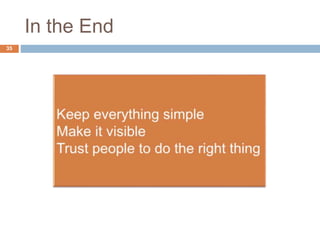
In the End
35

Program Management Office Lean Software Development and Six Sigma

  • 1.
     PROGRAM MANAGEMENT OFFICE AGILE SOFTWARE DEVELOPMENT  LEAN / 6 ALL LIVING IN HARMONY? Successfully combining a PMO, Agile, and Lean / 6 starts with understanding what benefit each paradigm brings to the table. Architecting a solution for the enterprise requires assembling a “Systems” with processes, people, and principles – all sharing the goal of business improvement. 1
  • 2.
    Where do westart?  Depends on where you want to go  Enterprise projects need some form of enterprise management  Agile software development has specific assumptions about management outside their domain  Lean and 6 are performance measurement processes  The solution starts with the Architecture of the desired business process – not the tools 2
  • 3.
  • 4.
    The Core Conceptsof the Lean Program Management Office “Lean Program Office, Defense Software Summit, 15 October 2007 4
  • 5.
    Three Steps toProduct and Process Improvement 5 Defining the Controls … That Assures Process Usage … Results in Reduced Waste The existing process, development, and operational controls assessed for effectiveness, efficiency and applicability. These incremental improvements are made using the principles of Kaizen guided by eliminating the 7 Wastes. Control applications applied to standard work. Standard work does not mean constrained, over controlled, draconian. It means “what we do for our customers as a firm is known, defined, and adds value in ways acknowledged by all participants. Using Kaizen as well as other process and product improvement process, search for, remove, and replace Waste Reducing process, products and service.
  • 6.
    What do Leanand PMO’s have in Common? Copyright © 2008, Lewis & Fowler, All Rights Reserved, Do Not Use without written permission 6
  • 7.
    Lean Processes 7 Specify valueValue is defined by the customer in terms of specific products & services Value is defines in terms of Mission Success Identify the value stream Map out all end-to-end linked actions, processes and functions necessary for transforming inputs to outputs to identify and eliminate waste Use a Value Stream Map or VSM to define the “good” plan Make value flow continuously Having eliminated waste, make remaining value-creating steps “flow” Let customers pull value Customer’s “pull” cascades all the way back to the lowest level supplier, enabling just-in-time production Pursue perfection Pursue continuous process of improvement striving for perfection
  • 8.
    But We’ve BeenHere Before ! Total Quality Management Traditional Six Sigma Lean Thinking Goal Meet customer expectations Reduce process variation Eliminate waste to create value Focus Product quality Sources of variation People and processes Org Structure Quality circles Green and black belts Integrated Product Teams Business Model Improve shareholder value Increase customer satisfaction Deliver value to all stakeholders 8
  • 9.
    What Does ThisMean for Enterprise Software Development? Value Identification Value Proposition Value Delivery Identify the stakeholders and their value expectations Develop a robust value proposition to meet the expectations Deliver on the promise with good technical and program performance Source: Lean Enterprise Value: Insights from MIT’s Lean Aerospace Initiative, Murman, et. al 2002 9
  • 10.
    Principles of thePMO Principle Activity Identify, coordinate, verify connections between projects, programs, and portfolios of projects are centrally managed Through a centralized clearing house, coordinate the interactions of projects and programs in support of the delivery of value for the enterprise Identify and solve issues in individual projects for the benefit of all projects Performs assessments of the overall state of projects and their management. Providing going assistance to assure issues remain solved Periodic reviews, assessments, oversight, and support assure issues that arise in individual projects are addressed in a centralized manner Centralized services to assure processes add value to all projects and programs Project management tools, processes, training, and coaching provided through a centralized enterprise wide organization 10
  • 11.
    Defining Value isa Difficult Processes 11  Value Added  Transforms or shapes material or information  And the customer wants it  And it’s done right the first time  Non-Value Added – Necessary  No value is created but which cannot be eliminated based on current technology or thinking  Required (regulatory, customer mandate, legal)  Non-Value Added – Waste  Consumes resources but creates no value in the eyes of the customer  If you can’t get rid of the activity, it’s non-value added but necessary
  • 12.
    Thinking Lean TakesEffort Craft Mass Production Lean Focus Task Product Customer Operation Single items Batch and queue Synchronized flow and pull Overall Aim Mastery of craft Reduce cost and increase efficiency Eliminate waste and add value Quality Integration (part of the craft) Inspection (a second stage after production) Inclusion (built in by design and methods) Business Strategy Customization Economies of scale and automation Flexibility and adaptability Improvement Master-driven continuous improvement Expert-driven periodic improvement Worker-driven continuous improvement Source: Lean Enterprise Value: Insights from MIT’s Lean Aerospace Initiative, Palgrave, 2002. 12
  • 13.
    Lean Principles inCommon with an Agile PMO 13 Lean Agile PMO Value Stream Mapping Project and Program Portfolio Management Create capacity Resource management Focus extra capacity on productive work Continuous delivery of increasing value of IT products and services Lean out analysis and test to relieve bottlenecks in production processes Define incremental increasing maturity and maturity assessment points of projects and programs Return to first principles, then apply these to reduce waste Minimize processes and activities that do not add value to the products and services
  • 14.
    Turn the processes from alinear, waterfall development approach … To iterative, incremental, continuously improvement activities … That deliver continuous value to the project, program, and portfolio stakeholders. 14
  • 15.
    CONNECTING LEAN AND THEPROGRAM MANAGEMENT OFFICE Lean and PMO are connected through the Seven Wastes and their resolution on projects, programs, and portfolios 15
  • 16.
    The Seven ProcessWastes (Remember TIM WOOD) Use these as test questions for Process Improvement or Development 16  Transportation  Unnecessary Inventory  Unnecessary or Excessive Motion  Waiting  Overproduction  Over or Inappropriate Processing  Defects
  • 17.
    Transportation 17 Any movement or motionfrom one place to another that adds no value  Make the distance over which something is moved as short as possible  Make review and approval cycles short and sweet  Reduce artifacts to only those that can be directly absorbed into the production of products or process – “executable maps in BPML”
  • 18.
    Unnecessary Inventory 18 Reduce the amountof work-in-process within the system  Ensure that work arrives at the downstream process when it is required and does not sit (no in basket overflow)  Use “pull” work stream management for all software production and test  Define the “pulled products” in a maturity map by working from Right to Left in the schedule
  • 19.
    19 Unnecessary or Excessive Motion Processingsteps that add no value to the product or service  Avoid looking, searching, or wasted effort that burdens the value of the product or service  Have producers hold all components until “pull” demand is made  Have repositories of usable components under configuration control
  • 20.
    20 Waiting Someone or something waiting withnothing to do  Keep people productively active  Avoid paper, or decisions around the paper, from sitting around before being processed  Provide adequate staffing at the bottlenecked operations  Minimize non-value- added transactions by asking “how does this effort move the product or service forward in it’s maturity?”
  • 21.
    21 Overproduction Production of products, services,documentation, or facilities ahead of demand  Establish a flow sequence to satisfy the downstream customer – pull don’t push  Create workplace guidelines and standards for each process and follow them at all times – pull don’t push  Forward 100% mature products – no rework
  • 22.
    22 Over or InappropriateProcessing Activities still performed but no longer needed or poor planning and organizational flow  Remove unnecessary steps – make NVA  Stop copying everyone on emails  Stop sending reports and see who complains  Stop unnecessary signoffs and reviews
  • 23.
    Defects 23 Activities that resultin error, rework, work arounds, or quality defects prevent the customer from accepting the product or service  Error proof the process steps  Build robust and fault recovery products and services  Use standardized work instructions  Continuous customer feedback used to make incremental improvement to errors, exceptions, and recoveries  Focus on the avoiding “exception handling” – this is where waste occurs and burns valuable resources
  • 24.
    Lean Principles forSoftware Development Lean Principle Software Development Examples Transportation  Hand offs and transfers of products to various functions along the way impedes momentum Unnecessary Inventory  Features built before needed Unnecessary or Excessive Motion  Looping between teams and functions  Production of unnecessary documents Waiting  Bottle necks, inadequate resources  Keep customer acceptance moving in small increments Overproduction  “better is the enemy of good enough” Over or Inappropriate Processing  Excess or inadequate coverage resulting in leakage Defects  Breakage of produced code means rework and lost value 24
  • 25.
    Most failures torealize potential return on process and product improvements starts by committing one of these Seven Sins The Seven Sins of Process Improvement Process not traceable to strategy Improvements don’t involve the right people Teams not given a clear charter and held accountable Top management focused on change not improvement Change to the people not considered Focused on redesign rather than implementation Failure to leave measurement system in place Improving Performance, How to Manage the White Space on the Organization Chart, 2nd Edition, Geary A. Rummler and Alan P. Brache, Jossey Bass, 1995 25
  • 26.
  • 27.
    Example – embeddedsoftware control system 27 Improve Gases Production System Unit Design and Deployment Process Mission Increase profit to cost of development of nonflammable gases design and prototyping cycles of semi-conductor plant standalone units process control software Goals  Reduce units from design and prototyping work  Reduce cycle time for design review and approval to prototype manufacturing for embedded process controller  Improve emergency shutdown integrity of software base Must Haves Can’t Do  Can make decision about improvements in the software design and integration process as long as there is no negative effect on other organizations within the gas unit interfaces  Must get agreement from other departments prior to executing change if the proposed change requires adjustment to the emergency shutdown procedures  No impact of sunk labor of this department or other departments results from changes to the emergency shutdown software changes
  • 28.
  • 29.
  • 30.
  • 31.
  • 32.
    MODEL OF THELEAN ENTERPRISE 32
  • 33.
    Meta Principles ofthe Lean Enterprise 33
  • 34.
    Overarching Practices ofthe Lean Enterprise 34 Overarching Practices Human Oriented Practices Process Oriented Practices Promote Lean Leadership at all Levels Optimize Capability & Utilization of People Assure Seamless Information Flow Maintain Challenge of Existing Processes Develop Relationships Based on Mutual Trust & Commitment Continuously Focus on the Customer Implement Integrated Product & Process Development Identify & Optimize Enterprise Flow Make Decisions at Lowest Possible Level Nurture a Learning Environment Ensure Process Capability and Maturation Maximize Stability in a Changing Environment Source: web.mit.edu/lean
  • 35.