
+
Parametric Project Monitoring and Control
Earned Value is one approach to Performance measurement for monitoring and controlling the progressof software
development projects.
There are other approaches,but all methodsneed to ask “what value is being returned for the invested cost and
effort?”
Without connecting predetermined delivered value with predeterminedeffort;progresscan only be measured as the
passage of time,and you'll be late before you start.
Performance–Based Project Management®, Copyright © Glen B. Alleman, 2002 - 2016
1
+
Project Management Context
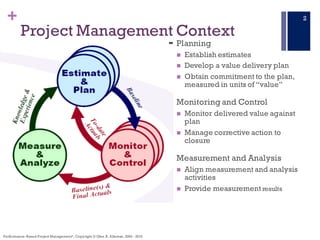
n Planning
n Establish estimates
n Develop a value delivery plan
n Obtain commitment to the plan,
measured in units of “value”
n Monitoring and Control
n Monitor delivered value against
plan
n Manage corrective action to
closure
n Measurement and Analysis
n Align measurement and analysis
activities
n Provide measurement results
Performance–Based Project Management®, Copyright © Glen B. Alleman, 2002 - 2016
2
+
Development and Measurement
Performance–Based Project Management®, Copyright © Glen B. Alleman, 2002 - 2016
3
+
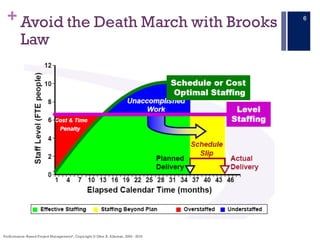
n Law 1 – smaller teams are more
efficient
n The smaller the team the higher
the productivity of each individual
person
n Law 2 – some schedule
compression can be bought
n Adding people to a project – to a
point – decreases the time and
increases the cost
n Law 3 – every project has a
minimum time
n There is an incremental person
that consumes more energy than is
produced.Team size beyond this
point decreases productivity and
increases time.
n Law 4 – productivity is scalable
n Projects of large software size can
use larger teams without violating
Law 3
n Law 5 – complexity limits staffing
n As complexity increases,the
number of people that can
effectively work on the project and
the rate at which they can be
added decreases
n Law 6 – staffing can be optimized
n There is an optimal staffing
function (shape) modeled as a
Raleigh distribution
Laws of Software Productivity
Performance–Based Project Management®, Copyright © Glen B. Alleman, 2002 - 2016
4
+
n Law 7 – projects that get behind
stay behind
n It is extremely difficult to bring
a project that is behind schedule
back on schedule
n Law 8 – work expands to fill the
time available
n It is possible to allow too much
time to complete a project
n Law 9 – better technology yield
higher productivity
n More capable teams,better tools,
and advanced,stable processes
yield higher productivity
n Law 10 – there are no silver
bullets
n There is no methodology,tool,or
process improvement strategy that
yields revolutionary improvements
in project efficiency
Laws of Software Productivity
Performance–Based Project Management®, Copyright © Glen B. Alleman, 2002 - 2016
5
+ Avoid the Death March with Brooks
Law
Performance–Based Project Management®, Copyright © Glen B. Alleman, 2002 - 2016
6
+
An Out of Control Process
Performance–Based Project Management®, Copyright © Glen B. Alleman, 2002 - 2016
7
+
An Ad Hoc Process
Performance–Based Project Management®, Copyright © Glen B. Alleman, 2002 - 2016
8
+
A Partially Managed Process
Performance–Based Project Management®, Copyright © Glen B. Alleman, 2002 - 2016
9
+
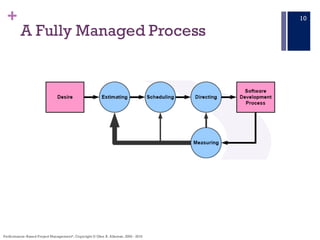
A Fully Managed Process
Performance–Based Project Management®, Copyright © Glen B. Alleman, 2002 - 2016
10
+
n Performance Indices
n Schedule performance index
n How much progress should
have been achieved (earned)
at this time?
n Cost performance index
n How much has been spent
compared to how much should
have been spent?
n Time performance
n How are we progressing along
the path to maturity as
measured by the technical
performance indicators?
n Performance Variances
n Schedule variance
n Comparison of the work
performed during the time
period to what was scheduled to
be performed with the actual
cost
n Cost variance
n Comparison of budgeted cost
for work performed with actual
cost
n Status and Forecasting
n Estimate at completion
n Estimate to complete
n Breakage rate
Useful Metrics
Performance–Based Project Management®, Copyright © Glen B. Alleman, 2002 - 2016
11
+
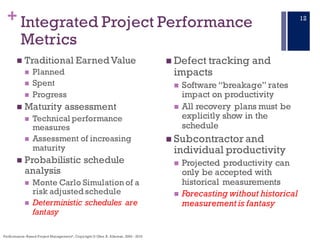
n Traditional EarnedValue
n Planned
n Spent
n Progress
n Maturity assessment
n Technical performance
measures
n Assessment of increasing
maturity
n Probabilistic schedule
analysis
n Monte Carlo Simulation of a
risk adjusted schedule
n Deterministic schedules are
fantasy
n Defect tracking and
impacts
n Software “breakage” rates
impact on productivity
n All recovery plans must be
explicitly show in the
schedule
n Subcontractor and
individual productivity
n Projected productivity can
only be accepted with
historical measurements
n Forecasting without historical
measurement is fantasy
Integrated Project Performance
Metrics
Performance–Based Project Management®, Copyright © Glen B. Alleman, 2002 - 2016
12
+
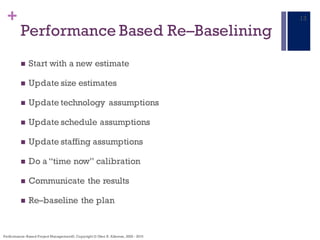
Performance Based Re–Baselining
n Start with a new estimate
n Update size estimates
n Update technology assumptions
n Update schedule assumptions
n Update staffing assumptions
n Do a “time now” calibration
n Communicate the results
n Re–baseline the plan
Performance–Based Project Management®, Copyright © Glen B. Alleman, 2002 - 2016
13
+
n It’s a sad fact, but software
projects fall short of
expectations more often than
not
n Project success is more
probable with proactive
management producing small
incremental deliverables
n Measurement objectifies
management
n Project Monitoring =
Performance Measurement
n Assessment of increasing
maturity connects progress
with value
n Project Control measures
and re–plans
n Re–Baselining =
Performance–Based
Forecasting
n Explicit visibilityof all risk
and mitigation is essential to
successful project
management
n Probabilistic estimates at
completion (EAC) of cost and
schedule that match
deterministic cost and
schedule with accompanying
margin is the starting point for
a credible plan
Summary
Performance–Based Project Management®, Copyright © Glen B. Alleman, 2002 - 2016
14

Parametric project metrics

  • 1.
    + Parametric Project Monitoringand Control Earned Value is one approach to Performance measurement for monitoring and controlling the progressof software development projects. There are other approaches,but all methodsneed to ask “what value is being returned for the invested cost and effort?” Without connecting predetermined delivered value with predeterminedeffort;progresscan only be measured as the passage of time,and you'll be late before you start. Performance–Based Project Management®, Copyright © Glen B. Alleman, 2002 - 2016 1
  • 2.
    + Project Management Context nPlanning n Establish estimates n Develop a value delivery plan n Obtain commitment to the plan, measured in units of “value” n Monitoring and Control n Monitor delivered value against plan n Manage corrective action to closure n Measurement and Analysis n Align measurement and analysis activities n Provide measurement results Performance–Based Project Management®, Copyright © Glen B. Alleman, 2002 - 2016 2
  • 3.
    + Development and Measurement Performance–BasedProject Management®, Copyright © Glen B. Alleman, 2002 - 2016 3
  • 4.
    + n Law 1– smaller teams are more efficient n The smaller the team the higher the productivity of each individual person n Law 2 – some schedule compression can be bought n Adding people to a project – to a point – decreases the time and increases the cost n Law 3 – every project has a minimum time n There is an incremental person that consumes more energy than is produced.Team size beyond this point decreases productivity and increases time. n Law 4 – productivity is scalable n Projects of large software size can use larger teams without violating Law 3 n Law 5 – complexity limits staffing n As complexity increases,the number of people that can effectively work on the project and the rate at which they can be added decreases n Law 6 – staffing can be optimized n There is an optimal staffing function (shape) modeled as a Raleigh distribution Laws of Software Productivity Performance–Based Project Management®, Copyright © Glen B. Alleman, 2002 - 2016 4
  • 5.
    + n Law 7– projects that get behind stay behind n It is extremely difficult to bring a project that is behind schedule back on schedule n Law 8 – work expands to fill the time available n It is possible to allow too much time to complete a project n Law 9 – better technology yield higher productivity n More capable teams,better tools, and advanced,stable processes yield higher productivity n Law 10 – there are no silver bullets n There is no methodology,tool,or process improvement strategy that yields revolutionary improvements in project efficiency Laws of Software Productivity Performance–Based Project Management®, Copyright © Glen B. Alleman, 2002 - 2016 5
  • 6.
    + Avoid theDeath March with Brooks Law Performance–Based Project Management®, Copyright © Glen B. Alleman, 2002 - 2016 6
  • 7.
    + An Out ofControl Process Performance–Based Project Management®, Copyright © Glen B. Alleman, 2002 - 2016 7
  • 8.
    + An Ad HocProcess Performance–Based Project Management®, Copyright © Glen B. Alleman, 2002 - 2016 8
  • 9.
    + A Partially ManagedProcess Performance–Based Project Management®, Copyright © Glen B. Alleman, 2002 - 2016 9
  • 10.
    + A Fully ManagedProcess Performance–Based Project Management®, Copyright © Glen B. Alleman, 2002 - 2016 10
  • 11.
    + n Performance Indices nSchedule performance index n How much progress should have been achieved (earned) at this time? n Cost performance index n How much has been spent compared to how much should have been spent? n Time performance n How are we progressing along the path to maturity as measured by the technical performance indicators? n Performance Variances n Schedule variance n Comparison of the work performed during the time period to what was scheduled to be performed with the actual cost n Cost variance n Comparison of budgeted cost for work performed with actual cost n Status and Forecasting n Estimate at completion n Estimate to complete n Breakage rate Useful Metrics Performance–Based Project Management®, Copyright © Glen B. Alleman, 2002 - 2016 11
  • 12.
    + n Traditional EarnedValue nPlanned n Spent n Progress n Maturity assessment n Technical performance measures n Assessment of increasing maturity n Probabilistic schedule analysis n Monte Carlo Simulation of a risk adjusted schedule n Deterministic schedules are fantasy n Defect tracking and impacts n Software “breakage” rates impact on productivity n All recovery plans must be explicitly show in the schedule n Subcontractor and individual productivity n Projected productivity can only be accepted with historical measurements n Forecasting without historical measurement is fantasy Integrated Project Performance Metrics Performance–Based Project Management®, Copyright © Glen B. Alleman, 2002 - 2016 12
  • 13.
    + Performance Based Re–Baselining nStart with a new estimate n Update size estimates n Update technology assumptions n Update schedule assumptions n Update staffing assumptions n Do a “time now” calibration n Communicate the results n Re–baseline the plan Performance–Based Project Management®, Copyright © Glen B. Alleman, 2002 - 2016 13
  • 14.
    + n It’s asad fact, but software projects fall short of expectations more often than not n Project success is more probable with proactive management producing small incremental deliverables n Measurement objectifies management n Project Monitoring = Performance Measurement n Assessment of increasing maturity connects progress with value n Project Control measures and re–plans n Re–Baselining = Performance–Based Forecasting n Explicit visibilityof all risk and mitigation is essential to successful project management n Probabilistic estimates at completion (EAC) of cost and schedule that match deterministic cost and schedule with accompanying margin is the starting point for a credible plan Summary Performance–Based Project Management®, Copyright © Glen B. Alleman, 2002 - 2016 14