Agile, PMI, and the
PMBOK   ® Guide


Rory McCorkle, MBA
Priya Sethuraman, MS
Product Managers – Credentials   18 February 2012
                                             1
PMI in Summary
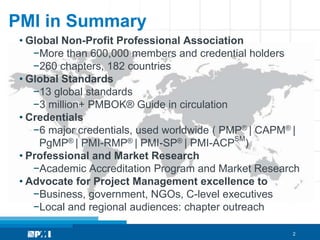
 • Global Non-Profit Professional Association
    −More than 600,000 members and credential holders
    −260 chapters, 182 countries
 • Global Standards
    −13 global standards
    −3 million+ PMBOK® Guide in circulation
 • Credentials
    −6 major credentials, used worldwide ( PMP® | CAPM® |
     PgMP® | PMI-RMP® | PMI-SP® | PMI-ACPSM)
 • Professional and Market Research
    −Academic Accreditation Program and Market Research
 • Advocate for Project Management excellence to
    −Business, government, NGOs, C-level executives
    −Local and regional audiences: chapter outreach

                                                       2
PMI’s History with Agile
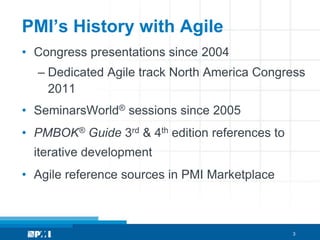
• Congress presentations since 2004
  – Dedicated Agile track North America Congress
    2011
• SeminarsWorld® sessions since 2005
• PMBOK® Guide 3rd & 4th edition references to
  iterative development
• Agile reference sources in PMI Marketplace


                                                 3
PMI’s History with Agile


                           4
PMI’s History with Agile


                           5
PMI’s History with Agile


                           6
PMI’s History with Agile
• February 2011: PMI Agile Certified Practitioner
  (PMI-ACP) certification announced
• May 2011: PMI-ACP launched
• January 2012: First class of 515 PMI-ACP
  credential holders awarded (59 from India)


                                                    7
PMI’s History with Agile


                           8
PMI’s History with Agile


                           9
Usefulness of Agile project
management to the organization
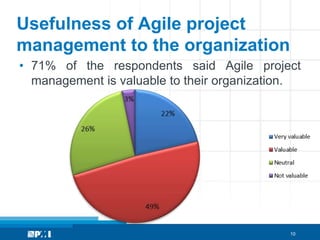
• 71% of the respondents said Agile project
  management is valuable to their organization.


                                             10
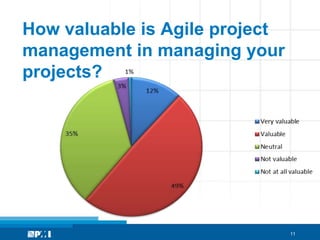
How valuable is Agile project
management in managing your
projects?


                                11
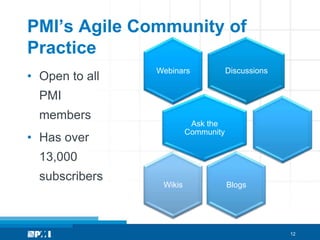
PMI’s Agile Community of
Practice
                Webinars             Discussions
• Open to all
  PMI
  members
                          Ask the
                         Community
• Has over
  13,000
  subscribers
                 Wikis               Blogs


                                                   12
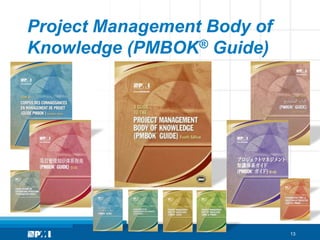
Project Management Body of
Knowledge (PMBOK® Guide)


                             13
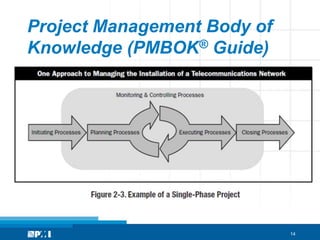
Project Management Body of
Knowledge (PMBOK® Guide)


                             14
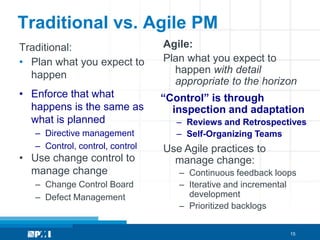
Traditional vs. Agile PM
Traditional:                     Agile:
• Plan what you expect to        Plan what you expect to
  happen                           happen with detail
                                   appropriate to the horizon
• Enforce that what              “Control” is through
  happens is the same as           inspection and adaptation
  what is planned                  – Reviews and Retrospectives
   – Directive management          – Self-Organizing Teams
   – Control, control, control   Use Agile practices to
• Use change control to            manage change:
  manage change                     – Continuous feedback loops
   – Change Control Board           – Iterative and incremental
   – Defect Management                development
                                    – Prioritized backlogs

                                                             15
The mapping of PMBOK Guide
practice to Agile practices courtesy of
Michelle Sliger (Sliger Consulting) and
her text Bridge to Agility


                                          16
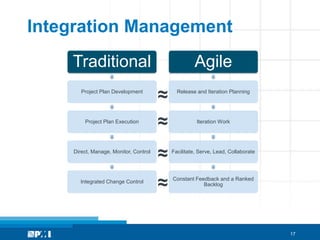
Integration Management
    Traditional                                     Agile
       Project Plan Development
                                       ≈     Release and Iteration Planning


        Project Plan Execution
                                       ≈             Iteration Work


    Direct, Manage, Monitor, Control
                                       ≈   Facilitate, Serve, Lead, Collaborate


      Integrated Change Control
                                       ≈   Constant Feedback and a Ranked
                                                       Backlog


                                                                                  17
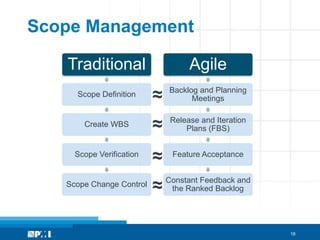
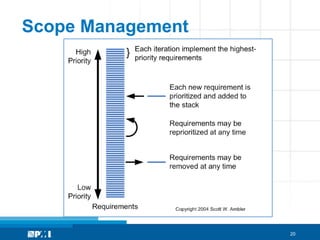
Scope Management

   Traditional                      Agile
     Scope Definition     ≈   Backlog and Planning
                                    Meetings


       Create WBS         ≈    Release and Iteration
                                   Plans (FBS)


     Scope Verification
                          ≈    Feature Acceptance


   Scope Change Control
                          ≈   Constant Feedback and
                               the Ranked Backlog


                                                       18
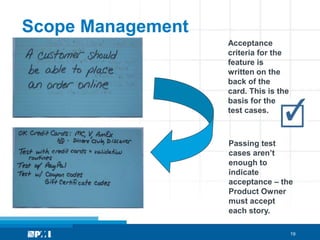
Scope Management
                   Acceptance
                   criteria for the
                   feature is
                   written on the
                   back of the
                   card. This is the
                   basis for the
                   test cases.


                   Passing test
                   cases aren’t
                   enough to
                   indicate
                   acceptance – the
                   Product Owner
                   must accept
                   each story.

                                       19
Scope Management


                   20
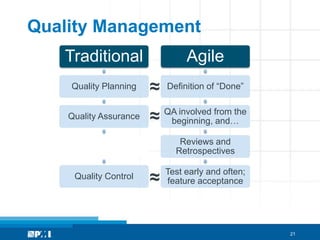
Quality Management
   Traditional                   Agile
    Quality Planning    ≈   Definition of “Done”


    Quality Assurance   ≈   QA involved from the
                             beginning, and…

                               Reviews and
                              Retrospectives

     Quality Control    ≈   Test early and often;
                            feature acceptance


                                                    21
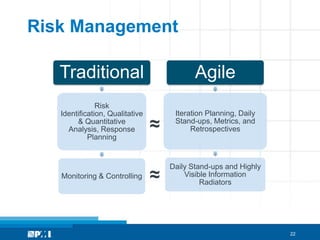
Risk Management

   Traditional                              Agile
               Risk
   Identification, Qualitative        Iteration Planning, Daily
        & Quantitative
     Analysis, Response          ≈    Stand-ups, Metrics, and
                                           Retrospectives
            Planning


                                     Daily Stand-ups and Highly
   Monitoring & Controlling      ≈       Visible Information
                                              Radiators


                                                                  22
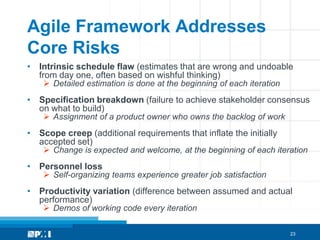
Agile Framework Addresses
Core Risks
• Intrinsic schedule flaw (estimates that are wrong and undoable
  from day one, often based on wishful thinking)
     Detailed estimation is done at the beginning of each iteration
• Specification breakdown (failure to achieve stakeholder consensus
  on what to build)
     Assignment of a product owner who owns the backlog of work
• Scope creep (additional requirements that inflate the initially
  accepted set)
     Change is expected and welcome, at the beginning of each iteration
• Personnel loss
     Self-organizing teams experience greater job satisfaction
• Productivity variation (difference between assumed and actual
  performance)
     Demos of working code every iteration

                                                                       23
Summary
• Scope is defined at a granularity that is
  appropriate for the time horizon
• Scope is verified by the acceptance of each
  feature by the customer
• Work Breakdown Structures become Feature
  Breakdown Structures
• Gantt charts are not typically used; instead
  progress charts help us to track progress

                                                 24
Summary
• Test-driven development and cross-functional
  teams help to bring quality assurance and
  planning activities forward to the beginning of the
  project, and continue throughout the project
• Bugs are found and fixed in the iteration; features
  are then accepted by the customer
• The nature of agile framework allows core risks to
  be addressed by the team throughout the project


                                                  25
Questions?


 rory.mccorkle@pmi.org
priya.sethuraman@pmi.org
   www.pmi.org/agile

                           26

Agile, PMI and PMBOK

  • 1.
    Agile, PMI, andthe PMBOK ® Guide Rory McCorkle, MBA Priya Sethuraman, MS Product Managers – Credentials 18 February 2012 1
  • 2.
    PMI in Summary • Global Non-Profit Professional Association −More than 600,000 members and credential holders −260 chapters, 182 countries • Global Standards −13 global standards −3 million+ PMBOK® Guide in circulation • Credentials −6 major credentials, used worldwide ( PMP® | CAPM® | PgMP® | PMI-RMP® | PMI-SP® | PMI-ACPSM) • Professional and Market Research −Academic Accreditation Program and Market Research • Advocate for Project Management excellence to −Business, government, NGOs, C-level executives −Local and regional audiences: chapter outreach 2
  • 3.
    PMI’s History withAgile • Congress presentations since 2004 – Dedicated Agile track North America Congress 2011 • SeminarsWorld® sessions since 2005 • PMBOK® Guide 3rd & 4th edition references to iterative development • Agile reference sources in PMI Marketplace 3
  • 4.
  • 5.
  • 6.
  • 7.
    PMI’s History withAgile • February 2011: PMI Agile Certified Practitioner (PMI-ACP) certification announced • May 2011: PMI-ACP launched • January 2012: First class of 515 PMI-ACP credential holders awarded (59 from India) 7
  • 8.
  • 9.
  • 10.
    Usefulness of Agileproject management to the organization • 71% of the respondents said Agile project management is valuable to their organization. 10
  • 11.
    How valuable isAgile project management in managing your projects? 11
  • 12.
    PMI’s Agile Communityof Practice Webinars Discussions • Open to all PMI members Ask the Community • Has over 13,000 subscribers Wikis Blogs 12
  • 13.
    Project Management Bodyof Knowledge (PMBOK® Guide) 13
  • 14.
    Project Management Bodyof Knowledge (PMBOK® Guide) 14
  • 15.
    Traditional vs. AgilePM Traditional: Agile: • Plan what you expect to Plan what you expect to happen happen with detail appropriate to the horizon • Enforce that what “Control” is through happens is the same as inspection and adaptation what is planned – Reviews and Retrospectives – Directive management – Self-Organizing Teams – Control, control, control Use Agile practices to • Use change control to manage change: manage change – Continuous feedback loops – Change Control Board – Iterative and incremental – Defect Management development – Prioritized backlogs 15
  • 16.
    The mapping ofPMBOK Guide practice to Agile practices courtesy of Michelle Sliger (Sliger Consulting) and her text Bridge to Agility 16
  • 17.
    Integration Management Traditional Agile Project Plan Development ≈ Release and Iteration Planning Project Plan Execution ≈ Iteration Work Direct, Manage, Monitor, Control ≈ Facilitate, Serve, Lead, Collaborate Integrated Change Control ≈ Constant Feedback and a Ranked Backlog 17
  • 18.
    Scope Management Traditional Agile Scope Definition ≈ Backlog and Planning Meetings Create WBS ≈ Release and Iteration Plans (FBS) Scope Verification ≈ Feature Acceptance Scope Change Control ≈ Constant Feedback and the Ranked Backlog 18
  • 19.
    Scope Management Acceptance criteria for the feature is written on the back of the card. This is the basis for the test cases. Passing test cases aren’t enough to indicate acceptance – the Product Owner must accept each story. 19
  • 20.
  • 21.
    Quality Management Traditional Agile Quality Planning ≈ Definition of “Done” Quality Assurance ≈ QA involved from the beginning, and… Reviews and Retrospectives Quality Control ≈ Test early and often; feature acceptance 21
  • 22.
    Risk Management Traditional Agile Risk Identification, Qualitative Iteration Planning, Daily & Quantitative Analysis, Response ≈ Stand-ups, Metrics, and Retrospectives Planning Daily Stand-ups and Highly Monitoring & Controlling ≈ Visible Information Radiators 22
  • 23.
    Agile Framework Addresses CoreRisks • Intrinsic schedule flaw (estimates that are wrong and undoable from day one, often based on wishful thinking)  Detailed estimation is done at the beginning of each iteration • Specification breakdown (failure to achieve stakeholder consensus on what to build)  Assignment of a product owner who owns the backlog of work • Scope creep (additional requirements that inflate the initially accepted set)  Change is expected and welcome, at the beginning of each iteration • Personnel loss  Self-organizing teams experience greater job satisfaction • Productivity variation (difference between assumed and actual performance)  Demos of working code every iteration 23
  • 24.
    Summary • Scope isdefined at a granularity that is appropriate for the time horizon • Scope is verified by the acceptance of each feature by the customer • Work Breakdown Structures become Feature Breakdown Structures • Gantt charts are not typically used; instead progress charts help us to track progress 24
  • 25.
    Summary • Test-driven developmentand cross-functional teams help to bring quality assurance and planning activities forward to the beginning of the project, and continue throughout the project • Bugs are found and fixed in the iteration; features are then accepted by the customer • The nature of agile framework allows core risks to be addressed by the team throughout the project 25
  • 26.

Editor's Notes

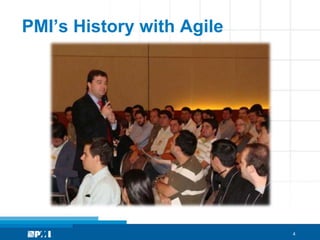
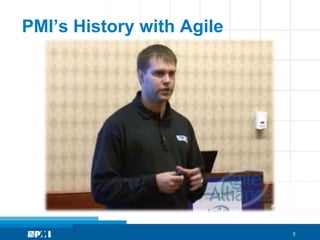
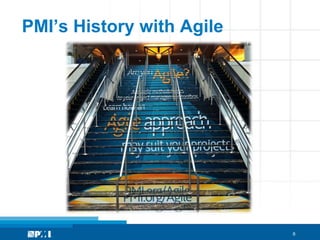
  • #5 March 2009: PMI President and CEO speaks at 2009 Orlando Scrum Gathering to promote collaboration between PMI and Agile evangelistsApril 2009: PMI Chairman of the Board Ricardo Vargas keynotes 2009 Brazil Scrum GatheringJuly 2009: The PMI Agile CoP goes liveAugust 2009: The PMI Agile CoP announces its launch at Agile 2009 in Chicago
  • #6 March 2009: PMI President and CEO speaks at 2009 Orlando Scrum Gathering to promote collaboration between PMI and Agile evangelistsApril 2009: PMI Chairman of the Board Ricardo Vargas keynotes 2009 Brazil Scrum GatheringJuly 2009: The PMI Agile CoP goes liveAugust 2009: The PMI Agile CoP announces its launch at Agile 2009 in Chicago
  • #7 March 2009: PMI President and CEO speaks at 2009 Orlando Scrum Gathering to promote collaboration between PMI and Agile evangelistsApril 2009: PMI Chairman of the Board Ricardo Vargas keynotes 2009 Brazil Scrum GatheringJuly 2009: The PMI Agile CoP goes liveAugust 2009: The PMI Agile CoP announces its launch at Agile 2009 in Chicago
  • #9 March 2009: PMI President and CEO speaks at 2009 Orlando Scrum Gathering to promote collaboration between PMI and Agile evangelistsApril 2009: PMI Chairman of the Board Ricardo Vargas keynotes 2009 Brazil Scrum GatheringJuly 2009: The PMI Agile CoP goes liveAugust 2009: The PMI Agile CoP announces its launch at Agile 2009 in Chicago
  • #10 March 2009: PMI President and CEO speaks at 2009 Orlando Scrum Gathering to promote collaboration between PMI and Agile evangelistsApril 2009: PMI Chairman of the Board Ricardo Vargas keynotes 2009 Brazil Scrum GatheringJuly 2009: The PMI Agile CoP goes liveAugust 2009: The PMI Agile CoP announces its launch at Agile 2009 in Chicago
  • #14 First published in 1987On Fourth EditionStandard recognizing five process groups and nine knowledge areasAmerican National Standard recognized by American National Standards Institute (ANSI) and Institute of Electrical and Electronics Engineers (IEEE)Available from PMI in 10 translations; 6 additional translations available from regional groupsMultiple references to iterative processes
  • #15 First published in 1987On Fourth EditionStandard recognizing five process groups and nine knowledge areasAmerican National Standard recognized by American National Standards Institute (ANSI) and Institute of Electrical and Electronics Engineers (IEEE)Multiple references to iterative processes