Subcellular fractionation
of organelles and markers
Animal Cell and organelles
Albert Claude in 1930 developed the technique of cell
fractionation & identified the different organelles. He
received Nobel Prize for the same in 1974.
Introduction
Cells contain organelles which perform a variety of specific functions.
 To obtain precise information about the structure and functions of
subcellular organelles, it is necessary to isolate them free from
contaminating organelles.
Hence subcellular fractionation using centrifugation technique is used.
Individual organelle is identified using specific markers.
This information is used to study potential cellular irregularities and
methods to correct them.
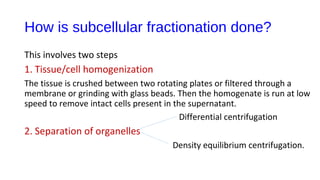
How is subcellular fractionation done?
This involves two steps
1. Tissue/cell homogenization
The tissue is crushed between two rotating plates or filtered through a
membrane or grinding with glass beads. Then the homogenate is run at low
speed to remove intact cells present in the supernatant.
Differential centrifugation
2. Separation of organelles
Density equilibrium centrifugation.
Subcellular fractionation – differential
centrifugation
Cellular Markers
• These are enzymes specific to certain organelles.
• Following the activity of these enzymes, it is possible to locate
the organelles.
• Presence of unrelated enzyme activity confirms presence of
other organelle contamination.
• However electron microscopy is the final step to determine
purity of the preparation and the presence of organelle in the
sample.
Common markers for organelles
Organelle Marker enzyme
Nucleus Lamin A & C
Mitochondria -Inner
memb
ATP synthetase
Mitochondria- outer
membrane
Monoamine oxidase
Mitochondria - matrix Citrate synthase
Lysosome Cathepsin
Golgi bodies Galactosyl transferase
Microsome Glucose -6-phosphatase
Cytoplasm Lactate dehydrogenase
Peroxisomes Catalase
Assay for cellular markers
C - Cytoplasmic
M- Membrane bound
N - Nuclear
References
• Sequential fractionation and isolation of subcellular proteins from
tissue and cultured cells.
www.sciencedirect.com/science/article/pii/S2215016115000564.
Science Direct by S Baghirova - 2015.Methods X 2(2015),440-445.
• Padh, H. 1992. Organelle isolation and marker enzyme assay. Pages
129–146, in Tested studies for laboratory teaching, Volume 13 (C. A.
Goldman, Editor). Proceedings of the 13th Workshop/Conference of
the Association for Biology Laboratory Education (ABLE), 191 pages.
• Text Book of Biochemistry. Vasudevan and Sreekumari.8th Edition
Page 10.
Thank youThank you

Subcellular fractionation

  • 1.
  • 2.
    Animal Cell andorganelles Albert Claude in 1930 developed the technique of cell fractionation & identified the different organelles. He received Nobel Prize for the same in 1974.
  • 3.
    Introduction Cells contain organelleswhich perform a variety of specific functions.  To obtain precise information about the structure and functions of subcellular organelles, it is necessary to isolate them free from contaminating organelles. Hence subcellular fractionation using centrifugation technique is used. Individual organelle is identified using specific markers. This information is used to study potential cellular irregularities and methods to correct them.
  • 4.
    How is subcellularfractionation done? This involves two steps 1. Tissue/cell homogenization The tissue is crushed between two rotating plates or filtered through a membrane or grinding with glass beads. Then the homogenate is run at low speed to remove intact cells present in the supernatant. Differential centrifugation 2. Separation of organelles Density equilibrium centrifugation.
  • 5.
    Subcellular fractionation –differential centrifugation
  • 6.
    Cellular Markers • Theseare enzymes specific to certain organelles. • Following the activity of these enzymes, it is possible to locate the organelles. • Presence of unrelated enzyme activity confirms presence of other organelle contamination. • However electron microscopy is the final step to determine purity of the preparation and the presence of organelle in the sample.
  • 7.
    Common markers fororganelles Organelle Marker enzyme Nucleus Lamin A & C Mitochondria -Inner memb ATP synthetase Mitochondria- outer membrane Monoamine oxidase Mitochondria - matrix Citrate synthase Lysosome Cathepsin Golgi bodies Galactosyl transferase Microsome Glucose -6-phosphatase Cytoplasm Lactate dehydrogenase Peroxisomes Catalase
  • 8.
    Assay for cellularmarkers C - Cytoplasmic M- Membrane bound N - Nuclear
  • 9.
    References • Sequential fractionationand isolation of subcellular proteins from tissue and cultured cells. www.sciencedirect.com/science/article/pii/S2215016115000564. Science Direct by S Baghirova - 2015.Methods X 2(2015),440-445. • Padh, H. 1992. Organelle isolation and marker enzyme assay. Pages 129–146, in Tested studies for laboratory teaching, Volume 13 (C. A. Goldman, Editor). Proceedings of the 13th Workshop/Conference of the Association for Biology Laboratory Education (ABLE), 191 pages. • Text Book of Biochemistry. Vasudevan and Sreekumari.8th Edition Page 10.
  • 10.