SOLID SCINTILLATION COUNTER
SUBMITTED TO : – DEPT. OF MICROBIOLOGY
BY :- SNEHA AGRAWAL
M.Sc. MICROBIOLOGY
2 SEMESTER
SESSION 2022-2023
CONTENTS
 RADIOACTIVITY
 EXPERIMENT FOR RADIOACTIVITY
 MEASUREMENT OF RADIOACTIVITY
 SCINTILLATION COUNTER
 HISTORY
 TYPES
 DIFFERENCE BETWEEN SOLID AND LIQUID SCINTILLATION COUNTER
 SOLID SCINTILLATION COUNTER
 PRINCIPLE
 INSTRUMENTATION
 WORKING
 APPLICATION
 ADVANTAGES
 DISADVANTAGES
 REFERENCE
RADIOACTIVITY
 The phenomenon in which the nucleus of the atom
of an element undergoes spontaneous and
uncontrollable disintegration or decay and emit
alpha, beta, or gamma rays
 It is the property of some unstable atoms to
spontaneously emit nuclear radiation.
 Radioactive rays = alpha rays, beta rays, gamma
rays.
 Radioactive elements = Uranium, Thorium etc.
 The phenomenon of radioactivity is discovered by
HENRI BACQUEREL IN 1896.
EXPERIMENT FOR RADIOACTIVITY
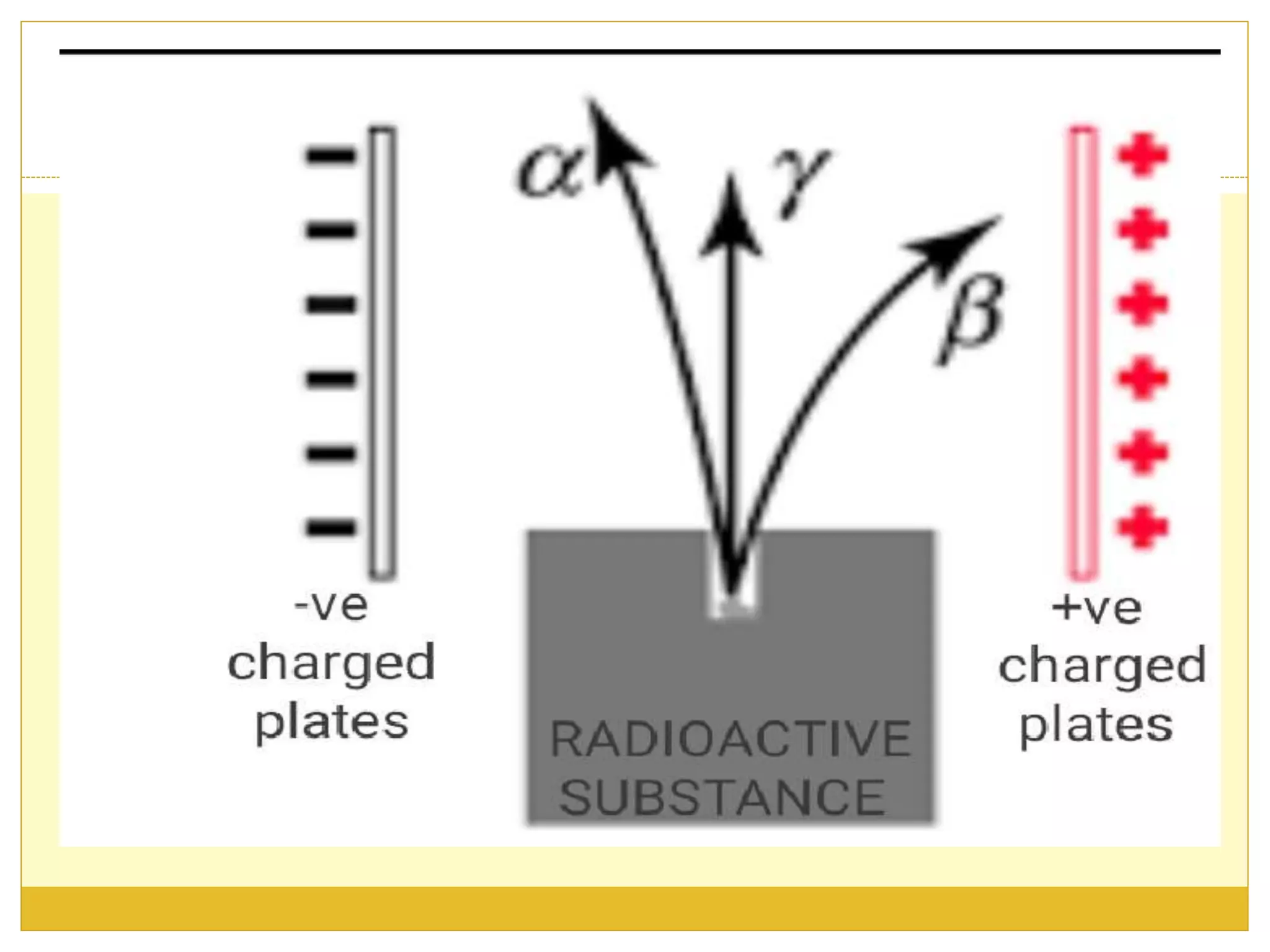
 In this experiment a radioactive substance is kept
between the two plates one is positively (+ve) charged
and other is negatively (-ve) charged.
 It was observed that some radiations are attracted
towards negative (-ve) plate because they will have
positive (+ve) charge and are knows as alpha (α) rays.
Some are attracted towards positive (+ve)
plate because they will have negative (-ve) charged and
are knows as beta (β) rays.
Some radiation are neither attracted
towards positive (+ve) or negative (-ve) plate i.e. they are
neutral charge and are known as gamma (γ) rays
MEASUREMENT OF RADIOACTIVITY
 The amount of radioactivity is reported in
Becquerel (Bq).
 The radioactivity of radioactive
substance is measured or detected by
instruments like :-
1. SCINTILLATION COUNTER
2. GAS FILLED CHAMBER
SCTILLATION COUNTER
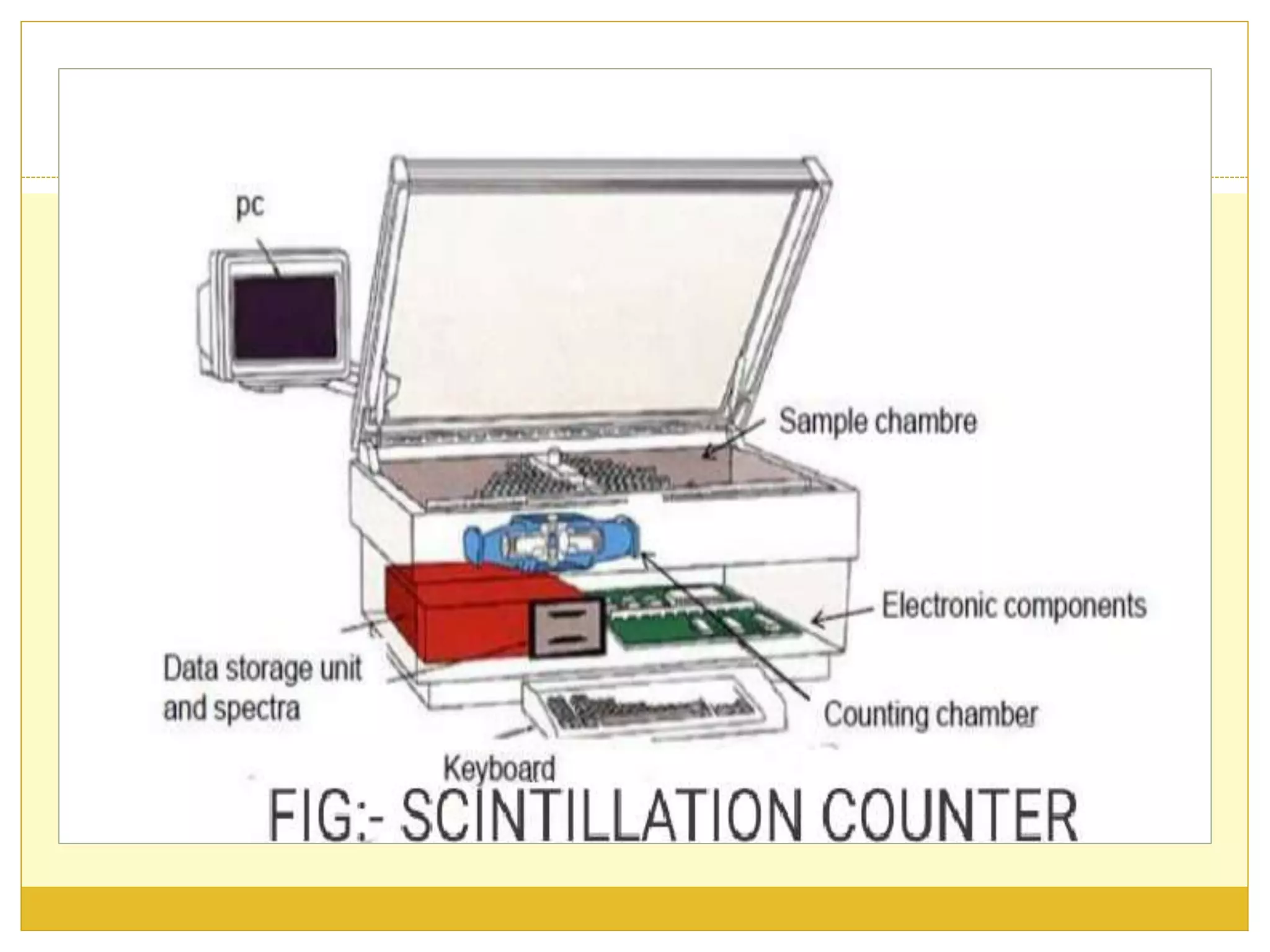
 A scintillation counter is an instrument for
detecting and measuring ionizing radiations
like alpha(α) rays, beta (β) rays, gamma (γ)
rays.
 Scintillation is the most sensitive and
versatile technique for the detection and
quantification of radioactivity.
HISTORY
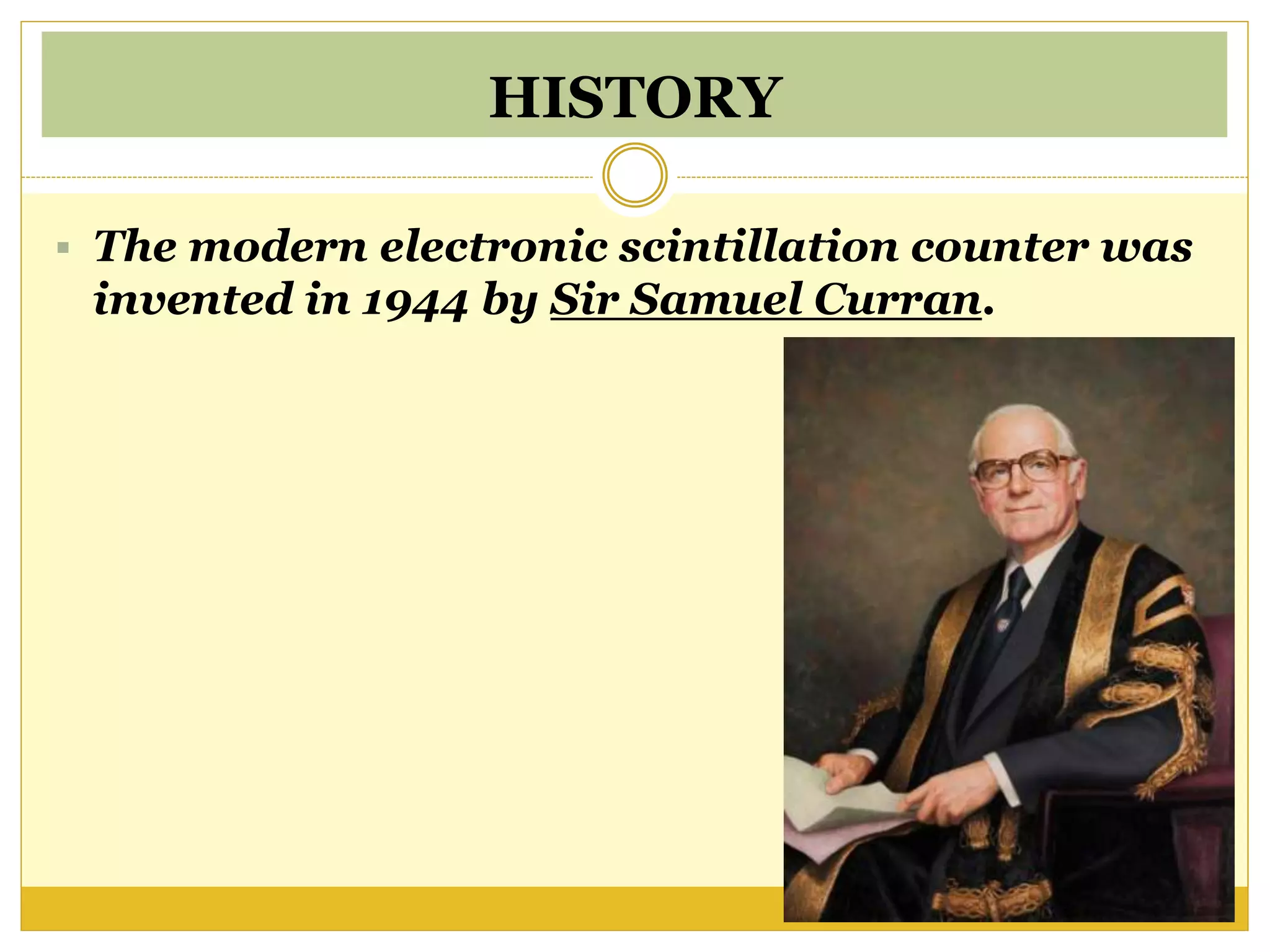
 The modern electronic scintillation counter was
invented in 1944 by Sir Samuel Curran.
TYPES
 There are two types of scintillation counter
based on the fluorescent material used they are:
1. Solid scintillation counter
2. Liquid scintillation counter
DIFFERENCE BETWEEN SOLID AND LIQUID
SCINTILLATION COUNTER
S.NO
.
SOLID SCINTILLATION
COUNTER
LIQUID SCINTILLATION
COUNTER
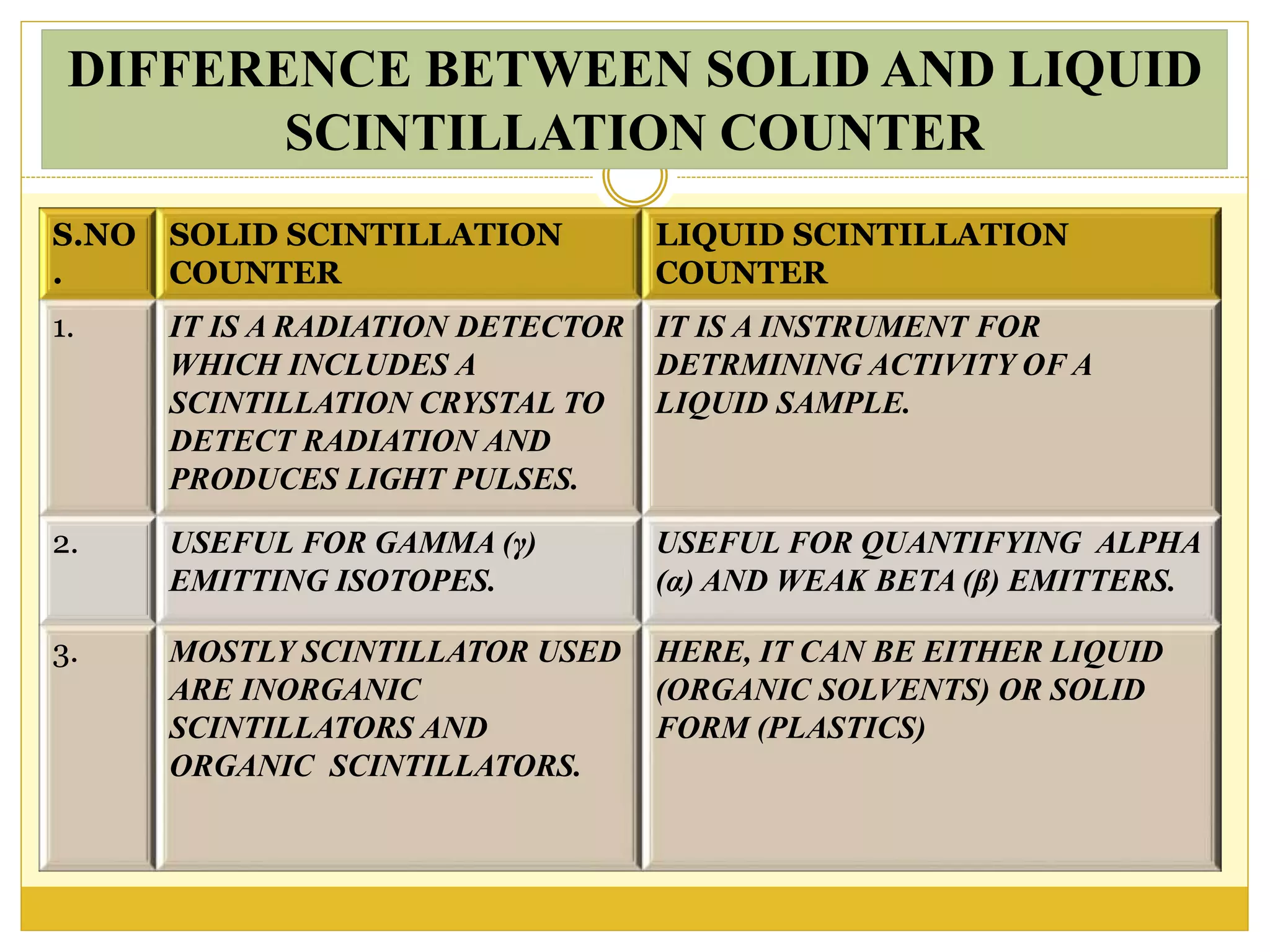
1. IT IS A RADIATION DETECTOR
WHICH INCLUDES A
SCINTILLATION CRYSTAL TO
DETECT RADIATION AND
PRODUCES LIGHT PULSES.
IT IS A INSTRUMENT FOR
DETRMINING ACTIVITY OF A
LIQUID SAMPLE.
2. USEFUL FOR GAMMA (γ)
EMITTING ISOTOPES.
USEFUL FOR QUANTIFYING ALPHA
(α) AND WEAK BETA (β) EMITTERS.
3. MOSTLY SCINTILLATOR USED
ARE INORGANIC
SCINTILLATORS AND
ORGANIC SCINTILLATORS.
HERE, IT CAN BE EITHER LIQUID
(ORGANIC SOLVENTS) OR SOLID
FORM (PLASTICS)
SOLID SCINTILLATION COUNTER
 A solid scintillation counter is a radiation
detector which includes a scintillation crystal
to detect radiation and produce light pulses.
 In the solid scintillation counters, the sample
is placed in a vial, just adjacent to a crystal
or fluorescent material.
 The crystal normally used are:
1. Sodium Iodide : For gamma emitters
2. Zinc Sulphide crystal : For alpha emitters
3. Anthracene : For beta emitters
PRINCIPLE
 When high energy atomic radiations are incident on a
surface coated with some fluorescent material, then
flashes of light (called scintillation) are produced.
 The scintillation are detected with the help of a
photomultiplier tube , that gives rise to an equivalent
electric pulse.
 These output electrical pulse can then be analyses and
counted electronically and gives rise to information
regarding the incident radiation.
 The solid scintillation counter is especially useful for
gamma emitting isotopes.
SCINTILLATORS MAY BE CHARACTERISED INTO 2
MAIN TYPES
1. ORGANIC SCINTILLATORS:-
A) Pure organic scintillators :- Anthracene, etc.
B)Liquid organic solutions :- pure organic
scintillators are dissolved in a suitable solvent &
then we obtain liquid organic scintillators.
C)Plastic scintillators :- pure organic scintillators
after dissolving in the solvent are subsequently
polymerized.
2. INORGANIC SCINTILLATORS :-
NaI(Tl) :- Thallium activated Sodium Iodide
CsI(Tl) :- Thallium activated Cesium Iodide
CsI(Na) :- Sodium activated Cesium Iodide
INSTRUMENTATION
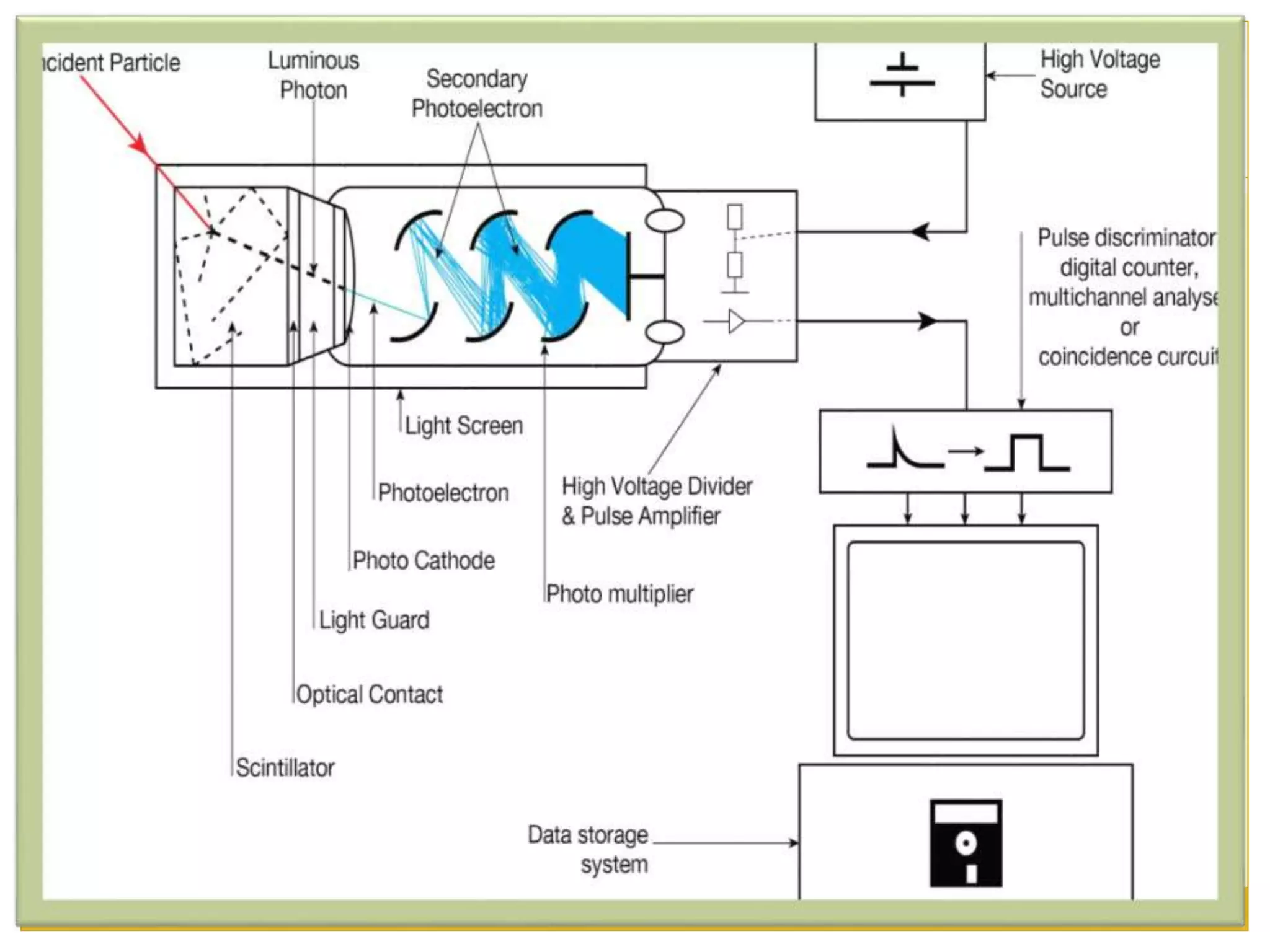
1. RADIATION- The high energy ionizing radiation strike
the crystal.
2. SCINTILLATOR- It consist of a scintillator which
generates photons in response to incident radiation.
3. LIGHT FLASHES- Flash or rays of light produced in a
transparent material by passing a particle.
4. PHOTOMULTIPLIER TUBE [PMT]- It converts the light
to an electrical signal and electronics to process this
signal.
5. PHOTOCATHODE- A photocathode is a surface that
convert light (photons) into electrons by photoelectric
effect.
CONTII…
6. ELECTRICAL PULSE- A pulse may last from a
fraction of a nanosecond upto several seconds or even
minutes.
7. AMPLIFIER- It is an electronic device that measures
the peak of potential pulse.
8. COUNTER- It measures the voltage of potential drop
created by the electrons.
WORKING
FIG:- PHOTOMULTIPLIER TUBE
APPLICATION
1. It is widely used in screening technologies, RIA
alternative technologies, cancer research, scientists,
physicians, engineers & technicians.
2. Border security, nuclear plant safety, national security.
3. This methodology is used routinely in the vast majority
of diagnostic and/or research laboratories from those of
biochemistry and biology to clinical departments.
ADVANTAGES
1. Its counting rate is very fast and very easiest method.
2. It can detect lower levels of radiation.
3. It can measure radiations of different types of
isotopes.
4. Virtually any kind of sample (liquids, solids,
suspensions, emulsions, gels, chromatograms, etc.)
can be accommodated in a scintillation counter and
its radioactivity can be determined accurately.
DISADVANTAGES
1. Hygroscopicity- A disadvantage of some
inorganic crystals, e.g. sodium iodide, is
their hygroscopicity, a property which
requires them to be housed in an airtight
container to protect them from moisture.
2. The cost per sample of scintillation
counting is significantly higher.
3. The high voltage applied to the
photomultiplier tube.
REFERANCE
 BIOPHYSICAL CHEMISTRY PRINCIPLES AND
TECHNIQUES BY UPADHYAYA AND UPADHYAY
AND NATH.
 A TEXTBOOK OF MICROBIOLOGY BBY R.C.
DUBEY & DR. D. K. MAHESHWARI.
 https://www.researchgate.net/publication/26320
9531_Liquid_and_solid_scintillation_principles_
and_applications
THANKYOU
…

SOILD SCINTILLATION COUNTER PPT.pptx

  • 1.
    SOLID SCINTILLATION COUNTER SUBMITTEDTO : – DEPT. OF MICROBIOLOGY BY :- SNEHA AGRAWAL M.Sc. MICROBIOLOGY 2 SEMESTER SESSION 2022-2023
  • 2.
    CONTENTS  RADIOACTIVITY  EXPERIMENTFOR RADIOACTIVITY  MEASUREMENT OF RADIOACTIVITY  SCINTILLATION COUNTER  HISTORY  TYPES  DIFFERENCE BETWEEN SOLID AND LIQUID SCINTILLATION COUNTER  SOLID SCINTILLATION COUNTER  PRINCIPLE  INSTRUMENTATION  WORKING  APPLICATION  ADVANTAGES  DISADVANTAGES  REFERENCE
  • 3.
    RADIOACTIVITY  The phenomenonin which the nucleus of the atom of an element undergoes spontaneous and uncontrollable disintegration or decay and emit alpha, beta, or gamma rays  It is the property of some unstable atoms to spontaneously emit nuclear radiation.  Radioactive rays = alpha rays, beta rays, gamma rays.  Radioactive elements = Uranium, Thorium etc.  The phenomenon of radioactivity is discovered by HENRI BACQUEREL IN 1896.
  • 4.
    EXPERIMENT FOR RADIOACTIVITY In this experiment a radioactive substance is kept between the two plates one is positively (+ve) charged and other is negatively (-ve) charged.  It was observed that some radiations are attracted towards negative (-ve) plate because they will have positive (+ve) charge and are knows as alpha (α) rays. Some are attracted towards positive (+ve) plate because they will have negative (-ve) charged and are knows as beta (β) rays. Some radiation are neither attracted towards positive (+ve) or negative (-ve) plate i.e. they are neutral charge and are known as gamma (γ) rays
  • 6.
    MEASUREMENT OF RADIOACTIVITY The amount of radioactivity is reported in Becquerel (Bq).  The radioactivity of radioactive substance is measured or detected by instruments like :- 1. SCINTILLATION COUNTER 2. GAS FILLED CHAMBER
  • 7.
    SCTILLATION COUNTER  Ascintillation counter is an instrument for detecting and measuring ionizing radiations like alpha(α) rays, beta (β) rays, gamma (γ) rays.  Scintillation is the most sensitive and versatile technique for the detection and quantification of radioactivity.
  • 9.
    HISTORY  The modernelectronic scintillation counter was invented in 1944 by Sir Samuel Curran.
  • 10.
    TYPES  There aretwo types of scintillation counter based on the fluorescent material used they are: 1. Solid scintillation counter 2. Liquid scintillation counter
  • 11.
    DIFFERENCE BETWEEN SOLIDAND LIQUID SCINTILLATION COUNTER S.NO . SOLID SCINTILLATION COUNTER LIQUID SCINTILLATION COUNTER 1. IT IS A RADIATION DETECTOR WHICH INCLUDES A SCINTILLATION CRYSTAL TO DETECT RADIATION AND PRODUCES LIGHT PULSES. IT IS A INSTRUMENT FOR DETRMINING ACTIVITY OF A LIQUID SAMPLE. 2. USEFUL FOR GAMMA (γ) EMITTING ISOTOPES. USEFUL FOR QUANTIFYING ALPHA (α) AND WEAK BETA (β) EMITTERS. 3. MOSTLY SCINTILLATOR USED ARE INORGANIC SCINTILLATORS AND ORGANIC SCINTILLATORS. HERE, IT CAN BE EITHER LIQUID (ORGANIC SOLVENTS) OR SOLID FORM (PLASTICS)
  • 12.
    SOLID SCINTILLATION COUNTER A solid scintillation counter is a radiation detector which includes a scintillation crystal to detect radiation and produce light pulses.  In the solid scintillation counters, the sample is placed in a vial, just adjacent to a crystal or fluorescent material.  The crystal normally used are: 1. Sodium Iodide : For gamma emitters 2. Zinc Sulphide crystal : For alpha emitters 3. Anthracene : For beta emitters
  • 13.
    PRINCIPLE  When highenergy atomic radiations are incident on a surface coated with some fluorescent material, then flashes of light (called scintillation) are produced.  The scintillation are detected with the help of a photomultiplier tube , that gives rise to an equivalent electric pulse.  These output electrical pulse can then be analyses and counted electronically and gives rise to information regarding the incident radiation.  The solid scintillation counter is especially useful for gamma emitting isotopes.
  • 14.
    SCINTILLATORS MAY BECHARACTERISED INTO 2 MAIN TYPES 1. ORGANIC SCINTILLATORS:- A) Pure organic scintillators :- Anthracene, etc. B)Liquid organic solutions :- pure organic scintillators are dissolved in a suitable solvent & then we obtain liquid organic scintillators. C)Plastic scintillators :- pure organic scintillators after dissolving in the solvent are subsequently polymerized. 2. INORGANIC SCINTILLATORS :- NaI(Tl) :- Thallium activated Sodium Iodide CsI(Tl) :- Thallium activated Cesium Iodide CsI(Na) :- Sodium activated Cesium Iodide
  • 15.
    INSTRUMENTATION 1. RADIATION- Thehigh energy ionizing radiation strike the crystal. 2. SCINTILLATOR- It consist of a scintillator which generates photons in response to incident radiation. 3. LIGHT FLASHES- Flash or rays of light produced in a transparent material by passing a particle. 4. PHOTOMULTIPLIER TUBE [PMT]- It converts the light to an electrical signal and electronics to process this signal. 5. PHOTOCATHODE- A photocathode is a surface that convert light (photons) into electrons by photoelectric effect.
  • 16.
    CONTII… 6. ELECTRICAL PULSE-A pulse may last from a fraction of a nanosecond upto several seconds or even minutes. 7. AMPLIFIER- It is an electronic device that measures the peak of potential pulse. 8. COUNTER- It measures the voltage of potential drop created by the electrons.
  • 17.
  • 19.
  • 20.
    APPLICATION 1. It iswidely used in screening technologies, RIA alternative technologies, cancer research, scientists, physicians, engineers & technicians. 2. Border security, nuclear plant safety, national security. 3. This methodology is used routinely in the vast majority of diagnostic and/or research laboratories from those of biochemistry and biology to clinical departments.
  • 21.
    ADVANTAGES 1. Its countingrate is very fast and very easiest method. 2. It can detect lower levels of radiation. 3. It can measure radiations of different types of isotopes. 4. Virtually any kind of sample (liquids, solids, suspensions, emulsions, gels, chromatograms, etc.) can be accommodated in a scintillation counter and its radioactivity can be determined accurately.
  • 22.
    DISADVANTAGES 1. Hygroscopicity- Adisadvantage of some inorganic crystals, e.g. sodium iodide, is their hygroscopicity, a property which requires them to be housed in an airtight container to protect them from moisture. 2. The cost per sample of scintillation counting is significantly higher. 3. The high voltage applied to the photomultiplier tube.
  • 23.
    REFERANCE  BIOPHYSICAL CHEMISTRYPRINCIPLES AND TECHNIQUES BY UPADHYAYA AND UPADHYAY AND NATH.  A TEXTBOOK OF MICROBIOLOGY BBY R.C. DUBEY & DR. D. K. MAHESHWARI.  https://www.researchgate.net/publication/26320 9531_Liquid_and_solid_scintillation_principles_ and_applications
  • 24.