
HAFIZ
MUHAM
MAD
WASEEM
lahore
Micrometry
Advanced Analytical Techniques
Introduction
 It is a process of rupturing the
cells and then separation into
the organelles to study their
structure, chemical
composition and functions
 Each organelle has
characteristics size, shape and
density which make it
different from other
organelles from the same cell
 This technique is devised to
separate various cell
components while preserving
their individual functions
 It allows to study different
parts of a cell in isolation
 It increases our knowledge of
organelle structure and
functions
 For example, it was
determined that a cell fraction
was rich in enzymes that
function in cellular respiration
 This unknown cell fraction was
found to be rich in
mitochondria and involved
with cellular respiration
 Although cell fractionation is
very gentle but it may result in
subtle changes to the cells
 It may involve enzymatic or
mechanical processes
Introduction
Advanced Analytical Techniques
Method of cell fractionation
 Different methods are used by
cell biologists for the cell
fractionation
 Starts with homogenization in
which cells are broken to
release their contents and is
followed by fractionating their
contents into different
components or cell organelles
 It involves the use of
techniques which range from
simple sieves, gravity
sedimentation or differential
precipitation to
ultracentrifugation for
separation of the fractions
 Main steps in cell fractionation
include
 Extraction. In this step the
cells or tissues are suspended
in suitable pH, salt
concentration and isotonic
medium
 Homogenization. It is
disruption of the cells or
tissues by grinding, sonication,
freeze/thawing, etc.
 Filtration. It is removal of
debris from the homogenate
 Centrifugation. In this step the
homogenate is separated due
to their densities
Method of cell fractionation
Advanced Analytical Techniques
Extraction
 It is first step in the way to cell
fractionation
 Here cell organelles and bio-
molecules are extracted in
mild conditions with minimum
damage to them
 Cells and organelles are
suspended at a suitable pH and
in isotonic medium
 Isotonic medium used is
generally sucrose at conc of
0.25 mol/L
 Different methods are used for
extraction of various
components or cell organelles
Phases of cell fractionation
Homogenization
 It is disruption of cells and
tissues in isotonic solution
which releases cellular
components which may contain
unbroken cells, pieces of cell
walls, cell membranes and
proteins such as enzymes
 Cell components are kept cold
and in isotonic form in a buffer
 Purpose is to prevent cell
organelles or bio-molecules
from osmotic damage,
degradation, etc.
 Protease or phosphatase
inhibitors are also used
Phases of cell fractionation
 Detergents used can interact
with both membranes and
parts of the cells that are
soluble in water
 Allow cellular components to
be mixed or homogenized
 It is combined with physical
methods like blenders, glass
beads or using sound energy
to lyse the cells
 It ensures that all of the cells in
the sample get broken and
isolation of cellular organelles
 Shear force must be carefully
controlled to avoid damage to
the cells/organelles
Phases of cell fractionation
Advanced Analytical Techniques
Filtration
 This step may not be
necessary and depends on
the source of cells under
investigation
 Animal tissue however is
likely to yield connective
tissue, debris, whole cells,
etc. which must be removed
 It is achieved either by
pouring through sieve with
or without some suction
pump
 Debris is discarded while the
clear filtrate is processed for
further analysis
Phases of cell fractionation
Centrifugation
 The homogenate is separated
in different fractions by
spinning it in a process called
centrifugation
 This imposes a centrifugal
force on the particles of the
homogenate perpendicular
to the axis of rotation
 As a result components of
the homogenate settle down
in the tubes on the basis of
their size and shape
 Each step yields a pellet and
supernatant which may be
centrifuged again
Phases of cell fractionation
Differential Centrifugation
 It is sequential centrifugation
of the homogenate at
increasing centrifugation force
 This results in isolation of
cellular components of
decreasing size and density
 This separation depends on
their sedimentation rate which
in turn is dependent on the
size and shape of the cellular
components
 The supernatant may be again
centrifuged to generate pellets
of lesser size and / or density
for further analysis
Phases of cell fractionation
Advanced Analytical Techniques
Density gradient
centrifugation
 It is achieved by placing layer
after layer of gradient media in
a tube with the heaviest layer
at the bottom and the lightest
one at the top
 The homogenate is placed on
top of the layer and then
centrifuged at high speed
 The heaviest organelles move
down the tube fastest and stop
in the gradient medium with
density equal to their own
density
 This method is used to purify
sub-cellular organelles
Phases of cell fractionation
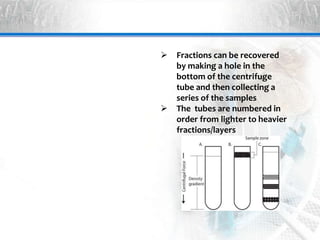
 Fractions can be recovered
by making a hole in the
bottom of the centrifuge
tube and then collecting a
series of the samples
 The tubes are numbered in
order from lighter to heavier
fractions/layers
Advanced Analytical Techniques
 It allows scientists to study
functions and biochemical
composition of cells and their
organelles
 Extraction of plasma
membrane proteins and their
functions. Membrane
fractions are isolated from
cell homogenate by density
gradient centrifugation to
study their properties and
functions
 Extraction of nuclear
proteins and their functions
 Fractionation of sub-cellular
proteins/ molecules
Applications of cell fractionation

Cell fractionation & centrifugation

  • 1.
  • 2.
  • 3.
    Introduction  It isa process of rupturing the cells and then separation into the organelles to study their structure, chemical composition and functions  Each organelle has characteristics size, shape and density which make it different from other organelles from the same cell  This technique is devised to separate various cell components while preserving their individual functions  It allows to study different parts of a cell in isolation
  • 4.
     It increasesour knowledge of organelle structure and functions  For example, it was determined that a cell fraction was rich in enzymes that function in cellular respiration  This unknown cell fraction was found to be rich in mitochondria and involved with cellular respiration  Although cell fractionation is very gentle but it may result in subtle changes to the cells  It may involve enzymatic or mechanical processes Introduction
  • 5.
  • 6.
    Method of cellfractionation  Different methods are used by cell biologists for the cell fractionation  Starts with homogenization in which cells are broken to release their contents and is followed by fractionating their contents into different components or cell organelles  It involves the use of techniques which range from simple sieves, gravity sedimentation or differential precipitation to ultracentrifugation for separation of the fractions
  • 7.
     Main stepsin cell fractionation include  Extraction. In this step the cells or tissues are suspended in suitable pH, salt concentration and isotonic medium  Homogenization. It is disruption of the cells or tissues by grinding, sonication, freeze/thawing, etc.  Filtration. It is removal of debris from the homogenate  Centrifugation. In this step the homogenate is separated due to their densities Method of cell fractionation
  • 8.
  • 9.
    Extraction  It isfirst step in the way to cell fractionation  Here cell organelles and bio- molecules are extracted in mild conditions with minimum damage to them  Cells and organelles are suspended at a suitable pH and in isotonic medium  Isotonic medium used is generally sucrose at conc of 0.25 mol/L  Different methods are used for extraction of various components or cell organelles Phases of cell fractionation
  • 10.
    Homogenization  It isdisruption of cells and tissues in isotonic solution which releases cellular components which may contain unbroken cells, pieces of cell walls, cell membranes and proteins such as enzymes  Cell components are kept cold and in isotonic form in a buffer  Purpose is to prevent cell organelles or bio-molecules from osmotic damage, degradation, etc.  Protease or phosphatase inhibitors are also used Phases of cell fractionation
  • 11.
     Detergents usedcan interact with both membranes and parts of the cells that are soluble in water  Allow cellular components to be mixed or homogenized  It is combined with physical methods like blenders, glass beads or using sound energy to lyse the cells  It ensures that all of the cells in the sample get broken and isolation of cellular organelles  Shear force must be carefully controlled to avoid damage to the cells/organelles Phases of cell fractionation
  • 12.
  • 13.
    Filtration  This stepmay not be necessary and depends on the source of cells under investigation  Animal tissue however is likely to yield connective tissue, debris, whole cells, etc. which must be removed  It is achieved either by pouring through sieve with or without some suction pump  Debris is discarded while the clear filtrate is processed for further analysis Phases of cell fractionation
  • 14.
    Centrifugation  The homogenateis separated in different fractions by spinning it in a process called centrifugation  This imposes a centrifugal force on the particles of the homogenate perpendicular to the axis of rotation  As a result components of the homogenate settle down in the tubes on the basis of their size and shape  Each step yields a pellet and supernatant which may be centrifuged again Phases of cell fractionation
  • 15.
    Differential Centrifugation  Itis sequential centrifugation of the homogenate at increasing centrifugation force  This results in isolation of cellular components of decreasing size and density  This separation depends on their sedimentation rate which in turn is dependent on the size and shape of the cellular components  The supernatant may be again centrifuged to generate pellets of lesser size and / or density for further analysis Phases of cell fractionation
  • 16.
    Phases of cellfractionation
  • 17.
  • 18.
    Density gradient centrifugation  Itis achieved by placing layer after layer of gradient media in a tube with the heaviest layer at the bottom and the lightest one at the top  The homogenate is placed on top of the layer and then centrifuged at high speed  The heaviest organelles move down the tube fastest and stop in the gradient medium with density equal to their own density  This method is used to purify sub-cellular organelles Phases of cell fractionation
  • 19.
     Fractions canbe recovered by making a hole in the bottom of the centrifuge tube and then collecting a series of the samples  The tubes are numbered in order from lighter to heavier fractions/layers
  • 20.
  • 21.
     It allowsscientists to study functions and biochemical composition of cells and their organelles  Extraction of plasma membrane proteins and their functions. Membrane fractions are isolated from cell homogenate by density gradient centrifugation to study their properties and functions  Extraction of nuclear proteins and their functions  Fractionation of sub-cellular proteins/ molecules Applications of cell fractionation