Photometry
• Photometry broadly deals with the study of the phenomenon of light
absorption by molecules in solution. The specificity of a compound to absorb
light at a particular wavelength (monochromatic light) is exploited in the
laboratory for quantitative measurements
• Monochromatic light is optical radiation containing only a single optical
frequency
• A green/red laser is an example of monochromatic light while simple
white light emitted from a torch is an example of polychromatic light as it is
made up of other monochromes
• From the biochemist's perspective, photometry forms an important laboratory
tool for accurate estimation of a wide variety of compounds in biological
samples
Principle
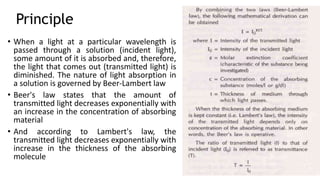
• When a light at a particular wavelength is
passed through a solution (incident light),
some amount of it is absorbed and, therefore,
the light that comes out (transmitted light) is
diminished. The nature of light absorption in
a solution is governed by Beer-Lambert law
• Beer's law states that the amount of
transmitted light decreases exponentially with
an increase in the concentration of absorbing
material
• And according to Lambert's law, the
transmitted light decreases exponentially with
increase in the thickness of the absorbing
molecule
Colorimeter
• Colorimeter (or photoelectric
colorimeter) is the instrument used for
the measurement of coloured
substances.
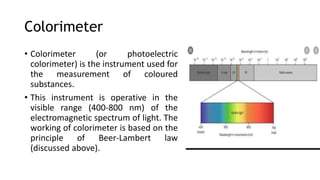
• This instrument is operative in the
visible range (400-800 nm) of the
electromagnetic spectrum of light. The
working of colorimeter is based on the
principle of Beer-Lambert law
(discussed above).
• A colorimeter is a device used in colorimetry that measures the
absorbance of particular wavelengths of light by a specific solution
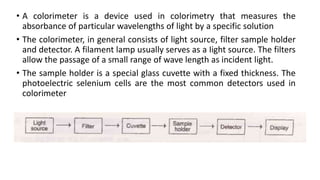
• The colorimeter, in general consists of light source, filter sample holder
and detector. A filament lamp usually serves as a Iight source. The filters
allow the passage of a small range of wave length as incident light.
• The sample holder is a special glass cuvette with a fixed thickness. The
photoelectric selenium cells are the most common detectors used in
colorimeter
fluorometry
• When certain compounds are subjected to light of a particular
wavelength, some of the molecules get excited.
• These molecules, while they return to ground state, emit light in the
form of fluorescence which is proportional to the concentration of
the compound.
• This is the principle in the operation of the instrument fluorometer
Flame photometry
• Flame photometry primarily deals with the quantitative measurement
of electrolytes such as sodium, potassium and lithium.
• The instrument, namely flame photometer, works on the following
principle.
• As a solution in air is finally sprayed over a burner, it dissociates to
give neutral atoms. Some of these atoms get excited and move to a
higher energy state.
• When the excited atoms fall back to the ground state, they emit light
of a characteristic wavelength which can be measured The intensity
of emission light is proportional to the concentration of the
electrolyte being estimated.
Spectrophotometer
• The spectrophotometer primarily differs from colorimeter by covering the
ultraviolet region (200-400 nm) of the electromagnetic spectrum
• The spectrophotometer is more sophisticated with several additional devices
that ultimately increase the sensitivity of its operation several fold when
compared to a colorimeter
• A precisely selected wavelength (234 nm or 610 nm) in both ultraviolet and
visible range can be used for measurement
• The spectrophotometer has similar basic components as described for
colorimeter and its operation is also based on the Beer-Lambert law
• In place of glass cuvettes (in colorimeter), quartz cells are used in a
spectrophotometer
• Typically quartz cuvette are used when the wavelength of the incident light is
in the UV range
Ultracentrifugation
• The ultracentrifuge was developed by a Swedish biochemist Svedberg
(1923). The principle is based on the generation of centrifugal force to as
high as 600,000 g (earth's gravity g = 9.81 m/s2) that allows the
sedimentation of particles or macromolecules
• Ultracentrifugation is an indispensable tool for the isolation of
subcellular organelles, proteins and nucleic acids. ln addition, this
technique is also employed in the determination of molecular weights of
macromolecule
• The rate at which the sedimentation occurs in ultracentrifugation
primarily depends on the size and shape of the particles or
macromolecules (i.e. on the molecular weight).
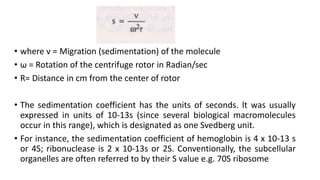
• lt is expressed in terms of sedimentation coefficient(s) and is given by
the formula
• where v = Migration (sedimentation) of the molecule
• ω = Rotation of the centrifuge rotor in Radian/sec
• R= Distance in cm from the center of rotor
• The sedimentation coefficient has the units of seconds. lt was usually
expressed in units of 10-13s (since several biological macromolecules
occur in this range), which is designated as one Svedberg unit.
• For instance, the sedimentation coefficient of hemoglobin is 4 x 10-13 s
or 4S; ribonuclease is 2 x 10-13s or 2S. Conventionally, the subcellular
organelles are often referred to by their S value e.g. 70S ribosome
lsolation of subcellular organelles by centrifugation
• The cells are subjected to disruption by sonication or osmotic shock or by use of
• homogenizer.
• This is usually carried out in an isotonic (0.25 M) sucrose (Isotonic
solutions have the same water concentration on both sides of the cell
membrane). The advantage with sucrose medium is that it does not cause the
organellesto swell.
• The subcellular particles can be separated by differential centrifugation
• Differential centrifugation is a method used to separate the different
components of a cell on the basis of mass. The cell membrane is first ruptured
to release the cell's components by using a homogenizer. The resulting mixture
is referred to as the homogenate
• The most commonly employed laboratory method separates subcellular
organelles into 3 major fractions-nuclear, mitochondrial and microsomal
• When the homogenate is centrifuged at 700g for about 10 min, the
nuclear fraction (includes plasma membrane) gets sedimented.
• On centrifuging the supernatant at 15,000 g for about 5 min
mitochondrial fraction (that includes
• lysosomes, peroxisomes) is pelleted.
• Further centrifugation of the supernatant at 100,000 g for about 60
min separates microsomal fraction (that includes ribosomes and
endoplasmic reticulum)
• The supernatant then obtained Corresponds to the cytosol
• The purity (or contamination) of the subcellular fractionation can
be checked by the use of marker enzymes
• DNA polymerase is the marker enzyme for nucleus,
• while glutamate dehydrogenase and glucose 6-phosphatase are the
markers for mitochondria and ribosomes, respectively.
• Hexokinase is the marker enzyme for cytosol.
Radioimmunoassay
• RIA is a highly sensitive and specific analytical tool
• This technique is used to estimate several compounds in biological fluids
that are found in exceedingly low concentrations may be in nanogram or
picogram
• Radioimmunoassay combines the principles of radioactivity of isotopes
and immunological reactions of antigen and antibody
• An immunoassay is a test that uses antibody and antigen complexes • An
antibody: antigen complex is also known as an immune- complex •
“Immuno” refers to an immune response that causes the body to
generate antibodies •
• The principle of RIA is primarily based on the competition between the
labelled and unlabeled antigens to bind with antibody to form
antigenantibody complexes (either labelled or unlabelled).
• The unlabeled antigen is the substance (say insulin) to be determined
• The antibody to it is produced by injecting the antigen to a goat or a rabbit
• The specific antibody (Ab) is then subjected to react with unlabeled antigen in the
presence of excess amounts of isotopically labelled (131I) antigen (Ag+) with known
radioactivity
• There occurs a competition between the antigens (Ag+ and Ag) to bind the
antibody
• Certainly, the labelled Ag+ will have an upper hand due to its excess presence
• As the concentration of unlabeled antigen (Ag) increases the amount of labelled
antigen-antibody complex (Ag+/Ab) decreases
• Thus, the concentration of Ag+/Ab is inversely related to the concentration of
unlabeled Ag
• This relation is almost linear
• A standard curve can be drawn by using different concentrations of unlabeled
antigen and the same quantities of antibody and labelled antigen
• The labelled antigen-antibody (Ag+/Ab) complex is separated by precipitation. The
• radioactivity of 131I present is Ag+-Ab is determined.
Primary antibodies bind to the antigen detected, whereas secondary antibodies bind to primary antibodies

19 Techniques.pptx

  • 1.
    Photometry • Photometry broadlydeals with the study of the phenomenon of light absorption by molecules in solution. The specificity of a compound to absorb light at a particular wavelength (monochromatic light) is exploited in the laboratory for quantitative measurements • Monochromatic light is optical radiation containing only a single optical frequency • A green/red laser is an example of monochromatic light while simple white light emitted from a torch is an example of polychromatic light as it is made up of other monochromes • From the biochemist's perspective, photometry forms an important laboratory tool for accurate estimation of a wide variety of compounds in biological samples
  • 2.
    Principle • When alight at a particular wavelength is passed through a solution (incident light), some amount of it is absorbed and, therefore, the light that comes out (transmitted light) is diminished. The nature of light absorption in a solution is governed by Beer-Lambert law • Beer's law states that the amount of transmitted light decreases exponentially with an increase in the concentration of absorbing material • And according to Lambert's law, the transmitted light decreases exponentially with increase in the thickness of the absorbing molecule
  • 3.
    Colorimeter • Colorimeter (orphotoelectric colorimeter) is the instrument used for the measurement of coloured substances. • This instrument is operative in the visible range (400-800 nm) of the electromagnetic spectrum of light. The working of colorimeter is based on the principle of Beer-Lambert law (discussed above).
  • 4.
    • A colorimeteris a device used in colorimetry that measures the absorbance of particular wavelengths of light by a specific solution • The colorimeter, in general consists of light source, filter sample holder and detector. A filament lamp usually serves as a Iight source. The filters allow the passage of a small range of wave length as incident light. • The sample holder is a special glass cuvette with a fixed thickness. The photoelectric selenium cells are the most common detectors used in colorimeter
  • 5.
    fluorometry • When certaincompounds are subjected to light of a particular wavelength, some of the molecules get excited. • These molecules, while they return to ground state, emit light in the form of fluorescence which is proportional to the concentration of the compound. • This is the principle in the operation of the instrument fluorometer
  • 6.
    Flame photometry • Flamephotometry primarily deals with the quantitative measurement of electrolytes such as sodium, potassium and lithium. • The instrument, namely flame photometer, works on the following principle. • As a solution in air is finally sprayed over a burner, it dissociates to give neutral atoms. Some of these atoms get excited and move to a higher energy state. • When the excited atoms fall back to the ground state, they emit light of a characteristic wavelength which can be measured The intensity of emission light is proportional to the concentration of the electrolyte being estimated.
  • 8.
    Spectrophotometer • The spectrophotometerprimarily differs from colorimeter by covering the ultraviolet region (200-400 nm) of the electromagnetic spectrum • The spectrophotometer is more sophisticated with several additional devices that ultimately increase the sensitivity of its operation several fold when compared to a colorimeter • A precisely selected wavelength (234 nm or 610 nm) in both ultraviolet and visible range can be used for measurement • The spectrophotometer has similar basic components as described for colorimeter and its operation is also based on the Beer-Lambert law • In place of glass cuvettes (in colorimeter), quartz cells are used in a spectrophotometer • Typically quartz cuvette are used when the wavelength of the incident light is in the UV range
  • 9.
    Ultracentrifugation • The ultracentrifugewas developed by a Swedish biochemist Svedberg (1923). The principle is based on the generation of centrifugal force to as high as 600,000 g (earth's gravity g = 9.81 m/s2) that allows the sedimentation of particles or macromolecules • Ultracentrifugation is an indispensable tool for the isolation of subcellular organelles, proteins and nucleic acids. ln addition, this technique is also employed in the determination of molecular weights of macromolecule • The rate at which the sedimentation occurs in ultracentrifugation primarily depends on the size and shape of the particles or macromolecules (i.e. on the molecular weight). • lt is expressed in terms of sedimentation coefficient(s) and is given by the formula
  • 10.
    • where v= Migration (sedimentation) of the molecule • ω = Rotation of the centrifuge rotor in Radian/sec • R= Distance in cm from the center of rotor • The sedimentation coefficient has the units of seconds. lt was usually expressed in units of 10-13s (since several biological macromolecules occur in this range), which is designated as one Svedberg unit. • For instance, the sedimentation coefficient of hemoglobin is 4 x 10-13 s or 4S; ribonuclease is 2 x 10-13s or 2S. Conventionally, the subcellular organelles are often referred to by their S value e.g. 70S ribosome
  • 11.
    lsolation of subcellularorganelles by centrifugation • The cells are subjected to disruption by sonication or osmotic shock or by use of • homogenizer. • This is usually carried out in an isotonic (0.25 M) sucrose (Isotonic solutions have the same water concentration on both sides of the cell membrane). The advantage with sucrose medium is that it does not cause the organellesto swell. • The subcellular particles can be separated by differential centrifugation • Differential centrifugation is a method used to separate the different components of a cell on the basis of mass. The cell membrane is first ruptured to release the cell's components by using a homogenizer. The resulting mixture is referred to as the homogenate • The most commonly employed laboratory method separates subcellular organelles into 3 major fractions-nuclear, mitochondrial and microsomal
  • 12.
    • When thehomogenate is centrifuged at 700g for about 10 min, the nuclear fraction (includes plasma membrane) gets sedimented. • On centrifuging the supernatant at 15,000 g for about 5 min mitochondrial fraction (that includes • lysosomes, peroxisomes) is pelleted. • Further centrifugation of the supernatant at 100,000 g for about 60 min separates microsomal fraction (that includes ribosomes and endoplasmic reticulum) • The supernatant then obtained Corresponds to the cytosol • The purity (or contamination) of the subcellular fractionation can be checked by the use of marker enzymes • DNA polymerase is the marker enzyme for nucleus, • while glutamate dehydrogenase and glucose 6-phosphatase are the markers for mitochondria and ribosomes, respectively. • Hexokinase is the marker enzyme for cytosol.
  • 13.
    Radioimmunoassay • RIA isa highly sensitive and specific analytical tool • This technique is used to estimate several compounds in biological fluids that are found in exceedingly low concentrations may be in nanogram or picogram • Radioimmunoassay combines the principles of radioactivity of isotopes and immunological reactions of antigen and antibody • An immunoassay is a test that uses antibody and antigen complexes • An antibody: antigen complex is also known as an immune- complex • “Immuno” refers to an immune response that causes the body to generate antibodies • • The principle of RIA is primarily based on the competition between the labelled and unlabeled antigens to bind with antibody to form antigenantibody complexes (either labelled or unlabelled).
  • 14.
    • The unlabeledantigen is the substance (say insulin) to be determined • The antibody to it is produced by injecting the antigen to a goat or a rabbit • The specific antibody (Ab) is then subjected to react with unlabeled antigen in the presence of excess amounts of isotopically labelled (131I) antigen (Ag+) with known radioactivity • There occurs a competition between the antigens (Ag+ and Ag) to bind the antibody • Certainly, the labelled Ag+ will have an upper hand due to its excess presence • As the concentration of unlabeled antigen (Ag) increases the amount of labelled antigen-antibody complex (Ag+/Ab) decreases • Thus, the concentration of Ag+/Ab is inversely related to the concentration of unlabeled Ag • This relation is almost linear • A standard curve can be drawn by using different concentrations of unlabeled antigen and the same quantities of antibody and labelled antigen • The labelled antigen-antibody (Ag+/Ab) complex is separated by precipitation. The • radioactivity of 131I present is Ag+-Ab is determined.
  • 15.
    Primary antibodies bindto the antigen detected, whereas secondary antibodies bind to primary antibodies