 Cell fractionation is a procedure for rupturing cells,
separation and suspension of cell constituents in
isotonic medium in order to study their structure,
chemical composition and function.
Cell fractionation involves 3 steps:
 Extraction
 Homogenization
 Centrifugation
 It is the first step toward isolating any sub-cellular structures.
 In order to maintain the biological activity of organelles and bio-
molecules, they must be extracted in mild conditions called cell-
free systems.
 For these, the cells or tissues are suspended in a solution of
appropriate pH and salt content, usually isotonic sucrose (0.25
mol/L) solution.
 The sample are then kept cold to prevent enzymatic damage
The suspended cells are then disrupted by the process of
homogenization.
 It is usually done by:
(i) Grinding
(ii) High Pressure (French Press or Nitrogen Bomb)
(iii) Osmotic shock
(iv) Sonication (ultrasonic vibrations)
Grinding is done by pestle and mortar or potter homogenizer (a
high-speed blender). The later consists of two cylinders
separated by a narrow gap.
 Last step of cell fractionation is the centrifugation.
 The separation (fractionation) of various components of
the homogenate is carried out by a series of
centrifugations in an instrument called preparative
ultracentrifuge.
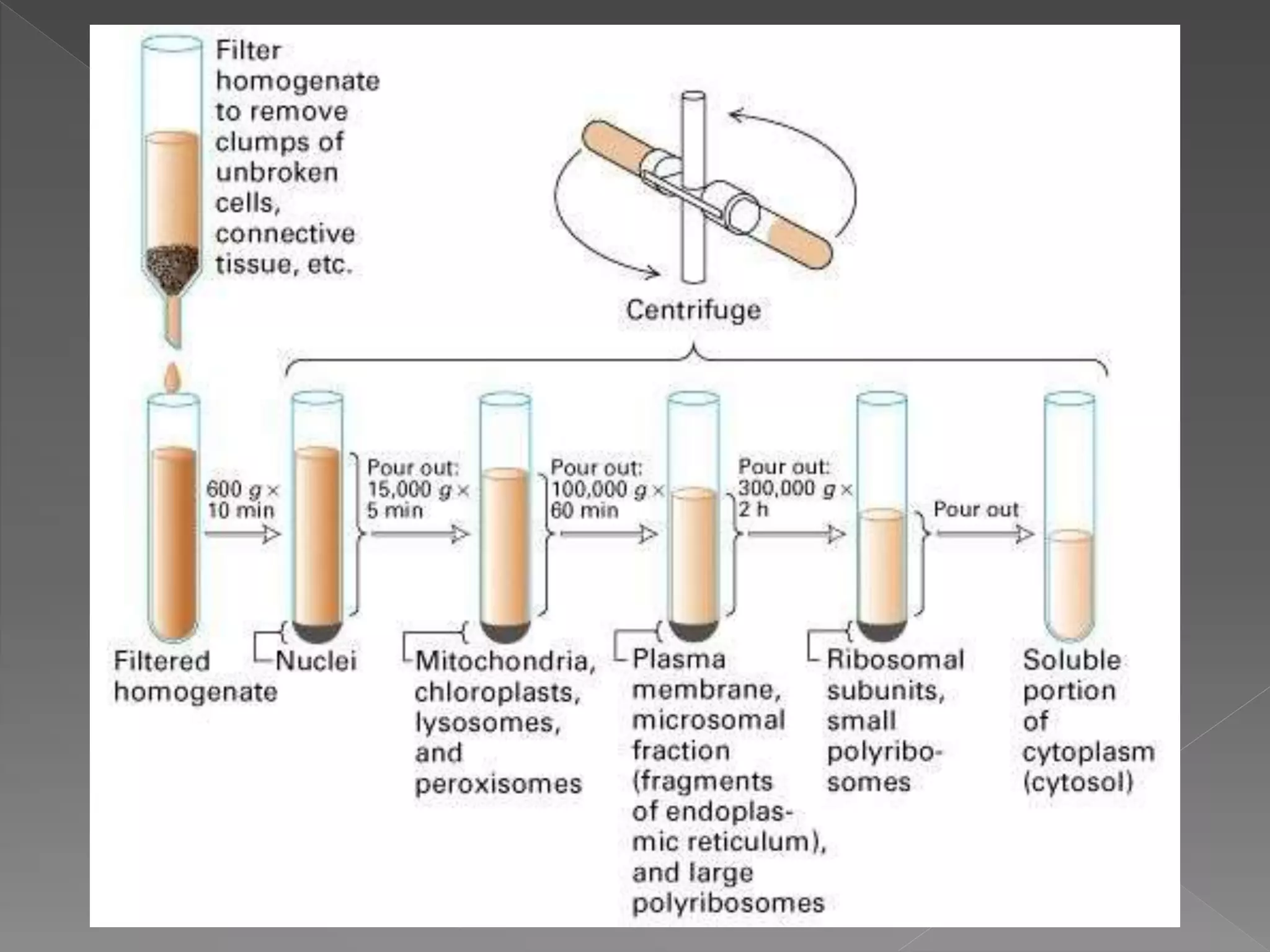
 It is a process in which sequential centrifugation of a cell
lysate at progressively increasing centrifugation force,
isolating cellular components of decreasing size and
density.
 Equilibrium density gradient
centrifugation is a procedure used to
separate particles and mixed substances
based on the difference in their buoyant
densities (density = mass/volume).
 The impure organelle fraction is layered on the
top of a gradient solution, e.g., sucrose solution
or glycerol solution.
 The solution is more concentrated (dense) at
the bottom of the centrifuge tube and decreases
in concentration gradually towards the top.
 The tube when centrifuged at high speed the
various organelles migrate to an equilibrium
position where their density is equal to the
density of the medium.
Any Question?

1. cell fractionation.pptx

  • 2.
     Cell fractionationis a procedure for rupturing cells, separation and suspension of cell constituents in isotonic medium in order to study their structure, chemical composition and function.
  • 3.
    Cell fractionation involves3 steps:  Extraction  Homogenization  Centrifugation
  • 4.
     It isthe first step toward isolating any sub-cellular structures.  In order to maintain the biological activity of organelles and bio- molecules, they must be extracted in mild conditions called cell- free systems.  For these, the cells or tissues are suspended in a solution of appropriate pH and salt content, usually isotonic sucrose (0.25 mol/L) solution.  The sample are then kept cold to prevent enzymatic damage
  • 5.
    The suspended cellsare then disrupted by the process of homogenization.  It is usually done by: (i) Grinding (ii) High Pressure (French Press or Nitrogen Bomb) (iii) Osmotic shock (iv) Sonication (ultrasonic vibrations) Grinding is done by pestle and mortar or potter homogenizer (a high-speed blender). The later consists of two cylinders separated by a narrow gap.
  • 7.
     Last stepof cell fractionation is the centrifugation.  The separation (fractionation) of various components of the homogenate is carried out by a series of centrifugations in an instrument called preparative ultracentrifuge.
  • 9.
     It isa process in which sequential centrifugation of a cell lysate at progressively increasing centrifugation force, isolating cellular components of decreasing size and density.
  • 11.
     Equilibrium densitygradient centrifugation is a procedure used to separate particles and mixed substances based on the difference in their buoyant densities (density = mass/volume).
  • 12.
     The impureorganelle fraction is layered on the top of a gradient solution, e.g., sucrose solution or glycerol solution.  The solution is more concentrated (dense) at the bottom of the centrifuge tube and decreases in concentration gradually towards the top.  The tube when centrifuged at high speed the various organelles migrate to an equilibrium position where their density is equal to the density of the medium.
  • 13.