UNIT 2: THE
IMUNNE
SYSTEMS
INTRODUCTION
TO IMMUNITY
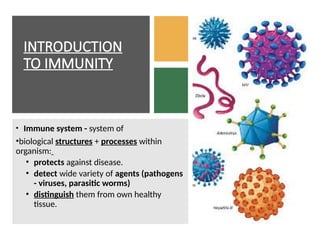
• Immune system - system of
•biological structures + processes within
organism:
• protects against disease.
• detect wide variety of agents (pathogens
- viruses, parasitic worms)
• distinguish them from own healthy
tissue.
COUNTER ACTION OF
THESE AGENTS
Agents referred to as
pathogens
organism / substance that
could cause a disease.
rapidly evolve + adapt to
avoid detection +
destruction by immune
system.
Multiple defence
mechanisms evolved to
recognize & neutralize
pathogens.
PHYSICAL
BARRIER
• Physical barriers prevent pathogens (bacteria +
viruses) from entering organism.
• If a pathogen enters through barriers  innate
immune system provides immediate but non-
specific response.
• Innate immune systems found in all plants +
animals
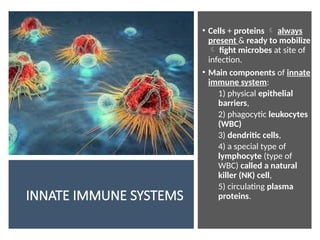
INNATE IMMUNE SYSTEMS
• Cells + proteins  always
present & ready to mobilize
 fight microbes at site of
infection.
• Main components of innate
immune system:
1) physical epithelial
barriers,
2) phagocytic leukocytes
(WBC)
3) dendritic cells,
4) a special type of
lymphocyte (type of
WBC) called a natural
killer (NK) cell,
5) circulating plasma
proteins.
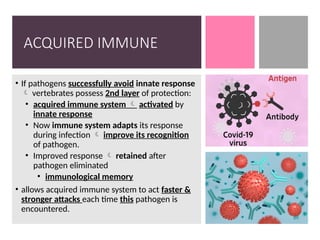
ACQUIRED IMMUNE
• If pathogens successfully avoid innate response
vertebrates possess
 2nd layer of protection:
• acquired immune system  activated by
innate response
• Now immune system adapts its response
during infection  improve its recognition
of pathogen.
• Improved response  retained after
pathogen eliminated
• immunological memory
• allows acquired immune system to act faster &
stronger attacks each time this pathogen is
encountered.
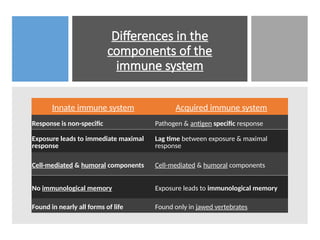
Differences in the
components of the
immune system
Innate immune system Acquired immune system
Response is non-specific Pathogen & antigen specific response
Exposure leads to immediate maximal
response
Lag time between exposure & maximal
response
Cell-mediated & humoral components Cell-mediated & humoral components
No immunological memory Exposure leads to immunological memory
Found in nearly all forms of life Found only in jawed vertebrates
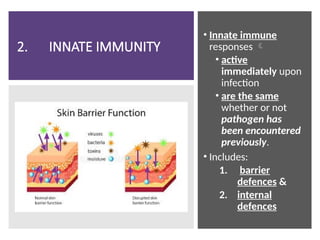
2. INNATE IMMUNITY
• Innate immune
responses 
• active
immediately upon
infection
• are the same
whether or not
pathogen has
been encountered
previously.
• Includes:
1. barrier
defences &
2. internal
defences
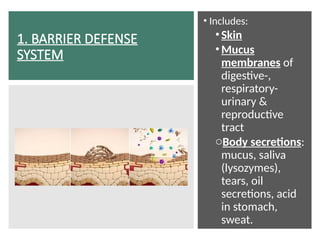
1. BARRIER DEFENSE
SYSTEM
• Includes:
•Skin
•Mucus
membranes of
digestive-,
respiratory-
urinary &
reproductive
tract
oBody secretions:
mucus, saliva
(lysozymes),
tears, oil
secretions, acid
in stomach,
sweat.
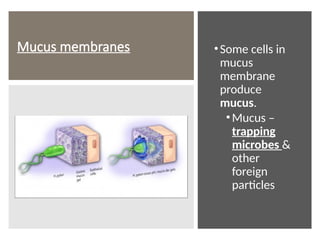
Mucus membranes •Some cells in
mucus
membrane
produce
mucus.
•Mucus –
trapping
microbes &
other
foreign
particles
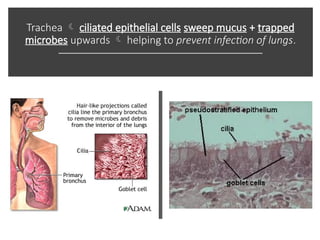
Trachea  ciliated epithelial cells sweep mucus + trapped
microbes upwards  helping to prevent infection of lungs.
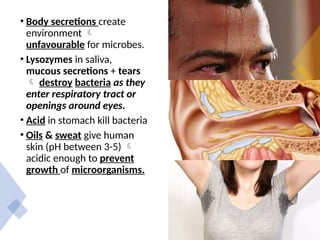
• Body secretions create
environment 
unfavourable for microbes.
• Lysozymes in saliva,
mucous secretions + tears
 destroy bacteria as they
enter respiratory tract or
openings around eyes.
• Acid in stomach kill bacteria
• Oils & sweat give human
skin (pH between 3-5) 
acidic enough to prevent
growth of microorganisms.
2. INTERNAL
DEFENSE
If barrier defences
damaged & pathogens
enter body of organism

• 2nd line of defence activated:
Internal defence system
 more sensitive +
includes phagocytosis +
inflammation.
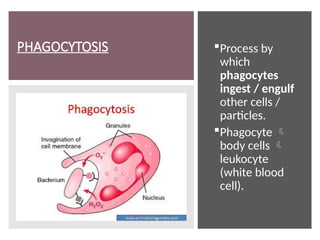
PHAGOCYTOSIS Process by
which
phagocytes
ingest / engulf
other cells /
particles.
Phagocyte 
body cells 
leukocyte
(white blood
cell).
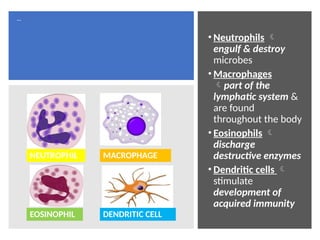
Different types of
:
• Neutrophils 
engulf & destroy
microbes
• Macrophages
part of the
lymphatic system &
are found
throughout the body
• Eosinophils 
discharge
destructive enzymes
• Dendritic cells 
stimulate
development of
acquired immunity
NEUTROPHIL MACROPHAGE
EOSINOPHIL DENDRITIC CELL
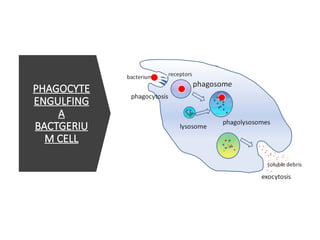
PHAGOCYTE
ENGULFING
A
BACTGERIU
M CELL
INFLAMMATORY
RESPONSES
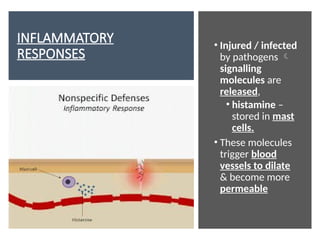
• Injured / infected
by pathogens 
signalling
molecules are
released,
• histamine –
stored in mast
cells.
• These molecules
trigger blood
vessels to dilate
& become more
permeable
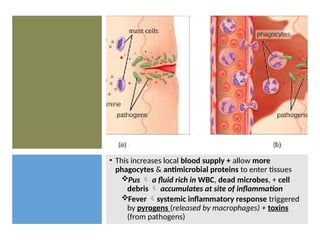
• This increases local blood supply + allow more
phagocytes & antimicrobial proteins to enter tissues
Pus  a fluid rich in WBC, dead microbes, + cell
debris  accumulates at site of inflammation
Fever systemic inflammatory response triggered
by pyrogens (released by macrophages) + toxins
(from pathogens)
MAJOR EVENTS IN A
LOCAL INFLAMMATORY
RESPONSE
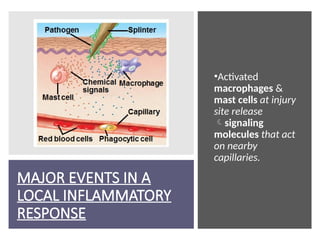
•Activated
macrophages &
mast cells at injury
site release
signaling
molecules that act
on nearby
capillaries.
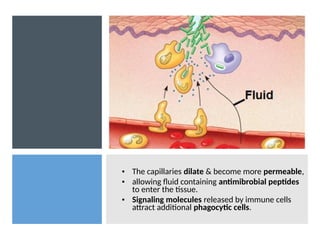
• The capillaries dilate & become more permeable,
• allowing fluid containing antimibrobial peptides
to enter the tissue.
• Signaling molecules released by immune cells
attract additional phagocytic cells.
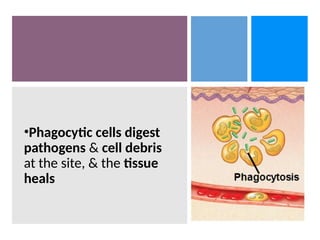
•Phagocytic cells digest
pathogens & cell debris
at the site, & the tissue
heals
ACQUIRED
IMMUNITY
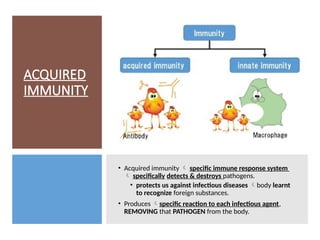
• Acquired immunity  specific immune response system
 specifically detects & destroys pathogens.
• protects us against infectious diseases body learnt
to recognize foreign substances.
• Produces specific reaction to each infectious agent,
REMOVING that PATHOGEN from the body.
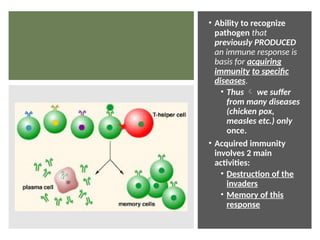
• Ability to recognize
pathogen that
previously PRODUCED
an immune response is
basis for acquiring
immunity to specific
diseases.
• Thus  we suffer
from many diseases
(chicken pox,
measles etc.) only
once.
• Acquired immunity
involves 2 main
activities:
• Destruction of the
invaders
• Memory of this
response
WHICH CELLS ARE
INVOLVED IN ACQUIRED
IMMUNITY RESPONSE?
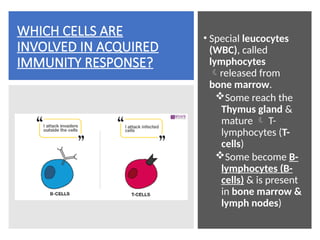
• Special leucocytes
(WBC), called
lymphocytes
released from
bone marrow.
Some reach the
Thymus gland &
mature  T-
lymphocytes (T-
cells)
Some become B-
lymphocytes (B-
cells) & is present
in bone marrow &
lymph nodes)
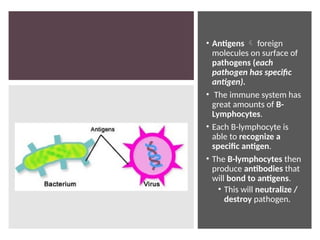
• Antigens  foreign
molecules on surface of
pathogens (each
pathogen has specific
antigen).
• The immune system has
great amounts of B-
Lymphocytes.
• Each B-lymphocyte is
able to recognize a
specific antigen.
• The B-lymphocytes then
produce antibodies that
will bond to antigens.
• This will neutralize /
destroy pathogen.
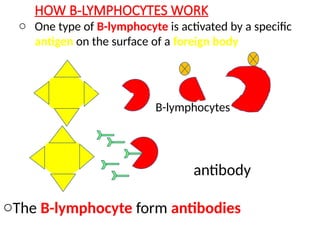
HOW B-LYMPHOCYTES WORK
antibody
B-lymphocytes
oThe B-lymphocyte form antibodies
o One type of B-lymphocyte is activated by a specific
antigen on the surface of a foreign body
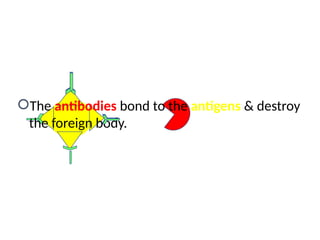
The antibodies bond to the antigens & destroy
the foreign body.
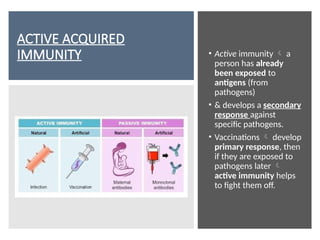
ACTIVE ACQUIRED
IMMUNITY • Active immunity  a
person has already
been exposed to
antigens (from
pathogens)
• & develops a secondary
response against
specific pathogens.
• Vaccinations  develop
primary response, then
if they are exposed to
pathogens later 
active immunity helps
to fight them off.
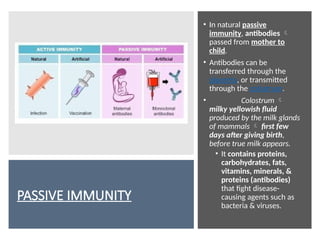
PASSIVE IMMUNITY
• In natural passive
immunity, antibodies 
passed from mother to
child.
• Antibodies can be
transferred through the
placenta, or transmitted
through the colostrum.
• Colostrum 
milky yellowish fluid
produced by the milk glands
of mammals  first few
days after giving birth,
before true milk appears.
• It contains proteins,
carbohydrates, fats,
vitamins, minerals, &
proteins (antibodies)
that fight disease-
causing agents such as
bacteria & viruses.
• Antibodies transmitted
through colostrum /
placenta only last for
several weeks
• long enough to
allow baby to start
to build up its own
immune system &
make its own
antibodies.
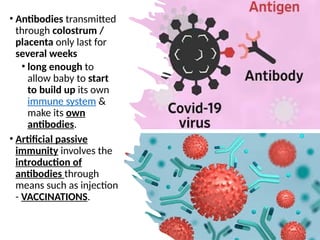
• Artificial passive
immunity involves the
introduction of
antibodies through
means such as injection
- VACCINATIONS.
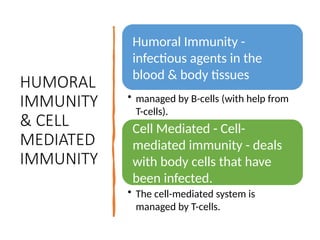
HUMORAL
IMMUNITY
& CELL
MEDIATED
IMMUNITY
Humoral Immunity -
infectious agents in the
blood & body tissues
• managed by B-cells (with help from
T-cells).
Cell Mediated - Cell-
mediated immunity - deals
with body cells that have
been infected.
• The cell-mediated system is
managed by T-cells.
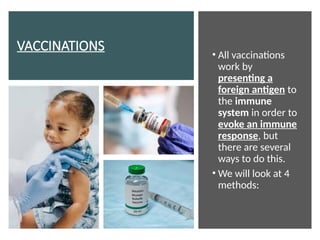
VACCINATIONS
• All vaccinations
work by
presenting a
foreign antigen to
the immune
system in order to
evoke an immune
response, but
there are several
ways to do this.
• We will look at 4
methods:
1. Using an
inactivated
vaccine
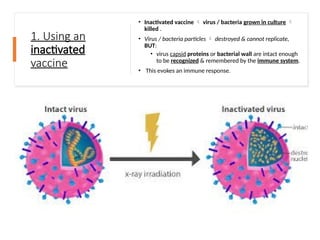
• Inactivated vaccine  virus / bacteria grown in culture 
killed .
• Virus / bacteria particles  destroyed & cannot replicate,
BUT:
• virus capsid proteins or bacterial wall are intact enough
to be recognized & remembered by the immune system.
• This evokes an immune response.
2. Using an
attenuated vaccine
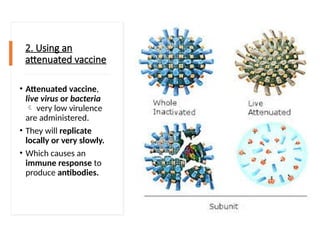
• Attenuated vaccine,
live virus or bacteria
 very low virulence
are administered.
• They will replicate
locally or very slowly.
• Which causes an
immune response to
produce antibodies.
3. Virus-like particle
vaccines
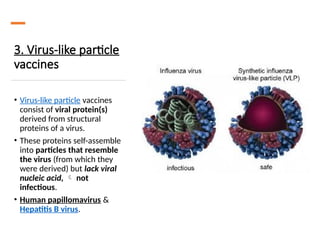
• Virus-like particle vaccines
consist of viral protein(s)
derived from structural
proteins of a virus.
• These proteins self-assemble
into particles that resemble
the virus (from which they
were derived) but lack viral
nucleic acid,  not
infectious.
• Human papillomavirus &
Hepatitis B virus.
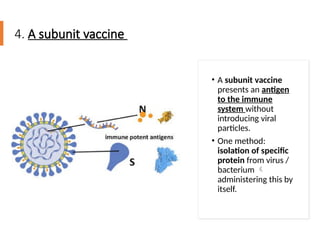
4. A subunit vaccine
• A subunit vaccine
presents an antigen
to the immune
system without
introducing viral
particles.
• One method:
isolation of specific
protein from virus /
bacterium 
administering this by
itself.
ANTIBIOTICS •Antibiotics are
also known as
anti-bacterials.
•They are drugs
used to treat
infections
caused by
bacteria.
• The first
antibiotic was
penicillin.
ANTIBIOTICS
• In 1952, penicillin was fully
effective against all strains of
staphylococcus bacteria, to such
an extent that by the early 1960s
the U.S. surgeon general, William
Stewart, felt confident enough
to declare: “The time has come to
close the book on infectious
diseases. We have basically
wiped out infection in the United
States.” Even as he spoke,
however, some 90 % of those
strains were in the process of
developing immunity to
penicillin. Soon one of these new
strains, called Methicillin-
Resistant Staphylococcus Aureus,
began to show up in hospitals.
Only 1 type of antibiotic,
vancomycin, remained effective
against it, but in 1997 a hospital
in Tokyo reported the
appearance of a strain that could
resist even that. Within months it
had spread to six other Japanese
hospitals. All over, the microbes
are beginning to win the war
again.
ANTIBIOTICS
• As James Surowiecki has
noted, given a choice
between developing
antibiotics that people
will take every day for
two weeks or
antidepressants that
people will take every
day forever, drug
companies not
surprisingly opt for the
latter.
• Although a few
antibiotics have been
toughened up a bit, the
pharmaceutical industry
hasn’t given us an
entirely new antibiotic
since the 1970s.
How do antibiotics work?
• Different types of
antibiotic,
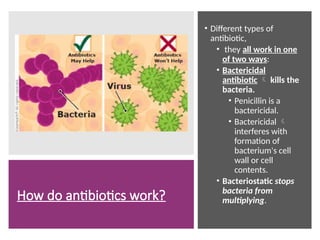
• they all work in one
of two ways:
• Bactericidal
antibiotic  kills the
bacteria.
• Penicillin is a
bactericidal.
• Bactericidal 
interferes with
formation of
bacterium's cell
wall or cell
contents.
• Bacteriostatic stops
bacteria from
multiplying.
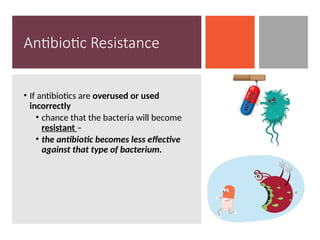
Antibiotic Resistance
• If antibiotics are overused or used
incorrectly
• chance that the bacteria will become
resistant –
• the antibiotic becomes less effective
against that type of bacterium.

Immune systems_Complete-(By Vuma KL).pptx

  • 1.
  • 2.
    INTRODUCTION TO IMMUNITY • Immunesystem - system of •biological structures + processes within organism: • protects against disease. • detect wide variety of agents (pathogens - viruses, parasitic worms) • distinguish them from own healthy tissue.
  • 3.
    COUNTER ACTION OF THESEAGENTS Agents referred to as pathogens organism / substance that could cause a disease. rapidly evolve + adapt to avoid detection + destruction by immune system. Multiple defence mechanisms evolved to recognize & neutralize pathogens.
  • 4.
    PHYSICAL BARRIER • Physical barriersprevent pathogens (bacteria + viruses) from entering organism. • If a pathogen enters through barriers  innate immune system provides immediate but non- specific response. • Innate immune systems found in all plants + animals
  • 5.
    INNATE IMMUNE SYSTEMS •Cells + proteins  always present & ready to mobilize  fight microbes at site of infection. • Main components of innate immune system: 1) physical epithelial barriers, 2) phagocytic leukocytes (WBC) 3) dendritic cells, 4) a special type of lymphocyte (type of WBC) called a natural killer (NK) cell, 5) circulating plasma proteins.
  • 6.
    ACQUIRED IMMUNE • Ifpathogens successfully avoid innate response vertebrates possess  2nd layer of protection: • acquired immune system  activated by innate response • Now immune system adapts its response during infection  improve its recognition of pathogen. • Improved response  retained after pathogen eliminated • immunological memory • allows acquired immune system to act faster & stronger attacks each time this pathogen is encountered.
  • 7.
    Differences in the componentsof the immune system Innate immune system Acquired immune system Response is non-specific Pathogen & antigen specific response Exposure leads to immediate maximal response Lag time between exposure & maximal response Cell-mediated & humoral components Cell-mediated & humoral components No immunological memory Exposure leads to immunological memory Found in nearly all forms of life Found only in jawed vertebrates
  • 8.
    2. INNATE IMMUNITY •Innate immune responses  • active immediately upon infection • are the same whether or not pathogen has been encountered previously. • Includes: 1. barrier defences & 2. internal defences
  • 9.
    1. BARRIER DEFENSE SYSTEM •Includes: •Skin •Mucus membranes of digestive-, respiratory- urinary & reproductive tract oBody secretions: mucus, saliva (lysozymes), tears, oil secretions, acid in stomach, sweat.
  • 10.
    Mucus membranes •Somecells in mucus membrane produce mucus. •Mucus – trapping microbes & other foreign particles
  • 11.
    Trachea  ciliatedepithelial cells sweep mucus + trapped microbes upwards  helping to prevent infection of lungs.
  • 12.
    • Body secretionscreate environment  unfavourable for microbes. • Lysozymes in saliva, mucous secretions + tears  destroy bacteria as they enter respiratory tract or openings around eyes. • Acid in stomach kill bacteria • Oils & sweat give human skin (pH between 3-5)  acidic enough to prevent growth of microorganisms.
  • 13.
    2. INTERNAL DEFENSE If barrierdefences damaged & pathogens enter body of organism  • 2nd line of defence activated: Internal defence system  more sensitive + includes phagocytosis + inflammation.
  • 14.
    PHAGOCYTOSIS Process by which phagocytes ingest/ engulf other cells / particles. Phagocyte  body cells  leukocyte (white blood cell).
  • 15.
    Different types of : •Neutrophils  engulf & destroy microbes • Macrophages part of the lymphatic system & are found throughout the body • Eosinophils  discharge destructive enzymes • Dendritic cells  stimulate development of acquired immunity NEUTROPHIL MACROPHAGE EOSINOPHIL DENDRITIC CELL
  • 16.
  • 17.
    INFLAMMATORY RESPONSES • Injured /infected by pathogens  signalling molecules are released, • histamine – stored in mast cells. • These molecules trigger blood vessels to dilate & become more permeable
  • 18.
    • This increaseslocal blood supply + allow more phagocytes & antimicrobial proteins to enter tissues Pus  a fluid rich in WBC, dead microbes, + cell debris  accumulates at site of inflammation Fever systemic inflammatory response triggered by pyrogens (released by macrophages) + toxins (from pathogens)
  • 19.
    MAJOR EVENTS INA LOCAL INFLAMMATORY RESPONSE •Activated macrophages & mast cells at injury site release signaling molecules that act on nearby capillaries.
  • 20.
    • The capillariesdilate & become more permeable, • allowing fluid containing antimibrobial peptides to enter the tissue. • Signaling molecules released by immune cells attract additional phagocytic cells.
  • 21.
    •Phagocytic cells digest pathogens& cell debris at the site, & the tissue heals
  • 22.
    ACQUIRED IMMUNITY • Acquired immunity specific immune response system  specifically detects & destroys pathogens. • protects us against infectious diseases body learnt to recognize foreign substances. • Produces specific reaction to each infectious agent, REMOVING that PATHOGEN from the body.
  • 23.
    • Ability torecognize pathogen that previously PRODUCED an immune response is basis for acquiring immunity to specific diseases. • Thus  we suffer from many diseases (chicken pox, measles etc.) only once. • Acquired immunity involves 2 main activities: • Destruction of the invaders • Memory of this response
  • 24.
    WHICH CELLS ARE INVOLVEDIN ACQUIRED IMMUNITY RESPONSE? • Special leucocytes (WBC), called lymphocytes released from bone marrow. Some reach the Thymus gland & mature  T- lymphocytes (T- cells) Some become B- lymphocytes (B- cells) & is present in bone marrow & lymph nodes)
  • 25.
    • Antigens foreign molecules on surface of pathogens (each pathogen has specific antigen). • The immune system has great amounts of B- Lymphocytes. • Each B-lymphocyte is able to recognize a specific antigen. • The B-lymphocytes then produce antibodies that will bond to antigens. • This will neutralize / destroy pathogen.
  • 26.
    HOW B-LYMPHOCYTES WORK antibody B-lymphocytes oTheB-lymphocyte form antibodies o One type of B-lymphocyte is activated by a specific antigen on the surface of a foreign body
  • 27.
    The antibodies bondto the antigens & destroy the foreign body.
  • 28.
    ACTIVE ACQUIRED IMMUNITY •Active immunity  a person has already been exposed to antigens (from pathogens) • & develops a secondary response against specific pathogens. • Vaccinations  develop primary response, then if they are exposed to pathogens later  active immunity helps to fight them off.
  • 29.
    PASSIVE IMMUNITY • Innatural passive immunity, antibodies  passed from mother to child. • Antibodies can be transferred through the placenta, or transmitted through the colostrum. • Colostrum  milky yellowish fluid produced by the milk glands of mammals  first few days after giving birth, before true milk appears. • It contains proteins, carbohydrates, fats, vitamins, minerals, & proteins (antibodies) that fight disease- causing agents such as bacteria & viruses.
  • 30.
    • Antibodies transmitted throughcolostrum / placenta only last for several weeks • long enough to allow baby to start to build up its own immune system & make its own antibodies. • Artificial passive immunity involves the introduction of antibodies through means such as injection - VACCINATIONS.
  • 31.
    HUMORAL IMMUNITY & CELL MEDIATED IMMUNITY Humoral Immunity- infectious agents in the blood & body tissues • managed by B-cells (with help from T-cells). Cell Mediated - Cell- mediated immunity - deals with body cells that have been infected. • The cell-mediated system is managed by T-cells.
  • 32.
    VACCINATIONS • All vaccinations workby presenting a foreign antigen to the immune system in order to evoke an immune response, but there are several ways to do this. • We will look at 4 methods:
  • 33.
    1. Using an inactivated vaccine •Inactivated vaccine  virus / bacteria grown in culture  killed . • Virus / bacteria particles  destroyed & cannot replicate, BUT: • virus capsid proteins or bacterial wall are intact enough to be recognized & remembered by the immune system. • This evokes an immune response.
  • 34.
    2. Using an attenuatedvaccine • Attenuated vaccine, live virus or bacteria  very low virulence are administered. • They will replicate locally or very slowly. • Which causes an immune response to produce antibodies.
  • 35.
    3. Virus-like particle vaccines •Virus-like particle vaccines consist of viral protein(s) derived from structural proteins of a virus. • These proteins self-assemble into particles that resemble the virus (from which they were derived) but lack viral nucleic acid,  not infectious. • Human papillomavirus & Hepatitis B virus.
  • 36.
    4. A subunitvaccine • A subunit vaccine presents an antigen to the immune system without introducing viral particles. • One method: isolation of specific protein from virus / bacterium  administering this by itself.
  • 37.
    ANTIBIOTICS •Antibiotics are alsoknown as anti-bacterials. •They are drugs used to treat infections caused by bacteria. • The first antibiotic was penicillin.
  • 38.
    ANTIBIOTICS • In 1952,penicillin was fully effective against all strains of staphylococcus bacteria, to such an extent that by the early 1960s the U.S. surgeon general, William Stewart, felt confident enough to declare: “The time has come to close the book on infectious diseases. We have basically wiped out infection in the United States.” Even as he spoke, however, some 90 % of those strains were in the process of developing immunity to penicillin. Soon one of these new strains, called Methicillin- Resistant Staphylococcus Aureus, began to show up in hospitals. Only 1 type of antibiotic, vancomycin, remained effective against it, but in 1997 a hospital in Tokyo reported the appearance of a strain that could resist even that. Within months it had spread to six other Japanese hospitals. All over, the microbes are beginning to win the war again.
  • 39.
    ANTIBIOTICS • As JamesSurowiecki has noted, given a choice between developing antibiotics that people will take every day for two weeks or antidepressants that people will take every day forever, drug companies not surprisingly opt for the latter. • Although a few antibiotics have been toughened up a bit, the pharmaceutical industry hasn’t given us an entirely new antibiotic since the 1970s.
  • 40.
    How do antibioticswork? • Different types of antibiotic, • they all work in one of two ways: • Bactericidal antibiotic  kills the bacteria. • Penicillin is a bactericidal. • Bactericidal  interferes with formation of bacterium's cell wall or cell contents. • Bacteriostatic stops bacteria from multiplying.
  • 41.
    Antibiotic Resistance • Ifantibiotics are overused or used incorrectly • chance that the bacteria will become resistant – • the antibiotic becomes less effective against that type of bacterium.