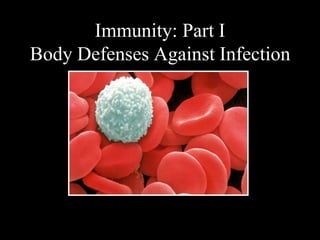
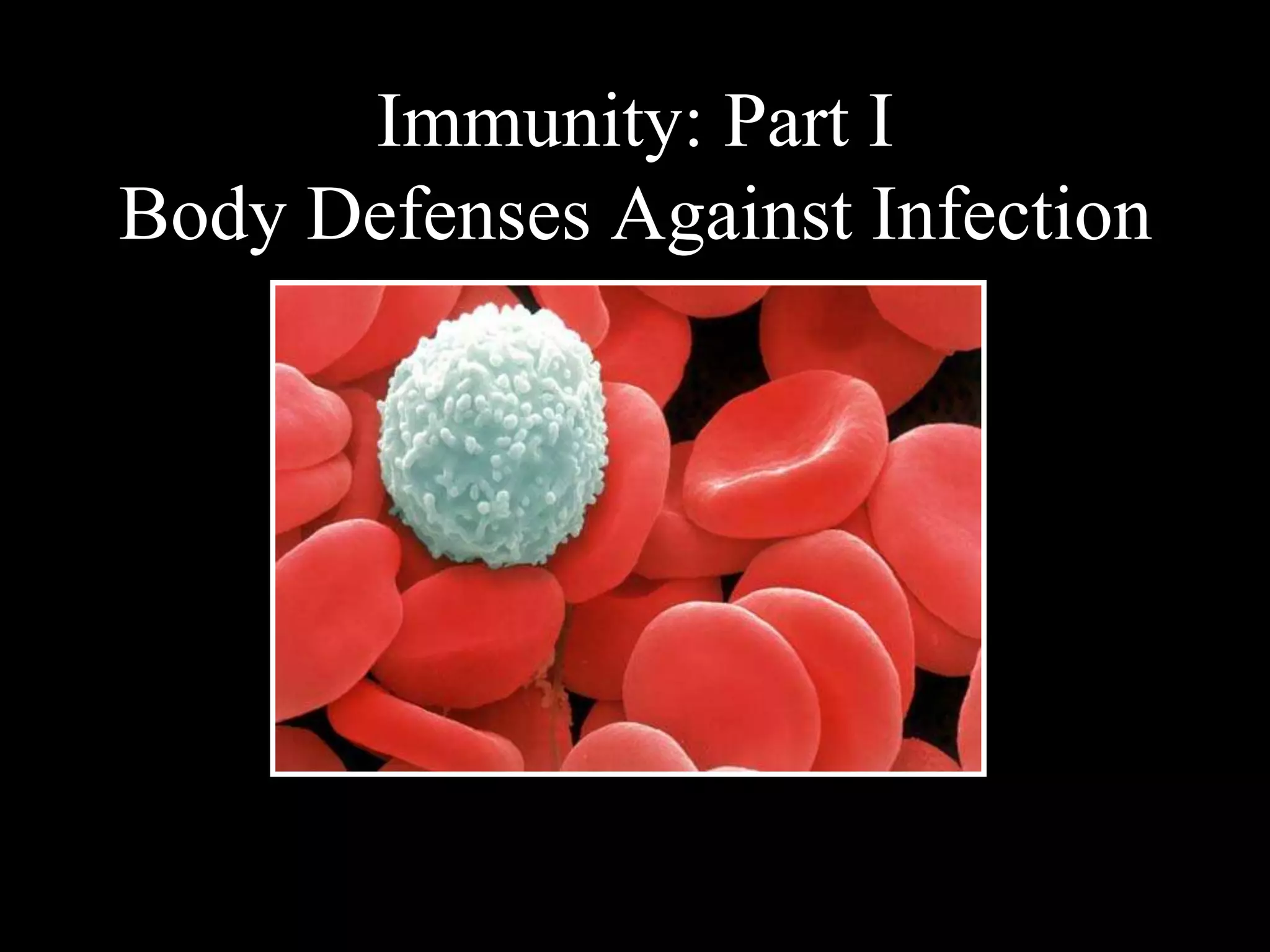
Immunity: Part I 
Body Defenses Against Infection
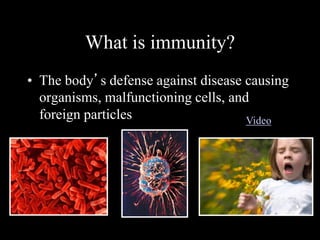
What is immunity? 
• The body’s defense against disease causing 
organisms, malfunctioning cells, and 
foreign particles Video
• Overview of Immunity: 
• Reconnaissance, Recognition, and Response 
• Two major kinds of defense have evolved that 
counter threats: 
– Innate immunity 
– Adaptive immunity 
Copyright © 2005 Pearson Education, Inc. publishing as Benjamin Cummings
Innate Immunity 
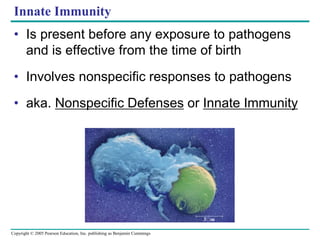
• Is present before any exposure to pathogens 
and is effective from the time of birth 
• Involves nonspecific responses to pathogens 
• aka. Nonspecific Defenses or Innate Immunity 
Copyright © 2005 Pearson Education, Inc. publishing as Benjamin Cummings 
3 m
Innate Immunity Includes: 
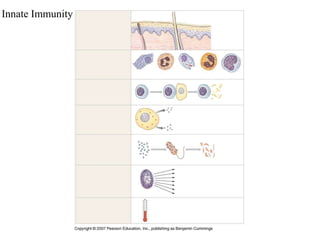
• Species resistance 
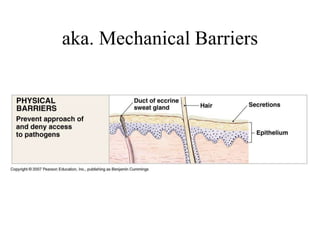
• Physical barriers 
• Phagocytic cells 
• Immunological surveillance 
• Interferons 
• Complement system 
• Inflammation 
• Fever 
Copyright © 2005 Pearson Education, Inc. publishing as Benjamin Cummings
Adaptive Defenses 
• Also called: 
– Specific defenses 
– Specific immunity 
– Acquired immunity 
• Develops only after exposure to inducing 
agents such as microbes, toxins, or other 
foreign substances (acquired) 
• Involves a very specific response to pathogens 
Copyright © 2005 Pearson Education, Inc. publishing as Benjamin Cummings
Innate Immunity
aka. Mechanical Barriers
External Defenses 
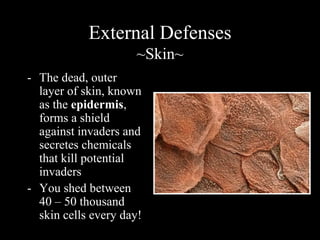
~Skin~ 
- The dead, outer 
layer of skin, known 
as the epidermis, 
forms a shield 
against invaders and 
secretes chemicals 
that kill potential 
invaders 
- You shed between 
40 – 50 thousand 
skin cells every day!
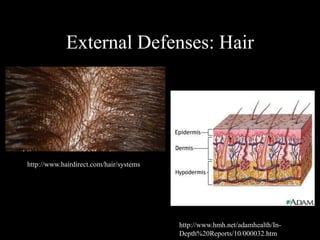
External Defenses: Hair 
http://www.hairdirect.com/hair/systems/s 
kin/hd10.aspx 
http://www.hmh.net/adamhealth/In- 
Depth%20Reports/10/000032.htm
• Secretions of the skin and mucous membranes 
– Provide an environment that is often hostile to 
microbes 
• Secretions from the skin 
– Give the skin a pH between 3 and 5, which is 
acidic enough to prevent colonization of many 
microbes 
– Also include proteins such as lysozyme, an 
enzyme that digests the cell walls of many 
bacteria 
Copyright © 2005 Pearson Education, Inc. publishing as Benjamin Cummings
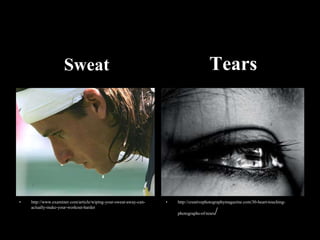
Sweat 
• http://www.examiner.com/article/wiping-your-sweat-away-can-actually- 
make-your-workout-harder 
Tears 
• http://creativephotographymagazine.com/30-heart-touching-photographs- 
of-tears/
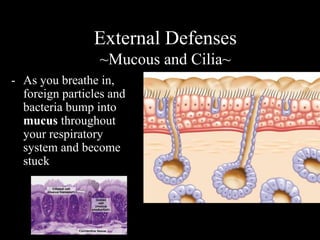
External Defenses 
~Mucous and Cilia~ 
- As you breathe in, 
foreign particles and 
bacteria bump into 
mucus throughout 
your respiratory 
system and become 
stuck
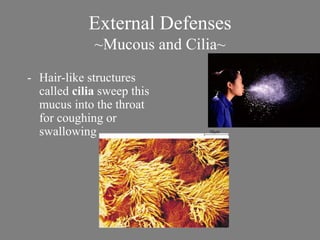
External Defenses 
~Mucous and Cilia~ 
- Hair-like structures 
called cilia sweep this 
mucus into the throat 
for coughing or 
swallowing
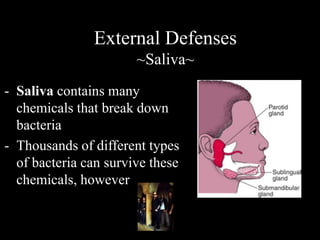
External Defenses 
~Saliva~ 
- Saliva contains many 
chemicals that break down 
bacteria 
- Thousands of different types 
of bacteria can survive these 
chemicals, however
External Defenses 
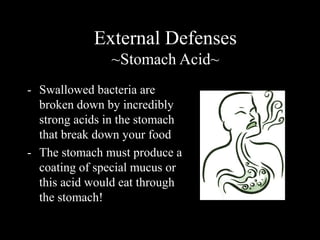
~Stomach Acid~ 
- Swallowed bacteria are 
broken down by incredibly 
strong acids in the stomach 
that break down your food 
- The stomach must produce a 
coating of special mucus or 
this acid would eat through 
the stomach!
Urinary Tract 
• Urine flushes the urinary passageways
Reproductive Tract 
• Glandular secretions flush structures of the 
reproductive system
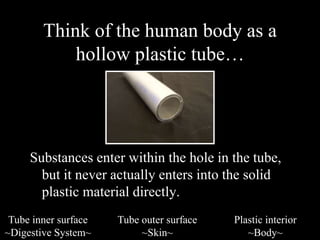
Think of the human body as a 
hollow plastic tube… 
Substances enter within the hole in the tube, 
but it never actually enters into the solid 
plastic material directly. 
Tube inner surface 
~Digestive System~ 
Plastic interior 
~Body~ 
Tube outer surface 
~Skin~
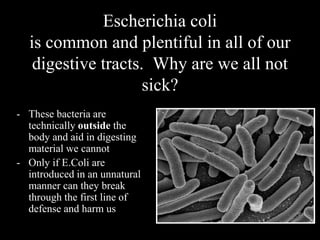
Escherichia coli 
is common and plentiful in all of our 
digestive tracts. Why are we all not 
sick? 
- These bacteria are 
technically outside the 
body and aid in digesting 
material we cannot 
- Only if E.Coli are 
introduced in an unnatural 
manner can they break 
through the first line of 
defense and harm us
Immunity part i intro_innate physical barriers

Immunity part i intro_innate physical barriers

  • 1.
    Immunity: Part I Body Defenses Against Infection
  • 2.
    What is immunity? • The body’s defense against disease causing organisms, malfunctioning cells, and foreign particles Video
  • 3.
    • Overview ofImmunity: • Reconnaissance, Recognition, and Response • Two major kinds of defense have evolved that counter threats: – Innate immunity – Adaptive immunity Copyright © 2005 Pearson Education, Inc. publishing as Benjamin Cummings
  • 4.
    Innate Immunity •Is present before any exposure to pathogens and is effective from the time of birth • Involves nonspecific responses to pathogens • aka. Nonspecific Defenses or Innate Immunity Copyright © 2005 Pearson Education, Inc. publishing as Benjamin Cummings 3 m
  • 5.
    Innate Immunity Includes: • Species resistance • Physical barriers • Phagocytic cells • Immunological surveillance • Interferons • Complement system • Inflammation • Fever Copyright © 2005 Pearson Education, Inc. publishing as Benjamin Cummings
  • 6.
    Adaptive Defenses •Also called: – Specific defenses – Specific immunity – Acquired immunity • Develops only after exposure to inducing agents such as microbes, toxins, or other foreign substances (acquired) • Involves a very specific response to pathogens Copyright © 2005 Pearson Education, Inc. publishing as Benjamin Cummings
  • 7.
  • 8.
  • 9.
    External Defenses ~Skin~ - The dead, outer layer of skin, known as the epidermis, forms a shield against invaders and secretes chemicals that kill potential invaders - You shed between 40 – 50 thousand skin cells every day!
  • 10.
    External Defenses: Hair http://www.hairdirect.com/hair/systems/s kin/hd10.aspx http://www.hmh.net/adamhealth/In- Depth%20Reports/10/000032.htm
  • 11.
    • Secretions ofthe skin and mucous membranes – Provide an environment that is often hostile to microbes • Secretions from the skin – Give the skin a pH between 3 and 5, which is acidic enough to prevent colonization of many microbes – Also include proteins such as lysozyme, an enzyme that digests the cell walls of many bacteria Copyright © 2005 Pearson Education, Inc. publishing as Benjamin Cummings
  • 12.
    Sweat • http://www.examiner.com/article/wiping-your-sweat-away-can-actually- make-your-workout-harder Tears • http://creativephotographymagazine.com/30-heart-touching-photographs- of-tears/
  • 13.
    External Defenses ~Mucousand Cilia~ - As you breathe in, foreign particles and bacteria bump into mucus throughout your respiratory system and become stuck
  • 14.
    External Defenses ~Mucousand Cilia~ - Hair-like structures called cilia sweep this mucus into the throat for coughing or swallowing
  • 15.
    External Defenses ~Saliva~ - Saliva contains many chemicals that break down bacteria - Thousands of different types of bacteria can survive these chemicals, however
  • 16.
    External Defenses ~StomachAcid~ - Swallowed bacteria are broken down by incredibly strong acids in the stomach that break down your food - The stomach must produce a coating of special mucus or this acid would eat through the stomach!
  • 17.
    Urinary Tract •Urine flushes the urinary passageways
  • 18.
    Reproductive Tract •Glandular secretions flush structures of the reproductive system
  • 19.
    Think of thehuman body as a hollow plastic tube… Substances enter within the hole in the tube, but it never actually enters into the solid plastic material directly. Tube inner surface ~Digestive System~ Plastic interior ~Body~ Tube outer surface ~Skin~
  • 20.
    Escherichia coli iscommon and plentiful in all of our digestive tracts. Why are we all not sick? - These bacteria are technically outside the body and aid in digesting material we cannot - Only if E.Coli are introduced in an unnatural manner can they break through the first line of defense and harm us

Editor's Notes

  • #5 Nonspecific immunity is maintained by mechanisms that attack any irritant or abnormal substance that threatens the internal invironment. Nonspecific immunity confers general protection rather than protection from certain kinds of invading cells or substances. These defenses function the same way regardless of the invader or the number of times a particular type of organism invades.
  • #9 1st line of defense for the body! External Defenses: Intact skin and mucous membranes Form physical barriers that bar the entry of microorganisms and viruses Certain cells of the mucous membranes produce mucus A viscous fluid that traps microbes and other particles
  • #10 The epidermis sloughs off, removing superficial bacteria with it. Sweat is a fluid that rinses away microorganisms and foreign substances.
  • #13 Mechanical washing away of substances Chemical agents within the fluid
  • #14 Normal airway lining diagram 1Cilia 2Mucous gland 3Mucous layer 4Goblet cell Mucus = a viscous fluid that traps microbes and other particles
  • #15 In the trachea, ciliated epithelial cells sweep mucus and any entrapped microbes upward, preventing the microbes from entering the lungs
  • #16 Human saliva is composed of 99.5% water, while the other 0.5% consists of electrolytes, mucus, glycoproteins, enzymes, and antibacterial compounds such as secretory IgA and lysozyme.
  • #17 Stomach = extremely hostile, even to our own cells Acidity = pH ranges from 1-2 to 4-5, depends on if and what you are eating (ex: with high protein meal, pH drops to lowest!)
  • #20 As long as the barriers remain intact, many pathogens are unable to penetrate them.
  • #21 Example of potential pathogen