
BASICS OF PHYTOCHEMISTRY
Delivered By-
Mrs. Poonam Nilesh Chougule
Assistant Professor
AMCP- Peth Vadgaon.
CONCEPTS:
 Modern methods of extraction,
 Application of latest technique like
Spectroscopy,
 Chromatography and
 Electrophoresis in the isolation,
 Purification and Identification of crude drugs.
MODERN METHODS OF EXTRACTION
 Extraction
 Methods of extraction:
 Maceration
 Percolation
 Modified Percolation
 Continuous Extraction(Soxhlet apparatus)
 Large scale extraction
 Super Critical fluid extraction
ISOLATION AND PURIFICATION
 Fractional Crystallization
 Fractional Distillation
 Fractional Liberation
 Sublimation
METHODS OF SEPARATION
 Chromatography:
 Paper Chromatography (PC)
 Thin Layer Chromatography (TLC)
 Gas liquid Chromatography (GLC)
 High Performance Liquid Chromatography
(HPLC)
 High Performance Thin Layer
Chromatography (HPTLC)
METHODS OF IDENTIFICATION
 Ultraviolet and Visible Spectroscopy
 Infrared Spectroscopy
 Mass Spectroscopy
 Nuclear Magnetic Resonance Spectroscopy
EXTRACTION
 It is defined as the process of isolation of soluble
material from an insoluble residue, which may be
liquid or solid, by treatment with a solvent.
 The crude drug contains the active constituents which
can be isolated from these drugs by various methods
of extraction and separation.
 Extraction methods are classified in to two
categories.
 Small scale extraction processes are like maceration
and percolation. This processes are slow and time
consuming.
 Large scale extraction is modified soxhlet extractor.
This extraction is easily with the help of attachments.
MACERATION
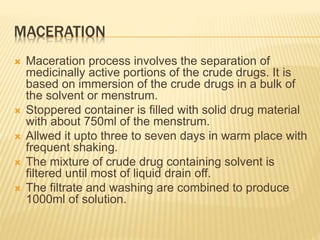
 Maceration process involves the separation of
medicinally active portions of the crude drugs. It is
based on immersion of the crude drugs in a bulk of
the solvent or menstrum.
 Stoppered container is filled with solid drug material
with about 750ml of the menstrum.
 Allwed it upto three to seven days in warm place with
frequent shaking.
 The mixture of crude drug containing solvent is
filtered until most of liquid drain off.
 The filtrate and washing are combined to produce
1000ml of solution.
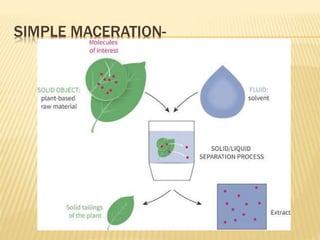
SIMPLE MACERATION-
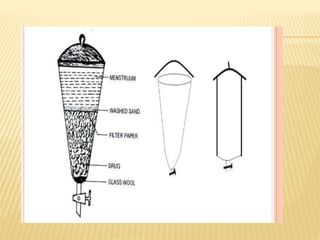
PERCOLATION.
 Percolation is continuous flow of the solvent
through the bed of the crude drug material to
get the extract.
 First step of process powdered drug is treated
with sufficient menstrum to make it uniformly
wet.
 Damp material is allowed to stand for about
15mins and then transfer to a percolator which
is generally ‘V’ shaped vessel open the both
ends.
 Sufficient menstrum is added to saturatenthe
drug. The lid is placed on top.
 The liquid starts dripping out from the outlet of
percolator, the lower opening is closed.
 The drug material is allow to macerate in the
vessel for 24 hrs, and then percolation is
continued gradually using sufficient menstrum to
produce 1000ml of solution.
 This process is dependent upon the flow of
solvent through the powdered drug and it yields
the product of greater concentration then
maceration products.
CONTINUOUS EXTRACTION:
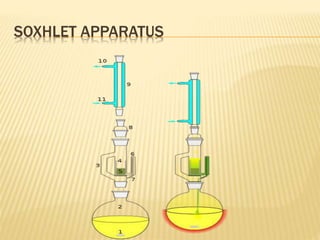
 Soxhlet apparatus: Soxhlet extraction is the
process of continuous extraction in which the
same solvent can be circulated through the
extractor for several times.
 This process involves extraction followed by
evaporation of solvent.
 The vapors of solvent are taken to condenser
and the condensed liquid is returned to the
drug for continue the extraction process.
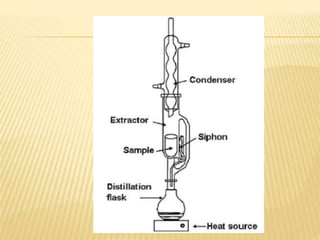
Soxhlet apparatus designed for
continuous extraction process.
It consists of:
•Body of extractor attached with side tube
and siphon tube.
•The extractor from the lower side can be
attached to distillation flask.
•Mouth of extractor is fixed to a condenser
by standard joints.
SOXHLET APPARATUS
PROCEDURE-
 The crude drug powder is packed in soxhlet apparatus
directly or in a thimble of filter paper or fine muslin.
 The powdered drug packing is completed, solvent is allow
to siphon once before heating. The fresh activated
porcelain pieces are added to the flask to avoid bumping of
solvent.
 The vapors pass through the side tube and condensed
liquid gradually increased the level of liquid in extractor and
in the siphon tube.
 A siphon is set up as the liquid reaches the point of return
and the contents of the extraction chamber are transferred
to the flask.
 The cycle of solvent evaporation and siphoning back can
be continued as many times as possible without changing
the solvent, so as to get efficient extraction.
 This method is continuous process is nothing but serious
of short maceration.
LARGE SCALE EXTRACTOR:
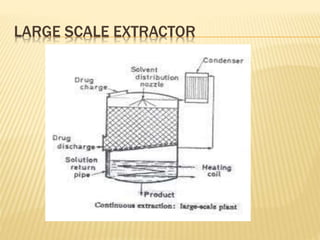
 Large scale extraction is meant for the extra large batches of
drug material, the various assemblies which are generally
attached with body of Soxhlet extractor are modified.
 The pilot plant extractor have separate extractor and
condenser unit. A separate inlet for loading the drug and an
outlet for drug discharge are provided.
 The extractor body is divided into two parts upper one for the
drug material and lower one as distillation chamber.
 The distillation chamber is electrically heated through heater.
The vapors of solvent passed through condenser and
condensed liquid is sprayed on the bed of crude drug with the
help of solvent distribution nozzle.
 Such large scale extractors are provided with the outlet from
the lower side of the extractor, for removing the extract.
LARGE SCALE EXTRACTOR
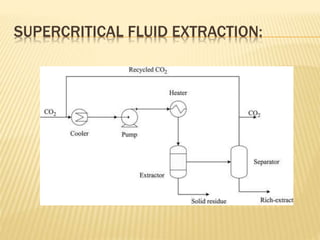
SUPER CRITICAL FLUID EXTRACTION
 This is recent method for extraction of drugs. A certain
gases are behave like a free flowing liquids or
supercritical fluids at the critical point of temperature and
pressure.
 Such Supercritical fluids have high penetrating power
and extraction efficiency.
 This principle was first used in food packing industries for
deodorization of the packed food products.
 The gases like CO₂ are held as supercritical fluid at the
critical point 73.83 bar pressure and 31.06ᵒ C
temperature.
 At this critical point CO₂ behave as liquefied gas or free
flowing and assists the extraction of the Phytochemical
SUPERCRITICAL FLUID EXTRACTION:
ADVANTAGES
 Carbon dioxide is used in supercritical
extraction has sterile and bacteriostatic
property.
 It is non combustible and non explosive.
 It is harmless to the environment and no
waste product are generated during the
process.
 It is available in large amount under
favorable condition.
ISOLATION AND PURIFICATION
FRACTIONAL CRYSTALLISATION
 It is an important method for the purification
of compounds from mixture.
 In fractional crystallization the compound is
mixed with a solvent, heated, and then
gradually cooled so that, as each of its
constituent components crystallizes, it can
be removed in its pure form from the
solution.
 Many natural products are crystalline in
nature even in mixture, process such as
concentration, slow evaporation, refrigeration
are used for crystallization
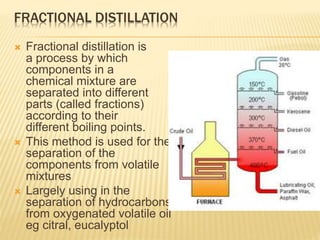
FRACTIONAL DISTILLATION
 Fractional distillation is
a process by which
components in a
chemical mixture are
separated into different
parts (called fractions)
according to their
different boiling points.
 This method is used for the
separation of the
components from volatile
mixtures
 Largely using in the
separation of hydrocarbons
from oxygenated volatile oil
eg citral, eucalyptol
FRACTIONAL LIBERATION
 In this process the groups of compounds having the tendency
of precipitation from the solution.
 This process is often used in separation of cinchona alkaloids,
morphine etc.
 Some groups of compounds lend themselves to fractional
liberation from a mixture , ex : a mixture of alkaloid salts in
aqueous solution when treated with aliquots of alkali , will give
first the weakest base in the free state followed by base
liberation in ascending order of basicity .
 If the mixture is shaken with an organic solvent after each
addition , then a fractionated series of bases will be obtained.
 A similar scheme can be used for organic acids soluble in
water – immiscible solvents ; in this case, starting with a
mixture of the acid salts , it is possible to fractionally liberate
the acids by addition of mineral acids .
SUBLIMATION
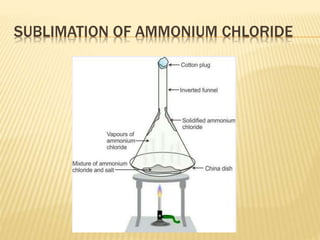
 Sublimation process the compound if subjected to
heating, changes from solid state to gaseous state
directly without passing through liquid state.
 Certain compounds from the gaseous state get
deposited on cooler surface in the form of crystals or
cake.
 Sublimation can also be used for the isolation of
caffeine from tea or for the purification of material
present in crude extract.
 In the inorganic compounds, sublimation is the well-
known process for the isolation and purification of
sulphur.
SUBLIMATION OF AMMONIUM CHLORIDE
METHODS OF SEPARATION
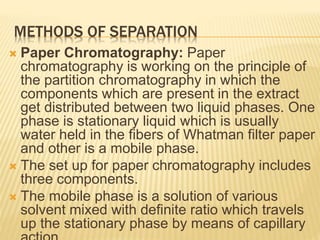
 Paper Chromatography: Paper
chromatography is working on the principle of
the partition chromatography in which the
components which are present in the extract
get distributed between two liquid phases. One
phase is stationary liquid which is usually
water held in the fibers of Whatman filter paper
and other is a mobile phase.
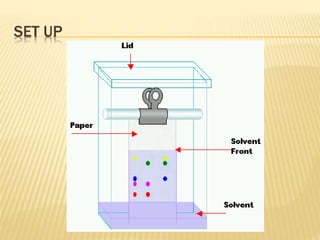
 The set up for paper chromatography includes
three components.
 The mobile phase is a solution of various
solvent mixed with definite ratio which travels
up the stationary phase by means of capillary
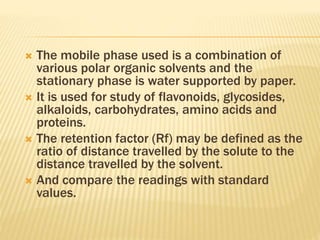
 The mobile phase used is a combination of
various polar organic solvents and the
stationary phase is water supported by paper.
 It is used for study of flavonoids, glycosides,
alkaloids, carbohydrates, amino acids and
proteins.
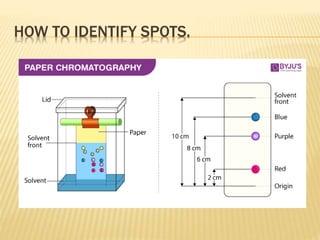
 The retention factor (Rf) may be defined as the
ratio of distance travelled by the solute to the
distance travelled by the solvent.
 And compare the readings with standard
values.
SET UP
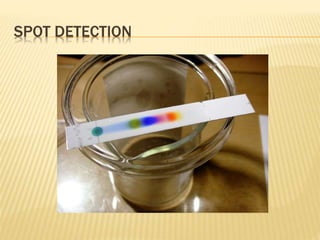
HOW TO IDENTIFY SPOTS.
THIN LAYER CHROMATOGRAPHY.
 Thin layer chromatography is also based on
the principle of partition as similar to paper
chromatography.
 It is used for the purpose of qualitative
screening of different plant extracts.
 In TLC the stationary phase used is generally
Silica gel G which is supported over glass or
aluminum plates and mobile phase is
different solvents or mixture of solvents.
PROCEDURE
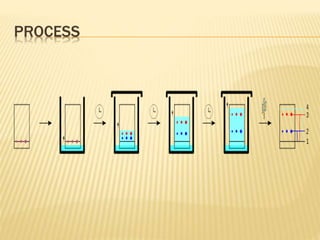
 Here this process is similar to paper chromatography. Spot of
extract is placed on the glass plates coated with Silica gel G
above 1cm from the bottom.
 After drying the plate is then inserted in TLC chamber filled
with solvent system having different combination for better
separation.
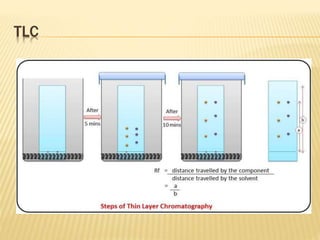
 The solvent system is then run up over the plate and the
components present in the extract is separated based on
their affinity for the stationary phase. The retention factor is
finally recorded as per paper chromatography.
 This process is faster then paper chromatography and better
separations.
 This technique is used for isolation of compounds on small
scale in the laboratories.
PROCESS
TLC
SPOT DETECTION
COLUMN CHROMATOGRAPHY
 Column chromatography is a separation
technique which is particularly used to
separate mixture of chemical substances into
its individual compound.
 It is one of the very common, successful and
widely used method for purification or
separation of chemical compound mixture in
lab to separate chemical constituents from
different plant extracts.
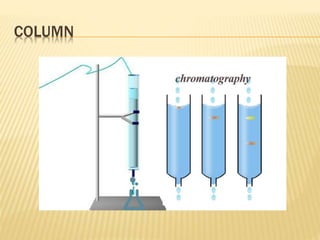
COLUMN
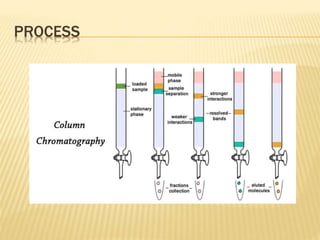
PROCESS
 Column chromatography consists of two
phases-
 Mobile phase- The mobile phase is consisting
of liquid which may be mixture of different
solvents.
 Contiguous stationary phase- The stationary
phase is solid. (Silica gel)
 The stationary phase- a column is used in
column chromatography which consist of a
glass tube with a circle large inlet and a small
outlet with a plug or tap.
 The column is placed vertically with a stand
where the outlet is downward.
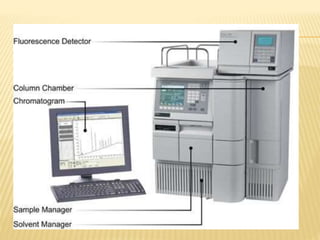
HIGH PERFORMANCE LIQUID CHROMATOGRAPHY
 HPLC is an advanced form of column
chromatography. This technique is mainly used
for the microanalysis of chemical constituents
present in plant extracts.
 This is basically a form of column chromatography
where packing material is of uniform particle size
and regular shape.
 HPLC is used to separate, identify and quantify
each component present in the mixture or extract.
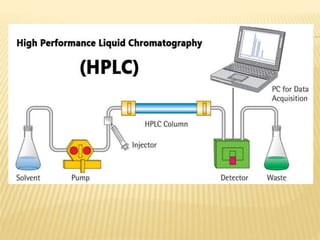
 It takes the help of a pump which pass
pressurized liquid solvent containing mixture of
components through the packed column.
 The column is packed with a adsorbent
material. The pressurized liquid is generally
mixture of solvents like water or acetonitrile
or methanol and it is referred as mobile
phase.
 The separation process relies on the
interaction between sample components
and adsorbent material.
 These interactions also the separation
process depends on the composition and
temperature.
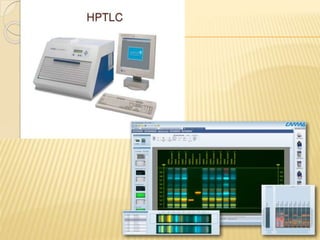
HIGH PERFORMANCE THIN LAYER CHROMATOGRAPHY
 HPTLC is the most advanced technique of TLC.
 It involves the use of highly efficient
chromatographic plates. HPTLC is associated
with advanced protocols like precise sample
application, development of standardized
reproducible chromatograms and software
controlled evaluation.
 In HPTLC samples to be separated are applied
over the self coated plates in the form of a band
without damage to the layer.
 The initial costs for HPTLC system as well as
maintenance, and costs per sample are
comparatively low.
 The possibility of visible evaluation of separated
samples on the plate is one of the most valuable
aspects of HPTLC.
 HPTLC is highly useful in the quantitative
analysis of natural products, herbal cosmetics
and it is also effective in the analysis of
pesticides and used in the biochemical
research.
METHODS OF IDENTIFICATION
 Phytochemical Screening by chemical tests-
• Tests for alkaloids
• Glycosides
• Carbohydrates
• Phytosterols
• Fixed oils
• Volatile oils
• Saponins
• Tannins
• Phenolic compounds
• Gums
• Mucilages
ULTRA VIOLET AND VISIBLE SPECTROSCOPY
 Spectrophotometric techniques utilized for the structural
elucidation of any isolated unknown chemical constituents.
 UV-visible spectroscopy is applicable to know degree of
conjugation in that isolated compounds.
 The absorption spectra of plant constituents can be measured
in the very dilute against a blank solvent by using automatic
recording spectrophotometer.
 If the isolated compound is colorless then it absorb in the range
of 200 to 400nm, i.e. UV range and if the isolated compound is
colored then it absorbs in the range of 400 to 700 nm, i.e.
Visible range.
 The wavelength of the maxima and minima from the absorption
spectrum of the compound is recorded in nm which can be
further compared with the standard peaks for their identification.
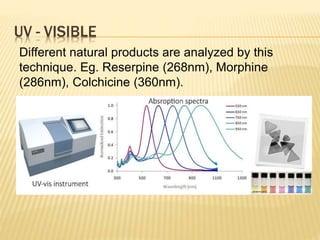
UV - VISIBLE
Different natural products are analyzed by this
technique. Eg. Reserpine (268nm), Morphine
(286nm), Colchicine (360nm).
INFRARED SPECTROSCOPY
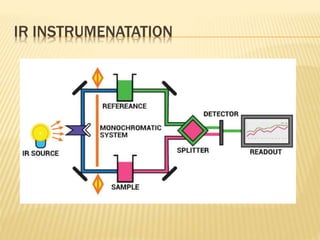
 IR spectroscopy is one of the most important
techniques used for characterization of
functional groups present in the plant
constituents.
 After isolation of chemical constituents from
plant parts they are subjected to different
spectroscopic techniques for their
characterization.
 IR spectroscopy produces the peaks as a result
of its study of reflected, absorbed or transmitted
radiant energy in the region of electromagnetic
spectrum wavelength ranging from 0.8 to
IR INSTRUMENATATION
MASS SPECTROSCOPY
 Mass spectroscopy is used to identify the
possible structure of the original molecules with
the help of study of various fragmentation
patterns.
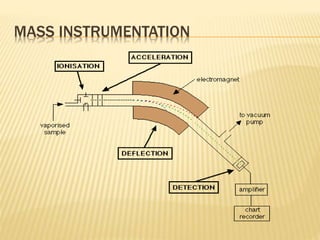
 Mass is mainly deal with electron ionization,
subsequent fragmentation of molecules,
determination of the mass to charge ratio and
relative abundance of ions that are produced.
Hence it helps to provide the molecular mass of
unknown compounds.
MASS INSTRUMENTATION
NUCLEAR MAGNETIC RESONANCE.
 NMR spectroscopy works on the principle of
absorption of ratio frequency radiation by the
substances which are kept in magnetic field.
 Due to interaction of radiation with magnetic
moment of nuclei present in the sample
absorption of radio frequency occurs in which
takes place at different frequencies for nuclei
with chemically different environment within a
molecule.
 It can be proton NMR i.e. 1H-NMR or 13C-
NMR.
 1H-NMR is used for determining the
structure of an organic compound by
measuring the chemical shift values of
different types proton present in it.
 13C-NMR spectroscopy gives direct
information on the nature of the carbon
skeleton of the molecule.
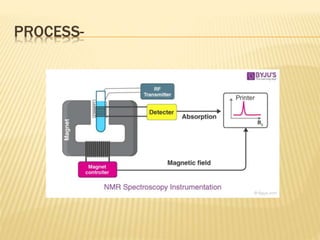
PROCESS-
THANK YOU.

Basics of Phytochemistry

  • 1.
    BASICS OF PHYTOCHEMISTRY DeliveredBy- Mrs. Poonam Nilesh Chougule Assistant Professor AMCP- Peth Vadgaon.
  • 2.
    CONCEPTS:  Modern methodsof extraction,  Application of latest technique like Spectroscopy,  Chromatography and  Electrophoresis in the isolation,  Purification and Identification of crude drugs.
  • 3.
    MODERN METHODS OFEXTRACTION  Extraction  Methods of extraction:  Maceration  Percolation  Modified Percolation  Continuous Extraction(Soxhlet apparatus)  Large scale extraction  Super Critical fluid extraction
  • 4.
    ISOLATION AND PURIFICATION Fractional Crystallization  Fractional Distillation  Fractional Liberation  Sublimation
  • 5.
    METHODS OF SEPARATION Chromatography:  Paper Chromatography (PC)  Thin Layer Chromatography (TLC)  Gas liquid Chromatography (GLC)  High Performance Liquid Chromatography (HPLC)  High Performance Thin Layer Chromatography (HPTLC)
  • 6.
    METHODS OF IDENTIFICATION Ultraviolet and Visible Spectroscopy  Infrared Spectroscopy  Mass Spectroscopy  Nuclear Magnetic Resonance Spectroscopy
  • 7.
    EXTRACTION  It isdefined as the process of isolation of soluble material from an insoluble residue, which may be liquid or solid, by treatment with a solvent.  The crude drug contains the active constituents which can be isolated from these drugs by various methods of extraction and separation.  Extraction methods are classified in to two categories.  Small scale extraction processes are like maceration and percolation. This processes are slow and time consuming.  Large scale extraction is modified soxhlet extractor. This extraction is easily with the help of attachments.
  • 8.
    MACERATION  Maceration processinvolves the separation of medicinally active portions of the crude drugs. It is based on immersion of the crude drugs in a bulk of the solvent or menstrum.  Stoppered container is filled with solid drug material with about 750ml of the menstrum.  Allwed it upto three to seven days in warm place with frequent shaking.  The mixture of crude drug containing solvent is filtered until most of liquid drain off.  The filtrate and washing are combined to produce 1000ml of solution.
  • 9.
  • 10.
    PERCOLATION.  Percolation iscontinuous flow of the solvent through the bed of the crude drug material to get the extract.  First step of process powdered drug is treated with sufficient menstrum to make it uniformly wet.  Damp material is allowed to stand for about 15mins and then transfer to a percolator which is generally ‘V’ shaped vessel open the both ends.
  • 11.
     Sufficient menstrumis added to saturatenthe drug. The lid is placed on top.  The liquid starts dripping out from the outlet of percolator, the lower opening is closed.  The drug material is allow to macerate in the vessel for 24 hrs, and then percolation is continued gradually using sufficient menstrum to produce 1000ml of solution.  This process is dependent upon the flow of solvent through the powdered drug and it yields the product of greater concentration then maceration products.
  • 13.
    CONTINUOUS EXTRACTION:  Soxhletapparatus: Soxhlet extraction is the process of continuous extraction in which the same solvent can be circulated through the extractor for several times.  This process involves extraction followed by evaporation of solvent.  The vapors of solvent are taken to condenser and the condensed liquid is returned to the drug for continue the extraction process.
  • 15.
    Soxhlet apparatus designedfor continuous extraction process. It consists of: •Body of extractor attached with side tube and siphon tube. •The extractor from the lower side can be attached to distillation flask. •Mouth of extractor is fixed to a condenser by standard joints.
  • 16.
  • 17.
    PROCEDURE-  The crudedrug powder is packed in soxhlet apparatus directly or in a thimble of filter paper or fine muslin.  The powdered drug packing is completed, solvent is allow to siphon once before heating. The fresh activated porcelain pieces are added to the flask to avoid bumping of solvent.  The vapors pass through the side tube and condensed liquid gradually increased the level of liquid in extractor and in the siphon tube.  A siphon is set up as the liquid reaches the point of return and the contents of the extraction chamber are transferred to the flask.  The cycle of solvent evaporation and siphoning back can be continued as many times as possible without changing the solvent, so as to get efficient extraction.  This method is continuous process is nothing but serious of short maceration.
  • 18.
    LARGE SCALE EXTRACTOR: Large scale extraction is meant for the extra large batches of drug material, the various assemblies which are generally attached with body of Soxhlet extractor are modified.  The pilot plant extractor have separate extractor and condenser unit. A separate inlet for loading the drug and an outlet for drug discharge are provided.  The extractor body is divided into two parts upper one for the drug material and lower one as distillation chamber.  The distillation chamber is electrically heated through heater. The vapors of solvent passed through condenser and condensed liquid is sprayed on the bed of crude drug with the help of solvent distribution nozzle.  Such large scale extractors are provided with the outlet from the lower side of the extractor, for removing the extract.
  • 19.
  • 20.
    SUPER CRITICAL FLUIDEXTRACTION  This is recent method for extraction of drugs. A certain gases are behave like a free flowing liquids or supercritical fluids at the critical point of temperature and pressure.  Such Supercritical fluids have high penetrating power and extraction efficiency.  This principle was first used in food packing industries for deodorization of the packed food products.  The gases like CO₂ are held as supercritical fluid at the critical point 73.83 bar pressure and 31.06ᵒ C temperature.  At this critical point CO₂ behave as liquefied gas or free flowing and assists the extraction of the Phytochemical
  • 21.
  • 22.
    ADVANTAGES  Carbon dioxideis used in supercritical extraction has sterile and bacteriostatic property.  It is non combustible and non explosive.  It is harmless to the environment and no waste product are generated during the process.  It is available in large amount under favorable condition.
  • 23.
    ISOLATION AND PURIFICATION FRACTIONALCRYSTALLISATION  It is an important method for the purification of compounds from mixture.  In fractional crystallization the compound is mixed with a solvent, heated, and then gradually cooled so that, as each of its constituent components crystallizes, it can be removed in its pure form from the solution.  Many natural products are crystalline in nature even in mixture, process such as concentration, slow evaporation, refrigeration are used for crystallization
  • 24.
    FRACTIONAL DISTILLATION  Fractionaldistillation is a process by which components in a chemical mixture are separated into different parts (called fractions) according to their different boiling points.  This method is used for the separation of the components from volatile mixtures  Largely using in the separation of hydrocarbons from oxygenated volatile oil eg citral, eucalyptol
  • 25.
    FRACTIONAL LIBERATION  Inthis process the groups of compounds having the tendency of precipitation from the solution.  This process is often used in separation of cinchona alkaloids, morphine etc.  Some groups of compounds lend themselves to fractional liberation from a mixture , ex : a mixture of alkaloid salts in aqueous solution when treated with aliquots of alkali , will give first the weakest base in the free state followed by base liberation in ascending order of basicity .  If the mixture is shaken with an organic solvent after each addition , then a fractionated series of bases will be obtained.  A similar scheme can be used for organic acids soluble in water – immiscible solvents ; in this case, starting with a mixture of the acid salts , it is possible to fractionally liberate the acids by addition of mineral acids .
  • 26.
    SUBLIMATION  Sublimation processthe compound if subjected to heating, changes from solid state to gaseous state directly without passing through liquid state.  Certain compounds from the gaseous state get deposited on cooler surface in the form of crystals or cake.  Sublimation can also be used for the isolation of caffeine from tea or for the purification of material present in crude extract.  In the inorganic compounds, sublimation is the well- known process for the isolation and purification of sulphur.
  • 27.
  • 28.
    METHODS OF SEPARATION Paper Chromatography: Paper chromatography is working on the principle of the partition chromatography in which the components which are present in the extract get distributed between two liquid phases. One phase is stationary liquid which is usually water held in the fibers of Whatman filter paper and other is a mobile phase.  The set up for paper chromatography includes three components.  The mobile phase is a solution of various solvent mixed with definite ratio which travels up the stationary phase by means of capillary
  • 29.
     The mobilephase used is a combination of various polar organic solvents and the stationary phase is water supported by paper.  It is used for study of flavonoids, glycosides, alkaloids, carbohydrates, amino acids and proteins.  The retention factor (Rf) may be defined as the ratio of distance travelled by the solute to the distance travelled by the solvent.  And compare the readings with standard values.
  • 30.
  • 31.
  • 32.
    THIN LAYER CHROMATOGRAPHY. Thin layer chromatography is also based on the principle of partition as similar to paper chromatography.  It is used for the purpose of qualitative screening of different plant extracts.  In TLC the stationary phase used is generally Silica gel G which is supported over glass or aluminum plates and mobile phase is different solvents or mixture of solvents.
  • 33.
    PROCEDURE  Here thisprocess is similar to paper chromatography. Spot of extract is placed on the glass plates coated with Silica gel G above 1cm from the bottom.  After drying the plate is then inserted in TLC chamber filled with solvent system having different combination for better separation.  The solvent system is then run up over the plate and the components present in the extract is separated based on their affinity for the stationary phase. The retention factor is finally recorded as per paper chromatography.  This process is faster then paper chromatography and better separations.  This technique is used for isolation of compounds on small scale in the laboratories.
  • 34.
  • 35.
  • 36.
  • 37.
    COLUMN CHROMATOGRAPHY  Columnchromatography is a separation technique which is particularly used to separate mixture of chemical substances into its individual compound.  It is one of the very common, successful and widely used method for purification or separation of chemical compound mixture in lab to separate chemical constituents from different plant extracts.
  • 38.
  • 39.
  • 40.
     Column chromatographyconsists of two phases-  Mobile phase- The mobile phase is consisting of liquid which may be mixture of different solvents.  Contiguous stationary phase- The stationary phase is solid. (Silica gel)  The stationary phase- a column is used in column chromatography which consist of a glass tube with a circle large inlet and a small outlet with a plug or tap.  The column is placed vertically with a stand where the outlet is downward.
  • 41.
    HIGH PERFORMANCE LIQUIDCHROMATOGRAPHY  HPLC is an advanced form of column chromatography. This technique is mainly used for the microanalysis of chemical constituents present in plant extracts.  This is basically a form of column chromatography where packing material is of uniform particle size and regular shape.  HPLC is used to separate, identify and quantify each component present in the mixture or extract.  It takes the help of a pump which pass pressurized liquid solvent containing mixture of components through the packed column.
  • 42.
     The columnis packed with a adsorbent material. The pressurized liquid is generally mixture of solvents like water or acetonitrile or methanol and it is referred as mobile phase.  The separation process relies on the interaction between sample components and adsorbent material.  These interactions also the separation process depends on the composition and temperature.
  • 45.
    HIGH PERFORMANCE THINLAYER CHROMATOGRAPHY  HPTLC is the most advanced technique of TLC.  It involves the use of highly efficient chromatographic plates. HPTLC is associated with advanced protocols like precise sample application, development of standardized reproducible chromatograms and software controlled evaluation.  In HPTLC samples to be separated are applied over the self coated plates in the form of a band without damage to the layer.
  • 46.
     The initialcosts for HPTLC system as well as maintenance, and costs per sample are comparatively low.  The possibility of visible evaluation of separated samples on the plate is one of the most valuable aspects of HPTLC.  HPTLC is highly useful in the quantitative analysis of natural products, herbal cosmetics and it is also effective in the analysis of pesticides and used in the biochemical research.
  • 48.
    METHODS OF IDENTIFICATION Phytochemical Screening by chemical tests- • Tests for alkaloids • Glycosides • Carbohydrates • Phytosterols • Fixed oils • Volatile oils • Saponins • Tannins • Phenolic compounds • Gums • Mucilages
  • 49.
    ULTRA VIOLET ANDVISIBLE SPECTROSCOPY  Spectrophotometric techniques utilized for the structural elucidation of any isolated unknown chemical constituents.  UV-visible spectroscopy is applicable to know degree of conjugation in that isolated compounds.  The absorption spectra of plant constituents can be measured in the very dilute against a blank solvent by using automatic recording spectrophotometer.  If the isolated compound is colorless then it absorb in the range of 200 to 400nm, i.e. UV range and if the isolated compound is colored then it absorbs in the range of 400 to 700 nm, i.e. Visible range.  The wavelength of the maxima and minima from the absorption spectrum of the compound is recorded in nm which can be further compared with the standard peaks for their identification.
  • 50.
    UV - VISIBLE Differentnatural products are analyzed by this technique. Eg. Reserpine (268nm), Morphine (286nm), Colchicine (360nm).
  • 51.
    INFRARED SPECTROSCOPY  IRspectroscopy is one of the most important techniques used for characterization of functional groups present in the plant constituents.  After isolation of chemical constituents from plant parts they are subjected to different spectroscopic techniques for their characterization.  IR spectroscopy produces the peaks as a result of its study of reflected, absorbed or transmitted radiant energy in the region of electromagnetic spectrum wavelength ranging from 0.8 to
  • 52.
  • 53.
    MASS SPECTROSCOPY  Massspectroscopy is used to identify the possible structure of the original molecules with the help of study of various fragmentation patterns.  Mass is mainly deal with electron ionization, subsequent fragmentation of molecules, determination of the mass to charge ratio and relative abundance of ions that are produced. Hence it helps to provide the molecular mass of unknown compounds.
  • 54.
  • 55.
    NUCLEAR MAGNETIC RESONANCE. NMR spectroscopy works on the principle of absorption of ratio frequency radiation by the substances which are kept in magnetic field.  Due to interaction of radiation with magnetic moment of nuclei present in the sample absorption of radio frequency occurs in which takes place at different frequencies for nuclei with chemically different environment within a molecule.
  • 56.
     It canbe proton NMR i.e. 1H-NMR or 13C- NMR.  1H-NMR is used for determining the structure of an organic compound by measuring the chemical shift values of different types proton present in it.  13C-NMR spectroscopy gives direct information on the nature of the carbon skeleton of the molecule.
  • 57.
  • 58.