Kunal P. Deshmukh
Assistant Professor
School of Life Sciences
S.R.T.M.University Nanded.
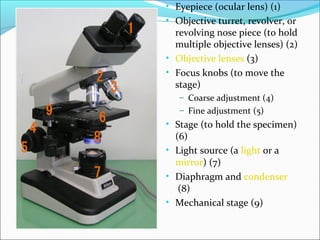
• Eyepiece (ocular lens) (1)
• Objective turret, revolver, or
revolving nose piece (to hold
multiple objective lenses) (2)
• Objective lenses (3)
• Focus knobs (to move the
stage)
– Coarse adjustment (4)
– Fine adjustment (5)
• Stage (to hold the specimen)
(6)
• Light source (a light or a
mirror) (7)
• Diaphragm and condenser
(8)
• Mechanical stage (9)
Eyepiece (ocular lens)
The eyepiece, or ocular lens, is a cylinder containing two or more lenses; its function is to bring the image 
into  focus  for  the  eye.  The  eyepiece  is  inserted  into  the  top  end  of  the  body  tube.  Eyepieces  are 
interchangeable and many different eyepieces can be inserted with different degrees of magnification. Typical 
magnification values for eyepieces include 2×, 50× and 10×.
Objective turret (revolver or revolving nose piece)
Objective turret, revolver, or revolving nose piece is the part that holds the set of objective lenses.
Objective 
At the lower end of a typical compound optical microscope, there are one or more objective lenses that collect 
light from the sample. The objective is usually in a cylinder housing containing a glass single or multi-element 
compound lens. Typically there will be around three objective lenses screwed into a circular nose piece which 
may  be  rotated  to  select  the  required  objective  lens.Microscope  objectives  are  characterized  by  two 
parameters, namely, magnification and numerical aperture. The former typically ranges from 5× to 100× while 
the latter ranges from 0.14 to 0.7, corresponding to focal lengths of about 40 to 2 mm, respectively. Objective 
lenses with higher magnifications normally have a higher numerical aperture and a shorter depth of field in 
the resulting image.
Oil immersion
Some microscopes make use of oil-immersion objectives
 or  water-immersion  objectives  for  greater  resolution  at 
high  magnification.  These  are  used  with 
index-matching material such  as immersion oil or  water 
and a matched cover slip between the objective lens and 
the  sample.  The  refractive  index  of  the  index-matching 
material is higher than air allowing the objective lens to 
have a larger numerical aperture (greater than 1) so that 
the light is transmitted from the specimen to the outer face 
of the objective lens with minimal refraction. Numerical 
apertures  as  high  as  1.6  can  be  achieved.The  larger 
numerical aperture allows collection of more light making 
detailed  observation  of  smaller  details  possible.  An  oil 
immersion lens usually has a magnification of 40 to 100×.
Focus knobs
Adjustment knobs move the stage up and down with separate adjustment for coarse and fine 
focusing.  The  same  controls  enable  the  microscope  to  adjust  to  specimens  of  different 
thickness.
Frame
The whole of the optical assembly is traditionally attached to a rigid arm, which in turn is 
attached to a robust U-shaped foot to provide the necessary rigidity. The arm angle may be 
adjustable to allow the viewing angle to be adjusted.
The frame provides  a  mounting  point  for  various microscope controls. Normally  this will 
include controls for focusing, typically a large knurled wheel to adjust coarse focus, together 
with  a  smaller  knurled  wheel  to  control  fine  focus.  Other  features  may  be  lamp  controls 
and/or controls for adjusting the condenser.
Stage
The  stage  is  a  platform  below  the  objective  which 
supports the specimen being viewed. In the center of 
the  stage  is  a  hole  through  which  light  passes  to 
illuminate the specimen. The stage usually has arms to 
hold slides (rectangular  glass  plates  with  typical 
dimensions of 25×75 mm, on which the specimen is 
mounted).
Light source 
Many  sources  of  light  can  be  used.  At  its  simplest, 
daylight  is  directed  via  a mirror.  Most  microscopes, 
however,  have  their  own  adjustable  and  controllable 
light  source  –  often  a halogen lamp,  although 
illumination  using LEDs and lasers are  becoming  a 
more common provision.
Condenser
The condenser is  a  lens  designed  to  focus  light  from  the 
illumination  source  onto  the  sample.  The  condenser  may  also 
include other features, such as a diaphragm and/or filters, to manage 
the  quality  and  intensity  of  the  illumination.  For  illumination 
techniques  like dark  field, phase  contrast and differential 
interference  contrast microscopy  additional  optical  components 
must be precisely aligned in the light path.
Magnification
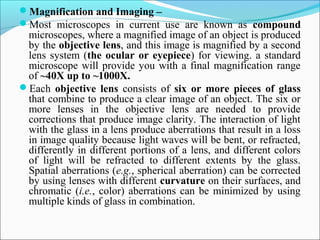
The  actual  power  or   magnification of  a  compound  optical 
microscope  is  the  product  of  the  powers  of  the  ocular  (eyepiece) 
and the objective lens. The maximum normal magnifications of the 
ocular and objective are 10× and 100× respectively, giving a final 
magnification of 1,000×.
Principles of Microscopy
- Resolution –
Resolution is defined as the ability to distinguish two very small
and closely-spaced objects as separate entities. Resolution is best 
when the distance separating the two tiny objects is small. Resolution 
is  determined  by  certain  physical  parameters  that  include  the 
wavelength of light, and the light-gathering power of the
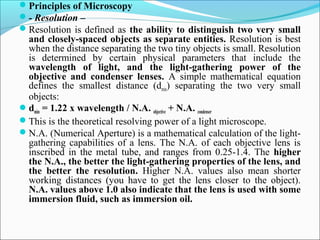
objective and condenser lenses. A  simple  mathematical  equation 
defines  the  smallest  distance  (dmin)  separating  the  two  very  small 
objects:
dmin = 1.22 x wavelength / N.A. objective + N.A. condenser
This is the theoretical resolving power of a light microscope.
N.A. (Numerical Aperture) is a mathematical calculation of the light-
gathering capabilities of a lens. The N.A. of each objective lens is 
inscribed  in  the  metal  tube,  and  ranges  from  0.25-1.4.  The  higher
the N.A., the better the light-gathering properties of the lens, and
the better the resolution.  Higher  N.A.  values  also  mean  shorter 
working  distances  (you  have  to  get  the  lens  closer  to  the  object). 
N.A. values above 1.0 also indicate that the lens is used with some
immersion fluid, such as immersion oil.
From  the  equation  above,  it  should  also  be  clear  that  shorter
wavelength light (bluer light) will provide you with better resolution 
(smaller dmin values).
In the early 1950's, a UV microscope was designed, but required quartz 
objectives and a specialized imaging device. The quartz lenses provided 
slightly better resolution (dmin = 0.1 µm), The human eye is best adapted 
for  green  light  and  our  ability  to  see  detail  may  be  compromised 
somewhat  with  the  use  of  blue  or  violet.  Most  manufacturers  of 
microscopes correct their simplest lenses (achromats) for green light.
-
Magnification and Imaging –
Most  microscopes  in  current  use  are  known  as  compound
microscopes, where a magnified image of an object is produced 
by the objective lens, and this image is magnified by a second 
lens system (the ocular or eyepiece) for viewing. a standard 
microscope will provide you with a final magnification range 
of ~40X up to ~1000X.
Each  objective lens consists  of  six or more pieces of glass
that combine to produce a clear image of an object. The six or 
more  lenses  in  the  objective  lens  are  needed  to  provide 
corrections that produce image clarity. The interaction of light 
with the glass in a lens produce aberrations that result in a loss 
in image quality because light waves will be bent, or refracted, 
differently in different portions of a lens, and different colors 
of  light  will  be  refracted  to  different  extents  by  the  glass. 
Spatial aberrations (e.g., spherical aberration) can be corrected 
by using lenses with different curvature on their surfaces, and 
chromatic (i.e., color) aberrations can be minimized by using 
multiple kinds of glass in combination.
These corrections increase the cost of the lens to the extent that an 
apochromatic  objective  lens  exhibiting  full  color  correction  and 
extremely  high  N.A.  can  cost  several  thousand  dollars.  This 
objective lens is about the size of your thumb.
The objective lenses in most microscopes are achromats,(achromat 
means=  a  lens  that  transmit  light  without  separating  it  into 
constituent  colore)    and  best  suited  for  imaging  with  green  light. 
Green filters narrow the bandwidth of the light, and make achromat 
objectives reasonably effective for most routine uses. The achromat 
lenses  are  not  suitable  for  critical  high-resolution  imaging  with 
white  light,  because  red  and  blue  light  do  not  focus  in  the  same 
plane as green light. Chromatic aberrations will degrade resolution 
in  color  images  obtained  with  achromatic  objectives.  Color 
photomicrography  aimed  at  the  highest  level  of  resolution  and 
image  clarity  should  be  performed  with  totally  corrected 
apochromatic  objective  lenses.(  apochromatic  is  photographic  or 
other  lens  that  has  better  correction  of  chromatic  and  spherical 
abbreation than the much more common  achromat lenses. 
Apochromatic lenses are usually made up of three
elements and brings light of three different frequencies
to a common focus.  Apochromatic  glasses  made  up  of 
flouro crown glasses and flint glasses).  Fluorite lenses, 
offer  intermediate  levels  of  correction,  better  than 
achromats  but  not  as  good  as  apochromats.  Fluorite
lenses are well suited for fluorescence microscopy
because of their high transmittance of shorter
wavelength light. Higher  levels  of  correction  make 
objective  lenses  more  expensive;  the  price  range  for 
apochromatic objectives goes from about $3,000 to over 
$10,000. when you look into a microscope, the magnified 
and  corrected  image  you  see  through  the  oculars  is 
actually a virtual image (as opposed to a real image). The 
ocular, designed to provide a corrected virtual image when 
viewed  by  eye,  is  not  suitable  for  the  generation  of 
photographic or video images through the microscope. For 
photography or video microscopy it is necessary to use a 
projection lens that generates a corrected real image.
- Illumination -
An essential factor in producing a good image with the light microscope 
is obtaining adequate levels of light in the specimen, or object plane. 
It is not only necessary to obtain bright light around the object, but for 
optimal imaging, the light should be uniform across the field of view. 
The best way to illuminate the specimen involves the use of yet another 
lens system, known as a condenser. The front element of the condenser 
is usually a large, flattened lens that sits directly beneath the specimen. 
Its placement on a movable rack provides you with the means to focus 
the light beam coming past the object and maximixe the intensity and 
control the uniformity of illumination. It may be necessary to center the 
field aperture diaphragm, using the condenser centering screws. When 
the microscope is properly illuminated, both the object and the edges of 
the field aperture diaphragm should be in the same plane of focus and 
the field iris diaphragm should be centered in the field of view.
Light Microscopy
The optical microscope,  often  referred  to  as  the 
"light microscope", is a type   of microscope which 
uses visible  light and  a  system  of lenses to  magnify 
images  of  small  samples.  The  light  microscope,  so 
called because it employs visible light to detect small 
objects,  is  probably  the  most  well-known  and  well-
used  research  tool  in  biology.  The  smallest  objects 
that are considered to be living are the bacteria. The 
smallest  bacteria  can  be  observed  and  cell  shape 
recognized at a mere 100x magnification.

Types of light microscopes
Bright Field Microscopy
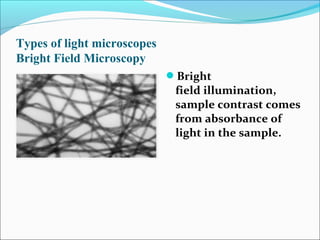
Bright
field illumination,
sample contrast comes
from absorbance of
light in the sample.
With  a  conventional  bright  field  microscope,  light  from  an 
incandescent source is aimed toward a lens beneath the stage called 
the condenser, through the specimen, through an objective lens, and 
to the eye through a second magnifying lens, the ocular or eyepiece. 
We  see  objects  in  the  light  path  because  natural  pigmentation  or 
stains absorb light differentially, or because they are thick enough to 
absorb  a  significant  amount  of  light  despite  being  colorless. 
A Paramecium should  show  up  fairly  well  in  a  bright  field 
microscope,  although  it  will  not  be  easy  to  see  cilia  or  most 
organelles. After passing through the specimen, the light is displayed 
to the eye with an apparent field that is much larger than the area 
illuminated Students are usually aware of the use of the coarse and 
fine focus knobs, used to sharpen the image of the specimen. They 
are  frequently  unaware  of  adjustments  to  the  condenser  that  can 
affect resolution and contrast. Some condensers are fixed in position, 
others are focusable, so that the quality of light can be adjusted.
Steps while Using a bright field microscope
1) Mount the specimen on the stage
2) Optimize the lighting
3) Adjust the condenser
4) Think about what you are looking for
5) Focus, locate, and center the specimen
6) Adjust eyepiece separation, focus
7) Select an objective lens for viewing
The  lowest  power  lens  is  usually  3.5 or 4x,  and  is 
used  primarily  for  initially  finding specimens.  We 
sometimes  call  it  the  scanning  lens  for  that  reason. 
The  most  frequently  used  objective  lens  is  the  10x 
lens, which gives a final magnification of 100x with a 
10x ocular lens. For very small protists and for details 
in prepared slides such as cell organelles or mitotic
figures, you will need a higher magnification. 
Typical high magnification lenses are 40x and 97x or
100x.  The  latter  two  magnifications  are  used 
exclusively with oil in order to improve resolution.
Higher magnification lenses must be physically closer 
to  the  specimen  itself,  which  poses  the  risk  of 
jamming  the  objective  into  the  specimen.  Be  very 
cautious when focusing
8) Adjust illumination for the selected objective lens
9) When to use bright field microscopy
Bright  field  microscopy  is  best  suited  to  viewing  stained  or  naturally  pigmented 
specimens such as stained prepared slides of tissue sections or living photosynthetic 
organisms.  It  is  useless  for  living  specimens  of  bacteria,  and  inferior  for  non-
photosynthetic  protists  or  metazoans,  or  unstained  cell  suspensions  or  tissue 
sections. 
Prepared slides, stained - bacteria (1000x), thick tissue sections (100x, 400x), thin 
sections  with  condensed  chromosomes  or  specially  stained  organelles  (1000x), 
large protists or metazoans (100x). 
Smears, stained - blood (400x, 1000x), negative stained bacteria (400x, 1000x). 
Living preparations (wet mounts, unstained) - pond water (40x, 100x, 400x), living 
protists or metazoans (40x, 100x, 400x occasionally), algae and other microscopic 
plant  material  (40x,  100x,  400x).  Smaller  specimens  will  be  difficult  to  observe 
without distortion, especially if they have no pigmentation.
distortion, especially if they have no pigmentation.
Care of the microscope
EVERYTHING on a good quality microscope is unbelievably expensive, so be careful.
Hold  a  microscope  firmly  by  the  stand,  only.  Never  grab  it  by  the  eyepiece  holder,  for 
example.
Hold the plug (not the cable) when unplugging the illuminator.
Since bulbs are expensive, and have a limited life, turn the illuminator off when you are done.
Always make sure the stage and lenses are clean before putting away the microscope.
NEVER use a paper towel, a kimwipe, your shirt, or any material other than good quality lens 
tissue or a cotton swab (must be 100% natural cotton) to clean an optical surface. Be gentle! 
You  may  use  an  appropriate  lens  cleaner  or  distilled  water  to  help  remove  dried  material. 
Organic solvents may separate or damage the lens elements or coatings.
Cover the instrument with a dust jacket when not in use.
Focus  smoothly;  don't  try  to  speed  through  the  focusing  process  or  force  anything.  For 
example if you encounter increased resistance when focusing then you've probably reached a 
limit and you are going in the wrong direction.
Phase Contrast Microscope
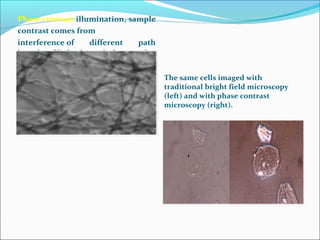
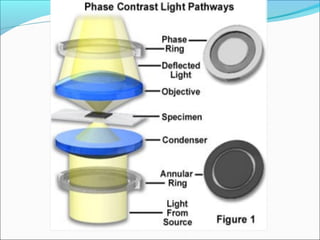
Phase contrast illumination, sample
contrast comes from
interference of different path
lengths of light through the sample.
The same cells imaged with
traditional bright field microscopy
(left) and with phase contrast
microscopy (right).
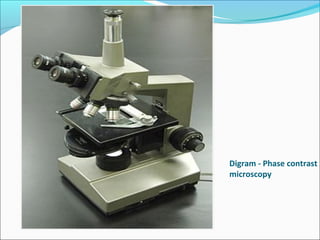
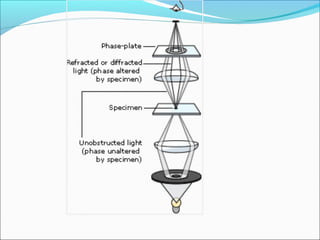
Digram - Phase contrast
microscopy
Frits Zernike (1888–1966) received a Nobel prize in 1953
for his discovery of phase contrast.
Microscopy
In positive phase contrast the object (e.g., cell component)
appears darker than the surrounding background.
In negative phase contrast the object appears brighter
than the background.
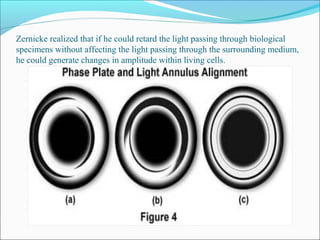
Phase annulus
Zernicke realized that if he could retard the light passing through biological
specimens without affecting the light passing through the surrounding medium,
he could generate changes in amplitude within living cells.
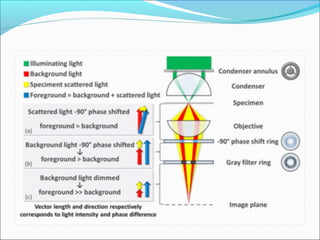
How phase contrast works
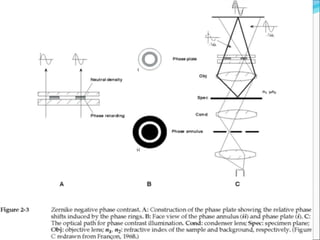
A compound microscope equipped for negative phase
contrast has two additional components: a “phase
plate” that retards light exactly 1
⁄4wavelength in a
centered, ring-shaped area located at the back focal
plane of the objective lens and a matching “phase
annulus” in the condenser consisting of a clear ring on
a black field (Figure 2-3B). The presence of the
annulus and matching phase plate causes the direct
(unmodified background) light to pass only through
the phase ring and thus be retarded 1
⁄4Ü.
The Invisible Can Be Seen
The phase contrast microscope is a vital instrument in biological and
medical research. When dealing with transparent and colorless
components in a cell, dyeing is an alternative but at the same time stops
all processes in it. The phase contrast microscope has made it possible to
study living cells, and cell division is an example of a process that has
been examined in detail with it.
The phase contrast microscope is able to show components in a cell or
bacteria, which would be very difficult to see in an ordinary light
microscope.
Phase contrast microscopy is particularly important in biology. It reveals
many cellular structures that are not visible with a simpler bright field
microscope, . These structures were made visible to earlier microscopists
by staining, but this required additional preparation killed the cells. The
phase contrast microscope made it possible for biologists to study living
cells and how they proliferate through cell division.
FLUORESCENT MICROSCOPY
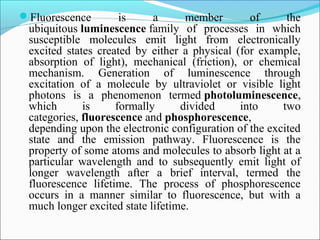
A fluorescence microscope
is much the same as a
conventional light
microscope with added
features to enhance its
capabilities
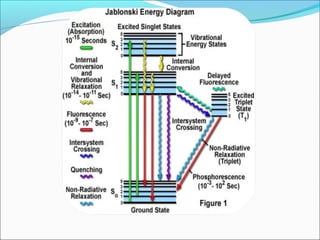
Basic Concepts in Fluorescence
When organic or inorganic specimens absorb and subsequently reradiate light, the
process is typically a result of fluorescence or phosphorescence. Fluorescence
emission is nearly simultaneous with the absorption of the excitation light as the
time delay between photon absorption and emission is typically less than a
microsecond. When the emission persists long after the excitation light is
extinguished, the phenomenon is known as phosphorescence.
In certain classes of atoms and molecules, electrons absorb light, become
energized, and then rapidly lose this energy in the form of heat and light emission.
If the electron keeps its spin, the electron is said to enter a singlet state, and the
kind of light that is emitted as the electron returns to ground state is called
fluorescence. If the electron changes its spin when excited, it enters the triplet
state, and the kind of light that is emitted as the electron returns to ground state is
known as phosphorescence. Phosphorescence is much longer-lived than
fluorescence. Both fluorescence and phosphorescence emissions are of particular
wavelengths for specific excited electrons. Both types of emission are dependent
on specific wavelengths of excitation light, and for both types of emission, the
energy of excitation is greater than the energy of emission.
Fluorescence is a member of the
ubiquitous luminescence family of processes in which
susceptible molecules emit light from electronically
excited states created by either a physical (for example,
absorption of light), mechanical (friction), or chemical
mechanism. Generation of luminescence through
excitation of a molecule by ultraviolet or visible light
photons is a phenomenon termed photoluminescence,
which is formally divided into two
categories, fluorescence and phosphorescence,
depending upon the electronic configuration of the excited
state and the emission pathway. Fluorescence is the
property of some atoms and molecules to absorb light at a
particular wavelength and to subsequently emit light of
longer wavelength after a brief interval, termed the
fluorescence lifetime. The process of phosphorescence
occurs in a manner similar to fluorescence, but with a
much longer excited state lifetime.
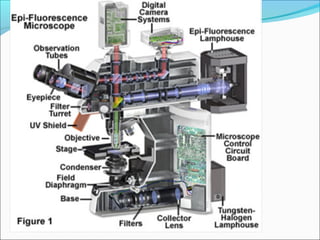
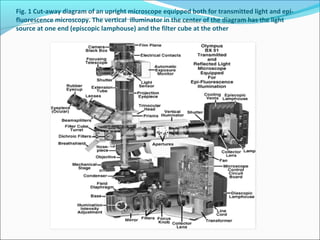
Fig. 1 Cut-away diagram of an upright microscope equipped both for transmitted light and epi-
fluorescence microscopy. The vertical illuminator in the center of the diagram has the light
source at one end (episcopic lamphouse) and the filter cube at the other
LIGHT SOURCES
.
The most common lamps are the mercury burners, ranging in wattage
from 50 to 200 W and the xenon burners ranging from 75 to 150 W.
These light sources are powered by a direct current (d.c.) supply,
furnishing enough start-up power to ignite the burner (by ionization of
the gaseous vapor) and to keep it burning with a minimum of flicker.
The power supply should have a timer to track the number of hours the
burner has been in use. Arc lamps lose efficiency and are more likely to
shatter, if used beyond their rated lifetime. The mercury burners do not
provide even intensity across the spectrum from UV to infrared and
much of the intensity of the
mercury burner is expended in the near UV. In recent years, there has
been increasing use of lasers, particularly the argon-ion and argon–
krypton-ion lasers as light sources. They have the virtues of small
source size, low divergence, monochromaticity, and high mean
luminance
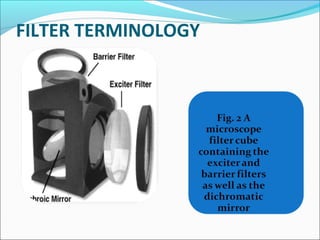
FILTER TERMINOLOGY
Basically, there are three categories of filters: exciter filters,
barrier filters, and dichromatic beam splitters (dichroic
mirrors). Fluorescence filters were formerly almost exclusively
made of colored glass or colored gelatin sandwiched between
glass plates. Now, interference filters are used for exciter filters to
pass or reject wavelengths of light with great selectivity and high
transmission. Dichromatic beam splitters are specialized
interference filters. Barrier filters may be either made of colored
glass or interference filters
Application of flouroscence Microscopy
To utilize fluorescence, we need to label the specimen (a cell, a tissue,
or a gel) with a suitable molecule (a fluorochrome) whose distribution
will become evident after illumination. The fluorescence microscope is
ideally suited for the detection of particular fluorochromes in cells and
tissues. Early investigations showed that many specimens (minerals,
crystals, resins, crude drugs, butter, chlorophyll, vitamins, inorganic
compounds, etc.) fluoresce when irradiated with UV light. In the 1930s,
the use of fluorochromes began in biology to stain tissue components,
bacteria, or other pathogens. Some of these stains were highly specific
and they stimulated the development of the fluorescence microscope.
Fluorescence microscopy has become an essential tool in biology as well
as in materials science as it has attributes that are not readily available in
other optical microscopy techniques.
The use of an array of fluorochromes has made it possible to
identify cells and submicroscopic cellular components and
entities with a high degree of specificity amid nonfluorescing
material. The fluorescence microscope can reveal the presence
of a single fluorescing molecule. In a sample, through the use
of multiple staining, different probes can simultaneously
identify several target molecules. There are specimens that
autofluoresce when they are irradiated and this phenomenon is
exploited in the field of botany, petrology, and in the
semiconductor industry. fluorochromes (also called
fluorophores), which are excited by specific wavelength
irradiating light and emit light of useful intensity.
Fluorochromes are stains that attach themselves to visible or
subvisible structures, are often highly specific in their
attachment targeting, and have significant quantum yield (the
photon emission/absorption ratio). The growth in the use of
fluorescent microscopes is closely linked to the development
of hundreds of fluorochromes with known intensity curves of
excitation and emission and well-understood biological
structure
targets.
Application of fluroscence Microscope
These microscopes are often used for -
Imaging structural components of small specimens, such as
cells
Conducting viability studies on cell populations (are they
alive or dead?)
Imaging the genetic material within a cell (DNA and RNA)
Viewing specific cells within a larger population with
techniques such as FISH
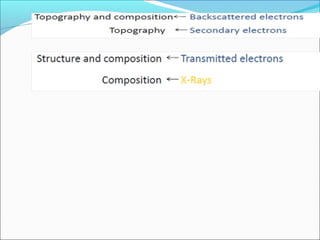
A scanning electron microscope (SEM) is a type of
electron microscope that produces images of a sample by
scanning it with a focused beam of electrons. The
electrons interact with atoms in the sample, producing
various signals that can be detected and that contain
information about the sample's surface topography
and composition. The most common mode of detection is
by secondary electrons emitted by atoms excited by the
electron beam.
Interaction with matter
Principles and capacities
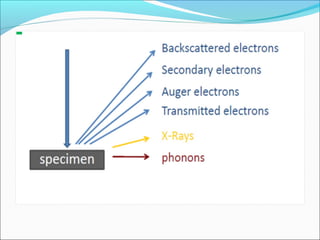
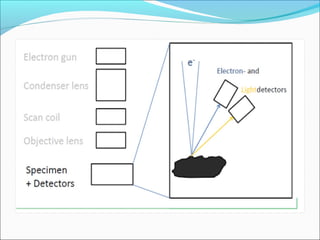
The types of signals produced by a SEM include secondary
electrons (SE), back-scattered electrons (BSE),
characteristic X-rays, light (cathodoluminescence) (CL),
specimen current and transmitted electrons. Secondary
electron detectors are standard equipment in all SEMs, but it
is rare that a single machine would have detectors for all
possible signals. The signals result from interactions of the
electron beam with atoms at or near the surface of the sample.
In the most common or standard detection mode, secondary
electron imaging or SEI, the SEM can produce very high-
resolution images of a sample surface, revealing details less
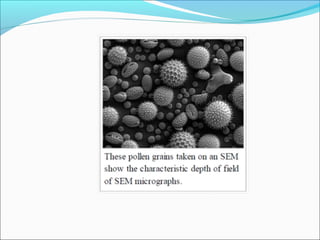
than 1 nm in size. Due to the very narrow electron beam, SEM
micrographs have a large depth of field yielding a
characteristic three-dimensional
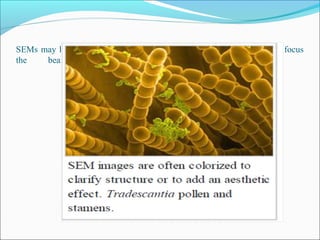
appearance useful for understanding the surface structure of a
sample. This is exemplified by the micrograph of pollen shown
above. Back-scattered electrons (BSE) are beam electrons that
are reflected from the sample by elastic scattering. BSE
are often used in analytical SEM along with the spectra made
from the characteristic X-rays, because the intensity of the
BSE signal is strongly related to the atomic number (Z) of
the specimen. BSE images can provide information about the
distribution of different elements in the sample. For the same
reason, BSE imaging can image colloidal gold immuno-labels
of 5 or 10 nm diameter, which would otherwise be difficult or
impossible to detect in secondary electron images in biological
specimens. Characteristic X-rays are emitted when the
electron beam removes an inner shell electron from the
sample, causing a higher-energy electron to fill the shell
and release energy. These characteristic X-rays are used to
identify the composition and measure the abundance of
elements in the sample.
Functional Principle
Biological samples
For SEM, a specimen is normally required to be completely dry, since the
specimen chamber is at high vacuum. Hard, dry materials such as wood,
bone, feathers, dried insects, or shells can be examined with little
further treatment, but living cells and tissues and whole, soft-bodied
organisms usually require chemical fixation to preserve
and stabilize their structure. Fixation is usually performed by incubation
in a solution of a buffered chemical fixative, such as glutaraldehyde,
sometimes in combination with formaldehyde and other fixativesa and
optionally followed by postfixation with osmium tetroxide.The fixed
tissue is then dehydrated. Because airdrying causes collapse and
shrinkage, this is commonly achieved by replacement of water in the cells
with organic
.

solvents such as ethanol or acetone, and replacement
of these solvents in turn with a transitional fluid such
as liquid carbon dioxide by critical point drying. The
carbon dioxide is finally removed while in a
supercritical state, so that no gas-liquid interface is
present within the sample during drying. The dry
specimen is usually mounted on a
specimen stub using an adhesive such as epoxy resin
or electrically conductive double-sided adhesive tape,
and sputter-coated with gold or gold/palladium alloy
before examination in the microscope
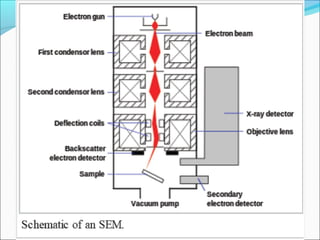
Scanning process and image formation
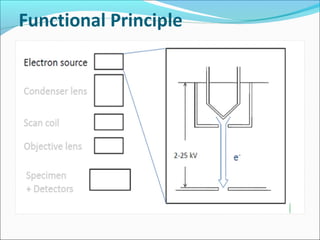
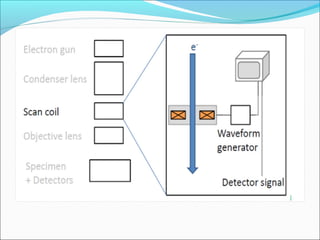
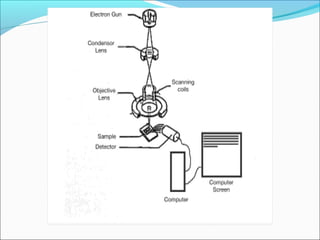
In a typical SEM, an electron beam is thermionically emitted from an
electron gun fitted with a tungsten filament cathode. Tungsten is
normally used in thermionic electron guns because it has the highest
melting point and lowest vapour pressure of all metals, thereby
allowing it to be heated for electron emission, and because of its low
cost.

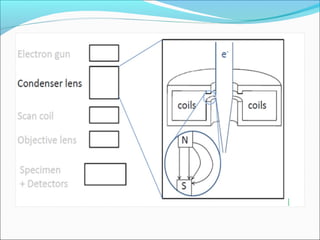
The electron beam, which typically has an energy ranging from 0.2
keV to 40 keV, is focused by one or two condenser lenses to a spot
about 0.4 nm to 5 nm in diameter. The beam passes through pairs of
scanning coils or pairs of deflector plates in the electron column, typically
in the final lens, which deflect the beam in the x and y axes so that it scans
in a raster fashion over a rectangular area of the sample surface.
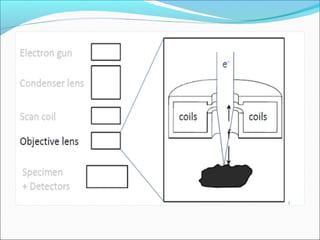
SEMs may have condenser and objective lenses, but their function is to focus
the beam to a spot, and not to image the specimen.
Detection of secondary electrons
The most common imaging mode collects low-energy (<50 eV) secondary
electrons that are ejected from the k-shell of the specimen atoms by
inelastic scattering interactions with beam electrons. Due to their low
energy, these electrons originate within a few nanometers from the sample
surface. The electrons are detected by an Everhart- Thornley detector
Detection of backscattered electrons
BSE detectors are usually either of scintillator or of semiconductor types.
X-ray microanalysis
X-rays, which are produced by the interaction of electrons with the sample,
may also be detected in an SEM equipped for energy-dispersive X-ray
spectroscopy or wavelength dispersive X-ray spectroscopy
Resolution
 
Factors affecting the resolution are:
i) The diameter of the electron beam
ii) Scattering within the specimen
iii) The signal-to-noise ratio
iv) External disturbances due to
1. Electric of magnetic fields
2. Mechanical vibrations
ADVANTAGES
High resolution and magnification
3-D Topographical imaging
Compatible with PC technologies and softwares
Fast Analysing
Store data in digital form
Easier sample preparation techniques
DISADVANTAGES
Can not analys fluid or gas compounds
Expensive Instrumentation
Wasting time on sample preparation
Constant voltage during analysing
RESULT
SEM uses electrons instead of light to form an 
image.
developed new areas of study & still helping.
popular among researchers due to their wide 
range of applications 
CONCLUSION
SEM;
provides detailed surface data of solid samples
informs external morphology, chemical 
composition, crystalline structure
  SAMPLE;
must be prepared before placed
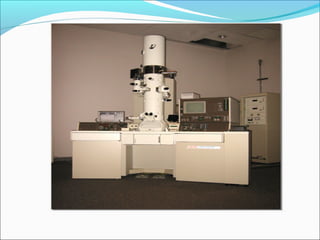
Transmission Electron Microscope
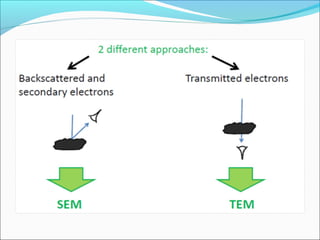
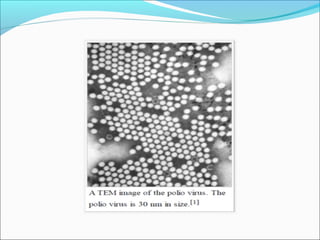
Transmission electron microscopy (TEM) is a microscopy
technique in which a beam of electrons is transmitted 
through an ultra-thin specimen, interacting with the 
specimen  as  it  passes  through.  An  image  is  formed 
from  the  interaction  of  the  electrons  transmitted 
through  the  specimen;  the  image  is  magnified  and 
focused onto an imaging device,
such  as  a  fluorescent  screen,  on  a  layer  of 
photographic film, or to be detected by a sensor such 
as a CCD camera.
Working Principle
TEM works like a slide projector. A projector shines a beam of light which
transmits through
the slide. The patterns painted on the slide only allow certain parts of the
light beam to pass
through. Thus the transmitted beam replicates the patterns on the slide,
forming an enlarged
image of the slide when falling on the screen. TEMs work the same way
except that they shine a beam of electrons (like the light in a slide projector)
through the specimen (like the slide). However, in TEM, the transmission
of electron beam is highly dependent on the properties of material being
examined. Such properties include density, composition, etc. For example,
porous material will allow more electrons to pass through while dense
material will allow less. As a result, a specimen with a non-uniform density
can be examined by this technique. Whatever part is transmitted is
projected onto a phosphor screen for the user to see.
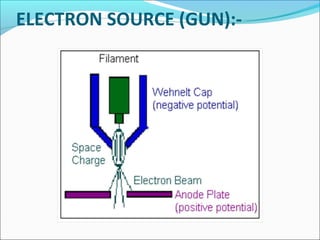
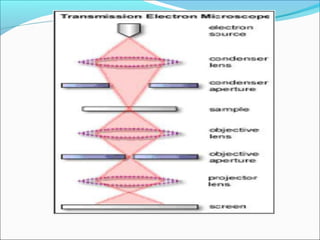
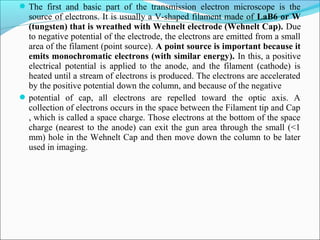
ELECTRON SOURCE (GUN):-
The first and basic part of the transmission electron microscope is the
source of electrons. It is usually a V-shaped filament made of LaB6 or W
(tungsten) that is wreathed with Wehnelt electrode (Wehnelt Cap). Due
to negative potential of the electrode, the electrons are emitted from a small
area of the filament (point source). A point source is important because it
emits monochromatic electrons (with similar energy). In this, a positive
electrical potential is applied to the anode, and the filament (cathode) is
heated until a stream of electrons is produced. The electrons are accelerated
by the positive potential down the column, and because of the negative
potential of cap, all electrons are repelled toward the optic axis. A
collection of electrons occurs in the space between the Filament tip and Cap
, which is called a space charge. Those electrons at the bottom of the space
charge (nearest to the anode) can exit the gun area through the small (<1
mm) hole in the Wehnelt Cap and then move down the column to be later
used in imaging.
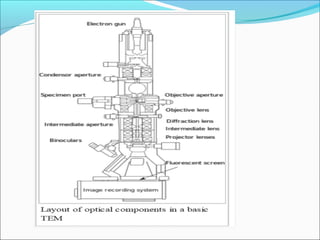
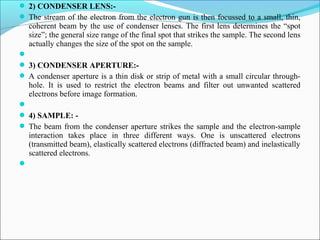
 2) CONDENSER LENS:-
 The stream of the electron from the electron gun is then focussed to a small, thin,
coherent beam by the use of condenser lenses. The first lens determines the “spot
size”; the general size range of the final spot that strikes the sample. The second lens
actually changes the size of the spot on the sample.

 3) CONDENSER APERTURE:-
 A condenser aperture is a thin disk or strip of metal with a small circular through-
hole. It is used to restrict the electron beams and filter out unwanted scattered
electrons before image formation.

 4) SAMPLE: -
 The beam from the condenser aperture strikes the sample and the electron-sample
interaction takes place in three different ways. One is unscattered electrons
(transmitted beam), elastically scattered electrons (diffracted beam) and inelastically
scattered electrons.

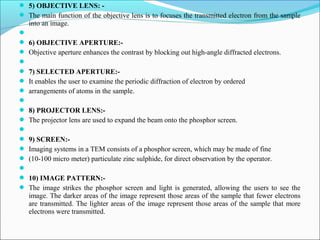
 5) OBJECTIVE LENS: -
 The main function of the objective lens is to focuses the transmitted electron from the sample
into an image.

 6) OBJECTIVE APERTURE:-
 Objective aperture enhances the contrast by blocking out high-angle diffracted electrons.

 7) SELECTED APERTURE:-
 It enables the user to examine the periodic diffraction of electron by ordered
 arrangements of atoms in the sample.

 8) PROJECTOR LENS:-
 The projector lens are used to expand the beam onto the phosphor screen.

 9) SCREEN:-
 Imaging systems in a TEM consists of a phosphor screen, which may be made of fine
 (10-100 micro meter) particulate zinc sulphide, for direct observation by the operator.

 10) IMAGE PATTERN:-
 The image strikes the phosphor screen and light is generated, allowing the users to see the
image. The darker areas of the image represent those areas of the sample that fewer electrons
are transmitted. The lighter areas of the image represent those areas of the sample that more
electrons were transmitted.
 Sample Preparation
 Sample preparation is important for electron microscopy. There are three main steps for sample
preparation: Processing, embedding and polymerization.

 Processing
 This includes: fixation, rinsing, post fixation, dehydration and infiltration.
 Fixation
 It stabilizes the cell structure. There is minimum alteration to cell morphology and volume.
Glutaraldehyde is
 often used as the fixative in TEM. As a result of glutaraldehyde fixation the protein molecules
are covalently cross linked to their
 neighbors.

 2) Rinsing
 The samples should be washed with a buffer to maintain the pH. For this purpose, sodium
cacodylate buffer is often used which has an effective buffering range of 5.1-7.4. The
sodium cacodylate buffer thus prevents excess acidity which may result from tissue fixation
during microscopy.

 3) Post fixation
 A secondary fixation with osmium tetroxide (OsO4), which is to increase the
stability and contrast of fine structure. OsO4 binds phospholipid head regions,
which creating contrast with the neighbouring protoplasm (cytoplasm). OsO4 helps
in the stabilization of many proteins by transforming them into gels without
destroying the structural features. Tissue proteins, which are stabilized by OsO4
and does not coagulated by alcohols during dehydration

 4) Dehydration
 The water content in the tissue sample should be replaced with an organic solvent
since the epoxy resin used in infiltration and embedding step are not miscible with
water.

 5) Infiltration
 Epoxy resin is used to infiltrate the cells. It penetrates the cells and fills the space to
give hard plastic material which will tolerate the pressure of cutting.

 6) Embedding:
 After processing the next step is embedding. This is done using flat molds.

7) Polymerization

Next is polymerization step in which the resin is allowed to set overnight at
a temperature of 60 degree in an oven..

8) Sectioning
The specimen must be cut into very thin sections for electron microscopy so
that the electrons are semitransparent to electrons. These
sections are cut on an ultramicrotome which is a device with a glass or
diamond knife. For best resolution the sections must be 30 to 60 nm. The
resin block can be made ready for the sectioning by trimming it at the tip
with a razor blade or black trimmer so that the smallest cutting face is
available. Fix the block to a microtome and cut the sections. Sections float
onto a surface of liquid held in trough and remain together in a form of
ribbon. Freshly distilled water is generally used to fill the trough. These
sections are then collected onto a copper grid and viewed under the
microscope.

 Advantages
 TEMs find application in cancer research, virology, materials science as well
as pollution, nanotechnology, and semiconductor research.

 TEM is however a significant achievement of quantum mechanical
understanding of electron. It was a major step in magnification studies and
obtaining better resolution than optical microscopes and hence is a very
important building block in study of application of quantum mechanics.
Moreover it is very commonly used in studies of material structures and
properties and for other experimental purposes.
 Limitations
 There are a number of drawbacks to the TEM technique. Many materials require
extensive sample preparation to produce a sample thin enough to be electron
transparent, which makes TEM analysis a relatively time consuming process with a
low throughput of samples. The structure of the sample may also be changed during
the preparation process. Also the field of
 view is relatively small, raising the possibility that the region analysed may not be
characteristic of the whole sample. There is potential that the sample may be
damaged by the electron beam, particularly in the case of biological materials.

Study of Microscopy.

  • 1.
    Kunal P. Deshmukh AssistantProfessor School of Life Sciences S.R.T.M.University Nanded.
  • 2.
    • Eyepiece (ocularlens) (1) • Objective turret, revolver, or revolving nose piece (to hold multiple objective lenses) (2) • Objective lenses (3) • Focus knobs (to move the stage) – Coarse adjustment (4) – Fine adjustment (5) • Stage (to hold the specimen) (6) • Light source (a light or a mirror) (7) • Diaphragm and condenser (8) • Mechanical stage (9)
  • 3.
    Eyepiece (ocular lens) The eyepiece, or ocular lens, is a cylinder containing two or more lenses; its function is to bring the image  into focus  for  the  eye.  The  eyepiece  is  inserted  into  the  top  end  of  the  body  tube.  Eyepieces  are  interchangeable and many different eyepieces can be inserted with different degrees of magnification. Typical  magnification values for eyepieces include 2×, 50× and 10×. Objective turret (revolver or revolving nose piece) Objective turret, revolver, or revolving nose piece is the part that holds the set of objective lenses. Objective  At the lower end of a typical compound optical microscope, there are one or more objective lenses that collect  light from the sample. The objective is usually in a cylinder housing containing a glass single or multi-element  compound lens. Typically there will be around three objective lenses screwed into a circular nose piece which  may  be  rotated  to  select  the  required  objective  lens.Microscope  objectives  are  characterized  by  two  parameters, namely, magnification and numerical aperture. The former typically ranges from 5× to 100× while  the latter ranges from 0.14 to 0.7, corresponding to focal lengths of about 40 to 2 mm, respectively. Objective  lenses with higher magnifications normally have a higher numerical aperture and a shorter depth of field in  the resulting image.
  • 4.
    Oil immersion Some microscopes make use of oil-immersion objectives  or  water-immersion objectives  for  greater  resolution  at  high  magnification.  These  are  used  with  index-matching material such  as immersion oil or  water  and a matched cover slip between the objective lens and  the  sample.  The  refractive  index  of  the  index-matching  material is higher than air allowing the objective lens to  have a larger numerical aperture (greater than 1) so that  the light is transmitted from the specimen to the outer face  of the objective lens with minimal refraction. Numerical  apertures  as  high  as  1.6  can  be  achieved.The  larger  numerical aperture allows collection of more light making  detailed  observation  of  smaller  details  possible.  An  oil  immersion lens usually has a magnification of 40 to 100×.
  • 5.
    Focus knobs Adjustment knobs move the stage up and down with separate adjustment for coarse and fine  focusing.  The same  controls  enable  the  microscope  to  adjust  to  specimens  of  different  thickness. Frame The whole of the optical assembly is traditionally attached to a rigid arm, which in turn is  attached to a robust U-shaped foot to provide the necessary rigidity. The arm angle may be  adjustable to allow the viewing angle to be adjusted. The frame provides  a  mounting  point  for  various microscope controls. Normally  this will  include controls for focusing, typically a large knurled wheel to adjust coarse focus, together  with  a  smaller  knurled  wheel  to  control  fine  focus.  Other  features  may  be  lamp  controls  and/or controls for adjusting the condenser.
  • 6.
    Stage The  stage  is a  platform  below  the  objective  which  supports the specimen being viewed. In the center of  the  stage  is  a  hole  through  which  light  passes  to  illuminate the specimen. The stage usually has arms to  hold slides (rectangular  glass  plates  with  typical  dimensions of 25×75 mm, on which the specimen is  mounted). Light source  Many  sources  of  light  can  be  used.  At  its  simplest,  daylight  is  directed  via  a mirror.  Most  microscopes,  however,  have  their  own  adjustable  and  controllable  light  source  –  often  a halogen lamp,  although  illumination  using LEDs and lasers are  becoming  a  more common provision.
  • 7.
    Condenser The condenser is  a  lens designed  to  focus  light  from  the  illumination  source  onto  the  sample.  The  condenser  may  also  include other features, such as a diaphragm and/or filters, to manage  the  quality  and  intensity  of  the  illumination.  For  illumination  techniques  like dark  field, phase  contrast and differential  interference  contrast microscopy  additional  optical  components  must be precisely aligned in the light path. Magnification The  actual  power  or   magnification of  a  compound  optical  microscope  is  the  product  of  the  powers  of  the  ocular  (eyepiece)  and the objective lens. The maximum normal magnifications of the  ocular and objective are 10× and 100× respectively, giving a final  magnification of 1,000×.
  • 8.
    Principles of Microscopy -Resolution – Resolution is defined as the ability to distinguish two very small and closely-spaced objects as separate entities. Resolution is best  when the distance separating the two tiny objects is small. Resolution  is  determined  by  certain  physical  parameters  that  include  the  wavelength of light, and the light-gathering power of the objective and condenser lenses. A  simple  mathematical  equation  defines  the  smallest  distance  (dmin)  separating  the  two  very  small  objects: dmin = 1.22 x wavelength / N.A. objective + N.A. condenser This is the theoretical resolving power of a light microscope. N.A. (Numerical Aperture) is a mathematical calculation of the light- gathering capabilities of a lens. The N.A. of each objective lens is  inscribed  in  the  metal  tube,  and  ranges  from  0.25-1.4.  The  higher the N.A., the better the light-gathering properties of the lens, and the better the resolution.  Higher  N.A.  values  also  mean  shorter  working  distances  (you  have  to  get  the  lens  closer  to  the  object).  N.A. values above 1.0 also indicate that the lens is used with some immersion fluid, such as immersion oil.
  • 9.
    From  the  equation above,  it  should  also  be  clear  that  shorter wavelength light (bluer light) will provide you with better resolution  (smaller dmin values). In the early 1950's, a UV microscope was designed, but required quartz  objectives and a specialized imaging device. The quartz lenses provided  slightly better resolution (dmin = 0.1 µm), The human eye is best adapted  for  green  light  and  our  ability  to  see  detail  may  be  compromised  somewhat  with  the  use  of  blue  or  violet.  Most  manufacturers  of  microscopes correct their simplest lenses (achromats) for green light. -
  • 10.
    Magnification and Imaging– Most  microscopes  in  current  use  are  known  as  compound microscopes, where a magnified image of an object is produced  by the objective lens, and this image is magnified by a second  lens system (the ocular or eyepiece) for viewing. a standard  microscope will provide you with a final magnification range  of ~40X up to ~1000X. Each  objective lens consists  of  six or more pieces of glass that combine to produce a clear image of an object. The six or  more  lenses  in  the  objective  lens  are  needed  to  provide  corrections that produce image clarity. The interaction of light  with the glass in a lens produce aberrations that result in a loss  in image quality because light waves will be bent, or refracted,  differently in different portions of a lens, and different colors  of  light  will  be  refracted  to  different  extents  by  the  glass.  Spatial aberrations (e.g., spherical aberration) can be corrected  by using lenses with different curvature on their surfaces, and  chromatic (i.e., color) aberrations can be minimized by using  multiple kinds of glass in combination.
  • 11.
    These corrections increase the cost of the lens to the extent that an  apochromatic  objective  lens exhibiting  full  color  correction  and  extremely  high  N.A.  can  cost  several  thousand  dollars.  This  objective lens is about the size of your thumb. The objective lenses in most microscopes are achromats,(achromat  means=  a  lens  that  transmit  light  without  separating  it  into  constituent  colore)    and  best  suited  for  imaging  with  green  light.  Green filters narrow the bandwidth of the light, and make achromat  objectives reasonably effective for most routine uses. The achromat  lenses  are  not  suitable  for  critical  high-resolution  imaging  with  white  light,  because  red  and  blue  light  do  not  focus  in  the  same  plane as green light. Chromatic aberrations will degrade resolution  in  color  images  obtained  with  achromatic  objectives.  Color  photomicrography  aimed  at  the  highest  level  of  resolution  and  image  clarity  should  be  performed  with  totally  corrected  apochromatic  objective  lenses.(  apochromatic  is  photographic  or  other  lens  that  has  better  correction  of  chromatic  and  spherical  abbreation than the much more common  achromat lenses. 
  • 12.
    Apochromatic lenses areusually made up of three elements and brings light of three different frequencies to a common focus.  Apochromatic  glasses  made  up  of  flouro crown glasses and flint glasses).  Fluorite lenses,  offer  intermediate  levels  of  correction,  better  than  achromats  but  not  as  good  as  apochromats.  Fluorite lenses are well suited for fluorescence microscopy because of their high transmittance of shorter wavelength light. Higher  levels  of  correction  make  objective  lenses  more  expensive;  the  price  range  for  apochromatic objectives goes from about $3,000 to over  $10,000. when you look into a microscope, the magnified  and  corrected  image  you  see  through  the  oculars  is  actually a virtual image (as opposed to a real image). The  ocular, designed to provide a corrected virtual image when  viewed  by  eye,  is  not  suitable  for  the  generation  of  photographic or video images through the microscope. For  photography or video microscopy it is necessary to use a  projection lens that generates a corrected real image.
  • 13.
    - Illumination - An essential factor in producing a good image with the light microscope  is obtainingadequate levels of light in the specimen, or object plane.  It is not only necessary to obtain bright light around the object, but for  optimal imaging, the light should be uniform across the field of view.  The best way to illuminate the specimen involves the use of yet another  lens system, known as a condenser. The front element of the condenser  is usually a large, flattened lens that sits directly beneath the specimen.  Its placement on a movable rack provides you with the means to focus  the light beam coming past the object and maximixe the intensity and  control the uniformity of illumination. It may be necessary to center the  field aperture diaphragm, using the condenser centering screws. When  the microscope is properly illuminated, both the object and the edges of  the field aperture diaphragm should be in the same plane of focus and  the field iris diaphragm should be centered in the field of view.
  • 14.
    Light Microscopy The optical microscope, often  referred  to  as  the  "light microscope", is a type   of microscope which  uses visible  light and  a  system  of lenses to  magnify  images  of  small  samples.  The  light  microscope,  so  called because it employs visible light to detect small  objects,  is  probably  the  most  well-known  and  well- used  research  tool  in  biology.  The  smallest  objects  that are considered to be living are the bacteria. The  smallest  bacteria  can  be  observed  and  cell  shape  recognized at a mere 100x magnification. 
  • 15.
    Types of lightmicroscopes Bright Field Microscopy Bright field illumination, sample contrast comes from absorbance of light in the sample.
  • 16.
    With  a  conventional bright  field  microscope,  light  from  an  incandescent source is aimed toward a lens beneath the stage called  the condenser, through the specimen, through an objective lens, and  to the eye through a second magnifying lens, the ocular or eyepiece.  We  see  objects  in  the  light  path  because  natural  pigmentation  or  stains absorb light differentially, or because they are thick enough to  absorb  a  significant  amount  of  light  despite  being  colorless.  A Paramecium should  show  up  fairly  well  in  a  bright  field  microscope,  although  it  will  not  be  easy  to  see  cilia  or  most  organelles. After passing through the specimen, the light is displayed  to the eye with an apparent field that is much larger than the area  illuminated Students are usually aware of the use of the coarse and  fine focus knobs, used to sharpen the image of the specimen. They  are  frequently  unaware  of  adjustments  to  the  condenser  that  can  affect resolution and contrast. Some condensers are fixed in position,  others are focusable, so that the quality of light can be adjusted.
  • 17.
    Steps while Usinga bright field microscope 1) Mount the specimen on the stage 2) Optimize the lighting 3) Adjust the condenser 4) Think about what you are looking for 5) Focus, locate, and center the specimen 6) Adjust eyepiece separation, focus 7) Select an objective lens for viewing
  • 18.
    The  lowest  power lens  is  usually  3.5 or 4x,  and  is  used  primarily  for  initially  finding specimens.  We  sometimes  call  it  the  scanning  lens  for  that  reason.  The  most  frequently  used  objective  lens  is  the  10x  lens, which gives a final magnification of 100x with a  10x ocular lens. For very small protists and for details  in prepared slides such as cell organelles or mitotic figures, you will need a higher magnification.  Typical high magnification lenses are 40x and 97x or 100x.  The  latter  two  magnifications  are  used  exclusively with oil in order to improve resolution. Higher magnification lenses must be physically closer  to  the  specimen  itself,  which  poses  the  risk  of  jamming  the  objective  into  the  specimen.  Be  very  cautious when focusing
  • 19.
    8) Adjust illuminationfor the selected objective lens 9) When to use bright field microscopy Bright  field  microscopy  is  best  suited  to  viewing  stained  or  naturally  pigmented  specimens such as stained prepared slides of tissue sections or living photosynthetic  organisms.  It  is  useless  for  living  specimens  of  bacteria,  and  inferior  for  non- photosynthetic  protists  or  metazoans,  or  unstained  cell  suspensions  or  tissue  sections.  Prepared slides, stained - bacteria (1000x), thick tissue sections (100x, 400x), thin  sections  with  condensed  chromosomes  or  specially  stained  organelles  (1000x),  large protists or metazoans (100x).  Smears, stained - blood (400x, 1000x), negative stained bacteria (400x, 1000x).  Living preparations (wet mounts, unstained) - pond water (40x, 100x, 400x), living  protists or metazoans (40x, 100x, 400x occasionally), algae and other microscopic  plant  material  (40x,  100x,  400x).  Smaller  specimens  will  be  difficult  to  observe  without distortion, especially if they have no pigmentation. distortion, especially if they have no pigmentation.
  • 20.
    Care of themicroscope EVERYTHING on a good quality microscope is unbelievably expensive, so be careful. Hold  a  microscope  firmly  by  the  stand,  only.  Never  grab  it  by  the  eyepiece  holder,  for  example. Hold the plug (not the cable) when unplugging the illuminator. Since bulbs are expensive, and have a limited life, turn the illuminator off when you are done. Always make sure the stage and lenses are clean before putting away the microscope. NEVER use a paper towel, a kimwipe, your shirt, or any material other than good quality lens  tissue or a cotton swab (must be 100% natural cotton) to clean an optical surface. Be gentle!  You  may  use  an  appropriate  lens  cleaner  or  distilled  water  to  help  remove  dried  material.  Organic solvents may separate or damage the lens elements or coatings. Cover the instrument with a dust jacket when not in use. Focus  smoothly;  don't  try  to  speed  through  the  focusing  process  or  force  anything.  For  example if you encounter increased resistance when focusing then you've probably reached a  limit and you are going in the wrong direction.
  • 21.
  • 22.
    Phase contrast illumination,sample contrast comes from interference of different path lengths of light through the sample. The same cells imaged with traditional bright field microscopy (left) and with phase contrast microscopy (right).
  • 23.
    Digram - Phasecontrast microscopy
  • 24.
    Frits Zernike (1888–1966)received a Nobel prize in 1953 for his discovery of phase contrast. Microscopy In positive phase contrast the object (e.g., cell component) appears darker than the surrounding background. In negative phase contrast the object appears brighter than the background.
  • 26.
  • 28.
    Zernicke realized thatif he could retard the light passing through biological specimens without affecting the light passing through the surrounding medium, he could generate changes in amplitude within living cells.
  • 30.
    How phase contrastworks A compound microscope equipped for negative phase contrast has two additional components: a “phase plate” that retards light exactly 1 ⁄4wavelength in a centered, ring-shaped area located at the back focal plane of the objective lens and a matching “phase annulus” in the condenser consisting of a clear ring on a black field (Figure 2-3B). The presence of the annulus and matching phase plate causes the direct (unmodified background) light to pass only through the phase ring and thus be retarded 1 ⁄4Ü.
  • 32.
    The Invisible CanBe Seen The phase contrast microscope is a vital instrument in biological and medical research. When dealing with transparent and colorless components in a cell, dyeing is an alternative but at the same time stops all processes in it. The phase contrast microscope has made it possible to study living cells, and cell division is an example of a process that has been examined in detail with it. The phase contrast microscope is able to show components in a cell or bacteria, which would be very difficult to see in an ordinary light microscope. Phase contrast microscopy is particularly important in biology. It reveals many cellular structures that are not visible with a simpler bright field microscope, . These structures were made visible to earlier microscopists by staining, but this required additional preparation killed the cells. The phase contrast microscope made it possible for biologists to study living cells and how they proliferate through cell division.
  • 33.
  • 34.
    A fluorescence microscope ismuch the same as a conventional light microscope with added features to enhance its capabilities
  • 35.
    Basic Concepts inFluorescence When organic or inorganic specimens absorb and subsequently reradiate light, the process is typically a result of fluorescence or phosphorescence. Fluorescence emission is nearly simultaneous with the absorption of the excitation light as the time delay between photon absorption and emission is typically less than a microsecond. When the emission persists long after the excitation light is extinguished, the phenomenon is known as phosphorescence. In certain classes of atoms and molecules, electrons absorb light, become energized, and then rapidly lose this energy in the form of heat and light emission. If the electron keeps its spin, the electron is said to enter a singlet state, and the kind of light that is emitted as the electron returns to ground state is called fluorescence. If the electron changes its spin when excited, it enters the triplet state, and the kind of light that is emitted as the electron returns to ground state is known as phosphorescence. Phosphorescence is much longer-lived than fluorescence. Both fluorescence and phosphorescence emissions are of particular wavelengths for specific excited electrons. Both types of emission are dependent on specific wavelengths of excitation light, and for both types of emission, the energy of excitation is greater than the energy of emission.
  • 36.
    Fluorescence is amember of the ubiquitous luminescence family of processes in which susceptible molecules emit light from electronically excited states created by either a physical (for example, absorption of light), mechanical (friction), or chemical mechanism. Generation of luminescence through excitation of a molecule by ultraviolet or visible light photons is a phenomenon termed photoluminescence, which is formally divided into two categories, fluorescence and phosphorescence, depending upon the electronic configuration of the excited state and the emission pathway. Fluorescence is the property of some atoms and molecules to absorb light at a particular wavelength and to subsequently emit light of longer wavelength after a brief interval, termed the fluorescence lifetime. The process of phosphorescence occurs in a manner similar to fluorescence, but with a much longer excited state lifetime.
  • 38.
    Fig. 1 Cut-awaydiagram of an upright microscope equipped both for transmitted light and epi- fluorescence microscopy. The vertical illuminator in the center of the diagram has the light source at one end (episcopic lamphouse) and the filter cube at the other
  • 39.
    LIGHT SOURCES . The mostcommon lamps are the mercury burners, ranging in wattage from 50 to 200 W and the xenon burners ranging from 75 to 150 W. These light sources are powered by a direct current (d.c.) supply, furnishing enough start-up power to ignite the burner (by ionization of the gaseous vapor) and to keep it burning with a minimum of flicker. The power supply should have a timer to track the number of hours the burner has been in use. Arc lamps lose efficiency and are more likely to shatter, if used beyond their rated lifetime. The mercury burners do not provide even intensity across the spectrum from UV to infrared and much of the intensity of the mercury burner is expended in the near UV. In recent years, there has been increasing use of lasers, particularly the argon-ion and argon– krypton-ion lasers as light sources. They have the virtues of small source size, low divergence, monochromaticity, and high mean luminance
  • 40.
  • 41.
    Basically, there arethree categories of filters: exciter filters, barrier filters, and dichromatic beam splitters (dichroic mirrors). Fluorescence filters were formerly almost exclusively made of colored glass or colored gelatin sandwiched between glass plates. Now, interference filters are used for exciter filters to pass or reject wavelengths of light with great selectivity and high transmission. Dichromatic beam splitters are specialized interference filters. Barrier filters may be either made of colored glass or interference filters
  • 43.
    Application of flouroscenceMicroscopy To utilize fluorescence, we need to label the specimen (a cell, a tissue, or a gel) with a suitable molecule (a fluorochrome) whose distribution will become evident after illumination. The fluorescence microscope is ideally suited for the detection of particular fluorochromes in cells and tissues. Early investigations showed that many specimens (minerals, crystals, resins, crude drugs, butter, chlorophyll, vitamins, inorganic compounds, etc.) fluoresce when irradiated with UV light. In the 1930s, the use of fluorochromes began in biology to stain tissue components, bacteria, or other pathogens. Some of these stains were highly specific and they stimulated the development of the fluorescence microscope. Fluorescence microscopy has become an essential tool in biology as well as in materials science as it has attributes that are not readily available in other optical microscopy techniques.
  • 44.
    The use ofan array of fluorochromes has made it possible to identify cells and submicroscopic cellular components and entities with a high degree of specificity amid nonfluorescing material. The fluorescence microscope can reveal the presence of a single fluorescing molecule. In a sample, through the use of multiple staining, different probes can simultaneously identify several target molecules. There are specimens that autofluoresce when they are irradiated and this phenomenon is exploited in the field of botany, petrology, and in the semiconductor industry. fluorochromes (also called fluorophores), which are excited by specific wavelength irradiating light and emit light of useful intensity. Fluorochromes are stains that attach themselves to visible or subvisible structures, are often highly specific in their attachment targeting, and have significant quantum yield (the photon emission/absorption ratio). The growth in the use of fluorescent microscopes is closely linked to the development of hundreds of fluorochromes with known intensity curves of excitation and emission and well-understood biological structure targets.
  • 45.
    Application of fluroscenceMicroscope These microscopes are often used for - Imaging structural components of small specimens, such as cells Conducting viability studies on cell populations (are they alive or dead?) Imaging the genetic material within a cell (DNA and RNA) Viewing specific cells within a larger population with techniques such as FISH
  • 47.
    A scanning electronmicroscope (SEM) is a type of electron microscope that produces images of a sample by scanning it with a focused beam of electrons. The electrons interact with atoms in the sample, producing various signals that can be detected and that contain information about the sample's surface topography and composition. The most common mode of detection is by secondary electrons emitted by atoms excited by the electron beam.
  • 49.
  • 52.
    Principles and capacities Thetypes of signals produced by a SEM include secondary electrons (SE), back-scattered electrons (BSE), characteristic X-rays, light (cathodoluminescence) (CL), specimen current and transmitted electrons. Secondary electron detectors are standard equipment in all SEMs, but it is rare that a single machine would have detectors for all possible signals. The signals result from interactions of the electron beam with atoms at or near the surface of the sample. In the most common or standard detection mode, secondary electron imaging or SEI, the SEM can produce very high- resolution images of a sample surface, revealing details less than 1 nm in size. Due to the very narrow electron beam, SEM micrographs have a large depth of field yielding a characteristic three-dimensional
  • 53.
    appearance useful forunderstanding the surface structure of a sample. This is exemplified by the micrograph of pollen shown above. Back-scattered electrons (BSE) are beam electrons that are reflected from the sample by elastic scattering. BSE are often used in analytical SEM along with the spectra made from the characteristic X-rays, because the intensity of the BSE signal is strongly related to the atomic number (Z) of the specimen. BSE images can provide information about the distribution of different elements in the sample. For the same reason, BSE imaging can image colloidal gold immuno-labels of 5 or 10 nm diameter, which would otherwise be difficult or impossible to detect in secondary electron images in biological specimens. Characteristic X-rays are emitted when the electron beam removes an inner shell electron from the sample, causing a higher-energy electron to fill the shell and release energy. These characteristic X-rays are used to identify the composition and measure the abundance of elements in the sample.
  • 54.
  • 59.
    Biological samples For SEM,a specimen is normally required to be completely dry, since the specimen chamber is at high vacuum. Hard, dry materials such as wood, bone, feathers, dried insects, or shells can be examined with little further treatment, but living cells and tissues and whole, soft-bodied organisms usually require chemical fixation to preserve and stabilize their structure. Fixation is usually performed by incubation in a solution of a buffered chemical fixative, such as glutaraldehyde, sometimes in combination with formaldehyde and other fixativesa and optionally followed by postfixation with osmium tetroxide.The fixed tissue is then dehydrated. Because airdrying causes collapse and shrinkage, this is commonly achieved by replacement of water in the cells with organic . 
  • 60.
    solvents such asethanol or acetone, and replacement of these solvents in turn with a transitional fluid such as liquid carbon dioxide by critical point drying. The carbon dioxide is finally removed while in a supercritical state, so that no gas-liquid interface is present within the sample during drying. The dry specimen is usually mounted on a specimen stub using an adhesive such as epoxy resin or electrically conductive double-sided adhesive tape, and sputter-coated with gold or gold/palladium alloy before examination in the microscope
  • 61.
    Scanning process andimage formation In a typical SEM, an electron beam is thermionically emitted from an electron gun fitted with a tungsten filament cathode. Tungsten is normally used in thermionic electron guns because it has the highest melting point and lowest vapour pressure of all metals, thereby allowing it to be heated for electron emission, and because of its low cost.  The electron beam, which typically has an energy ranging from 0.2 keV to 40 keV, is focused by one or two condenser lenses to a spot about 0.4 nm to 5 nm in diameter. The beam passes through pairs of scanning coils or pairs of deflector plates in the electron column, typically in the final lens, which deflect the beam in the x and y axes so that it scans in a raster fashion over a rectangular area of the sample surface.
  • 63.
    SEMs may havecondenser and objective lenses, but their function is to focus the beam to a spot, and not to image the specimen.
  • 64.
    Detection of secondaryelectrons The most common imaging mode collects low-energy (<50 eV) secondary electrons that are ejected from the k-shell of the specimen atoms by inelastic scattering interactions with beam electrons. Due to their low energy, these electrons originate within a few nanometers from the sample surface. The electrons are detected by an Everhart- Thornley detector Detection of backscattered electrons BSE detectors are usually either of scintillator or of semiconductor types. X-ray microanalysis X-rays, which are produced by the interaction of electrons with the sample, may also be detected in an SEM equipped for energy-dispersive X-ray spectroscopy or wavelength dispersive X-ray spectroscopy
  • 66.
    Resolution   Factors affecting theresolution are: i) The diameter of the electron beam ii) Scattering within the specimen iii) The signal-to-noise ratio iv) External disturbances due to 1. Electric of magnetic fields 2. Mechanical vibrations
  • 67.
  • 68.
  • 69.
  • 70.
    Transmission electron microscopy(TEM) is a microscopy technique in which a beam of electrons is transmitted  through an ultra-thin specimen, interacting with the  specimen  as  it  passes  through.  An  image  is  formed  from  the  interaction  of  the  electrons  transmitted  through  the  specimen;  the  image  is  magnified  and  focused onto an imaging device, such  as  a  fluorescent  screen,  on  a  layer  of  photographic film, or to be detected by a sensor such  as a CCD camera.
  • 72.
    Working Principle TEM workslike a slide projector. A projector shines a beam of light which transmits through the slide. The patterns painted on the slide only allow certain parts of the light beam to pass through. Thus the transmitted beam replicates the patterns on the slide, forming an enlarged image of the slide when falling on the screen. TEMs work the same way except that they shine a beam of electrons (like the light in a slide projector) through the specimen (like the slide). However, in TEM, the transmission of electron beam is highly dependent on the properties of material being examined. Such properties include density, composition, etc. For example, porous material will allow more electrons to pass through while dense material will allow less. As a result, a specimen with a non-uniform density can be examined by this technique. Whatever part is transmitted is projected onto a phosphor screen for the user to see.
  • 73.
  • 77.
    The first andbasic part of the transmission electron microscope is the source of electrons. It is usually a V-shaped filament made of LaB6 or W (tungsten) that is wreathed with Wehnelt electrode (Wehnelt Cap). Due to negative potential of the electrode, the electrons are emitted from a small area of the filament (point source). A point source is important because it emits monochromatic electrons (with similar energy). In this, a positive electrical potential is applied to the anode, and the filament (cathode) is heated until a stream of electrons is produced. The electrons are accelerated by the positive potential down the column, and because of the negative potential of cap, all electrons are repelled toward the optic axis. A collection of electrons occurs in the space between the Filament tip and Cap , which is called a space charge. Those electrons at the bottom of the space charge (nearest to the anode) can exit the gun area through the small (<1 mm) hole in the Wehnelt Cap and then move down the column to be later used in imaging.
  • 78.
     2) CONDENSERLENS:-  The stream of the electron from the electron gun is then focussed to a small, thin, coherent beam by the use of condenser lenses. The first lens determines the “spot size”; the general size range of the final spot that strikes the sample. The second lens actually changes the size of the spot on the sample.   3) CONDENSER APERTURE:-  A condenser aperture is a thin disk or strip of metal with a small circular through- hole. It is used to restrict the electron beams and filter out unwanted scattered electrons before image formation.   4) SAMPLE: -  The beam from the condenser aperture strikes the sample and the electron-sample interaction takes place in three different ways. One is unscattered electrons (transmitted beam), elastically scattered electrons (diffracted beam) and inelastically scattered electrons. 
  • 79.
     5) OBJECTIVELENS: -  The main function of the objective lens is to focuses the transmitted electron from the sample into an image.   6) OBJECTIVE APERTURE:-  Objective aperture enhances the contrast by blocking out high-angle diffracted electrons.   7) SELECTED APERTURE:-  It enables the user to examine the periodic diffraction of electron by ordered  arrangements of atoms in the sample.   8) PROJECTOR LENS:-  The projector lens are used to expand the beam onto the phosphor screen.   9) SCREEN:-  Imaging systems in a TEM consists of a phosphor screen, which may be made of fine  (10-100 micro meter) particulate zinc sulphide, for direct observation by the operator.   10) IMAGE PATTERN:-  The image strikes the phosphor screen and light is generated, allowing the users to see the image. The darker areas of the image represent those areas of the sample that fewer electrons are transmitted. The lighter areas of the image represent those areas of the sample that more electrons were transmitted.
  • 80.
     Sample Preparation Sample preparation is important for electron microscopy. There are three main steps for sample preparation: Processing, embedding and polymerization.   Processing  This includes: fixation, rinsing, post fixation, dehydration and infiltration.  Fixation  It stabilizes the cell structure. There is minimum alteration to cell morphology and volume. Glutaraldehyde is  often used as the fixative in TEM. As a result of glutaraldehyde fixation the protein molecules are covalently cross linked to their  neighbors.   2) Rinsing  The samples should be washed with a buffer to maintain the pH. For this purpose, sodium cacodylate buffer is often used which has an effective buffering range of 5.1-7.4. The sodium cacodylate buffer thus prevents excess acidity which may result from tissue fixation during microscopy. 
  • 81.
     3) Postfixation  A secondary fixation with osmium tetroxide (OsO4), which is to increase the stability and contrast of fine structure. OsO4 binds phospholipid head regions, which creating contrast with the neighbouring protoplasm (cytoplasm). OsO4 helps in the stabilization of many proteins by transforming them into gels without destroying the structural features. Tissue proteins, which are stabilized by OsO4 and does not coagulated by alcohols during dehydration   4) Dehydration  The water content in the tissue sample should be replaced with an organic solvent since the epoxy resin used in infiltration and embedding step are not miscible with water.   5) Infiltration  Epoxy resin is used to infiltrate the cells. It penetrates the cells and fills the space to give hard plastic material which will tolerate the pressure of cutting.   6) Embedding:  After processing the next step is embedding. This is done using flat molds. 
  • 82.
    7) Polymerization  Next ispolymerization step in which the resin is allowed to set overnight at a temperature of 60 degree in an oven..  8) Sectioning The specimen must be cut into very thin sections for electron microscopy so that the electrons are semitransparent to electrons. These sections are cut on an ultramicrotome which is a device with a glass or diamond knife. For best resolution the sections must be 30 to 60 nm. The resin block can be made ready for the sectioning by trimming it at the tip with a razor blade or black trimmer so that the smallest cutting face is available. Fix the block to a microtome and cut the sections. Sections float onto a surface of liquid held in trough and remain together in a form of ribbon. Freshly distilled water is generally used to fill the trough. These sections are then collected onto a copper grid and viewed under the microscope. 
  • 83.
     Advantages  TEMsfind application in cancer research, virology, materials science as well as pollution, nanotechnology, and semiconductor research.   TEM is however a significant achievement of quantum mechanical understanding of electron. It was a major step in magnification studies and obtaining better resolution than optical microscopes and hence is a very important building block in study of application of quantum mechanics. Moreover it is very commonly used in studies of material structures and properties and for other experimental purposes.
  • 84.
     Limitations  Thereare a number of drawbacks to the TEM technique. Many materials require extensive sample preparation to produce a sample thin enough to be electron transparent, which makes TEM analysis a relatively time consuming process with a low throughput of samples. The structure of the sample may also be changed during the preparation process. Also the field of  view is relatively small, raising the possibility that the region analysed may not be characteristic of the whole sample. There is potential that the sample may be damaged by the electron beam, particularly in the case of biological materials.