Dr R.Jayaprada

CONFOCAL MICROSCOPY
INTRODUCTION
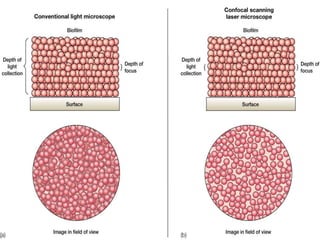
 A confocal microscope creates sharp images of a
  specimen that would appear otherwise blurred
  with the conventional microscope –this is
  achieved by excluding most of the light from the
  specimen, but not from the microscope’s focal
  plane.
 The image obtained has better contrast & less
  hazy .
 In confocal microscopy, a series of thin slices of
  the specimen is assembled to generate a 3-
  dimensinal image.
HISTORY
 Confocal microscopy was pioneered by Marvin
  Minsky in 1955.
 By illuminating single point at a time, Minsky
  avoided most of the unwanted scattered light
  that obscures an image when the entire
  specimen is illuminated at the same time.
Additionally, the light returning from the specimen
  passes through a second pin-hole aperture.
Remaining desirable light rays are collected by a
  photomultiplier & the image is reconstruted
  using a long persistance screen.
For builiding the image, Minsky scanned the
  specimen by moving the stage rather than light
  rays.
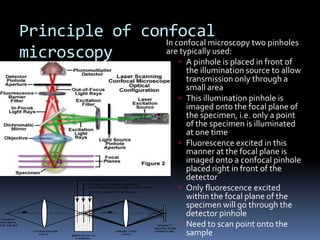
Principle of confocal
                           In confocal microscopy two pinholes
           microscopy      are typically used:
                                A pinhole is placed in front of
                                                                              the illumination source to allow
                                                                              transmission only through a
                                                                              small area
                                                                             This illumination pinhole is
                                                                              imaged onto the focal plane of
                                                                              the specimen, i.e. only a point
                                                                              of the specimen is illuminated
                                                                              at one time
                                                                             Fluorescence excited in this
                                                                              manner at the focal plane is
                                                                              imaged onto a confocal pinhole
                                                                              placed right in front of the
                              OUT-OF-FOCUS PLANE
                                                                              detector
                                                                          
                                IN-FOCUS (OBJECT) PLANE
                                CONTAINING ILLUMINATED S POT
                                   OUT-OF-FOCUS PLANE
                                                                              Only fluorescence excited
                                                                              within the focal plane of the
                                                                              specimen will go through the
"POINT"
                                                                              detector pinhole
S OURCE
OF LIGHT                                                        "POINT"
                                                               DETECTOR
                                                                             Need to scan point onto the
             CONDENS ER
               LENS
                          BIOLOGICAL
                            S AMPLE
                                           OBJECTIVE
                                             LENS
                                                               APERTURE
                                                                              sample
 . Confocal microscopy is unique because it
  can rapidly produce images of cellular
  morphology without the need to process the
  tissue (i.e., without freezing, sectioning and
  staining).
 A confocal microscope images have refractive
  index variation within the epithelial and
  stromal compartments of the tissue. These
  refractive index variations are due to the
  chemical variations within the tissue.
  Structures that backscatter more light appear
  brighter than less scattering structures.
 Because the source of image contrast is not
  due to exogenous stains, confocal images
  appear different than those from tissue that
  has been histologically processed and
  stained.
PROCEDURE
 The frozen tissue was thawed and
  confocally imaged.
 The thawed tissue specimen was washed
  in phosphate buffered saline and 5%
  acetic acid (3 minutes each solution) prior
  to confocal imaging.
 The acetic acid causes the aggregation of
  chromatin within the cell nuclei and
  enhances contrast in confocal images.
MODERN CONFOCAL MICROSCOPY
 Modern confocal microscope have taken the key
  elements of Minsky’s design;i.e; pinhole
  apertures & point-by-point illumination of the
  specimen.
 Majority of the confocal microscopes image
  either by reflecting the light off the specimen or
  by stimulating fluorescence from dyes
  (fluorophores) applied to the specimen.
 Advances in the optics & electronics have been
  incorporated into the current designs and
  provide improvements in speed, image quality &
  storage of generated images.
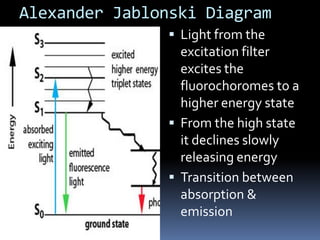
Alexander Jablonski Diagram
                Light from the
                 excitation filter
                 excites the
                 fluorochoromes to a
                 higher energy state
                From the high state
                 it declines slowly
                 releasing energy
                Transition between
                 absorption &
                 emission
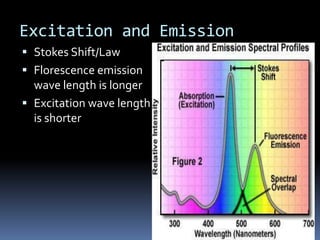
Excitation and Emission
 Stokes Shift/Law
 Florescence emission
  wave length is longer
 Excitation wave length
  is shorter
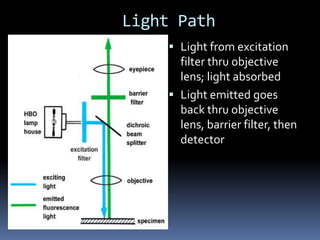
Light Path
     Light from excitation
      filter thru objective
      lens; light absorbed
     Light emitted goes
      back thru objective
      lens, barrier filter, then
      detector
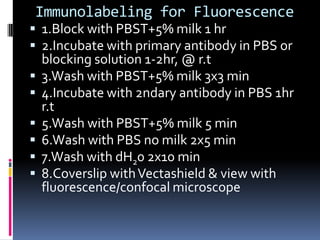
Immunolabeling for Fluorescence
 1.Block with PBST+5% milk 1 hr
 2.Incubate with primary antibody in PBS or
    blocking solution 1-2hr, @ r.t
   3.Wash with PBST+5% milk 3x3 min
   4.Incubate with 2ndary antibody in PBS 1hr
    r.t
   5.Wash with PBST+5% milk 5 min
   6.Wash with PBS no milk 2x5 min
   7.Wash with dH20 2x10 min
   8.Coverslip with Vectashield & view with
    fluorescence/confocal microscope
Confocal Microscope
 Better resolution
 Cells can be live or fixed
 Serial optical sections can be collected
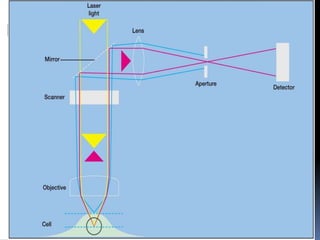
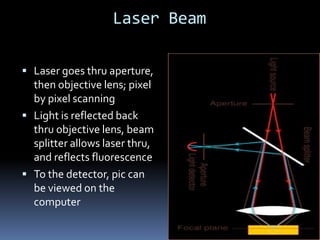
Laser Beam

 Laser goes thru aperture,
  then objective lens; pixel
  by pixel scanning
 Light is reflected back
  thru objective lens, beam
  splitter allows laser thru,
  and reflects fluorescence
 To the detector, pic can
  be viewed on the
  computer
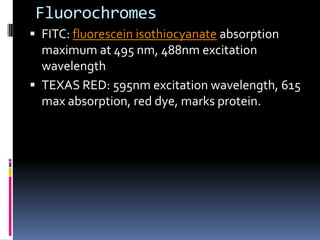
Fluorochromes
 FITC: fluorescein isothiocyanate absorption
  maximum at 495 nm, 488nm excitation
  wavelength
 TEXAS RED: 595nm excitation wavelength, 615
  max absorption, red dye, marks protein.
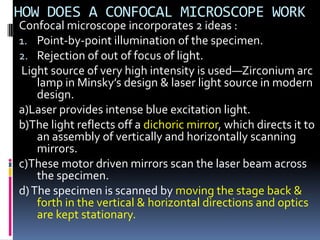
HOW DOES A CONFOCAL MICROSCOPE WORK
Confocal microscope incorporates 2 ideas :
1. Point-by-point illumination of the specimen.
2. Rejection of out of focus of light.
Light source of very high intensity is used—Zirconium arc
    lamp in Minsky’s design & laser light source in modern
    design.
a)Laser provides intense blue excitation light.
b)The light reflects off a dichoric mirror, which directs it to
    an assembly of vertically and horizontally scanning
    mirrors.
c)These motor driven mirrors scan the laser beam across
    the specimen.
d) The specimen is scanned by moving the stage back &
    forth in the vertical & horizontal directions and optics
    are kept stationary.
HOW DOES A CONFOCAL MICROSCOPE WORK
  Dye in the specimen is excited by the laser light
   & fluoresces. The fluorescent (green) light is
   descanned by the same mirrors that are used to
   scan the excitation (blue) light from the laser
   beam then it passes through the dichoric
   mirror then it is focused on to pinhole the
   light passing through the pinhole is measured
   by the detector such as photomultiplier tube.
  For visualization, detector is attached to the
   computer, which builds up the image at the rate
   of 0.1-1 second for single image.
ADVANTAGES OF CONFOCAL MICROSCOPY
 1.The specimen is everywhere illuminated axially,
    rather than at different angles, thereby avoiding
    optical aberrations entire field of view is
    illuminated uniformly.
   2.The field of view can be made larger than that of
    the static objective by controlling the amplitude of
    the stage movements.
   3.Better resolution
   4.Cells can be live or fixed
   5.Serial optical sections can be collected
LIMITATIONS OF CONFOCAL MICROSCOPY
 1.Resolution : It has inherent resolution limitation due to
  diffraction. Maximum best resolution of confocal microscopy is
  typically about 200nm.
 2.Pin hole size : Strength of optical sectioning depends on the size
  of the pinhole.
 3.Intensity of the incident light.


 4.Fluorophores :
 a)The fluorophore should tag the correct part of the specimen.
 b)Fluorophore should be sensitive enough for the given excitation
  wave length.
 C)It should not significantly alter the dynamics of the organism in
  the living specimen.
 5.Photobleaching
FAST CONFOCAL MICROSCOPY
  Most confocal microscopes generate a single
   image in 0.1-1 second.
  Two commonly used designs that can capture
   image at high speed are :
  Nipkow disk confocal microscope:This builds an
   image by passing light through a spinning mask
   of pinholes ,thereby simultaneously illuminating
   many discrete points.
  Confocal microscope that uses an acousto-optic
   deflector (AOD) for steering the excitation light.
   Fast horizontal scans can be achieved with AOD.
TWO PHOTON MICROSCOPY
 This microscopy is related to confocal microscopy.
 It provides excellent optical sectioning.
Confocal microscopy

Confocal microscopy

  • 1.
  • 2.
    INTRODUCTION  A confocalmicroscope creates sharp images of a specimen that would appear otherwise blurred with the conventional microscope –this is achieved by excluding most of the light from the specimen, but not from the microscope’s focal plane.  The image obtained has better contrast & less hazy .  In confocal microscopy, a series of thin slices of the specimen is assembled to generate a 3- dimensinal image.
  • 3.
    HISTORY  Confocal microscopywas pioneered by Marvin Minsky in 1955.  By illuminating single point at a time, Minsky avoided most of the unwanted scattered light that obscures an image when the entire specimen is illuminated at the same time. Additionally, the light returning from the specimen passes through a second pin-hole aperture. Remaining desirable light rays are collected by a photomultiplier & the image is reconstruted using a long persistance screen. For builiding the image, Minsky scanned the specimen by moving the stage rather than light rays.
  • 4.
    Principle of confocal In confocal microscopy two pinholes microscopy are typically used:  A pinhole is placed in front of the illumination source to allow transmission only through a small area  This illumination pinhole is imaged onto the focal plane of the specimen, i.e. only a point of the specimen is illuminated at one time  Fluorescence excited in this manner at the focal plane is imaged onto a confocal pinhole placed right in front of the OUT-OF-FOCUS PLANE detector  IN-FOCUS (OBJECT) PLANE CONTAINING ILLUMINATED S POT OUT-OF-FOCUS PLANE Only fluorescence excited within the focal plane of the specimen will go through the "POINT" detector pinhole S OURCE OF LIGHT "POINT" DETECTOR  Need to scan point onto the CONDENS ER LENS BIOLOGICAL S AMPLE OBJECTIVE LENS APERTURE sample
  • 6.
     . Confocalmicroscopy is unique because it can rapidly produce images of cellular morphology without the need to process the tissue (i.e., without freezing, sectioning and staining).  A confocal microscope images have refractive index variation within the epithelial and stromal compartments of the tissue. These refractive index variations are due to the chemical variations within the tissue. Structures that backscatter more light appear brighter than less scattering structures.  Because the source of image contrast is not due to exogenous stains, confocal images appear different than those from tissue that has been histologically processed and stained.
  • 8.
    PROCEDURE  The frozentissue was thawed and confocally imaged.  The thawed tissue specimen was washed in phosphate buffered saline and 5% acetic acid (3 minutes each solution) prior to confocal imaging.  The acetic acid causes the aggregation of chromatin within the cell nuclei and enhances contrast in confocal images.
  • 9.
    MODERN CONFOCAL MICROSCOPY Modern confocal microscope have taken the key elements of Minsky’s design;i.e; pinhole apertures & point-by-point illumination of the specimen.  Majority of the confocal microscopes image either by reflecting the light off the specimen or by stimulating fluorescence from dyes (fluorophores) applied to the specimen.  Advances in the optics & electronics have been incorporated into the current designs and provide improvements in speed, image quality & storage of generated images.
  • 10.
    Alexander Jablonski Diagram  Light from the excitation filter excites the fluorochoromes to a higher energy state  From the high state it declines slowly releasing energy  Transition between absorption & emission
  • 11.
    Excitation and Emission Stokes Shift/Law  Florescence emission wave length is longer  Excitation wave length is shorter
  • 12.
    Light Path  Light from excitation filter thru objective lens; light absorbed  Light emitted goes back thru objective lens, barrier filter, then detector
  • 13.
    Immunolabeling for Fluorescence 1.Block with PBST+5% milk 1 hr  2.Incubate with primary antibody in PBS or blocking solution 1-2hr, @ r.t  3.Wash with PBST+5% milk 3x3 min  4.Incubate with 2ndary antibody in PBS 1hr r.t  5.Wash with PBST+5% milk 5 min  6.Wash with PBS no milk 2x5 min  7.Wash with dH20 2x10 min  8.Coverslip with Vectashield & view with fluorescence/confocal microscope
  • 14.
    Confocal Microscope  Betterresolution  Cells can be live or fixed  Serial optical sections can be collected
  • 15.
    Laser Beam  Lasergoes thru aperture, then objective lens; pixel by pixel scanning  Light is reflected back thru objective lens, beam splitter allows laser thru, and reflects fluorescence  To the detector, pic can be viewed on the computer
  • 16.
    Fluorochromes  FITC: fluoresceinisothiocyanate absorption maximum at 495 nm, 488nm excitation wavelength  TEXAS RED: 595nm excitation wavelength, 615 max absorption, red dye, marks protein.
  • 17.
    HOW DOES ACONFOCAL MICROSCOPE WORK Confocal microscope incorporates 2 ideas : 1. Point-by-point illumination of the specimen. 2. Rejection of out of focus of light. Light source of very high intensity is used—Zirconium arc lamp in Minsky’s design & laser light source in modern design. a)Laser provides intense blue excitation light. b)The light reflects off a dichoric mirror, which directs it to an assembly of vertically and horizontally scanning mirrors. c)These motor driven mirrors scan the laser beam across the specimen. d) The specimen is scanned by moving the stage back & forth in the vertical & horizontal directions and optics are kept stationary.
  • 18.
    HOW DOES ACONFOCAL MICROSCOPE WORK  Dye in the specimen is excited by the laser light & fluoresces. The fluorescent (green) light is descanned by the same mirrors that are used to scan the excitation (blue) light from the laser beam then it passes through the dichoric mirror then it is focused on to pinhole the light passing through the pinhole is measured by the detector such as photomultiplier tube.  For visualization, detector is attached to the computer, which builds up the image at the rate of 0.1-1 second for single image.
  • 19.
    ADVANTAGES OF CONFOCALMICROSCOPY  1.The specimen is everywhere illuminated axially, rather than at different angles, thereby avoiding optical aberrations entire field of view is illuminated uniformly.  2.The field of view can be made larger than that of the static objective by controlling the amplitude of the stage movements.  3.Better resolution  4.Cells can be live or fixed  5.Serial optical sections can be collected
  • 20.
    LIMITATIONS OF CONFOCALMICROSCOPY  1.Resolution : It has inherent resolution limitation due to diffraction. Maximum best resolution of confocal microscopy is typically about 200nm.  2.Pin hole size : Strength of optical sectioning depends on the size of the pinhole.  3.Intensity of the incident light.  4.Fluorophores :  a)The fluorophore should tag the correct part of the specimen.  b)Fluorophore should be sensitive enough for the given excitation wave length.  C)It should not significantly alter the dynamics of the organism in the living specimen.  5.Photobleaching
  • 21.
    FAST CONFOCAL MICROSCOPY  Most confocal microscopes generate a single image in 0.1-1 second.  Two commonly used designs that can capture image at high speed are :  Nipkow disk confocal microscope:This builds an image by passing light through a spinning mask of pinholes ,thereby simultaneously illuminating many discrete points.  Confocal microscope that uses an acousto-optic deflector (AOD) for steering the excitation light. Fast horizontal scans can be achieved with AOD.
  • 22.
    TWO PHOTON MICROSCOPY This microscopy is related to confocal microscopy.  It provides excellent optical sectioning.