Individual Differences:
Mental Functioning, Emotional Intelligence,
Personality Perception, Attitudes, and
Values

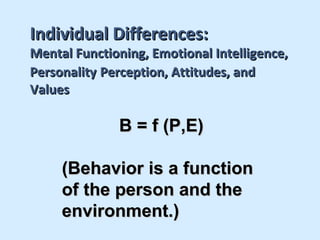
              B = f (P,E)

     (Behavior is a function
     of the person and the
     environment.)
Why is the study of
Individual Differences of
interest to managers?
            Selection
            Placement
            Training
            Motivation
            Leadership
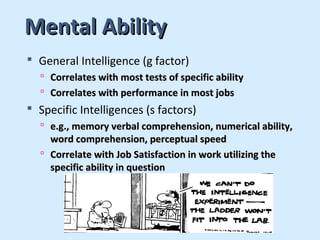
Mental Ability
 General Intelligence (g factor)
   Correlates with most tests of specific ability
   Correlates with performance in most jobs
 Specific Intelligences (s factors)
   e.g., memory verbal comprehension, numerical ability,
    word comprehension, perceptual speed
   Correlate with Job Satisfaction in work utilizing the
    specific ability in question
Cognitive Styles
 How do we gather information?
   Sensing - Look at the facts, details.

   Intuiting - Brainstorm, get a general overview.

 How do we choose between alternatives?
   Thinking - Analyze objectively, reason.

   Feeling - Consider the impact on people.
Cognitive Styles

 Sensation / Thinking (ST) (e.g., technician)

 Intuitive / Thinking (NT) (e.g., planner)

 Sensation / Feeling (SF) (e.g., teacher)

 Intuitive / Feeling (NF) (e.g., artist)
Myers-Briggs Test
Has 4 dimensions:
 Sensing vs. Intuiting

 Thinking vs. Feeling

 Extraversion vs. Introversion

 Judger vs. Perceiver
   (decisive vs. flexible)

Higher and lower positions in each of the dimensions
are used to classify people into one of 16 different
personality categories.
Emotional Intelligence
Dimensions
1)   Knowing one’s own emotions
2)   Controlling one’s emotions
3)   Recognizing others’ emotions (Empathy)
4)   Influencing others’ emotions

     Author Daniel Goleman says incompetence in
     management occurs more often from lack of EQ
     than lack of IQ
Personality
    Nature of Personality
       Internal State
       Uniqueness
       Consistency
       Stability

   Managers should be aware of subordinates’
    characteristics.
   Managers should also be aware of their own
    characteristics.
Personality Theories
 Developmental Stage (Psychodynamic)
    (Freud, etc.)
 Trait-Based (“Big Five”, etc.)
    e.g., Neurotic, Extraversion, Authoritarian (Eysenck)
 Motive-Based
    e.g., Achievement, Affiliation, Power (McClelland)
 Belief-Based
    e.g., Internal vs. External Locus of Control (Rotter)
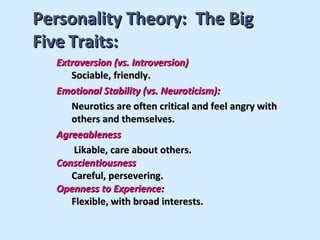
Personality Theory: The Big
Five Traits:
  Extraversion (vs. Introversion)
     Sociable, friendly.
  Emotional Stability (vs. Neuroticism):
     Neurotics are often critical and feel angry with
     others and themselves.
  Agreeableness
      Likable, care about others.
  Conscientiousness
     Careful, persevering.
  Openness to Experience:
     Flexible, with broad interests.
Other Characteristics

    Self-Monitoring: Tendency to manage impressions
     others have of you

    Risk taking and thrill seeking

    Self-Esteem: Degree to which people feel good about
     themselves and abilities.
Locus of Control
 People who believe that they are in control of their
  own lives are said to have an Internal locus of
  control.

 People who think that forces beyond their control
  dictate what happens to them are said to have an
  External locus of control.
Testing Intelligence and
Personality
 When using in
  selection and
  placement: Back up
  with validity studies.
 In General:
   Intelligence Tests-
    Moderate Validity
   Personality Tests- Low
    Validity
Perception
 “The link between the person and the
  environment”
 Broadly defined, includes Social Perception
  (impressions of people)
The Perception Process

                                          Organizing the
                     Screening the
Observing “data”                       selected “data” into
                      “data” and
 via the senses                             patterns for
                   selecting what to
                                        interpretation and
                        process
                                             response
Perception
 Why are perceptions often distorted?
   Why do people not always perceive things as they are?
   Why do people perceive things differently?
     Different people
     Same person at different times
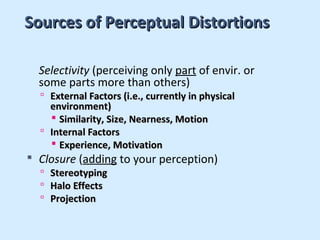
Sources of Perceptual Distortions

  Selectivity (perceiving only part of envir. or
  some parts more than others)
   External Factors (i.e., currently in physical
    environment)
     Similarity, Size, Nearness, Motion
   Internal Factors
     Experience, Motivation
 Closure (adding to your perception)
   Stereotyping
   Halo Effects
   Projection
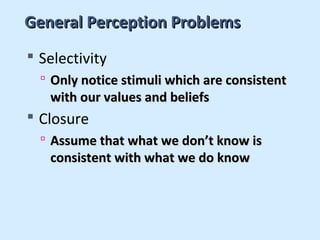
General Perception Problems
 Selectivity
   Only notice stimuli which are consistent
   with our values and beliefs
 Closure
   Assume that what we don’t know is
   consistent with what we do know
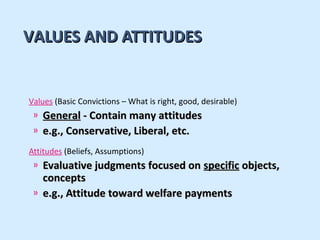
VALUES AND ATTITUDES


Values (Basic Convictions – What is right, good, desirable)
 » General - Contain many attitudes
 » e.g., Conservative, Liberal, etc.

Attitudes (Beliefs, Assumptions)
 » Evaluative judgments focused on specific objects,
   concepts
 » e.g., Attitude toward welfare payments
Types of Values
 Terminal Values
   Desired Goals
   e.g., World Peace, Happiness, Freedom, True
    Friendship, Equality, Family Security
 Instrumental Values
   Means of Achieving Terminal Values
   e.g., Ambition, Politeness, Self-Reliance, Honesty,
    Cheerfulness, Open-Mindedness
Work Values Across Generations
Group Entered Workforce                Values
Veterans    1945-1964          Loyal to Organization
                                 Conforming

Boomers      1965-1984         Loyal to Careers
                                 Dislike Authority

Xers         1985-1999      Loyal to Relationships
                                Seek Work-Life Balance

Nexters    2000-Present   Loyal to Self & Relationships
                                  Self-Reliant but
                                   Team-oriented
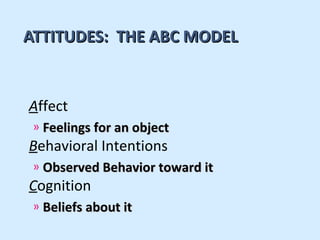
ATTITUDES: THE ABC MODEL


Affect
 » Feelings for an object
Behavioral Intentions
 » Observed Behavior toward it
Cognition
 » Beliefs about it
ATTITUDE CHANGE TECHNIQUES

Persuasion
 » Cognition -> Behavior
Conditioning
 » Affective -> Cognition -> Behavior
Cognitive Dissonance Production
  » Behavior -> Cognition -> Affective
(Based on the assumption that people are motivated to
 protect their self-concepts. This requires a perceived
 consistency among the three components.)
Thanks

Individual differences

  • 1.
    Individual Differences: Mental Functioning,Emotional Intelligence, Personality Perception, Attitudes, and Values B = f (P,E) (Behavior is a function of the person and the environment.)
  • 2.
    Why is thestudy of Individual Differences of interest to managers?  Selection  Placement  Training  Motivation  Leadership
  • 3.
    Mental Ability  GeneralIntelligence (g factor)  Correlates with most tests of specific ability  Correlates with performance in most jobs  Specific Intelligences (s factors)  e.g., memory verbal comprehension, numerical ability, word comprehension, perceptual speed  Correlate with Job Satisfaction in work utilizing the specific ability in question
  • 4.
    Cognitive Styles  Howdo we gather information?  Sensing - Look at the facts, details.  Intuiting - Brainstorm, get a general overview.  How do we choose between alternatives?  Thinking - Analyze objectively, reason.  Feeling - Consider the impact on people.
  • 5.
    Cognitive Styles  Sensation/ Thinking (ST) (e.g., technician)  Intuitive / Thinking (NT) (e.g., planner)  Sensation / Feeling (SF) (e.g., teacher)  Intuitive / Feeling (NF) (e.g., artist)
  • 6.
    Myers-Briggs Test Has 4dimensions:  Sensing vs. Intuiting  Thinking vs. Feeling  Extraversion vs. Introversion  Judger vs. Perceiver  (decisive vs. flexible) Higher and lower positions in each of the dimensions are used to classify people into one of 16 different personality categories.
  • 7.
    Emotional Intelligence Dimensions 1) Knowing one’s own emotions 2) Controlling one’s emotions 3) Recognizing others’ emotions (Empathy) 4) Influencing others’ emotions Author Daniel Goleman says incompetence in management occurs more often from lack of EQ than lack of IQ
  • 9.
    Personality Nature of Personality  Internal State  Uniqueness  Consistency  Stability  Managers should be aware of subordinates’ characteristics.  Managers should also be aware of their own characteristics.
  • 10.
    Personality Theories  DevelopmentalStage (Psychodynamic)  (Freud, etc.)  Trait-Based (“Big Five”, etc.)  e.g., Neurotic, Extraversion, Authoritarian (Eysenck)  Motive-Based  e.g., Achievement, Affiliation, Power (McClelland)  Belief-Based  e.g., Internal vs. External Locus of Control (Rotter)
  • 11.
    Personality Theory: TheBig Five Traits: Extraversion (vs. Introversion) Sociable, friendly. Emotional Stability (vs. Neuroticism): Neurotics are often critical and feel angry with others and themselves. Agreeableness Likable, care about others. Conscientiousness Careful, persevering. Openness to Experience: Flexible, with broad interests.
  • 12.
    Other Characteristics  Self-Monitoring: Tendency to manage impressions others have of you  Risk taking and thrill seeking  Self-Esteem: Degree to which people feel good about themselves and abilities.
  • 13.
    Locus of Control People who believe that they are in control of their own lives are said to have an Internal locus of control.  People who think that forces beyond their control dictate what happens to them are said to have an External locus of control.
  • 14.
    Testing Intelligence and Personality When using in selection and placement: Back up with validity studies.  In General:  Intelligence Tests- Moderate Validity  Personality Tests- Low Validity
  • 15.
    Perception  “The linkbetween the person and the environment”  Broadly defined, includes Social Perception (impressions of people)
  • 16.
    The Perception Process Organizing the Screening the Observing “data” selected “data” into “data” and via the senses patterns for selecting what to interpretation and process response
  • 17.
    Perception  Why areperceptions often distorted?  Why do people not always perceive things as they are?  Why do people perceive things differently?  Different people  Same person at different times
  • 18.
    Sources of PerceptualDistortions Selectivity (perceiving only part of envir. or some parts more than others)  External Factors (i.e., currently in physical environment)  Similarity, Size, Nearness, Motion  Internal Factors  Experience, Motivation  Closure (adding to your perception)  Stereotyping  Halo Effects  Projection
  • 19.
    General Perception Problems Selectivity  Only notice stimuli which are consistent with our values and beliefs  Closure  Assume that what we don’t know is consistent with what we do know
  • 20.
    VALUES AND ATTITUDES Values(Basic Convictions – What is right, good, desirable) » General - Contain many attitudes » e.g., Conservative, Liberal, etc. Attitudes (Beliefs, Assumptions) » Evaluative judgments focused on specific objects, concepts » e.g., Attitude toward welfare payments
  • 21.
    Types of Values Terminal Values  Desired Goals  e.g., World Peace, Happiness, Freedom, True Friendship, Equality, Family Security  Instrumental Values  Means of Achieving Terminal Values  e.g., Ambition, Politeness, Self-Reliance, Honesty, Cheerfulness, Open-Mindedness
  • 22.
    Work Values AcrossGenerations Group Entered Workforce Values Veterans 1945-1964 Loyal to Organization Conforming Boomers 1965-1984 Loyal to Careers Dislike Authority Xers 1985-1999 Loyal to Relationships Seek Work-Life Balance Nexters 2000-Present Loyal to Self & Relationships Self-Reliant but Team-oriented
  • 23.
    ATTITUDES: THE ABCMODEL Affect » Feelings for an object Behavioral Intentions » Observed Behavior toward it Cognition » Beliefs about it
  • 24.
    ATTITUDE CHANGE TECHNIQUES Persuasion » Cognition -> Behavior Conditioning » Affective -> Cognition -> Behavior Cognitive Dissonance Production » Behavior -> Cognition -> Affective (Based on the assumption that people are motivated to protect their self-concepts. This requires a perceived consistency among the three components.)
  • 25.

Editor's Notes

  • #20 At work, we are constantly bombarded with sensory stimuli—the phone ringing, people talking in the background, the sounds of our computers dinging as new e-mail arrives, people calling our names, etc. As limited processors of information, we cannot possibly notice, receive, and interpret all of this information. As a result, we attend to and accept some stimuli but screen out and reject others. However, this isn't a random process. Selective perception is the tendency to notice and accept objects and information consistent with our values, beliefs, and expectations, while ignoring or screening out or not accepting inconsistent information. Once we have initial information about a person, event, or process, closure is the tendency to fill in the gaps where information is missing, that is, to assume that what we don't know is consistent with what we already know. If employees are told that budgets must be cut by 10 percent, they may automatically assume that 10 percent of employees will lose their jobs, too, even if that isn't the case. Not surprisingly, when closure occurs, people sometimes "fill in the gaps" with inaccurate information, and this can create problems for organizations.
  • #21 1
  • #24 1
  • #25 1