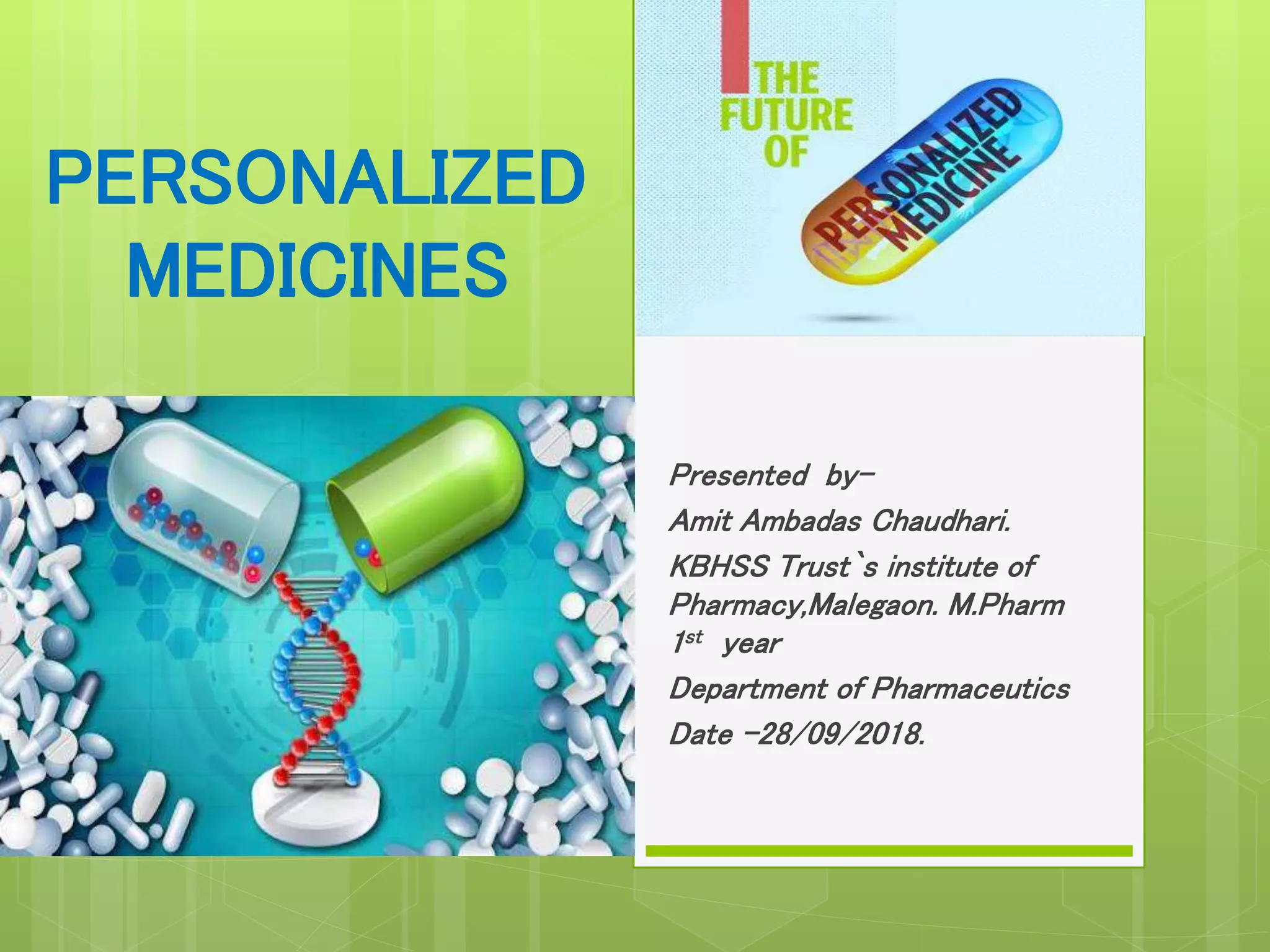



PERSONALIZED
MEDICINES
Presented by-
Amit Ambadas Chaudhari.
KBHSS Trust`s institute of
Pharmacy,Malegaon. M.Pharm
1st year
Department of Pharmaceutics
Date -28/09/2018.
INTRODUCTION
 Personalised medicine has the potential to tailor therapy with the best
response and highest safety margin to ensure better patient care. By
enabling each patient to receive earlier diagnosis, risk assessments and
optimal treatments.
 Physician have always practiced personalized medicine in order to make
effective treatment decisions for their patient.
 They take into account the patients:
 Lifestyle
 Family history
 Symptoms
 Data derived from many type of medical test
DEFINITION
 The term “Personalized medicine” is often described as providing
“the right patient with the right drug at the right dose at the right
time.”
 More broadly Personalized medicine may be thought of as the tailoring
of medical treatment to individual characteristics, needs and
preferences of a patient during all stages of care, including prevention,
diagnosis and treatment .
OTHER TERMS
 Precision medicine
 Stratified medicine
 Targeted medicine
 Pharmacogenomics
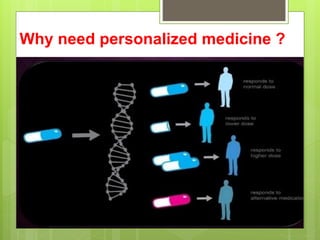
Why need personalized medicine ?
NEED FOR PM
 Similar symptoms but different illness.
 Medical intervention may work in some people but not in other. Because
human variation.
 In human beings 99.9% bases are same but remaining 0.1% base make
person unique.
 Every year in the USA 2 million people die due to adverse drugs effect.
 Drugs efficacy is only in 60% of the population.
 Other 40% have poor drug effect or no effect at all.
 To avoid any allergic and adverse effect the PM ability to offers:
 The right drug
 To the right patient
 For the right disease
 At the right time
 With the right dosage
PHARMACOGENETICS
 Pharmacogenetics is the study of how the action of and the reaction
to drugs vary with the patients genes.
 The study of the relationship between genetic factors and the nature
of responses to drugs.
 In humans, genes influence race, hair and eye color, gender, height,
weight, aspects of behavior and even the likelihood of developing
certain diseases.
 The study is still new, Pharmacogenetics promises to offers great
benefits in drug effectiveness and safety.
 Encompasses pharmacogenetics which employs tools for surveying
the entire genome to assess multigenic determinants in drug
response.
Variation in drug response
 Inter-individual variation in response to drugs serious problem.
 Results in lack of efficacy/ unexpected side effects.
 Variations:
 Pharmacokinetics
 Pharmacodynamics
 Idiosyncratic
ADVANTAGES OF PM
 To predict a patients response to drug.
 To improve efficacy and patient compliance.
 To improve rational drug development.
 To screen and monitor certain disease.
 Diminishes the duration and severity of illness.
 To develop “customized” prescriptions.
 To develop more powerful and safe vaccines.
 To allow improvements in drug research and development (R&D) and
the approval of new drugs.
DISADVANTAGES & LIMITATIONS
 Expensive
 Identification of small inter-individual variation in everyone gene is very
difficult.
 Genetic variations are numerous and quantitative.
 Incorrect diagnostic result.
 Insufficient validation of study results.
 Ethical issues.
Personalized medicines

Personalized medicines

  • 1.
    PERSONALIZED MEDICINES Presented by- Amit AmbadasChaudhari. KBHSS Trust`s institute of Pharmacy,Malegaon. M.Pharm 1st year Department of Pharmaceutics Date -28/09/2018.
  • 2.
    INTRODUCTION  Personalised medicinehas the potential to tailor therapy with the best response and highest safety margin to ensure better patient care. By enabling each patient to receive earlier diagnosis, risk assessments and optimal treatments.  Physician have always practiced personalized medicine in order to make effective treatment decisions for their patient.  They take into account the patients:  Lifestyle  Family history  Symptoms  Data derived from many type of medical test
  • 3.
    DEFINITION  The term“Personalized medicine” is often described as providing “the right patient with the right drug at the right dose at the right time.”  More broadly Personalized medicine may be thought of as the tailoring of medical treatment to individual characteristics, needs and preferences of a patient during all stages of care, including prevention, diagnosis and treatment . OTHER TERMS  Precision medicine  Stratified medicine  Targeted medicine  Pharmacogenomics
  • 4.
  • 5.
    NEED FOR PM Similar symptoms but different illness.  Medical intervention may work in some people but not in other. Because human variation.  In human beings 99.9% bases are same but remaining 0.1% base make person unique.  Every year in the USA 2 million people die due to adverse drugs effect.  Drugs efficacy is only in 60% of the population.  Other 40% have poor drug effect or no effect at all.
  • 6.
     To avoidany allergic and adverse effect the PM ability to offers:  The right drug  To the right patient  For the right disease  At the right time  With the right dosage
  • 7.
    PHARMACOGENETICS  Pharmacogenetics isthe study of how the action of and the reaction to drugs vary with the patients genes.  The study of the relationship between genetic factors and the nature of responses to drugs.  In humans, genes influence race, hair and eye color, gender, height, weight, aspects of behavior and even the likelihood of developing certain diseases.  The study is still new, Pharmacogenetics promises to offers great benefits in drug effectiveness and safety.  Encompasses pharmacogenetics which employs tools for surveying the entire genome to assess multigenic determinants in drug response.
  • 8.
    Variation in drugresponse  Inter-individual variation in response to drugs serious problem.  Results in lack of efficacy/ unexpected side effects.  Variations:  Pharmacokinetics  Pharmacodynamics  Idiosyncratic
  • 9.
    ADVANTAGES OF PM To predict a patients response to drug.  To improve efficacy and patient compliance.  To improve rational drug development.  To screen and monitor certain disease.  Diminishes the duration and severity of illness.  To develop “customized” prescriptions.  To develop more powerful and safe vaccines.  To allow improvements in drug research and development (R&D) and the approval of new drugs.
  • 10.
    DISADVANTAGES & LIMITATIONS Expensive  Identification of small inter-individual variation in everyone gene is very difficult.  Genetic variations are numerous and quantitative.  Incorrect diagnostic result.  Insufficient validation of study results.  Ethical issues.