Prof. Dr. Atıl BULU1
Chapter 2
Flows under Pressure in Pipes
If the fluid is flowing full in a pipe under pressure with no openings to the atmosphere, it
is called “pressured flow”. The typical example of pressured pipe flows is the water
distribution system of a city.
2.1. Equation of Motion
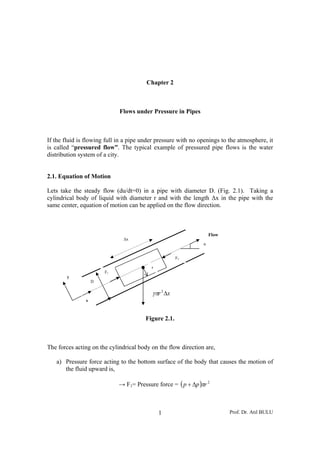
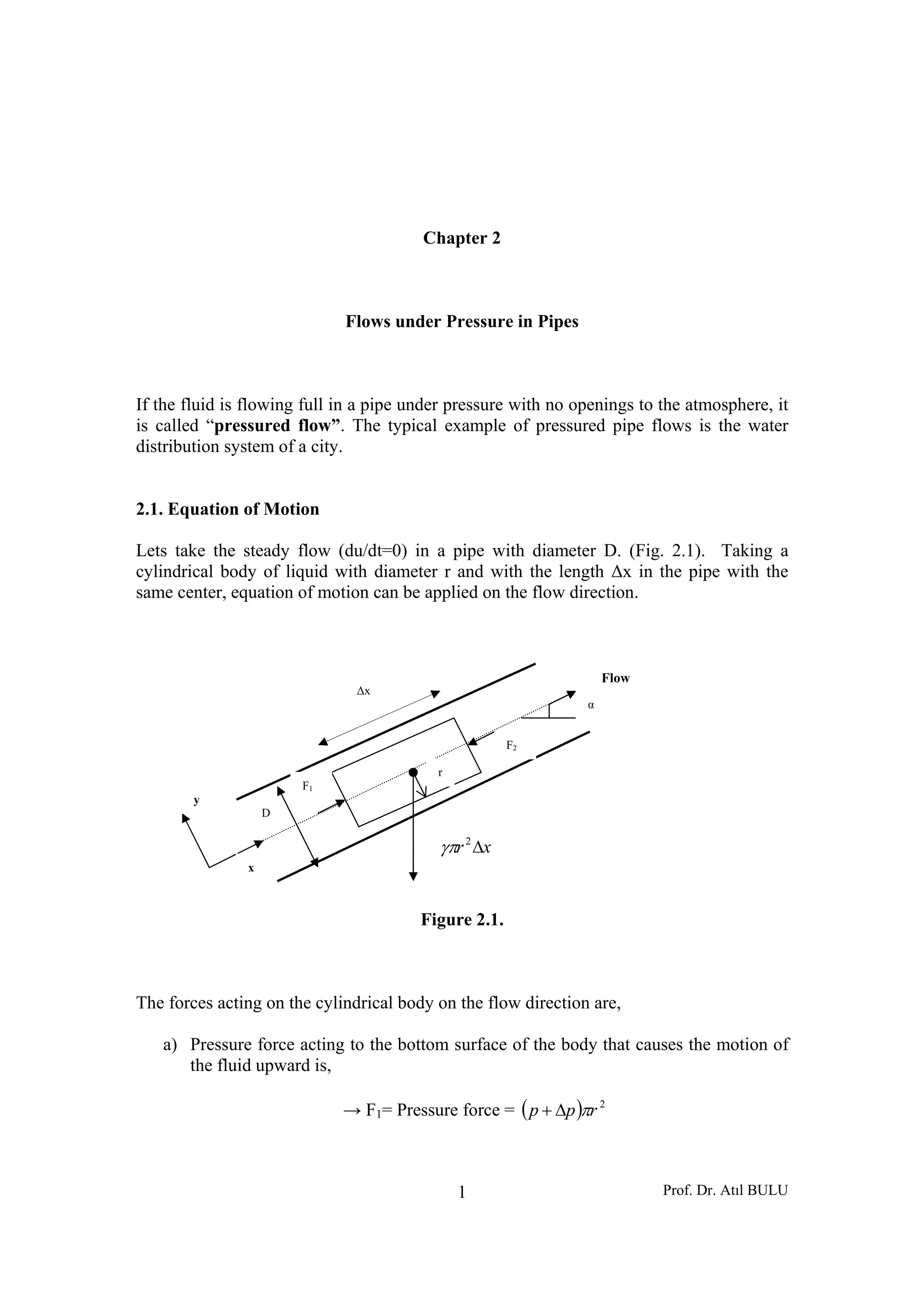
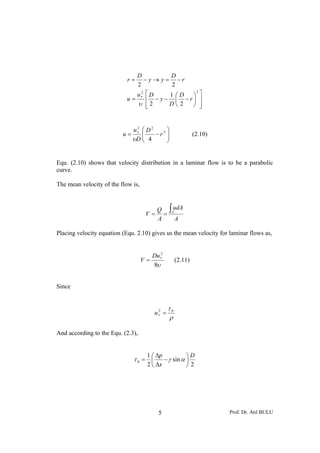
Lets take the steady flow (du/dt=0) in a pipe with diameter D. (Fig. 2.1). Taking a
cylindrical body of liquid with diameter r and with the length Δx in the pipe with the
same center, equation of motion can be applied on the flow direction.
Figure 2.1.
The forces acting on the cylindrical body on the flow direction are,
a) Pressure force acting to the bottom surface of the body that causes the motion of
the fluid upward is,
→ F1= Pressure force = ( ) 2
rpp πΔ+
D
r
F1
F2
xr Δ2
γπ
Δx
y
x
Flow
α
Prof. Dr. Atıl BULU2
b) Pressure force to the top surface of the cylindrical body is,
← F2= Pressure force = 2
rpπ
c) The body weight component on the flow direction is,
← αγπ sin2
xrX Δ=
d) The resultant frictional (shearing) force that acts on the side of the cylindrical
surface due to the viscosity of the fluid is,
← Shearing force = xrΔπτ 2
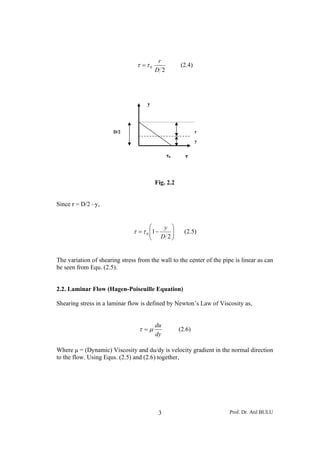
The equation of motion on the flow direction can be written as,
( ) =Δ−Δ−−Δ+ xrxrrprpp πταγπππ 2sin222
Mass × Acceleration (2.1)
The velocity will not change on the flow direction since the pipe diameter is kept
constant and also the flow is a steady flow. The acceleration of the flow body will be
zero, Equ. (2.1) will take the form of,
02sin22
=Δ−Δ−Δ xrxrpr ταγ
r
x
p
⎟
⎠
⎞
⎜
⎝
⎛
−
Δ
Δ
= αγτ sin
2
1
(2.2)
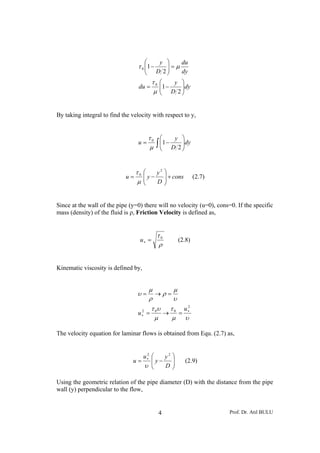
The frictional stress on the wall of the pipe τ0 with r = D/2,
2
sin
2
1
0
D
x
p
⎟
⎠
⎞
⎜
⎝
⎛
−
Δ
Δ
= αγτ (2.3)
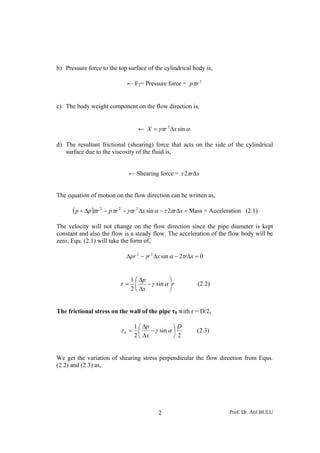
We get the variation of shearing stress perpendicular the flow direction from Equs.
(2.2) and (2.3) as,
Prof. Dr. Atıl BULU3
2
0
D
r
ττ = (2.4)
Fig. 2.2
Since r = D/2 –y,
⎟⎟
⎠
⎞
⎜⎜
⎝
⎛
−=
2
10
D
y
ττ (2.5)
The variation of shearing stress from the wall to the center of the pipe is linear as can
be seen from Equ. (2.5).
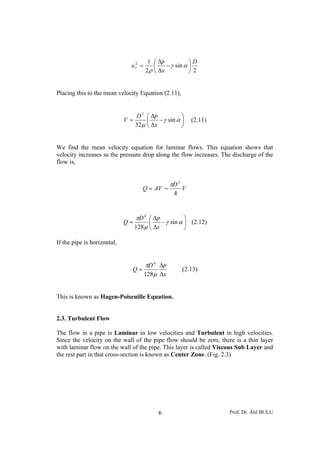
2.2. Laminar Flow (Hagen-Poiseuille Equation)
Shearing stress in a laminar flow is defined by Newton’s Law of Viscosity as,
dy
du
μτ = (2.6)
Where μ = (Dynamic) Viscosity and du/dy is velocity gradient in the normal direction
to the flow. Using Equs. (2.5) and (2.6) together,
r
y
ττ0
y
D/2
Prof. Dr. Atıl BULU4
dy
D
y
du
dy
du
D
y
⎟⎟
⎠
⎞
⎜⎜
⎝
⎛
−=
=⎟⎟
⎠
⎞
⎜⎜
⎝
⎛
−
2
1
2
1
0
0
μ
τ
μτ
By taking integral to find the velocity with respect to y,
∫ ⎟⎟
⎠
⎞
⎜⎜
⎝
⎛
−= dy
D
y
u
2
10
μ
τ
cons
D
y
yu +⎟⎟
⎠
⎞
⎜⎜
⎝
⎛
−=
2
0
μ
τ
(2.7)
Since at the wall of the pipe (y=0) there will no velocity (u=0), cons=0. If the specific
mass (density) of the fluid is ρ, Friction Velocity is defined as,
ρ
τ 0
=∗u (2.8)
Kinematic viscosity is defined by,
υμ
τ
μ
υτ
υ
μ
ρ
ρ
μ
υ
2
002 ∗
∗ =→=
=→=
u
u
The velocity equation for laminar flows is obtained from Equ. (2.7) as,
⎟⎟
⎠
⎞
⎜⎜
⎝
⎛
−= ∗
D
y
y
u
u
22
υ
(2.9)
Using the geometric relation of the pipe diameter (D) with the distance from the pipe
wall (y) perpendicular to the flow,
Prof. Dr. Atıl BULU5
⎥
⎥
⎦
⎤
⎢
⎢
⎣
⎡
⎟
⎠
⎞
⎜
⎝
⎛
−−−=
−=→−=
∗
22
2
1
2
22
r
D
D
y
Du
u
r
D
yy
D
r
υ
⎟⎟
⎠
⎞
⎜⎜
⎝
⎛
−= ∗ 2
22
4
r
D
D
u
u
υ
(2.10)
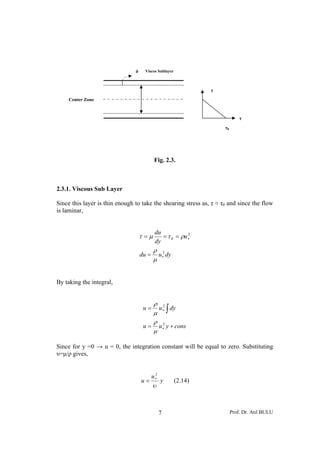
Equ. (2.10) shows that velocity distribution in a laminar flow is to be a parabolic
curve.
The mean velocity of the flow is,
A
udA
A
Q
V A∫==
Placing velocity equation (Equ. 2.10) gives us the mean velocity for laminar flows as,
υ8
2
∗
=
Du
V (2.11)
Since
ρ
τ 02
=∗u
And according to the Equ. (2.3),
2
sin
2
1
0
D
x
p
⎟
⎠
⎞
⎜
⎝
⎛
−
Δ
Δ
= αγτ
Prof. Dr. Atıl BULU6
2
sin
2
12 D
x
p
u ⎟
⎠
⎞
⎜
⎝
⎛
−
Δ
Δ
=∗ αγ
ρ
Placing this to the mean velocity Equation (2.11),
⎟
⎠
⎞
⎜
⎝
⎛
−
Δ
Δ
= αγ
μ
sin
32
2
x
pD
V (2.11)
We find the mean velocity equation for laminar flows. This equation shows that
velocity increases as the pressure drop along the flow increases. The discharge of the
flow is,
V
D
AVQ
4
2
π
==
⎟
⎠
⎞
⎜
⎝
⎛
−
Δ
Δ
= αγ
μ
π
sin
128
4
x
pD
Q (2.12)
If the pipe is horizontal,
x
pD
Q
Δ
Δ
=
μ
π
128
4
(2.13)
This is known as Hagen-Poiseuille Equation.
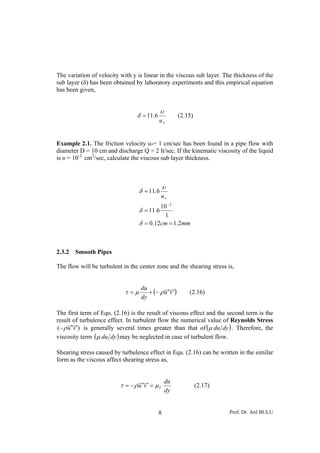
2.3. Turbulent Flow
The flow in a pipe is Laminar in low velocities and Turbulent in high velocities.
Since the velocity on the wall of the pipe flow should be zero, there is a thin layer
with laminar flow on the wall of the pipe. This layer is called Viscous Sub Layer and
the rest part in that cross-section is known as Center Zone. (Fig. 2.3)
Prof. Dr. Atıl BULU7
Fig. 2.3.
2.3.1. Viscous Sub Layer
Since this layer is thin enough to take the shearing stress as, τ ≈ τ0 and since the flow
is laminar,
dyudu
u
dy
du
2
2
0
∗
∗
=
===
μ
ρ
ρτμτ
By taking the integral,
consyuu
dyuu
+=
=
∗
∗ ∫
2
2
μ
ρ
μ
ρ
Since for y =0 → u = 0, the integration constant will be equal to zero. Substituting
υ=μ/ρ gives,
y
u
u
υ
2
∗
= (2.14)
δ Viscos Sublayer
Center Zone
y
τ
τ0
Prof. Dr. Atıl BULU8
The variation of velocity with y is linear in the viscous sub layer. The thickness of the
sub layer (δ) has been obtained by laboratory experiments and this empirical equation
has been given,
∗
=
u
υ
δ 6.11 (2.15)
Example 2.1. The friction velocity u*= 1 cm/sec has been found in a pipe flow with
diameter D = 10 cm and discharge Q = 2 lt/sec. If the kinematic viscosity of the liquid
is υ = 10-2
cm2
/sec, calculate the viscous sub layer thickness.
mmcm
u
2.112.0
1
10
6.11
6.11
2
==
=
=
−
∗
δ
δ
υ
δ
2.3.2 Smooth Pipes
The flow will be turbulent in the center zone and the shearing stress is,
( )vu
dy
du
′′−+= ρμτ (2.16)
The first term of Equ. (2.16) is the result of viscous effect and the second term is the
result of turbulence effect. In turbulent flow the numerical value of Reynolds Stress
)( vu ′′−ρ is generally several times greater than that of( )dyduμ . Therefore, the
viscosity term ( )dyduμ may be neglected in case of turbulent flow.
Shearing stress caused by turbulence effect in Equ. (2.16) can be written in the similar
form as the viscous affect shearing stress as,
dy
du
vu Tμρτ =′′−= (2.17)
Prof. Dr. Atıl BULU9
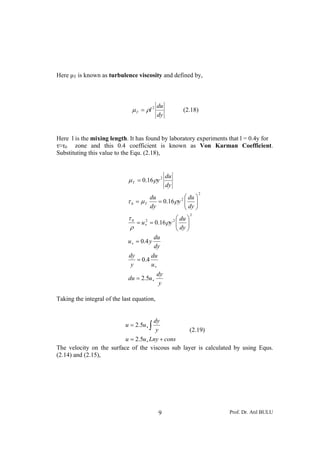
Here μT is known as turbulence viscosity and defined by,
dy
du
lT
2
ρμ = (2.18)
Here l is the mixing length. It has found by laboratory experiments that l = 0.4y for
τ≈τ0 zone and this 0.4 coefficient is known as Von Karman Coefficient.
Substituting this value to the Equ. (2.18),
y
dy
udu
u
du
y
dy
dy
du
yu
dy
du
yu
dy
du
y
dy
du
dy
du
y
T
T
∗
∗
∗
∗
=
=
=
⎟⎟
⎠
⎞
⎜⎜
⎝
⎛
==
⎟⎟
⎠
⎞
⎜⎜
⎝
⎛
==
=
5.2
4.0
4.0
16.0
16.0
16.0
2
220
2
2
0
2
ρ
ρ
τ
ρμτ
ρμ
Taking the integral of the last equation,
consLnyuu
y
dy
uu
+=
=
∗
∗ ∫
5.2
5.2
(2.19)
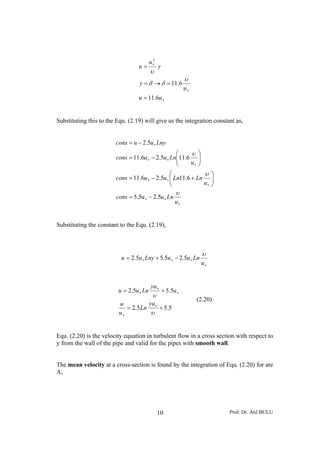
The velocity on the surface of the viscous sub layer is calculated by using Equs.
(2.14) and (2.15),
Prof. Dr. Atıl BULU10
∗
∗
∗
=
=→=
=
uu
u
y
y
u
u
6.11
6.11
2
υ
δδ
υ
Substituting this to the Equ. (2.19) will give us the integration constant as,
∗
∗∗
∗
∗∗
∗
∗∗
∗
−=
⎟⎟
⎠
⎞
⎜⎜
⎝
⎛
+−=
⎟⎟
⎠
⎞
⎜⎜
⎝
⎛
−=
−=
u
Lnuucons
u
LnLnuucons
u
Lnuucons
Lnyuucons
υ
υ
υ
5.25.5
6.115.26.11
6.115.26.11
5.2
Substituting the constant to the Equ. (2.19),
∗
∗∗∗ −+=
u
LnuuLnyuu
υ
5.25.55.2
5.55.2
5.55.2
+=
+=
∗
∗
∗
∗
∗
υ
υ
yu
Ln
u
u
u
yu
Lnuu
(2.20)
Equ. (2.20) is the velocity equation in turbulent flow in a cross section with respect to
y from the wall of the pipe and valid for the pipes with smooth wall.
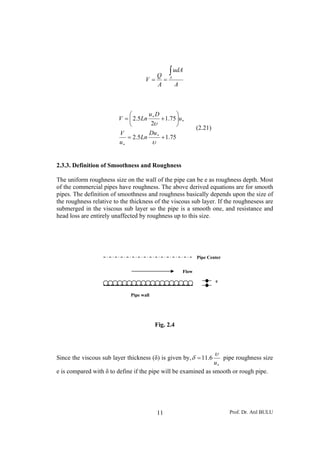
The mean velocity at a cross-section is found by the integration of Equ. (2.20) for are
A,
Prof. Dr. Atıl BULU11
A
udA
A
Q
V A
∫
==
75.15.2
75.1
2
5.2
+=
⎟
⎠
⎞
⎜
⎝
⎛
+=
∗
∗
∗
∗
υ
υ
Du
Ln
u
V
u
Du
LnV
(2.21)
2.3.3. Definition of Smoothness and Roughness
The uniform roughness size on the wall of the pipe can be e as roughness depth. Most
of the commercial pipes have roughness. The above derived equations are for smooth
pipes. The definition of smoothness and roughness basically depends upon the size of
the roughness relative to the thickness of the viscous sub layer. If the roughnesess are
submerged in the viscous sub layer so the pipe is a smooth one, and resistance and
head loss are entirely unaffected by roughness up to this size.
Fig. 2.4
Since the viscous sub layer thickness (δ) is given by,
∗
=
u
υ
δ 6.11 pipe roughness size
e is compared with δ to define if the pipe will be examined as smooth or rough pipe.
Flow
e
Pipe Center
Pipe wall
Prof. Dr. Atıl BULU12
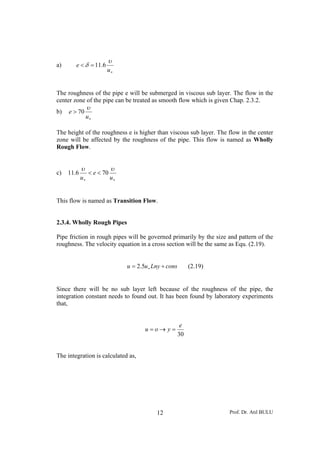
a)
∗
=<
u
e
υ
δ 6.11
The roughness of the pipe e will be submerged in viscous sub layer. The flow in the
center zone of the pipe can be treated as smooth flow which is given Chap. 2.3.2.
b)
∗
>
u
e
υ
70
The height of the roughness e is higher than viscous sub layer. The flow in the center
zone will be affected by the roughness of the pipe. This flow is named as Wholly
Rough Flow.
c)
∗∗
<<
u
e
u
υυ
706.11
This flow is named as Transition Flow.
2.3.4. Wholly Rough Pipes
Pipe friction in rough pipes will be governed primarily by the size and pattern of the
roughness. The velocity equation in a cross section will be the same as Equ. (2.19).
consLnyuu += ∗5.2 (2.19)
Since there will be no sub layer left because of the roughness of the pipe, the
integration constant needs to found out. It has been found by laboratory experiments
that,
30
e
you =→=
The integration is calculated as,
Prof. Dr. Atıl BULU13
30
5.25.2
30
5.2
30
5.20
e
LnuLnyuu
e
Lnuconst
const
e
Lnu
∗∗
∗
∗
−=
−=
+=
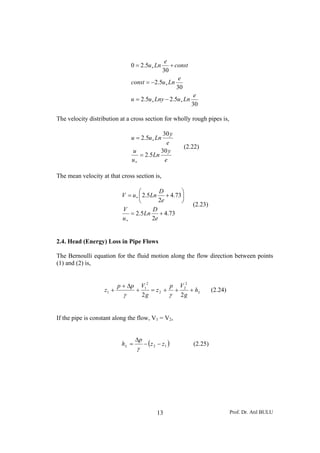
The velocity distribution at a cross section for wholly rough pipes is,
e
y
Ln
u
u
e
y
Lnuu
30
5.2
30
5.2
=
=
∗
∗
(2.22)
The mean velocity at that cross section is,
73.4
2
5.2
73.4
2
5.2
+=
⎟
⎠
⎞
⎜
⎝
⎛
+=
∗
∗
e
D
Ln
u
V
e
D
LnuV
(2.23)
2.4. Head (Energy) Loss in Pipe Flows
The Bernoulli equation for the fluid motion along the flow direction between points
(1) and (2) is,
Lh
g
Vp
z
g
Vpp
z +++=+
Δ+
+
22
2
2
2
2
1
1
γγ
(2.24)
If the pipe is constant along the flow, V1 = V2,
( )12 zz
p
hL −−
Δ
=
γ
(2.25)
Prof. Dr. Atıl BULU14
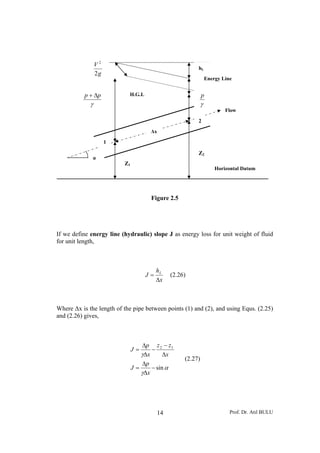
Figure 2.5
If we define energy line (hydraulic) slope J as energy loss for unit weight of fluid
for unit length,
x
h
J L
Δ
= (2.26)
Where Δx is the length of the pipe between points (1) and (2), and using Equs. (2.25)
and (2.26) gives,
α
γ
γ
sin
12
−
Δ
Δ
=
Δ
−
−
Δ
Δ
=
x
p
J
x
zz
x
p
J
(2.27)
g
V
2
2
γ
pp Δ+
hL
γ
p
Z1
Z2
Horizontal Datum
Energy Line
H.G.L
Flow
α
1
2
Δx
Prof. Dr. Atıl BULU15
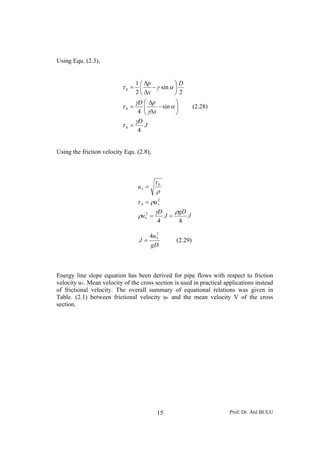
Using Equ. (2.3),
J
D
x
pD
D
x
p
4
sin
4
2
sin
2
1
0
0
0
γ
τ
α
γ
γ
τ
αγτ
=
⎟⎟
⎠
⎞
⎜⎜
⎝
⎛
−
Δ
Δ
=
⎟
⎠
⎞
⎜
⎝
⎛
−
Δ
Δ
=
(2.28)
Using the friction velocity Equ. (2.8),
J
gD
J
D
u
u
u
44
2
2
0
0
ργ
ρ
ρτ
ρ
τ
==
=
=
∗
∗
∗
gD
u
J
2
4 ∗
= (2.29)
Energy line slope equation has been derived for pipe flows with respect to friction
velocity u*. Mean velocity of the cross section is used in practical applications instead
of frictional velocity. The overall summary of equational relations was given in
Table. (2.1) between frictional velocity u* and the mean velocity V of the cross
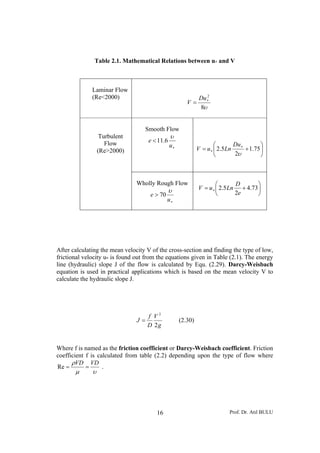
section.
Prof. Dr. Atıl BULU16
Table 2.1. Mathematical Relations between u* and V
Laminar Flow
(Re<2000)
υ8
2
∗
=
Du
V
Turbulent
Flow
(Re>2000)
Smooth Flow
∗
<
u
e
υ
6.11
⎟
⎠
⎞
⎜
⎝
⎛
+= ∗
∗ 75.1
2
5.2
υ
Du
LnuV
Wholly Rough Flow
∗
>
u
e
υ
70
⎟
⎠
⎞
⎜
⎝
⎛
+= ∗ 73.4
2
5.2
e
D
LnuV
After calculating the mean velocity V of the cross-section and finding the type of low,
frictional velocity u* is found out from the equations given in Table (2.1). The energy
line (hydraulic) slope J of the flow is calculated by Equ. (2.29). Darcy-Weisbach
equation is used in practical applications which is based on the mean velocity V to
calculate the hydraulic slope J.
g
V
D
f
J
2
2
= (2.30)
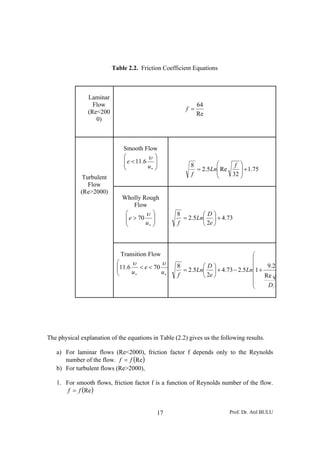
Where f is named as the friction coefficient or Darcy-Weisbach coefficient. Friction
coefficient f is calculated from table (2.2) depending upon the type of flow where
υμ
ρ VDVD
==Re .
Prof. Dr. Atıl BULU17
Table 2.2. Friction Coefficient Equations
Laminar
Flow
(Re<200
0)
Re
64
=f
Turbulent
Flow
(Re>2000)
Smooth Flow
⎟⎟
⎠
⎞
⎜⎜
⎝
⎛
<
∗u
e
υ
6.11
75.1
32
Re5.2
8
+⎟
⎟
⎠
⎞
⎜
⎜
⎝
⎛
=
f
Ln
f
Wholly Rough
Flow
⎟⎟
⎠
⎞
⎜⎜
⎝
⎛
>
∗u
e
υ
70 73.4
2
5.2
8
+⎟
⎠
⎞
⎜
⎝
⎛
=
e
D
Ln
f
Transition Flow
⎜⎜
⎝
⎛
<<
∗∗ u
e
u
υυ
706.11
⎜
⎜
⎜
⎜
⎜
⎝
⎛
+−+⎟
⎠
⎞
⎜
⎝
⎛
=
eD
Ln
e
D
Ln
f Re
2.9
15.273.4
2
5.2
8
The physical explanation of the equations in Table (2.2) gives us the following results.
a) For laminar flows (Re<2000), friction factor f depends only to the Reynolds
number of the flow. ( )Reff =
b) For turbulent flows (Re>2000),
1. For smooth flows, friction factor f is a function of Reynolds number of the flow.
( )Reff =
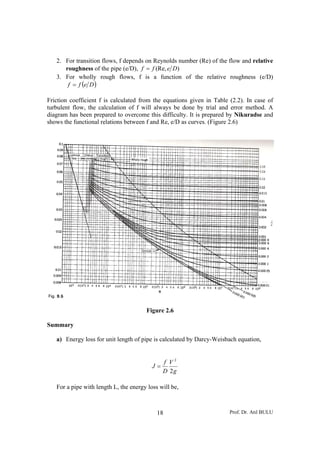
Fric
turb
diag
show
Sum
2. For tran
roughn
3. For wh
(eff =
ction coeffic
bulent flow,
gram has be
ws the func
mmary
a) Energy
For a pipe w
nsition flow
ness of the p
holly rough
)De
cient f is c
, the calcul
een prepare
ctional relati
loss for uni
with length
ws, f depend
pipe (e/D), f
h flows, f
calculated fr
lation of f
ed to overco
ions betwee
it length of
L, the ener
18
ds on Reyno
(Re,eff =
f is a fun
from the eq
will alway
ome this dif
en f and Re,
Figure 2
pipe is calc
D
f
J =
gy loss will
olds number
)De
nction of t
quations giv
s be done
fficulty. It i
, e/D as curv
.6
culated by D
g
V
2
2
l be,
r (Re) of the
the relative
ven in Tabl
by trial an
is prepared
ves. (Figure
Darcy-Weisb
Prof. Dr. A
e flow and r
e roughnes
le (2.2). In
d error me
by Nikura
e 2.6)
bach equati
Atıl BULU
relative
s (e/D)
case of
thod. A
adse and
ion,
Prof. Dr. Atıl BULU19
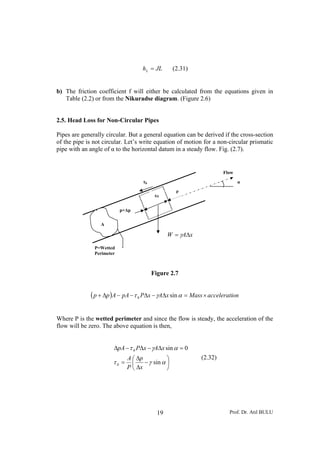
JLhL = (2.31)
b) The friction coefficient f will either be calculated from the equations given in
Table (2.2) or from the Nikuradse diagram. (Figure 2.6)
2.5. Head Loss for Non-Circular Pipes
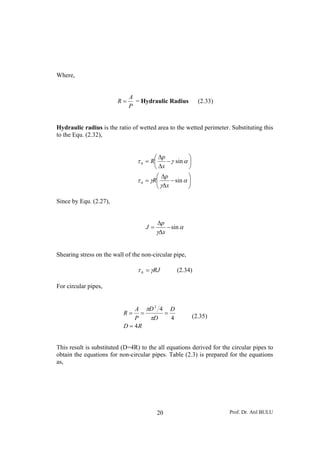
Pipes are generally circular. But a general equation can be derived if the cross-section
of the pipe is not circular. Let’s write equation of motion for a non-circular prismatic
pipe with an angle of α to the horizontal datum in a steady flow. Fig. (2.7).
Figure 2.7
( ) onacceleratiMassxAxPpAApp ×=Δ−Δ−−Δ+ αγτ sin0
Where P is the wetted perimeter and since the flow is steady, the acceleration of the
flow will be zero. The above equation is then,
⎟
⎠
⎞
⎜
⎝
⎛
−
Δ
Δ
=
=Δ−Δ−Δ
αγτ
αγτ
sin
0sin
0
0
x
p
P
A
xAxPpA
(2.32)
A
xAW Δ= γ
ατ0
p+Δp
p
Flow
P=Wetted
Perimeter
Δx
Prof. Dr. Atıl BULU20
Where,
P
A
R = = Hydraulic Radius (2.33)
Hydraulic radius is the ratio of wetted area to the wetted perimeter. Substituting this
to the Equ. (2.32),
⎟⎟
⎠
⎞
⎜⎜
⎝
⎛
−
Δ
Δ
=
⎟
⎠
⎞
⎜
⎝
⎛
−
Δ
Δ
=
α
γ
γτ
αγτ
sin
sin
0
0
x
p
R
x
p
R
Since by Equ. (2.27),
α
γ
sin−
Δ
Δ
=
x
p
J
Shearing stress on the wall of the non-circular pipe,
RJγτ =0 (2.34)
For circular pipes,
RD
D
D
D
P
A
R
4
4
42
=
===
π
π
(2.35)
This result is substituted (D=4R) to the all equations derived for the circular pipes to
obtain the equations for non-circular pipes. Table (2.3) is prepared for the equations
as,
Prof. Dr. Atıl BULU21
Table 2.3.
Circular Pipes Non-Circular pipes
J
D
4
0 γτ =
g
V
D
f
J
2
2
×=
( )eDff Re,=
υ
VD
=Re
RJγτ =0
g
V
R
f
J
24
2
×=
( )eRff 4Re,=
υ
RV 4
Re =
2.6. Hydraulic and Energy Grade Lines
The terms of energy equation have a dimension of length[ ]L ; thus we can attach a
useful relationship to them.
Lhz
g
Vp
z
g
Vp
+++=++ 2
2
22
1
2
11
22 γγ
(2.36)
If we were to tap a piezometer tube into the pipe, the liquid in the pipe would rise in
the tube to a height p/γ (pressure head), hence that is the reason for the name
hydraulic grade line (HGL). The total head ⎟⎟
⎠
⎞
⎜⎜
⎝
⎛
++ z
g
Vp
2
2
γ
in the system is greater
than ⎟⎟
⎠
⎞
⎜⎜
⎝
⎛
+ z
p
γ
by an amount
g
V
2
2
(velocity head), thus the energy (grade) line (EGL)
is above the HGL with a distance
g
V
2
2
.
Some hints for drawing hydraulic grade lines and energy lines are as follows.
1.
2.
3.
4.
5.
6.
7.
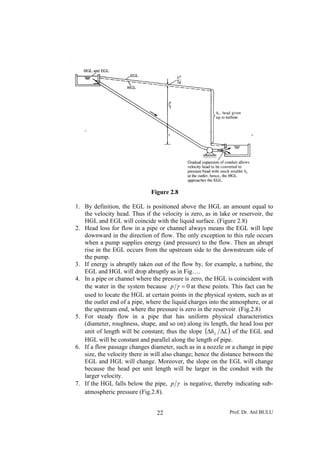
By definiti
the velocity
HGL and E
Head loss f
downward
when a pum
rise in the
the pump.
If energy is
EGL and H
In a pipe or
the water in
used to loc
the outlet e
the upstream
For steady
(diameter, r
unit of leng
HGL will b
If a flow pa
size, the ve
EGL and H
because the
larger veloc
If the HGL
atmospheri
on, the EG
y head. Thu
EGL will co
for flow in
in the direc
mp supplies
EGL occur
s abruptly t
HGL will dro
r channel w
n the system
ate the HGL
end of a pipe
m end, whe
y flow in
roughness,
gth will be
be constant
assage chan
elocity there
HGL will ch
e head per
city.
L falls below
ic pressure (
22
Figure
L is positio
us if the vel
oincide with
a pipe or c
ction of flow
s energy (an
rs from the
taken out of
op abruptly
where the pre
m because
L at certain
e, where the
ere the press
a pipe tha
shape, and
constant; th
and parallel
nges diamete
e in will also
hange. Mor
unit length
w the pipe,
(Fig.2.8).
e 2.8
oned above
locity is zer
h the liquid s
channel alw
w. The only
nd pressure
upstream si
f the flow b
y as in Fig…
essure is zer
0=γp at
n points in th
e liquid cha
sure is zero
at has unif
so on) alon
hus the slop
l along the l
er, such as i
o change; h
reover, the s
h will be la
γp is neg
the HGL a
ro, as in lak
surface. (Fig
ways means
y exception
e) to the flo
ide to the d
by, for exam
….
ro, the HGL
these point
he physical
arges into th
in the reser
form physi
ng its length
pe ( LhL ΔΔ
length of pi
in a nozzle
hence the di
slope on the
arger in the
gative, there
Prof. Dr. A
an amount e
ke or reserv
gure 2.8)
the EGL w
n to this rule
ow. Then an
downstream
mple, a turb
L is coincide
ts. This fact
l system, su
he atmosphe
rvoir. (Fig.2
ical charac
h, the head
)L of the E
ipe.
or a change
istance betw
e EGL will
e conduit w
eby indicati
Atıl BULU
equal to
voir, the
will lope
e occurs
n abrupt
m side of
bine, the
ent with
t can be
uch as at
ere, or at
2.8)
cteristics
loss per
EGL and
e in pipe
ween the
l change
with the
ing sub-
Prof. Dr. Atıl BULU23
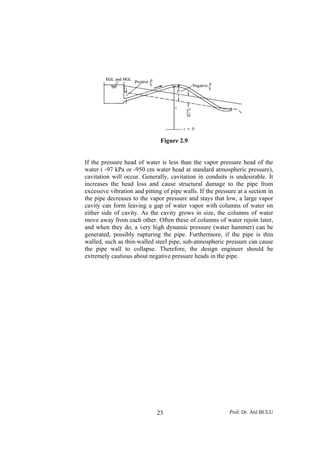
Figure 2.9
If the pressure head of water is less than the vapor pressure head of the
water ( -97 kPa or -950 cm water head at standard atmospheric pressure),
cavitation will occur. Generally, cavitation in conduits is undesirable. It
increases the head loss and cause structural damage to the pipe from
excessive vibration and pitting of pipe walls. If the pressure at a section in
the pipe decreases to the vapor pressure and stays that low, a large vapor
cavity can form leaving a gap of water vapor with columns of water on
either side of cavity. As the cavity grows in size, the columns of water
move away from each other. Often these of columns of water rejoin later,
and when they do, a very high dynamic pressure (water hammer) can be
generated, possibly rupturing the pipe. Furthermore, if the pipe is thin
walled, such as thin-walled steel pipe, sub-atmospheric pressure can cause
the pipe wall to collapse. Therefore, the design engineer should be
extremely cautious about negative pressure heads in the pipe.
Prof. Dr. Atıl BULU24

Flows under Pressure in Pipes (Lecture notes 02)

  • 1.
    Prof. Dr. AtılBULU1 Chapter 2 Flows under Pressure in Pipes If the fluid is flowing full in a pipe under pressure with no openings to the atmosphere, it is called “pressured flow”. The typical example of pressured pipe flows is the water distribution system of a city. 2.1. Equation of Motion Lets take the steady flow (du/dt=0) in a pipe with diameter D. (Fig. 2.1). Taking a cylindrical body of liquid with diameter r and with the length Δx in the pipe with the same center, equation of motion can be applied on the flow direction. Figure 2.1. The forces acting on the cylindrical body on the flow direction are, a) Pressure force acting to the bottom surface of the body that causes the motion of the fluid upward is, → F1= Pressure force = ( ) 2 rpp πΔ+ D r F1 F2 xr Δ2 γπ Δx y x Flow α
  • 2.
    Prof. Dr. AtılBULU2 b) Pressure force to the top surface of the cylindrical body is, ← F2= Pressure force = 2 rpπ c) The body weight component on the flow direction is, ← αγπ sin2 xrX Δ= d) The resultant frictional (shearing) force that acts on the side of the cylindrical surface due to the viscosity of the fluid is, ← Shearing force = xrΔπτ 2 The equation of motion on the flow direction can be written as, ( ) =Δ−Δ−−Δ+ xrxrrprpp πταγπππ 2sin222 Mass × Acceleration (2.1) The velocity will not change on the flow direction since the pipe diameter is kept constant and also the flow is a steady flow. The acceleration of the flow body will be zero, Equ. (2.1) will take the form of, 02sin22 =Δ−Δ−Δ xrxrpr ταγ r x p ⎟ ⎠ ⎞ ⎜ ⎝ ⎛ − Δ Δ = αγτ sin 2 1 (2.2) The frictional stress on the wall of the pipe τ0 with r = D/2, 2 sin 2 1 0 D x p ⎟ ⎠ ⎞ ⎜ ⎝ ⎛ − Δ Δ = αγτ (2.3) We get the variation of shearing stress perpendicular the flow direction from Equs. (2.2) and (2.3) as,
  • 3.
    Prof. Dr. AtılBULU3 2 0 D r ττ = (2.4) Fig. 2.2 Since r = D/2 –y, ⎟⎟ ⎠ ⎞ ⎜⎜ ⎝ ⎛ −= 2 10 D y ττ (2.5) The variation of shearing stress from the wall to the center of the pipe is linear as can be seen from Equ. (2.5). 2.2. Laminar Flow (Hagen-Poiseuille Equation) Shearing stress in a laminar flow is defined by Newton’s Law of Viscosity as, dy du μτ = (2.6) Where μ = (Dynamic) Viscosity and du/dy is velocity gradient in the normal direction to the flow. Using Equs. (2.5) and (2.6) together, r y ττ0 y D/2
  • 4.
    Prof. Dr. AtılBULU4 dy D y du dy du D y ⎟⎟ ⎠ ⎞ ⎜⎜ ⎝ ⎛ −= =⎟⎟ ⎠ ⎞ ⎜⎜ ⎝ ⎛ − 2 1 2 1 0 0 μ τ μτ By taking integral to find the velocity with respect to y, ∫ ⎟⎟ ⎠ ⎞ ⎜⎜ ⎝ ⎛ −= dy D y u 2 10 μ τ cons D y yu +⎟⎟ ⎠ ⎞ ⎜⎜ ⎝ ⎛ −= 2 0 μ τ (2.7) Since at the wall of the pipe (y=0) there will no velocity (u=0), cons=0. If the specific mass (density) of the fluid is ρ, Friction Velocity is defined as, ρ τ 0 =∗u (2.8) Kinematic viscosity is defined by, υμ τ μ υτ υ μ ρ ρ μ υ 2 002 ∗ ∗ =→= =→= u u The velocity equation for laminar flows is obtained from Equ. (2.7) as, ⎟⎟ ⎠ ⎞ ⎜⎜ ⎝ ⎛ −= ∗ D y y u u 22 υ (2.9) Using the geometric relation of the pipe diameter (D) with the distance from the pipe wall (y) perpendicular to the flow,
  • 5.
    Prof. Dr. AtılBULU5 ⎥ ⎥ ⎦ ⎤ ⎢ ⎢ ⎣ ⎡ ⎟ ⎠ ⎞ ⎜ ⎝ ⎛ −−−= −=→−= ∗ 22 2 1 2 22 r D D y Du u r D yy D r υ ⎟⎟ ⎠ ⎞ ⎜⎜ ⎝ ⎛ −= ∗ 2 22 4 r D D u u υ (2.10) Equ. (2.10) shows that velocity distribution in a laminar flow is to be a parabolic curve. The mean velocity of the flow is, A udA A Q V A∫== Placing velocity equation (Equ. 2.10) gives us the mean velocity for laminar flows as, υ8 2 ∗ = Du V (2.11) Since ρ τ 02 =∗u And according to the Equ. (2.3), 2 sin 2 1 0 D x p ⎟ ⎠ ⎞ ⎜ ⎝ ⎛ − Δ Δ = αγτ
  • 6.
    Prof. Dr. AtılBULU6 2 sin 2 12 D x p u ⎟ ⎠ ⎞ ⎜ ⎝ ⎛ − Δ Δ =∗ αγ ρ Placing this to the mean velocity Equation (2.11), ⎟ ⎠ ⎞ ⎜ ⎝ ⎛ − Δ Δ = αγ μ sin 32 2 x pD V (2.11) We find the mean velocity equation for laminar flows. This equation shows that velocity increases as the pressure drop along the flow increases. The discharge of the flow is, V D AVQ 4 2 π == ⎟ ⎠ ⎞ ⎜ ⎝ ⎛ − Δ Δ = αγ μ π sin 128 4 x pD Q (2.12) If the pipe is horizontal, x pD Q Δ Δ = μ π 128 4 (2.13) This is known as Hagen-Poiseuille Equation. 2.3. Turbulent Flow The flow in a pipe is Laminar in low velocities and Turbulent in high velocities. Since the velocity on the wall of the pipe flow should be zero, there is a thin layer with laminar flow on the wall of the pipe. This layer is called Viscous Sub Layer and the rest part in that cross-section is known as Center Zone. (Fig. 2.3)
  • 7.
    Prof. Dr. AtılBULU7 Fig. 2.3. 2.3.1. Viscous Sub Layer Since this layer is thin enough to take the shearing stress as, τ ≈ τ0 and since the flow is laminar, dyudu u dy du 2 2 0 ∗ ∗ = === μ ρ ρτμτ By taking the integral, consyuu dyuu += = ∗ ∗ ∫ 2 2 μ ρ μ ρ Since for y =0 → u = 0, the integration constant will be equal to zero. Substituting υ=μ/ρ gives, y u u υ 2 ∗ = (2.14) δ Viscos Sublayer Center Zone y τ τ0
  • 8.
    Prof. Dr. AtılBULU8 The variation of velocity with y is linear in the viscous sub layer. The thickness of the sub layer (δ) has been obtained by laboratory experiments and this empirical equation has been given, ∗ = u υ δ 6.11 (2.15) Example 2.1. The friction velocity u*= 1 cm/sec has been found in a pipe flow with diameter D = 10 cm and discharge Q = 2 lt/sec. If the kinematic viscosity of the liquid is υ = 10-2 cm2 /sec, calculate the viscous sub layer thickness. mmcm u 2.112.0 1 10 6.11 6.11 2 == = = − ∗ δ δ υ δ 2.3.2 Smooth Pipes The flow will be turbulent in the center zone and the shearing stress is, ( )vu dy du ′′−+= ρμτ (2.16) The first term of Equ. (2.16) is the result of viscous effect and the second term is the result of turbulence effect. In turbulent flow the numerical value of Reynolds Stress )( vu ′′−ρ is generally several times greater than that of( )dyduμ . Therefore, the viscosity term ( )dyduμ may be neglected in case of turbulent flow. Shearing stress caused by turbulence effect in Equ. (2.16) can be written in the similar form as the viscous affect shearing stress as, dy du vu Tμρτ =′′−= (2.17)
  • 9.
    Prof. Dr. AtılBULU9 Here μT is known as turbulence viscosity and defined by, dy du lT 2 ρμ = (2.18) Here l is the mixing length. It has found by laboratory experiments that l = 0.4y for τ≈τ0 zone and this 0.4 coefficient is known as Von Karman Coefficient. Substituting this value to the Equ. (2.18), y dy udu u du y dy dy du yu dy du yu dy du y dy du dy du y T T ∗ ∗ ∗ ∗ = = = ⎟⎟ ⎠ ⎞ ⎜⎜ ⎝ ⎛ == ⎟⎟ ⎠ ⎞ ⎜⎜ ⎝ ⎛ == = 5.2 4.0 4.0 16.0 16.0 16.0 2 220 2 2 0 2 ρ ρ τ ρμτ ρμ Taking the integral of the last equation, consLnyuu y dy uu += = ∗ ∗ ∫ 5.2 5.2 (2.19) The velocity on the surface of the viscous sub layer is calculated by using Equs. (2.14) and (2.15),
  • 10.
    Prof. Dr. AtılBULU10 ∗ ∗ ∗ = =→= = uu u y y u u 6.11 6.11 2 υ δδ υ Substituting this to the Equ. (2.19) will give us the integration constant as, ∗ ∗∗ ∗ ∗∗ ∗ ∗∗ ∗ −= ⎟⎟ ⎠ ⎞ ⎜⎜ ⎝ ⎛ +−= ⎟⎟ ⎠ ⎞ ⎜⎜ ⎝ ⎛ −= −= u Lnuucons u LnLnuucons u Lnuucons Lnyuucons υ υ υ 5.25.5 6.115.26.11 6.115.26.11 5.2 Substituting the constant to the Equ. (2.19), ∗ ∗∗∗ −+= u LnuuLnyuu υ 5.25.55.2 5.55.2 5.55.2 += += ∗ ∗ ∗ ∗ ∗ υ υ yu Ln u u u yu Lnuu (2.20) Equ. (2.20) is the velocity equation in turbulent flow in a cross section with respect to y from the wall of the pipe and valid for the pipes with smooth wall. The mean velocity at a cross-section is found by the integration of Equ. (2.20) for are A,
  • 11.
    Prof. Dr. AtılBULU11 A udA A Q V A ∫ == 75.15.2 75.1 2 5.2 += ⎟ ⎠ ⎞ ⎜ ⎝ ⎛ += ∗ ∗ ∗ ∗ υ υ Du Ln u V u Du LnV (2.21) 2.3.3. Definition of Smoothness and Roughness The uniform roughness size on the wall of the pipe can be e as roughness depth. Most of the commercial pipes have roughness. The above derived equations are for smooth pipes. The definition of smoothness and roughness basically depends upon the size of the roughness relative to the thickness of the viscous sub layer. If the roughnesess are submerged in the viscous sub layer so the pipe is a smooth one, and resistance and head loss are entirely unaffected by roughness up to this size. Fig. 2.4 Since the viscous sub layer thickness (δ) is given by, ∗ = u υ δ 6.11 pipe roughness size e is compared with δ to define if the pipe will be examined as smooth or rough pipe. Flow e Pipe Center Pipe wall
  • 12.
    Prof. Dr. AtılBULU12 a) ∗ =< u e υ δ 6.11 The roughness of the pipe e will be submerged in viscous sub layer. The flow in the center zone of the pipe can be treated as smooth flow which is given Chap. 2.3.2. b) ∗ > u e υ 70 The height of the roughness e is higher than viscous sub layer. The flow in the center zone will be affected by the roughness of the pipe. This flow is named as Wholly Rough Flow. c) ∗∗ << u e u υυ 706.11 This flow is named as Transition Flow. 2.3.4. Wholly Rough Pipes Pipe friction in rough pipes will be governed primarily by the size and pattern of the roughness. The velocity equation in a cross section will be the same as Equ. (2.19). consLnyuu += ∗5.2 (2.19) Since there will be no sub layer left because of the roughness of the pipe, the integration constant needs to found out. It has been found by laboratory experiments that, 30 e you =→= The integration is calculated as,
  • 13.
    Prof. Dr. AtılBULU13 30 5.25.2 30 5.2 30 5.20 e LnuLnyuu e Lnuconst const e Lnu ∗∗ ∗ ∗ −= −= += The velocity distribution at a cross section for wholly rough pipes is, e y Ln u u e y Lnuu 30 5.2 30 5.2 = = ∗ ∗ (2.22) The mean velocity at that cross section is, 73.4 2 5.2 73.4 2 5.2 += ⎟ ⎠ ⎞ ⎜ ⎝ ⎛ += ∗ ∗ e D Ln u V e D LnuV (2.23) 2.4. Head (Energy) Loss in Pipe Flows The Bernoulli equation for the fluid motion along the flow direction between points (1) and (2) is, Lh g Vp z g Vpp z +++=+ Δ+ + 22 2 2 2 2 1 1 γγ (2.24) If the pipe is constant along the flow, V1 = V2, ( )12 zz p hL −− Δ = γ (2.25)
  • 14.
    Prof. Dr. AtılBULU14 Figure 2.5 If we define energy line (hydraulic) slope J as energy loss for unit weight of fluid for unit length, x h J L Δ = (2.26) Where Δx is the length of the pipe between points (1) and (2), and using Equs. (2.25) and (2.26) gives, α γ γ sin 12 − Δ Δ = Δ − − Δ Δ = x p J x zz x p J (2.27) g V 2 2 γ pp Δ+ hL γ p Z1 Z2 Horizontal Datum Energy Line H.G.L Flow α 1 2 Δx
  • 15.
    Prof. Dr. AtılBULU15 Using Equ. (2.3), J D x pD D x p 4 sin 4 2 sin 2 1 0 0 0 γ τ α γ γ τ αγτ = ⎟⎟ ⎠ ⎞ ⎜⎜ ⎝ ⎛ − Δ Δ = ⎟ ⎠ ⎞ ⎜ ⎝ ⎛ − Δ Δ = (2.28) Using the friction velocity Equ. (2.8), J gD J D u u u 44 2 2 0 0 ργ ρ ρτ ρ τ == = = ∗ ∗ ∗ gD u J 2 4 ∗ = (2.29) Energy line slope equation has been derived for pipe flows with respect to friction velocity u*. Mean velocity of the cross section is used in practical applications instead of frictional velocity. The overall summary of equational relations was given in Table. (2.1) between frictional velocity u* and the mean velocity V of the cross section.
  • 16.
    Prof. Dr. AtılBULU16 Table 2.1. Mathematical Relations between u* and V Laminar Flow (Re<2000) υ8 2 ∗ = Du V Turbulent Flow (Re>2000) Smooth Flow ∗ < u e υ 6.11 ⎟ ⎠ ⎞ ⎜ ⎝ ⎛ += ∗ ∗ 75.1 2 5.2 υ Du LnuV Wholly Rough Flow ∗ > u e υ 70 ⎟ ⎠ ⎞ ⎜ ⎝ ⎛ += ∗ 73.4 2 5.2 e D LnuV After calculating the mean velocity V of the cross-section and finding the type of low, frictional velocity u* is found out from the equations given in Table (2.1). The energy line (hydraulic) slope J of the flow is calculated by Equ. (2.29). Darcy-Weisbach equation is used in practical applications which is based on the mean velocity V to calculate the hydraulic slope J. g V D f J 2 2 = (2.30) Where f is named as the friction coefficient or Darcy-Weisbach coefficient. Friction coefficient f is calculated from table (2.2) depending upon the type of flow where υμ ρ VDVD ==Re .
  • 17.
    Prof. Dr. AtılBULU17 Table 2.2. Friction Coefficient Equations Laminar Flow (Re<200 0) Re 64 =f Turbulent Flow (Re>2000) Smooth Flow ⎟⎟ ⎠ ⎞ ⎜⎜ ⎝ ⎛ < ∗u e υ 6.11 75.1 32 Re5.2 8 +⎟ ⎟ ⎠ ⎞ ⎜ ⎜ ⎝ ⎛ = f Ln f Wholly Rough Flow ⎟⎟ ⎠ ⎞ ⎜⎜ ⎝ ⎛ > ∗u e υ 70 73.4 2 5.2 8 +⎟ ⎠ ⎞ ⎜ ⎝ ⎛ = e D Ln f Transition Flow ⎜⎜ ⎝ ⎛ << ∗∗ u e u υυ 706.11 ⎜ ⎜ ⎜ ⎜ ⎜ ⎝ ⎛ +−+⎟ ⎠ ⎞ ⎜ ⎝ ⎛ = eD Ln e D Ln f Re 2.9 15.273.4 2 5.2 8 The physical explanation of the equations in Table (2.2) gives us the following results. a) For laminar flows (Re<2000), friction factor f depends only to the Reynolds number of the flow. ( )Reff = b) For turbulent flows (Re>2000), 1. For smooth flows, friction factor f is a function of Reynolds number of the flow. ( )Reff =
  • 18.
    Fric turb diag show Sum 2. For tran roughn 3.For wh (eff = ction coeffic bulent flow, gram has be ws the func mmary a) Energy For a pipe w nsition flow ness of the p holly rough )De cient f is c , the calcul een prepare ctional relati loss for uni with length ws, f depend pipe (e/D), f h flows, f calculated fr lation of f ed to overco ions betwee it length of L, the ener 18 ds on Reyno (Re,eff = f is a fun from the eq will alway ome this dif en f and Re, Figure 2 pipe is calc D f J = gy loss will olds number )De nction of t quations giv s be done fficulty. It i , e/D as curv .6 culated by D g V 2 2 l be, r (Re) of the the relative ven in Tabl by trial an is prepared ves. (Figure Darcy-Weisb Prof. Dr. A e flow and r e roughnes le (2.2). In d error me by Nikura e 2.6) bach equati Atıl BULU relative s (e/D) case of thod. A adse and ion,
  • 19.
    Prof. Dr. AtılBULU19 JLhL = (2.31) b) The friction coefficient f will either be calculated from the equations given in Table (2.2) or from the Nikuradse diagram. (Figure 2.6) 2.5. Head Loss for Non-Circular Pipes Pipes are generally circular. But a general equation can be derived if the cross-section of the pipe is not circular. Let’s write equation of motion for a non-circular prismatic pipe with an angle of α to the horizontal datum in a steady flow. Fig. (2.7). Figure 2.7 ( ) onacceleratiMassxAxPpAApp ×=Δ−Δ−−Δ+ αγτ sin0 Where P is the wetted perimeter and since the flow is steady, the acceleration of the flow will be zero. The above equation is then, ⎟ ⎠ ⎞ ⎜ ⎝ ⎛ − Δ Δ = =Δ−Δ−Δ αγτ αγτ sin 0sin 0 0 x p P A xAxPpA (2.32) A xAW Δ= γ ατ0 p+Δp p Flow P=Wetted Perimeter Δx
  • 20.
    Prof. Dr. AtılBULU20 Where, P A R = = Hydraulic Radius (2.33) Hydraulic radius is the ratio of wetted area to the wetted perimeter. Substituting this to the Equ. (2.32), ⎟⎟ ⎠ ⎞ ⎜⎜ ⎝ ⎛ − Δ Δ = ⎟ ⎠ ⎞ ⎜ ⎝ ⎛ − Δ Δ = α γ γτ αγτ sin sin 0 0 x p R x p R Since by Equ. (2.27), α γ sin− Δ Δ = x p J Shearing stress on the wall of the non-circular pipe, RJγτ =0 (2.34) For circular pipes, RD D D D P A R 4 4 42 = === π π (2.35) This result is substituted (D=4R) to the all equations derived for the circular pipes to obtain the equations for non-circular pipes. Table (2.3) is prepared for the equations as,
  • 21.
    Prof. Dr. AtılBULU21 Table 2.3. Circular Pipes Non-Circular pipes J D 4 0 γτ = g V D f J 2 2 ×= ( )eDff Re,= υ VD =Re RJγτ =0 g V R f J 24 2 ×= ( )eRff 4Re,= υ RV 4 Re = 2.6. Hydraulic and Energy Grade Lines The terms of energy equation have a dimension of length[ ]L ; thus we can attach a useful relationship to them. Lhz g Vp z g Vp +++=++ 2 2 22 1 2 11 22 γγ (2.36) If we were to tap a piezometer tube into the pipe, the liquid in the pipe would rise in the tube to a height p/γ (pressure head), hence that is the reason for the name hydraulic grade line (HGL). The total head ⎟⎟ ⎠ ⎞ ⎜⎜ ⎝ ⎛ ++ z g Vp 2 2 γ in the system is greater than ⎟⎟ ⎠ ⎞ ⎜⎜ ⎝ ⎛ + z p γ by an amount g V 2 2 (velocity head), thus the energy (grade) line (EGL) is above the HGL with a distance g V 2 2 . Some hints for drawing hydraulic grade lines and energy lines are as follows.
  • 22.
    1. 2. 3. 4. 5. 6. 7. By definiti the velocity HGLand E Head loss f downward when a pum rise in the the pump. If energy is EGL and H In a pipe or the water in used to loc the outlet e the upstream For steady (diameter, r unit of leng HGL will b If a flow pa size, the ve EGL and H because the larger veloc If the HGL atmospheri on, the EG y head. Thu EGL will co for flow in in the direc mp supplies EGL occur s abruptly t HGL will dro r channel w n the system ate the HGL end of a pipe m end, whe y flow in roughness, gth will be be constant assage chan elocity there HGL will ch e head per city. L falls below ic pressure ( 22 Figure L is positio us if the vel oincide with a pipe or c ction of flow s energy (an rs from the taken out of op abruptly where the pre m because L at certain e, where the ere the press a pipe tha shape, and constant; th and parallel nges diamete e in will also hange. Mor unit length w the pipe, (Fig.2.8). e 2.8 oned above locity is zer h the liquid s channel alw w. The only nd pressure upstream si f the flow b y as in Fig… essure is zer 0=γp at n points in th e liquid cha sure is zero at has unif so on) alon hus the slop l along the l er, such as i o change; h reover, the s h will be la γp is neg the HGL a ro, as in lak surface. (Fig ways means y exception e) to the flo ide to the d by, for exam …. ro, the HGL these point he physical arges into th in the reser form physi ng its length pe ( LhL ΔΔ length of pi in a nozzle hence the di slope on the arger in the gative, there Prof. Dr. A an amount e ke or reserv gure 2.8) the EGL w n to this rule ow. Then an downstream mple, a turb L is coincide ts. This fact l system, su he atmosphe rvoir. (Fig.2 ical charac h, the head )L of the E ipe. or a change istance betw e EGL will e conduit w eby indicati Atıl BULU equal to voir, the will lope e occurs n abrupt m side of bine, the ent with t can be uch as at ere, or at 2.8) cteristics loss per EGL and e in pipe ween the l change with the ing sub-
  • 23.
    Prof. Dr. AtılBULU23 Figure 2.9 If the pressure head of water is less than the vapor pressure head of the water ( -97 kPa or -950 cm water head at standard atmospheric pressure), cavitation will occur. Generally, cavitation in conduits is undesirable. It increases the head loss and cause structural damage to the pipe from excessive vibration and pitting of pipe walls. If the pressure at a section in the pipe decreases to the vapor pressure and stays that low, a large vapor cavity can form leaving a gap of water vapor with columns of water on either side of cavity. As the cavity grows in size, the columns of water move away from each other. Often these of columns of water rejoin later, and when they do, a very high dynamic pressure (water hammer) can be generated, possibly rupturing the pipe. Furthermore, if the pipe is thin walled, such as thin-walled steel pipe, sub-atmospheric pressure can cause the pipe wall to collapse. Therefore, the design engineer should be extremely cautious about negative pressure heads in the pipe.
  • 24.