CED 426
Structural Theory II
Lecture 18
Moment Distribution:
Stiffness-Factor Modification and Frames no Sideways
Mary Joanne C. Aniñon
Instructor
Stiffness-Factor Modification
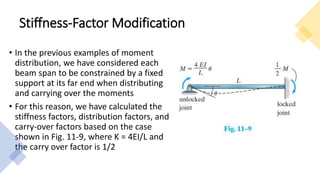
• In the previous examples of moment
distribution, we have considered each
beam span to be constrained by a fixed
support at its far end when distributing
and carrying over the moments
• For this reason, we have calculated the
stiffness factors, distribution factors, and
carry-over factors based on the case
shown in Fig. 11-9, where K = 4EI/L and
the carry over factor is 1/2
Stiffness-Factor Modification
• In some cases, it is possible to modify the stiffness factor of a span
and thereby simplify the process of moment distribution.
• Three cases where this frequently occurs will be considered:
a) Member Pin Supported at Far End
b) Symmetric Beam and Loading
c) Symmetric Beam with Antisymmetric loading
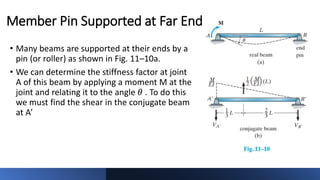
• Many beams are supported at their ends by a
pin (or roller) as shown in Fig. 11–10a.
• We can determine the stiffness factor at joint
A of this beam by applying a moment M at the
joint and relating it to the angle 𝜃 . To do this
we must find the shear in the conjugate beam
at A’
Member Pin Supported at Far End
• From the conjugate beam Fig. 11-10b, we have
Member Pin Supported at Far End
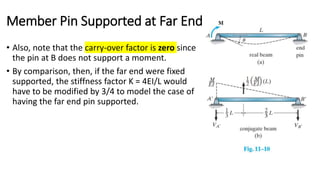
• Also, note that the carry-over factor is zero since
the pin at B does not support a moment.
• By comparison, then, if the far end were fixed
supported, the stiffness factor K = 4EI/L would
have to be modified by 3/4 to model the case of
having the far end pin supported.
Member Pin Supported at Far End
Symmetric Beam and Loading
• If a beam is symmetric with respect to both its loading and geometry,
the bending moment diagram for the beam will also be symmetric.
• As a result, a modification of the stiffness factor for the center span
can be made, so that moments in the beam only have to be
distributed through a joint lying on either half of the beam.
Symmetric Beam and Loading
• To develop the appropriate stiffness-factor modification, consider the
beam shown in Fig.11-11a. Due to the symmetry, the internal
moments at B and C are equal. Assuming this value to be M, the
conjugate beam for span BC is shown in Fig.11-11b
Symmetric Beam and Loading
Symmetric Beam with Antisymmetric loading
• If the asymmetric beam is subjected to antisymmetric loading, the
resulting moment diagram will be antisymmetric.
• Considering the beam Fig. 11-12a, due to the antisymmetric loading, the
internal moment at B is equal but opposite to that of C
• Assuming the value to be M, the conjugate beam for its center span BC is
shown in Fig. 11-12b.
Symmetric Beam with Antisymmetric loading
Example 1
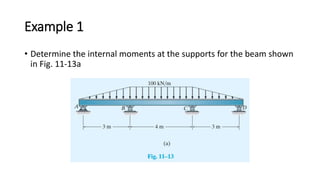
• Determine the internal moments at the supports for the beam shown
in Fig. 11-13a
Example 1
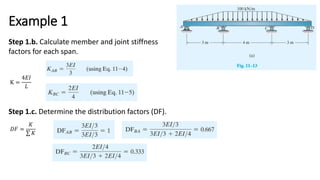
Step 1.a. Identify the joints and spans in the
beam: A, B, C, D and span AB, BC, CD
Step 1.b. Calculate member and joint stiffness
factors for each span.
• By inspection, the beam and loading are symmetrical
• We will apply K=2EI/L to calculate the stiffness factor of the center span BC and therefore
use only the left half of the beam for analysis.
• The analysis can be shortened even further by using K = 3EI/L for calculating the stiffness of
segment AB since the far end A is pinned.
Example 1
Step 1.b. Calculate member and joint stiffness
factors for each span.
Step 1.c. Determine the distribution factors (DF).
K =
4𝐸𝐼
𝐿
𝐷𝐹 =
𝐾
𝐾
Example 1
1.d. Determine the fixed-end moments
FEMBA
FEMAB =0 FEMBC FEMCB
FEMCD FEMDC =0
Example 1
FEMBA
FEMAB =0 FEMBC FEMCB
FEMCD FEMDC =0
Joint A B
Member AB BA BC
DF 1 0.667 0.333
FEM
Dist.
0
0
60
48.9
-133.33
24.4
∑M 0 108.9 -108.9
• The data are listed in the table.
• Calculating the stiffness factors as
shown considerably reduces the
analysis, since only joint B must be
balanced and carry-overs to joint A
and C are not necessary.
Moment Distribution For Frames: No Sidesway
• Application of the moment distribution method for frames having no
sideways follows the same procedure as that given for beams.
• To minimize the chance for errors, it is suggested that the analysis be
arranged in a tabular form, as in the previous examples
• The distribution of moments can be shortened if the stiffness factor of a
span can be modified.
Example 2
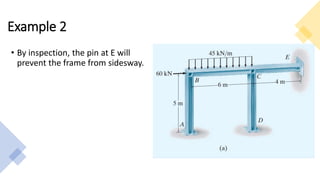
• Determine the internal moments at the joints of the frame shown in Fig.
11-15a. There is a pin at E and D and a fixed support at A. EI is constant
• By inspection, the pin at E will
prevent the frame from sidesway.
Example 2
Example 2
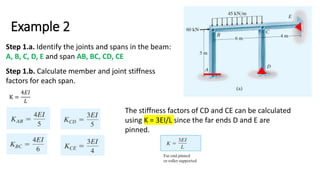
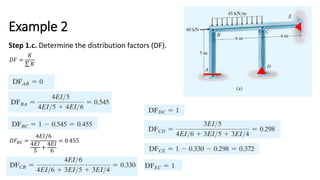
Step 1.a. Identify the joints and spans in the beam:
A, B, C, D, E and span AB, BC, CD, CE
Step 1.b. Calculate member and joint stiffness
factors for each span.
The stiffness factors of CD and CE can be calculated
using K = 3EI/L since the far ends D and E are
pinned.
K =
4𝐸𝐼
𝐿
Example 2
Step 1.c. Determine the distribution factors (DF).
𝐷𝐹 =
𝐾
𝐾
𝐷𝐹𝐵𝐶 =
4𝐸𝐼/6
4𝐸𝐼
5
+
4𝐸𝐼
6
= 0.455
Example 2
1.d. Determine the fixed-end moments
Example 2
Joint A B C D E
Member AB BA BC CB CE CD DC EC
DF 0 0.545 0.455 0.330 0.372 0.298 1 1
FEM
Dist.
0
0
0
73.6
-135
61.4
135
-44.6
0
-50.2
0
-40.2
0
0
0
0
CO
Dist.
36.8
0
0
12.2
-22.3
10.1
30.7
-10.1
0
-11.5
0
-9.1
0
0
0
0
CO
Dist.
6.1
0
0
2.8
-5.1
2.3
5.1
-1.7
0
-1.9
0
-1.5
0
0
0
0
CO
Dist.
1.4
0
0
0.4
-0.8
0.4
1.2
-0.4
0
-0.4
0
-0.4
0
0
0
0
CO
Dist.
0.2
0
0
0.1
-0.2
0.1
0.2
-0.1
0
-0.1
0
0
0
0
0
0
∑M 44.5 89.1 -89.1 115 -64.1 -51.2 0 0
Moment Diagram for frame
+
-
-
+

Topic4_Moment Distribution with Stiffness Factor Modification.pptx

  • 1.
    CED 426 Structural TheoryII Lecture 18 Moment Distribution: Stiffness-Factor Modification and Frames no Sideways Mary Joanne C. Aniñon Instructor
  • 2.
    Stiffness-Factor Modification • Inthe previous examples of moment distribution, we have considered each beam span to be constrained by a fixed support at its far end when distributing and carrying over the moments • For this reason, we have calculated the stiffness factors, distribution factors, and carry-over factors based on the case shown in Fig. 11-9, where K = 4EI/L and the carry over factor is 1/2
  • 3.
    Stiffness-Factor Modification • Insome cases, it is possible to modify the stiffness factor of a span and thereby simplify the process of moment distribution. • Three cases where this frequently occurs will be considered: a) Member Pin Supported at Far End b) Symmetric Beam and Loading c) Symmetric Beam with Antisymmetric loading
  • 4.
    • Many beamsare supported at their ends by a pin (or roller) as shown in Fig. 11–10a. • We can determine the stiffness factor at joint A of this beam by applying a moment M at the joint and relating it to the angle 𝜃 . To do this we must find the shear in the conjugate beam at A’ Member Pin Supported at Far End
  • 5.
    • From theconjugate beam Fig. 11-10b, we have Member Pin Supported at Far End
  • 6.
    • Also, notethat the carry-over factor is zero since the pin at B does not support a moment. • By comparison, then, if the far end were fixed supported, the stiffness factor K = 4EI/L would have to be modified by 3/4 to model the case of having the far end pin supported. Member Pin Supported at Far End
  • 7.
    Symmetric Beam andLoading • If a beam is symmetric with respect to both its loading and geometry, the bending moment diagram for the beam will also be symmetric. • As a result, a modification of the stiffness factor for the center span can be made, so that moments in the beam only have to be distributed through a joint lying on either half of the beam.
  • 8.
    Symmetric Beam andLoading • To develop the appropriate stiffness-factor modification, consider the beam shown in Fig.11-11a. Due to the symmetry, the internal moments at B and C are equal. Assuming this value to be M, the conjugate beam for span BC is shown in Fig.11-11b
  • 9.
  • 10.
    Symmetric Beam withAntisymmetric loading • If the asymmetric beam is subjected to antisymmetric loading, the resulting moment diagram will be antisymmetric. • Considering the beam Fig. 11-12a, due to the antisymmetric loading, the internal moment at B is equal but opposite to that of C • Assuming the value to be M, the conjugate beam for its center span BC is shown in Fig. 11-12b.
  • 11.
    Symmetric Beam withAntisymmetric loading
  • 12.
    Example 1 • Determinethe internal moments at the supports for the beam shown in Fig. 11-13a
  • 13.
    Example 1 Step 1.a.Identify the joints and spans in the beam: A, B, C, D and span AB, BC, CD Step 1.b. Calculate member and joint stiffness factors for each span. • By inspection, the beam and loading are symmetrical • We will apply K=2EI/L to calculate the stiffness factor of the center span BC and therefore use only the left half of the beam for analysis. • The analysis can be shortened even further by using K = 3EI/L for calculating the stiffness of segment AB since the far end A is pinned.
  • 14.
    Example 1 Step 1.b.Calculate member and joint stiffness factors for each span. Step 1.c. Determine the distribution factors (DF). K = 4𝐸𝐼 𝐿 𝐷𝐹 = 𝐾 𝐾
  • 15.
    Example 1 1.d. Determinethe fixed-end moments FEMBA FEMAB =0 FEMBC FEMCB FEMCD FEMDC =0
  • 16.
    Example 1 FEMBA FEMAB =0FEMBC FEMCB FEMCD FEMDC =0 Joint A B Member AB BA BC DF 1 0.667 0.333 FEM Dist. 0 0 60 48.9 -133.33 24.4 ∑M 0 108.9 -108.9 • The data are listed in the table. • Calculating the stiffness factors as shown considerably reduces the analysis, since only joint B must be balanced and carry-overs to joint A and C are not necessary.
  • 17.
    Moment Distribution ForFrames: No Sidesway • Application of the moment distribution method for frames having no sideways follows the same procedure as that given for beams. • To minimize the chance for errors, it is suggested that the analysis be arranged in a tabular form, as in the previous examples • The distribution of moments can be shortened if the stiffness factor of a span can be modified.
  • 18.
    Example 2 • Determinethe internal moments at the joints of the frame shown in Fig. 11-15a. There is a pin at E and D and a fixed support at A. EI is constant
  • 19.
    • By inspection,the pin at E will prevent the frame from sidesway. Example 2
  • 20.
    Example 2 Step 1.a.Identify the joints and spans in the beam: A, B, C, D, E and span AB, BC, CD, CE Step 1.b. Calculate member and joint stiffness factors for each span. The stiffness factors of CD and CE can be calculated using K = 3EI/L since the far ends D and E are pinned. K = 4𝐸𝐼 𝐿
  • 21.
    Example 2 Step 1.c.Determine the distribution factors (DF). 𝐷𝐹 = 𝐾 𝐾 𝐷𝐹𝐵𝐶 = 4𝐸𝐼/6 4𝐸𝐼 5 + 4𝐸𝐼 6 = 0.455
  • 22.
    Example 2 1.d. Determinethe fixed-end moments
  • 23.
    Example 2 Joint AB C D E Member AB BA BC CB CE CD DC EC DF 0 0.545 0.455 0.330 0.372 0.298 1 1 FEM Dist. 0 0 0 73.6 -135 61.4 135 -44.6 0 -50.2 0 -40.2 0 0 0 0 CO Dist. 36.8 0 0 12.2 -22.3 10.1 30.7 -10.1 0 -11.5 0 -9.1 0 0 0 0 CO Dist. 6.1 0 0 2.8 -5.1 2.3 5.1 -1.7 0 -1.9 0 -1.5 0 0 0 0 CO Dist. 1.4 0 0 0.4 -0.8 0.4 1.2 -0.4 0 -0.4 0 -0.4 0 0 0 0 CO Dist. 0.2 0 0 0.1 -0.2 0.1 0.2 -0.1 0 -0.1 0 0 0 0 0 0 ∑M 44.5 89.1 -89.1 115 -64.1 -51.2 0 0
  • 24.
    Moment Diagram forframe + - - +