Stress Testing the Loan Portfolio
Mike Lubansky, Director of Consulting Services
Sageworks
The Leader in the Financial Analysis of Privately Held Companies
O - (919) 851-7474 | F - (919) 851-6718
info@sageworks.com
www.sageworks.com
Questions
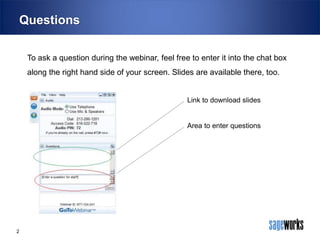
To ask a question during the webinar, feel free to enter it into the chat box
along the right hand side of your screen. Slides are available there, too.

Link to download slides

Area to enter questions

2
About Sageworks & Our Speaker
 Financial information company that provides credit and risk management

solutions to financial institutions
 Data and applications used by thousands of financial institutions and
accounting firms across North America

 Mike Lubansky
 Mike is a director of consulting services at Sageworks, where he oversees

product development and implementation in the financial institutions market. He
serves as the in-house stress testing expert at Sageworks and has been a
featured speaker for audiences of both financial institutions and regulatory

agencies on matters pertaining to the banking industry. Most recently, he spoke
before federal examiners at the FFIEC, on the subject of stress testing
approaches and challenges.
3
Agenda
1. About Sageworks and Our Speaker
2. Poll
3. Regulatory Requirements: Who, What and When
4. Stress Testing Objective
5. Why Stress Testing’s Important
6. Types of Community Bank Stress Testing
7. Biggest Challenge: Data
8. Scenario Selection
9. Maximizing Value of Reports
10. Sample Stress Tests

11. Common Mistakes
12. Q & A
4
Quick Polls
1. Types of Stress Testing Performed
2. Obstacles to Stress Testing
Regulatory Update: Who, What and When
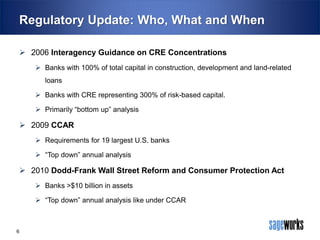
 2006 Interagency Guidance on CRE Concentrations
 Banks with 100% of total capital in construction, development and land-related
loans
 Banks with CRE representing 300% of risk-based capital.

 Primarily “bottom up” analysis

 2009 CCAR
 Requirements for 19 largest U.S. banks

 “Top down” annual analysis

 2010 Dodd-Frank Wall Street Reform and Consumer Protection Act
 Banks >$10 billion in assets

 “Top down” annual analysis like under CCAR

6
Regulatory Update: Who, What and When
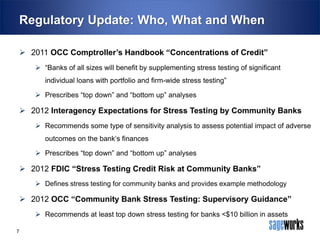
 2011 OCC Comptroller’s Handbook “Concentrations of Credit”
 “Banks of all sizes will benefit by supplementing stress testing of significant
individual loans with portfolio and firm-wide stress testing”
 Prescribes “top down” and “bottom up” analyses

 2012 Interagency Expectations for Stress Testing by Community Banks
 Recommends some type of sensitivity analysis to assess potential impact of adverse
outcomes on the bank’s finances

 Prescribes “top down” and “bottom up” analyses

 2012 FDIC “Stress Testing Credit Risk at Community Banks”
 Defines stress testing for community banks and provides example methodology

 2012 OCC “Community Bank Stress Testing: Supervisory Guidance”
 Recommends at least top down stress testing for banks <$10 billion in assets
7
Stress Testing Objective
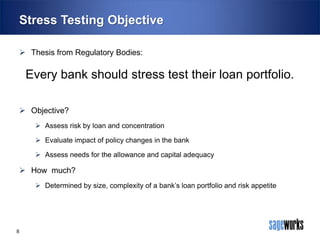
 Thesis from Regulatory Bodies:

Every bank should stress test their loan portfolio.
 Objective?
 Assess risk by loan and concentration
 Evaluate impact of policy changes in the bank

 Assess needs for the allowance and capital adequacy

 How much?
 Determined by size, complexity of a bank’s loan portfolio and risk appetite

8
Why Stress Testing’s Important
 Best practice for banks that

demonstrates proactive and progressive
improvement
 Identify pockets of portfolio that are

vulnerable to a variety of outside factors:
e.g. changes in short term interest rates
or deteriorating real estate market

conditions
 Recognize overexposures in
concentrations, geographies, industries

or types of real estate

9
Why Stress Testing’s Important
 Increase banks’ ability to mitigate risk by targeting potentially problematic

loans for additional scrutiny, such as more frequent rent-roll reviews or
owner-income updates
 Provide bank management with clues on how to amend credit policies,

pricing or business strategy based on desired risk profile

10
Why Stress Testing’s Important

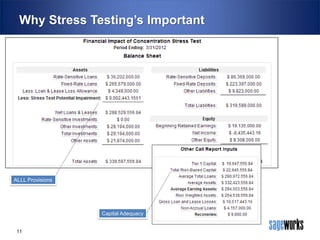
ALLL Provisions

Capital Adequacy
11
Types of Community Bank Stress Testing
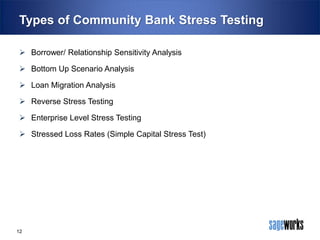
 Borrower/ Relationship Sensitivity Analysis

 Bottom Up Scenario Analysis
 Loan Migration Analysis
 Reverse Stress Testing
 Enterprise Level Stress Testing
 Stressed Loss Rates (Simple Capital Stress Test)

12
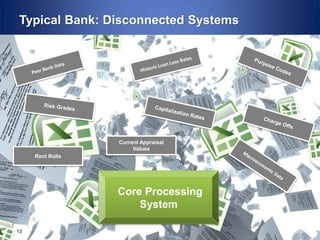
Typical Bank: Disconnected Systems

Current Appraisal
Values
Rent Rolls

Core Processing
System
13
Biggest Challenge: Data
 Accumulate and examine data for largest real estate exposures or the

segment with higher dollar/ higher risk—should be the first priority
 Develop a process for accumulating the necessary data on ongoing basis
and account for different data sources
 Help identify data weaknesses within the institution for that and other segments

 Expand stress testing coverage to include other portfolio segments over time
 Review processes over time to ensure the right data is included

14
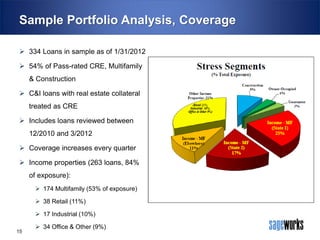
Sample Portfolio Analysis, Coverage
 334 Loans in sample as of 1/31/2012

 54% of Pass-rated CRE, Multifamily
& Construction
 C&I loans with real estate collateral

treated as CRE
 Includes loans reviewed between
12/2010 and 3/2012
 Coverage increases every quarter
 Income properties (263 loans, 84%
of exposure):
 174 Multifamily (53% of exposure)

 38 Retail (11%)
 17 Industrial (10%)
15

 34 Office & Other (9%)
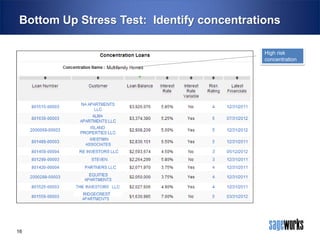
Bottom Up Stress Test: Identify concentrations
High risk
concentration

16
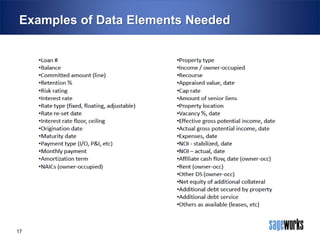
Examples of Data Elements Needed

17
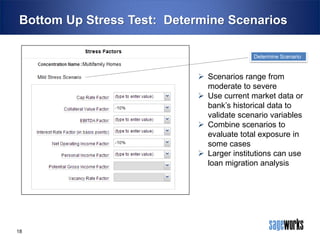
Bottom Up Stress Test: Determine Scenarios
Determine Scenario

 Scenarios range from
moderate to severe
 Use current market data or
bank’s historical data to
validate scenario variables
 Combine scenarios to
evaluate total exposure in
some cases
 Larger institutions can use
loan migration analysis

18
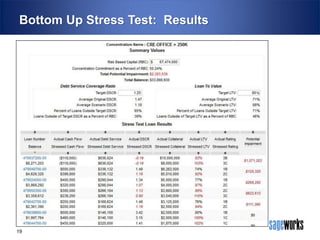
Bottom Up Stress Test: Results

19
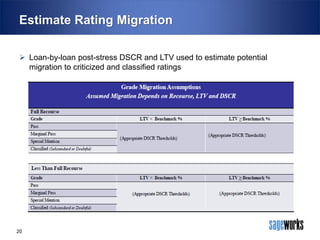
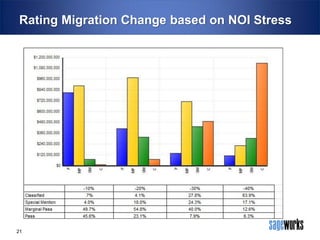
Estimate Rating Migration
 Loan-by-loan post-stress DSCR and LTV used to estimate potential
migration to criticized and classified ratings

20
Rating Migration Change based on NOI Stress

21
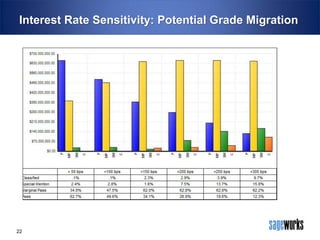
Interest Rate Sensitivity: Potential Grade Migration

22
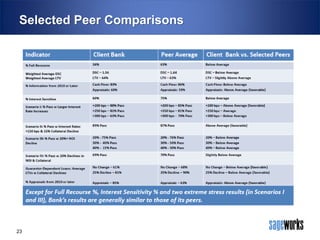
Selected Peer Comparisons

23
Sample Top Down Approach
 “For most community banks, a simple stressed loss-rate analysis based on

call report categories may provide an acceptable foundation to determine if
additional analysis is necessary.”
 OCC Supervisory Guidance– Community Bank Stress Testing– 10/18/2012

 Segment the portfolio into pools with similar risk characteristics
 Develop “stressed” loss rates for each segment; consider:
 Bank’s historical loss rates over several stress periods
 Peer/ market loss rates over several stress periods
 Results of any “bottom up” stress testing

 Calculate Stress Period Loss amounts (2 year timeframe)
 Estimate Earnings impact, apply to Tier 1 Capital ratios
24
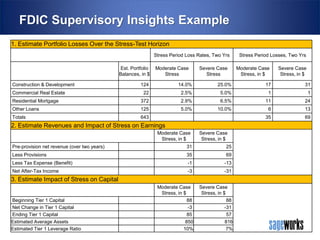
FDIC Supervisory Insights Example
1. Estimate Portfolio Losses Over the Stress-Test Horizon
Stress Period Loss Rates, Two Yrs

Est. Portfolio
Balances, in $
Construction & Development

Moderate Case
Stress

Severe Case
Stress

Stress Period Losses, Two Yrs

Moderate Case
Stress, in $

Severe Case
Stress, in $

124

14.0%

25.0%

17

31

22

2.5%

5.0%

1

1

Residential Mortgage

372

2.9%

6.5%

11

24

Other Loans

125

5.0%

10.0%

6

13

Totals

643

35

69

Commercial Real Estate

2. Estimate Revenues and Impact of Stress on Earnings
Moderate Case
Stress, in $

Severe Case
Stress, in $

Pre-provision net revenue (over two years)

31

25

Less Provisions

35

69

Less Tax Expense (Benefit)

-1

-13

Net After-Tax Income

-3

-31

Moderate Case
Stress, in $
88
-3
85
850
10%

Severe Case
Stress, in $
88
-31
57
816
7%

3. Estimate Impact of Stress on Capital

Beginning Tier 1 Capital
Net Change in Tier 1 Capital
Ending Tier 1 Capital
Estimated Average Assets
Estimated Tier 1 Leverage Ratio
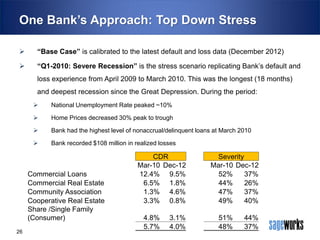
One Bank’s Approach: Top Down Stress


“Base Case” is calibrated to the latest default and loss data (December 2012)



“Q1-2010: Severe Recession” is the stress scenario replicating Bank’s default and
loss experience from April 2009 to March 2010. This was the longest (18 months)
and deepest recession since the Great Depression. During the period:


National Unemployment Rate peaked ~10%



Home Prices decreased 30% peak to trough



Bank had the highest level of nonaccrual/delinquent loans at March 2010



Bank recorded $108 million in realized losses

Commercial Loans
Commercial Real Estate
Community Association
Cooperative Real Estate
Share /Single Family
(Consumer)
26

CDR
Mar-10 Dec-12
12.4% 9.5%
6.5% 1.8%
1.3% 4.6%
3.3% 0.8%
4.8%
5.7%

3.1%
4.0%

Severity
Mar-10 Dec-12
52%
37%
44%
26%
47%
37%
49%
40%
51%
48%

44%
37%
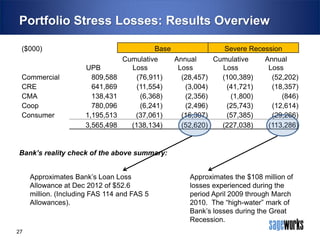
Portfolio Stress Losses: Results Overview
($000)

Commercial
CRE
CMA
Coop
Consumer

UPB
809,588
641,869
138,431
780,096
1,195,513
3,565,498

Base
Severe Recession
Cumulative
Annual
Cumulative
Annual
Loss
Loss
Loss
Loss
(76,911)
(28,457)
(100,389)
(52,202)
(11,554)
(3,004)
(41,721)
(18,357)
(6,368)
(2,356)
(1,800)
(846)
(6,241)
(2,496)
(25,743)
(12,614)
(37,061)
(16,307)
(57,385)
(29,266)
(138,134)
(52,620)
(227,038)
(113,286)

Bank’s reality check of the above summary:
Approximates Bank’s Loan Loss
Allowance at Dec 2012 of $52.6
million. (Including FAS 114 and FAS 5
Allowances).

27

Approximates the $108 million of
losses experienced during the
period April 2009 through March
2010. The “high-water” mark of
Bank’s losses during the Great
Recession.
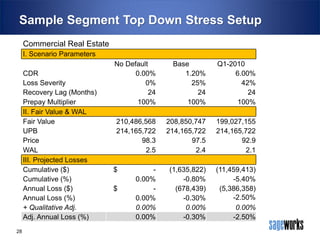
Sample Segment Top Down Stress Setup
Commercial Real Estate
I. Scenario Parameters
CDR
Loss Severity
Recovery Lag (Months)
Prepay Multiplier
II. Fair Value & WAL
Fair Value
UPB
Price
WAL
III. Projected Losses
Cumulative ($)
Cumulative (%)
Annual Loss ($)
Annual Loss (%)
+ Qualitative Adj.
Adj. Annual Loss (%)
28

No Default
0.00%
0%
24
100%

Base
1.20%
25%
24
100%

Q1-2010
6.00%
42%
24
100%

210,486,568
214,165,722
98.3
2.5

208,850,747
214,165,722
97.5
2.4

199,027,155
214,165,722
92.9
2.1

(1,635,822)
-0.80%
(678,439)
-0.30%
0.00%
-0.30%

(11,459,413)
-5.40%
(5,386,358)
-2.50%
0.00%
-2.50%

$

$

0.00%
0.00%
0.00%
0.00%
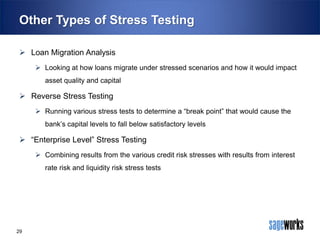
Other Types of Stress Testing
 Loan Migration Analysis
 Looking at how loans migrate under stressed scenarios and how it would impact
asset quality and capital

 Reverse Stress Testing
 Running various stress tests to determine a “break point” that would cause the
bank’s capital levels to fall below satisfactory levels

 “Enterprise Level” Stress Testing
 Combining results from the various credit risk stresses with results from interest
rate risk and liquidity risk stress tests

29
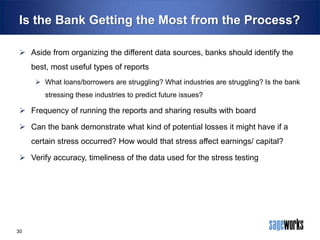
Is the Bank Getting the Most from the Process?
 Aside from organizing the different data sources, banks should identify the

best, most useful types of reports
 What loans/borrowers are struggling? What industries are struggling? Is the bank
stressing these industries to predict future issues?

 Frequency of running the reports and sharing results with board
 Can the bank demonstrate what kind of potential losses it might have if a
certain stress occurred? How would that stress affect earnings/ capital?

 Verify accuracy, timeliness of the data used for the stress testing

30
Quick Polls
1. Stress testing solution from Sageworks
2. Stress testing resources from Sageworks
Questions?
Mike Lubansky
866.603.7029 ext. 651
Mike.Lubansky@sageworks.com

Additional whitepapers and archived webinars available at www.sageworksanalyst.com.
Featured whitepaper – Stress Testing: The Who, What, When and Why
Featured resource – Stress Testing Template by Sageworks
Selected References
 FDIC Supervisory Insights 2012

 OCC Community Bank Stress Testing, October 2012
 CEIS Review Methodology for Stress Testing; Peer Stress Results
 Sample bank’s Top Down Stress Test
 Sageworks Clarity Stress testing sample data and results

33

Stress Testing the Loan Portfolio

  • 1.
    Stress Testing theLoan Portfolio Mike Lubansky, Director of Consulting Services Sageworks The Leader in the Financial Analysis of Privately Held Companies O - (919) 851-7474 | F - (919) 851-6718 info@sageworks.com www.sageworks.com
  • 2.
    Questions To ask aquestion during the webinar, feel free to enter it into the chat box along the right hand side of your screen. Slides are available there, too. Link to download slides Area to enter questions 2
  • 3.
    About Sageworks &Our Speaker  Financial information company that provides credit and risk management solutions to financial institutions  Data and applications used by thousands of financial institutions and accounting firms across North America  Mike Lubansky  Mike is a director of consulting services at Sageworks, where he oversees product development and implementation in the financial institutions market. He serves as the in-house stress testing expert at Sageworks and has been a featured speaker for audiences of both financial institutions and regulatory agencies on matters pertaining to the banking industry. Most recently, he spoke before federal examiners at the FFIEC, on the subject of stress testing approaches and challenges. 3
  • 4.
    Agenda 1. About Sageworksand Our Speaker 2. Poll 3. Regulatory Requirements: Who, What and When 4. Stress Testing Objective 5. Why Stress Testing’s Important 6. Types of Community Bank Stress Testing 7. Biggest Challenge: Data 8. Scenario Selection 9. Maximizing Value of Reports 10. Sample Stress Tests 11. Common Mistakes 12. Q & A 4
  • 5.
    Quick Polls 1. Typesof Stress Testing Performed 2. Obstacles to Stress Testing
  • 6.
    Regulatory Update: Who,What and When  2006 Interagency Guidance on CRE Concentrations  Banks with 100% of total capital in construction, development and land-related loans  Banks with CRE representing 300% of risk-based capital.  Primarily “bottom up” analysis  2009 CCAR  Requirements for 19 largest U.S. banks  “Top down” annual analysis  2010 Dodd-Frank Wall Street Reform and Consumer Protection Act  Banks >$10 billion in assets  “Top down” annual analysis like under CCAR 6
  • 7.
    Regulatory Update: Who,What and When  2011 OCC Comptroller’s Handbook “Concentrations of Credit”  “Banks of all sizes will benefit by supplementing stress testing of significant individual loans with portfolio and firm-wide stress testing”  Prescribes “top down” and “bottom up” analyses  2012 Interagency Expectations for Stress Testing by Community Banks  Recommends some type of sensitivity analysis to assess potential impact of adverse outcomes on the bank’s finances  Prescribes “top down” and “bottom up” analyses  2012 FDIC “Stress Testing Credit Risk at Community Banks”  Defines stress testing for community banks and provides example methodology  2012 OCC “Community Bank Stress Testing: Supervisory Guidance”  Recommends at least top down stress testing for banks <$10 billion in assets 7
  • 8.
    Stress Testing Objective Thesis from Regulatory Bodies: Every bank should stress test their loan portfolio.  Objective?  Assess risk by loan and concentration  Evaluate impact of policy changes in the bank  Assess needs for the allowance and capital adequacy  How much?  Determined by size, complexity of a bank’s loan portfolio and risk appetite 8
  • 9.
    Why Stress Testing’sImportant  Best practice for banks that demonstrates proactive and progressive improvement  Identify pockets of portfolio that are vulnerable to a variety of outside factors: e.g. changes in short term interest rates or deteriorating real estate market conditions  Recognize overexposures in concentrations, geographies, industries or types of real estate 9
  • 10.
    Why Stress Testing’sImportant  Increase banks’ ability to mitigate risk by targeting potentially problematic loans for additional scrutiny, such as more frequent rent-roll reviews or owner-income updates  Provide bank management with clues on how to amend credit policies, pricing or business strategy based on desired risk profile 10
  • 11.
    Why Stress Testing’sImportant ALLL Provisions Capital Adequacy 11
  • 12.
    Types of CommunityBank Stress Testing  Borrower/ Relationship Sensitivity Analysis  Bottom Up Scenario Analysis  Loan Migration Analysis  Reverse Stress Testing  Enterprise Level Stress Testing  Stressed Loss Rates (Simple Capital Stress Test) 12
  • 13.
    Typical Bank: DisconnectedSystems Current Appraisal Values Rent Rolls Core Processing System 13
  • 14.
    Biggest Challenge: Data Accumulate and examine data for largest real estate exposures or the segment with higher dollar/ higher risk—should be the first priority  Develop a process for accumulating the necessary data on ongoing basis and account for different data sources  Help identify data weaknesses within the institution for that and other segments  Expand stress testing coverage to include other portfolio segments over time  Review processes over time to ensure the right data is included 14
  • 15.
    Sample Portfolio Analysis,Coverage  334 Loans in sample as of 1/31/2012  54% of Pass-rated CRE, Multifamily & Construction  C&I loans with real estate collateral treated as CRE  Includes loans reviewed between 12/2010 and 3/2012  Coverage increases every quarter  Income properties (263 loans, 84% of exposure):  174 Multifamily (53% of exposure)  38 Retail (11%)  17 Industrial (10%) 15  34 Office & Other (9%)
  • 16.
    Bottom Up StressTest: Identify concentrations High risk concentration 16
  • 17.
    Examples of DataElements Needed 17
  • 18.
    Bottom Up StressTest: Determine Scenarios Determine Scenario  Scenarios range from moderate to severe  Use current market data or bank’s historical data to validate scenario variables  Combine scenarios to evaluate total exposure in some cases  Larger institutions can use loan migration analysis 18
  • 19.
    Bottom Up StressTest: Results 19
  • 20.
    Estimate Rating Migration Loan-by-loan post-stress DSCR and LTV used to estimate potential migration to criticized and classified ratings 20
  • 21.
    Rating Migration Changebased on NOI Stress 21
  • 22.
    Interest Rate Sensitivity:Potential Grade Migration 22
  • 23.
  • 24.
    Sample Top DownApproach  “For most community banks, a simple stressed loss-rate analysis based on call report categories may provide an acceptable foundation to determine if additional analysis is necessary.”  OCC Supervisory Guidance– Community Bank Stress Testing– 10/18/2012  Segment the portfolio into pools with similar risk characteristics  Develop “stressed” loss rates for each segment; consider:  Bank’s historical loss rates over several stress periods  Peer/ market loss rates over several stress periods  Results of any “bottom up” stress testing  Calculate Stress Period Loss amounts (2 year timeframe)  Estimate Earnings impact, apply to Tier 1 Capital ratios 24
  • 25.
    FDIC Supervisory InsightsExample 1. Estimate Portfolio Losses Over the Stress-Test Horizon Stress Period Loss Rates, Two Yrs Est. Portfolio Balances, in $ Construction & Development Moderate Case Stress Severe Case Stress Stress Period Losses, Two Yrs Moderate Case Stress, in $ Severe Case Stress, in $ 124 14.0% 25.0% 17 31 22 2.5% 5.0% 1 1 Residential Mortgage 372 2.9% 6.5% 11 24 Other Loans 125 5.0% 10.0% 6 13 Totals 643 35 69 Commercial Real Estate 2. Estimate Revenues and Impact of Stress on Earnings Moderate Case Stress, in $ Severe Case Stress, in $ Pre-provision net revenue (over two years) 31 25 Less Provisions 35 69 Less Tax Expense (Benefit) -1 -13 Net After-Tax Income -3 -31 Moderate Case Stress, in $ 88 -3 85 850 10% Severe Case Stress, in $ 88 -31 57 816 7% 3. Estimate Impact of Stress on Capital Beginning Tier 1 Capital Net Change in Tier 1 Capital Ending Tier 1 Capital Estimated Average Assets Estimated Tier 1 Leverage Ratio
  • 26.
    One Bank’s Approach:Top Down Stress  “Base Case” is calibrated to the latest default and loss data (December 2012)  “Q1-2010: Severe Recession” is the stress scenario replicating Bank’s default and loss experience from April 2009 to March 2010. This was the longest (18 months) and deepest recession since the Great Depression. During the period:  National Unemployment Rate peaked ~10%  Home Prices decreased 30% peak to trough  Bank had the highest level of nonaccrual/delinquent loans at March 2010  Bank recorded $108 million in realized losses Commercial Loans Commercial Real Estate Community Association Cooperative Real Estate Share /Single Family (Consumer) 26 CDR Mar-10 Dec-12 12.4% 9.5% 6.5% 1.8% 1.3% 4.6% 3.3% 0.8% 4.8% 5.7% 3.1% 4.0% Severity Mar-10 Dec-12 52% 37% 44% 26% 47% 37% 49% 40% 51% 48% 44% 37%
  • 27.
    Portfolio Stress Losses:Results Overview ($000) Commercial CRE CMA Coop Consumer UPB 809,588 641,869 138,431 780,096 1,195,513 3,565,498 Base Severe Recession Cumulative Annual Cumulative Annual Loss Loss Loss Loss (76,911) (28,457) (100,389) (52,202) (11,554) (3,004) (41,721) (18,357) (6,368) (2,356) (1,800) (846) (6,241) (2,496) (25,743) (12,614) (37,061) (16,307) (57,385) (29,266) (138,134) (52,620) (227,038) (113,286) Bank’s reality check of the above summary: Approximates Bank’s Loan Loss Allowance at Dec 2012 of $52.6 million. (Including FAS 114 and FAS 5 Allowances). 27 Approximates the $108 million of losses experienced during the period April 2009 through March 2010. The “high-water” mark of Bank’s losses during the Great Recession.
  • 28.
    Sample Segment TopDown Stress Setup Commercial Real Estate I. Scenario Parameters CDR Loss Severity Recovery Lag (Months) Prepay Multiplier II. Fair Value & WAL Fair Value UPB Price WAL III. Projected Losses Cumulative ($) Cumulative (%) Annual Loss ($) Annual Loss (%) + Qualitative Adj. Adj. Annual Loss (%) 28 No Default 0.00% 0% 24 100% Base 1.20% 25% 24 100% Q1-2010 6.00% 42% 24 100% 210,486,568 214,165,722 98.3 2.5 208,850,747 214,165,722 97.5 2.4 199,027,155 214,165,722 92.9 2.1 (1,635,822) -0.80% (678,439) -0.30% 0.00% -0.30% (11,459,413) -5.40% (5,386,358) -2.50% 0.00% -2.50% $ $ 0.00% 0.00% 0.00% 0.00%
  • 29.
    Other Types ofStress Testing  Loan Migration Analysis  Looking at how loans migrate under stressed scenarios and how it would impact asset quality and capital  Reverse Stress Testing  Running various stress tests to determine a “break point” that would cause the bank’s capital levels to fall below satisfactory levels  “Enterprise Level” Stress Testing  Combining results from the various credit risk stresses with results from interest rate risk and liquidity risk stress tests 29
  • 30.
    Is the BankGetting the Most from the Process?  Aside from organizing the different data sources, banks should identify the best, most useful types of reports  What loans/borrowers are struggling? What industries are struggling? Is the bank stressing these industries to predict future issues?  Frequency of running the reports and sharing results with board  Can the bank demonstrate what kind of potential losses it might have if a certain stress occurred? How would that stress affect earnings/ capital?  Verify accuracy, timeliness of the data used for the stress testing 30
  • 31.
    Quick Polls 1. Stresstesting solution from Sageworks 2. Stress testing resources from Sageworks
  • 32.
    Questions? Mike Lubansky 866.603.7029 ext.651 Mike.Lubansky@sageworks.com Additional whitepapers and archived webinars available at www.sageworksanalyst.com. Featured whitepaper – Stress Testing: The Who, What, When and Why Featured resource – Stress Testing Template by Sageworks
  • 33.
    Selected References  FDICSupervisory Insights 2012  OCC Community Bank Stress Testing, October 2012  CEIS Review Methodology for Stress Testing; Peer Stress Results  Sample bank’s Top Down Stress Test  Sageworks Clarity Stress testing sample data and results 33